

572 J. FOR. SCI., 54, 2008 (12): 572–578
JOURNAL OF FOREST SCIENCE, 54, 2008 (12): 572–578
Compensation liming not only affects the soil en-
vironment but also influences the nutrition of trees,
when the content of some elements as well as the
vitality of trees are changed. Changes in the chem-
istry of assimilatory organs of birch (Betula pendula
Roth) after the application of dolomitic limestone
became evident particularly by an increase in cal-
cium and magnesium, decrease in phosphorus and
potassium and partly in manganese and cadmium
(Hrdlička, Kula 2007a). If some papers dealing
with the impact of dolomitic limestone on soil and
epigeous fauna (earthworms, soil mites etc.) were
published (Huhta 1979; Hågvar, Amundsen 1981;
Winter 1990; Weber, Eisenbeis 1992; Rundgren
1994; Kula, Matějková 2007), then information
on the response of phytophages developing on leaves
(sucking, mining and leaf-eating) is nearly missing.
Cates (1980) reported that larvae of monophagous
and oligophagous species preferred young extend-
ing leaves while larvae of polyphages developed on
mature leaves. The variability of herbivorous spe-
cies is affected by chemistry (Claridge, Wilson
1978; Strong, Levin 1979), seasonal changes in
the content of nitrogen and the growth of indigest-
ible components of food (Rhoades 1979; Mattson
1980) and by the antiherbivorous strategy of plants
(Rhoades 1979).
The crown fauna of birch includes quite a broad
spectrum of phytophages. Some of them can also be
classified as pests, e.g. Lochmaea capreae L., Eriocra-
nia sp., Coleophora serratella (L.), Operophtera fagata
(Scharf.) (Kula 2006b; Kula, Pražanová 2007).
The aim of the paper is to evaluate the response of
some phytophages to changes being in progress in
assimilatory organs in the first four years after the
application of dolomitic limestone.
A hypothesis: the content of elements in assimila-
tory organs as well as the quality of food for phy-
Supported by the Ministry of Agriculture of the Czech Republic, Project No. QH 82113, and Ministry od Education, Youth and
Sports of the Czech Republic, Project No. MSM 6215648902. It was sponsored by the following companies and organizations:
Netex Co. and Alusuisse Co. in Děčín, Municipal Office in Děčín, ČEZ Co. Prague, Cement Works Co. in Čížkovice, North-
Bohemian Mines Co. in Chomutov and Dieter Bussmann Co. in Ústí nad Labem.
Response of birch (Betula pendula Roth) phytophages
to liming
E. Kula
Faculty of Forestry and Wood Technology, Mendel University of Agriculture and Forestry in Brno,
Brno, Czech Republic
ABSTRACT: In the course of 2004–2007, the effects of compensation liming at the application dose of 1.5–3–6 t/ha
dolomitic limestone on the elimination or activation of phytophages or other types of damage resulting in the loss of
assimilatory organs did not become evident yet. A shift was noted in the fluctuation expressed indirectly by the extent
of damage to the assimilatory area in feeding caused by an undetermined hymenopterous larva (summer increase),
weevils (spring and summer decline and increase in 2007), Coleophora serratella (decline), Eriocrania sp. (increase),
mites Acalitus rudis (increase), Eriophyes leionotus (increase in 2006–2007). Only signs of a positive response to higher
doses of dolomitic limestone characterized the mite Eriophyes leionotus.
Keywords: birch Betula pendula Roth; liming; dolomitic limestone; phytophages; Eriophyes leionotus

J. FOR. SCI., 54, 2008 (12): 572–578 573
tophagous insects change as a result of liming, and
they can response by a change in their abundance.
mATERiAl And mEThodS
Liming was carried out on 28th August 2003 at
a planned dose of 1.5–3–6 t/ha crushed dolomitic
limestone applying the Deutche Heli Forst/DHD
technology using a HUGHES 500D/E helicopter.
Main research plots were situated in the zone of air
pollution threat (lower limit of the potential area
recompensation liming), locality Buttersteig 1 at an
altitude of 710–730 m, moderate southern slope be-
low a road (plots 1–4, stand 338B3c birch 65, rowan
20, spruce 10, age 27 years, forest type group 6K)
and on the central slope above a road Buttersteig 2
at an altitude of 720–770 m (plots 5–8, stand 36B2
birch 80, rowan 15, spruce 5, age 20 years, forest type
group 6K). Particular stand parts with birch mono-
cultures are separated from each other by forested
clearcut areas with stabilized plantations.
In all stands (8) of Buttersteig localities (Litvínov
Forest District), damage to the assimilatory organs of
birch was evaluated in the spring (VI) and summer as-
pect (VIII) on permanent sample trees (3 trees/stand).
Two branches were taken from each sample trees,
one in the lower part of the crown 6–8 m and one in
the upper part 10–12 m. Defoliation was evaluated
by a qualified estimate of the percentage of damaged
area on the randomly selected group of 70 leaves
from each of unit branches (Σ 48 samplings). A fac-
tor causing damage was determined according to
Schnaider (1991) and Uhlířová and Kapitola
(2004). In wild caterpillars and hymenopterous lar-
vae, feeding was not specified to the level of a species,
because, with the exception of mining insects, this
difference could not be determined.
For statistical evaluation one-way ANOVA pro-
cedures were used (95% Scheffe HSD test). Eight
stands were tested in relation to the applied dose of
dolomitic limestone in the particular years, number
of samples from a stand 6 (420 leaves).
RESulTS And diSCuSSion
defoliation and the health condition of birch
The broad spectrum of phytophages, some of which
can cause heavy defoliation and even complete defolia-
tion, is nutritionally related to the assimilatory organs
of birch (Kula 2000; Kula 2007b; Kula, Pražanová
2007). At the same time, birch can be exposed to air
pollution impact, fungal pathogens, physiologically
functioning factors with specific manifestations of
damage detected according to Schnaider (1991) and
Uhlířová and Kapitola (2004). During inspections,
33 types of damage were noted.
In 2004–2007, the area of the Litvínov transect is
characterized by the spring 16.4–12.8% defoliation
of birch and the summer 17.8–12.6% loss of assimila-
tory area (Kula, Pražanová 2007). Stands of birch
differed under the effect of liming in the total loss of
assimilatory area in the particular years (Table 1).
Changes between the particular years are known not
only in the content of elements (Hrdlička, Kula
2004) but also in the activity of particular pathogens
due to e.g. the course of weather (Kula et al. 2004).
Therefore, it was inevitable to analyze particular
limed stands in relation to dynamic changes (Ta-
ble 1) and thus to eliminate the effects of climatic
factors because the monitored stands show identical
site conditions (altitude, aspect, soil).
If certain heterogeneity became evident in the de-
velopment of defoliation on monitored check plots
Table 1. The development of total defoliation of birch on limed plots of the Buttersteig locality in spring and summer
(Litvínov Forest District, 2004–2007)
Aspects Spring Summer
Plots Application (t/ha) 2004 2005 2006 2007 2004 2005 2006 2007
1 control 13.50 8.64 8.48 12.74 17.95 11.83 12.90 21.60
2 1.5 8.45 13.95 8.10 13.21 9.98 9.14 10.98 14.36
3 3 9.71 10.5 12.57 16.17 13.29 10.69 14.43 13.62
4 6 9.57 15.62 18.36 22.79 12.26 13.45 14.29 21.43
8 control 11.12 13.21 7.67 7.57 15.90 10.52 8.71 17.14
5 1.5 9.64 16.1 16.36 15.45 11.83 12.62 12.52 15.26
6 3 9.36 12.12 16.79 16.60 15.79 9.50 16.45 14.05
7 6 14.14 12.69 9.50 11.00 17.95 13.86 11.93 15.02
Average defoliation 16.42 12.78 14.39 13.63 17.84 16.54 12.62 15.62

574 J. FOR. SCI., 54, 2008 (12): 572–578
(unlimed) and stands with the application of 1.5 t/ha
in the spring aspect, then in stands with the higher
application of dolomitic limestone (3 and 6 t/ha)
mainly an increase in the total disturbed assimilatory
area became evident during the monitored four-year
period. In the summer aspect the total defoliation
did not manifest itself by the specific regularity of
periodic changes. The cause can consist in the high
stability and proportion of spring species related
to expanding leaves (mites, mining insects). But
exceptions, no fundamental deviations occurred in
the extent of defoliation on limed plots as compared
with the total loss of the assimilatory area on the level
of the Litvínov transect monitored for a long time
(Kula, Pražanová 2007).
dynamics of factors causing defoliation
The most important group of defoliators (free-liv-
ing Lepidoptera larvae) did not show a relationship
that would be affected by the application of dolomitic
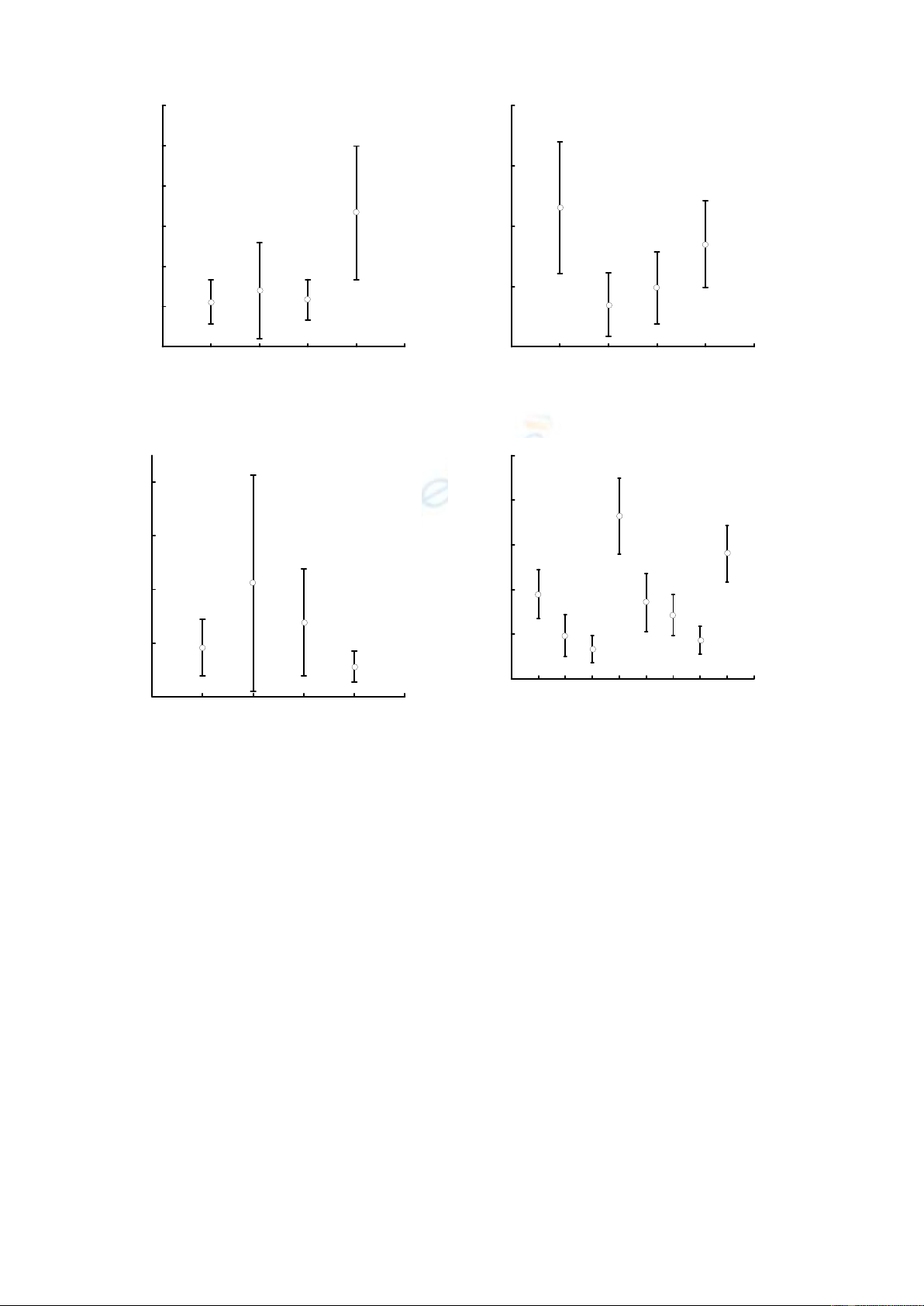
limestone (Fig. 1a). Changes in the fluctuation and
resulting feeding of moth larvae became evident
in the whole area of the eastern Krušné hory Mts.
not being affected by local conditions (Kula 2006a,
2007a; Kula, Pražanová 2007). Changes in the
chemistry leaves, which became evident by the
marked fall of sulphur in 1995–2007 (Hrdlička,
Kula 2006, 2007b), did not affect the long-term
fluctuation. Niemelä and Haukioja (1982) ranked
birch among the species with continuously accruing
leaves when the spectrum of caterpillars was differ-
entiated by food relations to young leaves and mature
leaves. According to Feeny (1970), the attractiveness
of leaves is limited by the content of nitrogen, water
and by the accumulation of proteins bound to tan-
nins of mature leaves.
The feeding of hymenopterous larvae occurring in
the summer aspect became evident by an increase in
the course of studied years in all localities. A partial
fall in the population density was noted on plots with
the highest application dose. With respect to the
generally low proportion in feeding it is necessary to
accept this finding conditionally with the necessity
of further testing.
In Curculionidae, feeding generally decreased in
2004–2006 with a consequential marked increase
(Fig. 1j), which corresponded to changes in the
fluctuation of species of e.g. the genus Phyllobius.
Deviations in the extent of feeding in stands with
the application of 1.5 t/ha as compared to the con-
trol and higher application doses were considered
to be significant (Fig. 1b). The increased content
of nitrogen in leaves induces partial preferences of
weevils in searching birch as a nutritive plant (Kula
et al. 2008). The feeding of weevils became markedly
evident e.g. in the Janov transect (approximately
50°32'N, 13°24'E) (500 to 900 m a.s.l.), being less
markedly determined in the area of the Litvínov
transect (approximately 50°38'N, 13°37'E) (500 to
900 m a.s.l.) (Kula et al. 2006). In Apion simile
Kirby, no relationships were determined either in
fluctuation or with respect to liming. Although the
representatives of mining insects are important pests
of birch, their density in birch stands is not balanced
(Kula 2005) in the eastern Krušné hory Mts.
Existing developmental changes in the extent
of harmfulness in Coleophora serratella can be
explained by the permanent fall in the population
density (2004–2007) not related to liming. Differ-
ences between the particular years are not statis-
tically significant and the difference between the
spring and summer aspect is related to the spring
feeding and persistence of leaves with mines even in
the summer season (Fig. 1c). In the case of mining
insects of the genus Eriocrania it is not possible to
support unambiguously low abundance at the ap-
plication of 6 t/ha by statistical dependence in spite
of the indicated trend of decrease with the increas-
ing application of dolomitic limestone (Fig. 1d).
The oviposition preference of Eriocrania females
on variously stressed birch showed that plants with
the higher content of nitrogen in leaves were less
attacked (Kula, Kaňová 2005). Koricheva and
Haukioja (1995) reported a negative correlation
of the population density of solitary-mining spe-
cies of the genus Eriocrania and the total content
of nitrogen in leaves. Drought affected the attack
negatively. The definite effect of the content of sul-
phur in leaves (1.5–4.9 mg/g DM) was not proved.
The lower number of leaves with two caterpillars in
variants with increased nitrogen nutrition and with
drought stress can be a result of the lower attractive-
ness of these birch trees for females laying eggs and
decreased population density of E. semipurpurella
(Step.) and E. sparrmannella (Bosc) even under na-
tural conditions (Kula, Kaňová 2005). Although
we determined the lower content of nitrogen in
birch leaves in stands with the application of 3 and
6 t/ha dolomitic limestone as compared with the
control, generally, it corresponds to the content of
nitrogen (15–31 mg/g) determined under condi-
tions of controlled stress (Kula, Kaňová 2005).
Phytophagous mites of birch occur above all at
altitudes of 500–600 m, but with a certain regional
variance and different long-term fluctuation, which
[according to a hypothesis expressed by Kula et al.
(2008b)] can be related to site conditions, changing

J. FOR. SCI., 54, 2008 (12): 572–578 575
0 1.5 3 6
t/ha
3.0
3.4
3.8
4.2
4.6
5.0
5.4
%
a
0 1.5 3 6
t/ha
0.4
0.6
0.8
1.0
1.2
1.4
%
b
0 1.5 3 6
t/ha
0.4
0.5
0.6
0.7
0.8
0.9
1.0
%
c
0 1.5 3 6
t/ha
0.8
1.2
1.6
2.0
2.4
%
d
0 1.5 3 6
t/ha
0.0
0.4
0.8
1.2
1.6
%
e
0 1.5 3 6
t/ha
0
1
2
3
4
5
6
%
f
Fig. 1 a–f. The proportion of freely living caterpillars and hymenopterous larvae (a), Curculionidae (b), Coleophora serratella
L. (c), Eriocrania sp. (d) in the defoliation of birch (%) and the proportion of Acalitus rudis (Can.) (e), Eriophyes leionotus (Nal.)
(f) depending on the applied dose of dolomitic limestone (t/ha)
(%)
(t/ha)
(a) (b)
(d)(c)
(f)
(e)
(%)(%)
(%)
(%)
(%)
(t/ha)
(t/ha)(t/ha)
(t/ha)(t/ha)
576 J. FOR. SCI., 54, 2008 (12): 572–578
air pollution load and thus also the chemistry of
leaves.
In Acalitus rudis (Can.), a deviation in the abun-
dance of leaf attack occurred at site 5 with the ap-
plication of 1.5 t/ha dolomitic limestone (Fig. 1e).
In Eriophyes leionotus (Nal.), we noted changes in
population dynamics (increase in 2006–2007), but
without statistical significance. The abundance of
leaf attack on plots with higher inputs of dolom-
itic limestone (2005–2007) with statistical signifi-
cance between the control or low applications and
maximum application (6 t/ha) is very interesting
(Fig. 1f).
The attack of assimilatory organs of birch by rusts
of the genus Discula is affected by a number of
factors (altitude, humidity, temperature) (Kula et
al. 2002a,b; Kula 2006b). At the generally low oc-
currence, it is interesting that in both stands with
the application of 6 t/ha dolomitic limestone the
presence of the rust was markedly increased both in
the spring and summer aspect with the subsequent
decline and nearly statistical significance (Fig. 1g).
Nevertheless, it is not possible to draw a conclusion
that high inputs of dolomitic limestone would result
in its development. Its response at heavy occurrence
and optimum climatic conditions will be decisive for
its development.
The disintegration of leaves for non-specific
reasons (abiotic, physiological disorders) was not
dependent on the aspect. The higher proportion of
Fig. 1 g–j. The proportion of the rust Discula (g) in damage to leaves of birch (%) and birch leaves disturbed by disintegration
(h), yellowing leaves of birch (i) depending on the applied dose of dolomitic limestone (t/ha) and the proportion of Curculionidae
depending on the date of the control (Buttersteig 2004–2007)
0 1.5 3 6
t/ha
0.0
0.4
0.8
1.2
1.6
2.0
2.4
%
g
0 1.5 3 6
t/ha
0.2
0.4
0.6
0.8
1.0
%
h
0 1.5 3 6
t/ha
0
1
2
3
4
%
i
VI_04
VI_05
VI_06
VI_07
VIII_04
VIII_05
VIII_06
VIII_07
Date of control
0.2
0.6
1.0
1.4
1.8
2.2
%
j
(g)
(%)
(t/ha)
(h)
(%)
(t/ha)
(i)
(%)
(t/ha)
(j)
(%)
Date of control


%20--%3e%3cdefs%3e%3cstyle%3e%20.st0%20{%20fill:%20%23fff;%20}%20.st1%20{%20fill:%20%237800fa;%20}%20%3c/style%3e%3c/defs%3e%3cpath%20class='st1'%20d='M117.78,12.18H43.11c2.9,3.47,4.65,7.94,4.65,12.82,0,5.6-2.3,10.66-6.01,14.29h76.02l7.22-13.56-7.22-13.56Z'/%3e%3cg%3e%3cpath%20class='st0'%20d='M53.58,26.17h-.59v-1.46h.59v-4.96h2.83c1.78,0,2.67.94,2.67,2.82v5.76c0,1.87-.89,2.81-2.67,2.81h-2.83v-4.96ZM55.36,21.37v3.34h1.1v1.46h-1.1v3.34h1.01c.61,0,.91-.37.91-1.1v-5.93c0-.74-.3-1.1-.91-1.1h-1.01Z'/%3e%3cpath%20class='st0'%20d='M65.99,31.14h-1.8l-.31-2.07h-2.19l-.31,2.07h-1.64l1.82-11.39h2.62l1.82,11.39ZM65.28,18.04c-.25.46-.51.77-.75.94-.21.15-.47.22-.79.22-.26,0-.57-.07-.92-.22l-.38-.15c-.14-.05-.26-.07-.37-.07-.3,0-.53.18-.71.54l-.91-.68c.25-.46.51-.77.75-.94.21-.14.48-.21.79-.21.26,0,.57.07.92.21l.38.15c.14.05.26.07.37.07.3,0,.53-.18.71-.54l.91.68ZM61.91,27.52h1.73l-.87-5.76-.87,5.76Z'/%3e%3cpath%20class='st0'%20d='M74.53,26.89v1.52c0,1.91-.89,2.86-2.67,2.86s-2.67-.95-2.67-2.86v-5.93c0-1.91.89-2.86,2.67-2.86s2.67.95,2.67,2.86v1.11h-1.69v-1.22c0-.75-.31-1.12-.93-1.12s-.93.37-.93,1.12v6.15c0,.74.31,1.11.93,1.11s.93-.37.93-1.11v-1.63h1.69Z'/%3e%3cpath%20class='st0'%20d='M81.4,31.14h-1.8l-.31-2.07h-2.19l-.31,2.07h-1.64l1.82-11.39h2.62l1.82,11.39ZM75.9,19.2l1.52-1.91h1.71l1.51,1.91h-1.61l-.76-.95-.75.95h-1.61ZM77.32,27.52h1.73l-.87-5.76-.87,5.76ZM83.1,15.99l-1.76,1.91h-1.26l1.17-1.91h1.86Z'/%3e%3cpath%20class='st0'%20d='M84.86,19.75c1.78,0,2.67.94,2.67,2.82v1.48c0,1.87-.89,2.81-2.67,2.81h-.85v4.28h-1.79v-11.39h2.64ZM84.01,21.37v3.86h.85c.58,0,.87-.36.87-1.08v-1.71c0-.71-.29-1.07-.87-1.07h-.85Z'/%3e%3cpath%20class='st0'%20d='M93.51,19.75c1.78,0,2.67.94,2.67,2.82v1.48c0,1.87-.89,2.81-2.67,2.81h-.85v4.28h-1.79v-11.39h2.64ZM92.66,21.37v3.86h.85c.58,0,.87-.36.87-1.08v-1.71c0-.71-.29-1.07-.87-1.07h-.85Z'/%3e%3cpath%20class='st0'%20d='M98.8,31.14h-1.79v-11.39h1.79v4.88h2.03v-4.88h1.83v11.39h-1.83v-4.88h-2.03v4.88Z'/%3e%3cpath%20class='st0'%20d='M105.36,24.55h2.46v1.62h-2.46v3.34h3.09v1.63h-4.88v-11.39h4.88v1.63h-3.09v3.18ZM108.17,17.29l-1.76,1.91h-1.26l1.17-1.91h1.86Z'/%3e%3cpath%20class='st0'%20d='M112.2,19.75c1.78,0,2.67.94,2.67,2.82v1.48c0,1.87-.89,2.81-2.67,2.81h-.85v4.28h-1.79v-11.39h2.64ZM111.35,21.37v3.86h.85c.58,0,.87-.36.87-1.08v-1.71c0-.71-.29-1.07-.87-1.07h-.85Z'/%3e%3c/g%3e%3ccircle%20class='st1'%20cx='25'%20cy='25'%20r='20'/%3e%3cpath%20class='st0'%20d='M32.78,19.27c2.92,0,4.43,2.55,5.28,5.33l.71,2.17c.14.38-.33.75-.71.75h-5.61c.19-.33.24-.71.09-1.08l-.75-2.45c-.43-1.32-.99-2.64-1.79-3.77.75-.57,1.65-.94,2.78-.94h0ZM25,18.38c3.25,0,4.9,2.78,5.89,5.89l.76,2.45c.14.42-.33.8-.8.8h-11.69c-.42,0-.94-.38-.8-.8l.75-2.45c.99-3.11,2.64-5.89,5.89-5.89h0ZM25,11.35c1.74,0,3.11,1.37,3.11,3.11s-1.37,3.11-3.11,3.11-3.11-1.41-3.11-3.11,1.41-3.11,3.11-3.11h0ZM17.27,19.27c1.08,0,1.98.38,2.73.94-.8,1.13-1.37,2.45-1.74,3.77l-.8,2.45c-.14.38-.05.75.09,1.08h-5.56c-.42,0-.9-.38-.75-.75l.71-2.17c.9-2.78,2.41-5.33,5.33-5.33h0ZM17.27,12.91c1.51,0,2.78,1.27,2.78,2.83s-1.27,2.83-2.78,2.83-2.83-1.27-2.83-2.83,1.27-2.83,2.83-2.83h0ZM32.78,12.91c1.56,0,2.78,1.27,2.78,2.83s-1.23,2.83-2.78,2.83-2.83-1.27-2.83-2.83,1.27-2.83,2.83-2.83h0ZM27.07,28.56v.09c0,.57-.24,1.08-.61,1.46h0v.05c-.38.33-.9.57-1.46.57s-1.08-.24-1.46-.61h0c-.38-.38-.61-.9-.61-1.46v-.09h1.41v.09c0,.19.05.38.19.47v.05c.09.09.28.19.47.19s.38-.09.47-.19v-.05c.14-.09.24-.28.24-.47t-.05-.09h1.41ZM30.99,28.56v.09c0,1.65-.66,3.16-1.74,4.24-1.08,1.08-2.59,1.79-4.24,1.79s-3.16-.71-4.24-1.79l-.05-.05c-1.04-1.08-1.7-2.55-1.7-4.2v-.09h1.41v.09c0,1.27.47,2.4,1.27,3.25h.05c.85.85,1.98,1.37,3.25,1.37s2.4-.52,3.25-1.37c.85-.8,1.37-1.98,1.37-3.25v-.09h1.37ZM34.99,28.56v.09c0,2.78-1.13,5.28-2.92,7.07-1.79,1.79-4.29,2.92-7.07,2.92s-5.23-1.13-7.07-2.92c-1.79-1.79-2.92-4.29-2.92-7.07v-.09h1.41v.09c0,2.4.94,4.53,2.5,6.08,1.56,1.56,3.72,2.5,6.08,2.5s4.52-.94,6.08-2.5c1.56-1.56,2.5-3.68,2.5-6.08v-.09h1.41Z'/%3e%3c/svg%3e)