

491
JOURNAL OF SCIENCE, Hue University, N0 61, 2010
USING THE MODEL “MEALS SEEN AND PRACTISED” FOR THE
PREVENTION AND CONTROL OF MALNUTRITION OF ETHNIC
MINORITY CHILDREN UNDER 5 YEARS OLD IN PHU DO COMMUNE,
PHU LUONG DISTRICT,THAI NGUYEN PROVINCE
Nguyen Minh Tuan
Thai Nguyen University of Medicine and Pharmacy
SUMMARY
An intervention using the model “Meals seen and practised” was organized regularly at
San Chay households with children under 5 years old in Thai Nguyen Province. The results
showed that families with children under 5 years old contributed their time and efforts actively, as
well as sharing resources such as 652.9 kg of foods for preparation of complementary food for
children. Mother’s nutrient knowledge and practice was clearly improved (Good knowledge:
44.3%, good practice: 35.4%). The prevalence rate of underweight malnutrition in San Chay
children under 5 years old decreased to 32.1% from 41.6% as found in the previous survey.
(p<0,05).
Key words: Malnutrition, San Chay ethnic minority, complementary food, “Meals seen
and practised”.
1. Introduction
Guiding preparation of complementary food for children is one of the key
contents in prevention and control of children’s malnutrition in the community. Normally,
this activity is deployed in the style of a demonstration at the community health center.
Therefore, the information of caring for and bringing up children is transmitted to the
mothers by health staff. However, this did not stimulate the creative ability of families
and the community. In the San Chay minority ethnic group, a deep relationship between
the population and supporting the food are still commonly in many ways. Based on
these characteristics, the study has selected a solution by organizing “meals seen and
practised” at households to mobilize the participation of the San Chay minority ethnic
community in prevention and control of malnutrition in the children under 5 years old.
2. Methods
2.1. Study subject and scope
The research was conducted for all children under 5 years and their mothers at Phu
492
Do commune, Phu Lương district, Thai Nguyên province, during a period of 18 months.
2.2. Study design: intervention study with a before and after comparison.
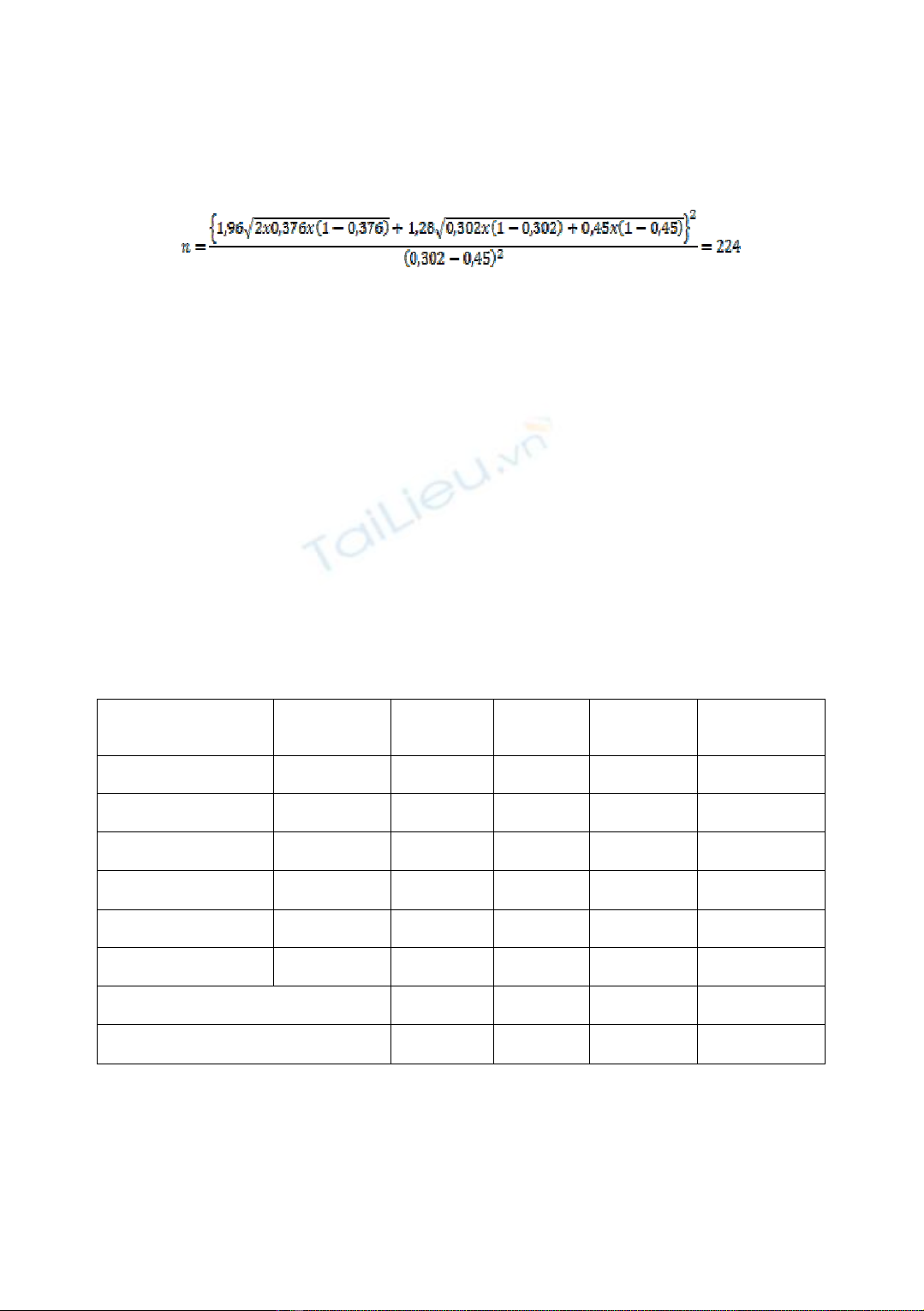
- Sample size:
- Sample selection: The San Chay minority ethnic mothers and their children
under 5 years old were selected under the study, based on a list of children managed at
the community health center.
2.3. Intervention contents
The practices of “Meals seen and practised” are alternately organized at
households with children under 5 years old. The model utilized items available in the
family such as fuel, tools for cooking, dishes, vegetable and fruit. The mothers
voluntarily contribute materials, food, and their time in preparation of a meal and
feeding their children. The meal was estimated to provide about 300 - 350 kcal. The
energy rate supplied by protein was from 12% - 14%. The table 1 below was an
example of a ration and nutrient value of “Meals seen and practised”. Depending on the
food source available in the area, we can increase or decrease particular kinds of food to
maintain the diversity of the ration.
Table 1. Nutrient value of “Meal seen and practised” for one child
Food Amount Protein
(g) Lipid
(g) Glucose
(g) Energy
(kcal)
Ordinary rice (g) 50 3.95 0.50 38.10 172.0
Pork (g) 20 3.80 1.40 0.00 27.8
Sauropus (g) 20 1.06 0.00 0.68 7.0
Fat (g) 10 0.00 9.96 0.00 89.6
Fish sauce (ml) 10 0.71 0.00 0.00 2.8
Papaya (g) 100 1.00 0.00 7.70 35.0
Total 10.52 11.86 46.48 334.2
Percentage (%) 12.6 31.9 55.5 100.0
2.4. Data collection methods
Mothers were directly interviewed using a set of questionnaires regarding KPC
(Knowledge, Practice, Coverage) and to sort out knowledge and practice basing on the
cut-off of 75% of total points.

493
To measure the anthropometry of children under 5 years old and then to compare
with the reference population of NCHS.
2.5. Data processing and analysis: Anthropometry data were processed by
Epinut and then exported to SPSS 13.0 to analyze interventional effectiveness with 2
test and Mann - Whitney U test.
3. Result
The activity of the model “Meals seen and practised” was organized monthly at
each household in the village. The household who organized this meal would supply all
food including cereals, vegetable and fruit as well as vegetable oil and fat. The remaining
households would bring other ingredients depending on their capacity and food
available in their area.
Table 2. Amount of food contributed by the San Chay households during a period of 18 months
Food contributed by households
(n = 237 households) Total
Rice (kg) 171.8
Kinds of vegetable (kg) 68.7
Vegetable oil and fat (litre) 34.4
Fish sauce (litre) 34.4
Ripe fruit (kg) 343.6
Total (kg) 652.9
During 18 months of intervention, the San Chay households in the commune had
contributed the total of 652.9kg of cereals, and other food to practice “Meals seen and
practised”. These food sources was used to improve the quality of a complementary
meal for their children.
Table 3. Result to practice “Meals seen and practiced” on a complementary meal with different
foods during a period of 18 months of intervention
Complementary food No of
practice
No of times
attended by
mothers and
children
Average number
of times/ 1
mother and child
(n = 237)
Egg boiled rice flour/porridge 45 640 2.7
Meat boiled rice flour/ porridge 54 735 3.1
Fish boiled rice flour/gruel 32 521 2.2

494
Crab boiled rice flour/ porridge 26 379 1.6
Shrimp boiled rice flour/ porridge 21 308 1.3
Soya curd boiled rice flour/ porridge 19 332 1.4
Liver boiled rice flour/porridge 16 213 0.9
China squash boiled rice
flour/porridge 13 166 0.7
Peanut boiled rice flour/ porridge 9 142 0.6
Total 235 3436 14.5
Note: Every practice, rice flour or porridge were cooked with the same materials
The kinds of complementary food were varied, and the highest number of
children attending a meal was when boiled rice flour/ meat porridge, egg porridge, fish
porridge were prepared. On average, every mother practised preparation of
complimentary meals 14.5 times with different materials. Regardless of the number of
times “Meal seen and practised” was practiced, it contributed to improving the San
Chay children’s daily meals.
Table 4. Change in quality of complementary meal in children over 6 months old
Ration of 24 h
Before
intervention After
intervention p
(n =207) (%) (n =208) (%)
Children eaten protein - rich plant
foods 148 71.5 178 85.6 <0.01*
Children eaten β-caroten- rich plant
foods 122 58.9 164 78.8 <0.01*
Children eaten a complementary meal
enough times recommended 79 38.2 121 58.2 <0.01*
Average dietary diversity 3.24 1.11 4.18 1.48 <0.01**
*
2 tets. **Mann - Whitney U test
The quantity and quality of children’s complementary meals were improved
much more than before the intervention (p<0.01). The meal was processed with many
kinds of plant foods. The average dietary diversity increased 4.18 1.48 scores (p<0.01).

495
Table 5. Change in the San Chay mother’s young child feeding practices and knowledge
Norm Before intervention After intervention p
(2test)
(n = 231) (%) (n =237) (%)
Mother with good
knowledge 62 26.8 105 44.3 <0.01
Mother with good practice 51 22.1 84 35.4 <0.01
Through practising “Meal seen and practised”, the rate of mothers with good
knowledge on nutrition increased to 44.3% from 22.1% (p<0.01).
Table 6. Malnutrition prevalence rate in the San Chay children under 5 years old before and
after intervention
Malnutrition form
Before intervention After intervention p
(2test)
(n =231) (%) (n =237) (%)
Underweight 96 41.6 75 32.1 <0.05
Stunting 101 43.7 100 42.2 >0.05
Wasting 25 10.8 17 7.2 >0.05
After intervention, the malnutrition prevalence of underweight type decreased to
32.1% from 41.6% (p<0.05). The stunting and wasting types were also dropped, but a
statistically significant difference was not found when compared with before the
intervention.
4. Discussion
One of the orientations of the National Strategy on Nutrition in the 2001-2010
period is “ The socialization of nutrition task needs to be considered as a strategically
solution with participation of many social sectors”. Based on the viewpoint of
socialization, the author Phạm Mạnh Hùng said that it was necessary to create an
appropriate environment for the community’s participation. Each individual’s health
care from an unprompted activity only became a self-conscious activity when it had an
impact on the whole community through collective activities. “Meals seen and
practised” organized at households was a way to develop the community’s participation
in children under five years old care activities. The results presented in Table 2 and 3
shown that the San Chay households had contributed 652.9 kg of cereals, plant foods
including meat, fish, eggs, shrimp, crab, liver, Soya curd, peanut, sesame, China squash
and the kinds of vegetables available in the families, which were used to prepare a
complementary meal. The effectiveness of this development was not only the amount of
plant foods contributed by households, but also had an educational significance on the


%20--%3e%3cdefs%3e%3cstyle%3e%20.st0%20{%20fill:%20%23fff;%20}%20.st1%20{%20fill:%20%237800fa;%20}%20%3c/style%3e%3c/defs%3e%3cpath%20class='st1'%20d='M117.78,12.18H43.11c2.9,3.47,4.65,7.94,4.65,12.82,0,5.6-2.3,10.66-6.01,14.29h76.02l7.22-13.56-7.22-13.56Z'/%3e%3cg%3e%3cpath%20class='st0'%20d='M53.58,26.17h-.59v-1.46h.59v-4.96h2.83c1.78,0,2.67.94,2.67,2.82v5.76c0,1.87-.89,2.81-2.67,2.81h-2.83v-4.96ZM55.36,21.37v3.34h1.1v1.46h-1.1v3.34h1.01c.61,0,.91-.37.91-1.1v-5.93c0-.74-.3-1.1-.91-1.1h-1.01Z'/%3e%3cpath%20class='st0'%20d='M65.99,31.14h-1.8l-.31-2.07h-2.19l-.31,2.07h-1.64l1.82-11.39h2.62l1.82,11.39ZM65.28,18.04c-.25.46-.51.77-.75.94-.21.15-.47.22-.79.22-.26,0-.57-.07-.92-.22l-.38-.15c-.14-.05-.26-.07-.37-.07-.3,0-.53.18-.71.54l-.91-.68c.25-.46.51-.77.75-.94.21-.14.48-.21.79-.21.26,0,.57.07.92.21l.38.15c.14.05.26.07.37.07.3,0,.53-.18.71-.54l.91.68ZM61.91,27.52h1.73l-.87-5.76-.87,5.76Z'/%3e%3cpath%20class='st0'%20d='M74.53,26.89v1.52c0,1.91-.89,2.86-2.67,2.86s-2.67-.95-2.67-2.86v-5.93c0-1.91.89-2.86,2.67-2.86s2.67.95,2.67,2.86v1.11h-1.69v-1.22c0-.75-.31-1.12-.93-1.12s-.93.37-.93,1.12v6.15c0,.74.31,1.11.93,1.11s.93-.37.93-1.11v-1.63h1.69Z'/%3e%3cpath%20class='st0'%20d='M81.4,31.14h-1.8l-.31-2.07h-2.19l-.31,2.07h-1.64l1.82-11.39h2.62l1.82,11.39ZM75.9,19.2l1.52-1.91h1.71l1.51,1.91h-1.61l-.76-.95-.75.95h-1.61ZM77.32,27.52h1.73l-.87-5.76-.87,5.76ZM83.1,15.99l-1.76,1.91h-1.26l1.17-1.91h1.86Z'/%3e%3cpath%20class='st0'%20d='M84.86,19.75c1.78,0,2.67.94,2.67,2.82v1.48c0,1.87-.89,2.81-2.67,2.81h-.85v4.28h-1.79v-11.39h2.64ZM84.01,21.37v3.86h.85c.58,0,.87-.36.87-1.08v-1.71c0-.71-.29-1.07-.87-1.07h-.85Z'/%3e%3cpath%20class='st0'%20d='M93.51,19.75c1.78,0,2.67.94,2.67,2.82v1.48c0,1.87-.89,2.81-2.67,2.81h-.85v4.28h-1.79v-11.39h2.64ZM92.66,21.37v3.86h.85c.58,0,.87-.36.87-1.08v-1.71c0-.71-.29-1.07-.87-1.07h-.85Z'/%3e%3cpath%20class='st0'%20d='M98.8,31.14h-1.79v-11.39h1.79v4.88h2.03v-4.88h1.83v11.39h-1.83v-4.88h-2.03v4.88Z'/%3e%3cpath%20class='st0'%20d='M105.36,24.55h2.46v1.62h-2.46v3.34h3.09v1.63h-4.88v-11.39h4.88v1.63h-3.09v3.18ZM108.17,17.29l-1.76,1.91h-1.26l1.17-1.91h1.86Z'/%3e%3cpath%20class='st0'%20d='M112.2,19.75c1.78,0,2.67.94,2.67,2.82v1.48c0,1.87-.89,2.81-2.67,2.81h-.85v4.28h-1.79v-11.39h2.64ZM111.35,21.37v3.86h.85c.58,0,.87-.36.87-1.08v-1.71c0-.71-.29-1.07-.87-1.07h-.85Z'/%3e%3c/g%3e%3ccircle%20class='st1'%20cx='25'%20cy='25'%20r='20'/%3e%3cpath%20class='st0'%20d='M32.78,19.27c2.92,0,4.43,2.55,5.28,5.33l.71,2.17c.14.38-.33.75-.71.75h-5.61c.19-.33.24-.71.09-1.08l-.75-2.45c-.43-1.32-.99-2.64-1.79-3.77.75-.57,1.65-.94,2.78-.94h0ZM25,18.38c3.25,0,4.9,2.78,5.89,5.89l.76,2.45c.14.42-.33.8-.8.8h-11.69c-.42,0-.94-.38-.8-.8l.75-2.45c.99-3.11,2.64-5.89,5.89-5.89h0ZM25,11.35c1.74,0,3.11,1.37,3.11,3.11s-1.37,3.11-3.11,3.11-3.11-1.41-3.11-3.11,1.41-3.11,3.11-3.11h0ZM17.27,19.27c1.08,0,1.98.38,2.73.94-.8,1.13-1.37,2.45-1.74,3.77l-.8,2.45c-.14.38-.05.75.09,1.08h-5.56c-.42,0-.9-.38-.75-.75l.71-2.17c.9-2.78,2.41-5.33,5.33-5.33h0ZM17.27,12.91c1.51,0,2.78,1.27,2.78,2.83s-1.27,2.83-2.78,2.83-2.83-1.27-2.83-2.83,1.27-2.83,2.83-2.83h0ZM32.78,12.91c1.56,0,2.78,1.27,2.78,2.83s-1.23,2.83-2.78,2.83-2.83-1.27-2.83-2.83,1.27-2.83,2.83-2.83h0ZM27.07,28.56v.09c0,.57-.24,1.08-.61,1.46h0v.05c-.38.33-.9.57-1.46.57s-1.08-.24-1.46-.61h0c-.38-.38-.61-.9-.61-1.46v-.09h1.41v.09c0,.19.05.38.19.47v.05c.09.09.28.19.47.19s.38-.09.47-.19v-.05c.14-.09.24-.28.24-.47t-.05-.09h1.41ZM30.99,28.56v.09c0,1.65-.66,3.16-1.74,4.24-1.08,1.08-2.59,1.79-4.24,1.79s-3.16-.71-4.24-1.79l-.05-.05c-1.04-1.08-1.7-2.55-1.7-4.2v-.09h1.41v.09c0,1.27.47,2.4,1.27,3.25h.05c.85.85,1.98,1.37,3.25,1.37s2.4-.52,3.25-1.37c.85-.8,1.37-1.98,1.37-3.25v-.09h1.37ZM34.99,28.56v.09c0,2.78-1.13,5.28-2.92,7.07-1.79,1.79-4.29,2.92-7.07,2.92s-5.23-1.13-7.07-2.92c-1.79-1.79-2.92-4.29-2.92-7.07v-.09h1.41v.09c0,2.4.94,4.53,2.5,6.08,1.56,1.56,3.72,2.5,6.08,2.5s4.52-.94,6.08-2.5c1.56-1.56,2.5-3.68,2.5-6.08v-.09h1.41Z'/%3e%3c/svg%3e)