
Legal perspectives on inflation: Implications for economic
growth in 45 nations
Quan điểm pháp luật về lạm phát: Ý nghĩa tới tăng trưởng kinh tế
ở 45 quốc gia
Vu Bich Diep, Truong Quynh Anh, Nguyen Thi My Uyen, Hoang Thi Tra, Nguyen
Thi Linh, Le Huong, Nguyen Thuy Trang
Faculty of Economics and Management, International School, Vietnam National
University, Hanoi
Corresponding author: Vu Bich Diep. E-mail: vubichdiep2710@gmail.com
Abstract: Inflation, a phenomenon with far-reaching social and economic implications,
has gained heightened attention in the wake of the COVID-19 pandemic, prompting global
scrutiny. This study examines the current state of inflation across 45 nations and reevaluates
its interplay with economic growth, focusing on the years 2010 through 2021. Utilizing
methodologies including Ordinary Least Squares (OLS), fixed effects, and random effects
models, we analyze the legal ramifications of inflation on economic development and
discern disparities between developed and developing jurisdictions. The goal of the study
is to investigate the current state of global inflation and its relationship to economic
development using a sample of 45 nations for the years 2010 through 2021. Our findings
underscore the dual impact of inflation on economic growth, with implications for legal
frameworks and regulatory approaches. There was a negative impact of inflation on the
economic growth in both 45 countries and each group of countries in the period from 2010
to 2021. In contrast, inflation remained positive with economic growth during the COVID-
19 pandemic period from 2019 to 2021. The motivation of this research paper is to fill the
gap with previous studies, providing an overview and more objective results for the
inflation situation as well as its impact on economic growth.
Keywords: COVID-19; Developed countries; Developing countries; Inflation; Economic
growth.
Tóm tắt: Lạm phát, một hiện tượng có ý nghĩa kinh tế và xã hội sâu rộng, đã thu hút được
nhiều sự chú ý sau đại dịch COVID-19, khiến toàn cầu phải giám sát chặt chẽ. Nghiên cứu
này xem xét tình trạng lạm phát hiện tại ở 45 quốc gia và đánh giá lại mối tương tác của nó
với tăng trưởng kinh tế, tập trung vào các năm từ 2010 đến 2021. Bằng cách sử dụng các
phương pháp bao gồm Bình phương tối thiểu thông thường (OLS), mô hình hiệu ứng cố
định và hiệu ứng ngẫu nhiên, chúng tôi phân tích các tác động pháp lý lạm phát đối với sự
phát triển kinh tế và phân biệt sự khác biệt giữa các khu vực pháp lý phát triển và đang phát
triển. Mục tiêu của nghiên cứu này là điều tra tình trạng lạm phát toàn cầu hiện nay và mối
quan hệ của nó với phát triển kinh tế bằng cách sử dụng mẫu gồm 45 quốc gia trong các
năm từ 2010 đến 2021. Phát hiện của chúng tôi nhấn mạnh tác động kép của lạm phát đối
với tăng trưởng kinh tế, cùng với những tác động đối với khuôn khổ pháp lý và các phương
pháp điều tiết. Lạm phát có tác động tiêu cực đến tăng trưởng kinh tế ở cả 45 quốc gia và
từng nhóm quốc gia trong giai đoạn 2010-2021. Ngược lại, lạm phát vẫn dương với tăng
trưởng kinh tế trong giai đoạn đại dịch Covid-19 từ 2019 đến 2021. Mục đích của bài nghiên
cứu này là nhằm lấp đầy khoảng trống với các nghiên cứu trước đây, đưa ra những kết quả
tổng quan và khách quan hơn về tình hình lạm phát cũng như tác động của nó tới tăng
trưởng kinh tế.
Từ khóa: Các nước phát triển; Các nước đang phát triển; COVID-19; Lạm phát; Tăng
trưởng kinh tế.
Tạp chí khoa học và công nghệ - Trường Đại học Bình Dương – Quyển 7, số 1/2024
Journal of Science and Technology – Binh Duong University – Vol.7, No.1/2024
67
https://doi.org./10.56097/binhduonguniversityjournalofscienceandtechnology.v7i1.214

1. Introduction
Inflation has long been recognized as one
of the most pressing issues facing the
global economy, and concerns about its
potential impact on economic growth
have continued to be a topic of debate.
Inflation has been linked to a range of
factors, such as changes in interest rates,
unemployment, and foreign direct
investment (FDI). Understanding the
relationship between inflation and
economic growth is critical for
economists, researchers, and
policymakers. As a result, a large body
of literature has examined the impact of
inflation on economies as well as
economic growth.
In recent years, many countries have
experienced moderate inflation levels,
driven by various factors such as supply
chain disruptions, higher commodity
prices, and increased demand for goods
and services. However, some countries
have seen significantly higher levels of
inflation. According to data from the
World Bank, as of 2021, the countries
with the highest inflation rates were
Sudan (382.8%), Lebanon (154.8%), and
Zimbabwe (98.5%). On the other hand,
the countries with the lowest inflation
rates were Chad (-0.8%), Bahrain (-
0.6%), and Rwanda (-0.4%). The causes
of inflation can vary depending on the
specific economic conditions of a
country, and the impact of inflation can
have wide-ranging consequences for its
economies, businesses, and citizens.
There are several lines of literature that
reflect the causes of inflation. Factors
such as fiscal policy, monetary policy,
exchange rate movements, supply
shocks, structural factors [1], and
changes in aggregate demand [2] can
contribute to inflationary pressures in
developing economies.
To examine the impact of inflation on
economic growth, two competing
hypotheses are developed. The first
hypothesis argues that inflation has a
potentially positive impact on economic
growth [3] [4] [5] [6] [7] [8]. Using
cointegration and error correction
models, [9] found a positive long-run
relationship between GDP growth rates
and inflation, which results in moderate
inflation being beneficial to growth and
higher economic growth entails inflation.
Moreover, a low but positive inflation
rate can help overcome nominal
rigidities, facilitate relative price
adjustments, and provide flexibility in
monetary. Conversely, the alternative
hypothesis is that inflation has a negative
impact on economic growth, and it
outweighs any potential positive ones.
High inflation rates hinder investment,
reduce productivity, distort resource
allocation and negatively affect. Inflation
can exacerbate income inequality by
eroding the purchasing power of lower-
income groups and redistributing wealth
towards those with more bargaining
power. Furthermore, high inflation rates
can lead to increased unemployment
through various channels, such as wage-
setting behavior, labor market frictions,
and the impact on investment decisions
[10]. It can be easily seen that the
differences in economic theories,
methodological approaches, and
empirical data lead to the existence of
competing hypotheses regarding the
impact of inflation on economic growth.
Hence, the complexity of the issue and
the various factors that can influence the
relationship were emphasized.
Researchers use different theories,
68
Legal perspectives on inflation: Implications for economic growth in 45 nations

methods, and data to investigate this
relationship, leading to a range of
findings in previous research. As a result,
the debate continues among economists,
policymakers, and academics regarding
the precise nature and magnitude of the
relationship between inflation and
economic growth.
However, little is known about
whether and how inflation today impacts
economic growth. This research will fill
the gap of former research as most of
them ceased data of 2020 without the
latest updated data, and they mainly
focused on analyzing data in one country
or several countries in the same region
without wide-scaled comparison [3] [11]
[8]. To test these hypotheses, we analyze
the current situation in the world with
data up to 2021 from 45 different
countries, which are divided into groups
of developed and developing countries.
Besides, we will show the relationship
between inflation and economic growth.
2021 has seen a number of upheaval
events that could undermine the
commonly documented relationship
between inflation and economic growth.
The most notable is the COVID-19
pandemic, dramatically affecting the
global economy. Firstly, the pandemic
caused disruptions in supply chains,
causing shortages and higher prices for
certain items, contributing to inflation.
However, as the pandemic led to
widespread economic shutdowns, the
demand for goods and services
decreased, leading to a deflationary
impact on prices. The pandemic has
caused a significant GDP drop and
negatively affected economic growth.
Governments worldwide have
introduced different policies to boost
their economies, including interest rate
cuts and stimulus packages. Nonetheless,
it is still uncertain how long and severe
the pandemic's economic repercussions
will be. The COVID-19 pandemic has
significantly impacted inflation and
economic growth, and it is still uncertain
how long and how severe the effects will
be. It is also unclear what strategies will
be the most effective in reducing the
impact.
Our study uses ordinary least squares
(OLS), fixed effects, and random effects
models to examine whether and how
inflation has impacted economic growth.
Using data from 45 countries worldwide,
we documented that the coefficient of
inflation impacts on GDP in 45 countries
is negative in all cross-countries,
developed and developing countries.
Therefore, if inflation increases,
economic growth will decrease and vice
versa. In contrast, the subsample in the
COVID-19 pandemic period from 2019
to 2021 showed a positive impact of
inflation on economic growth, this is
opposed to our previous findings. If
inflation increases, economic growth
will also develop and vice versa. Figure
1 shows the impacts of inflation on
economic growth in the world context
from the 2010-2021 period. In Figure 1,
we can see positive and negative
relationships between inflation and
economic growth. The positive
relationship is concisely shown in the
year of 2012, 2015, 2017, 2019, 2020
and 2021 while the negative relationship
occurred in the year of 2011, 2013, 2014,
2016 and 2018. The highest GDP and
CPI figures are 5.87% and 4.82%, while
the lowest GDP and CPI figures are -
3.11% and 1.43%, respectively.
69
Vu Bich Diep et al.
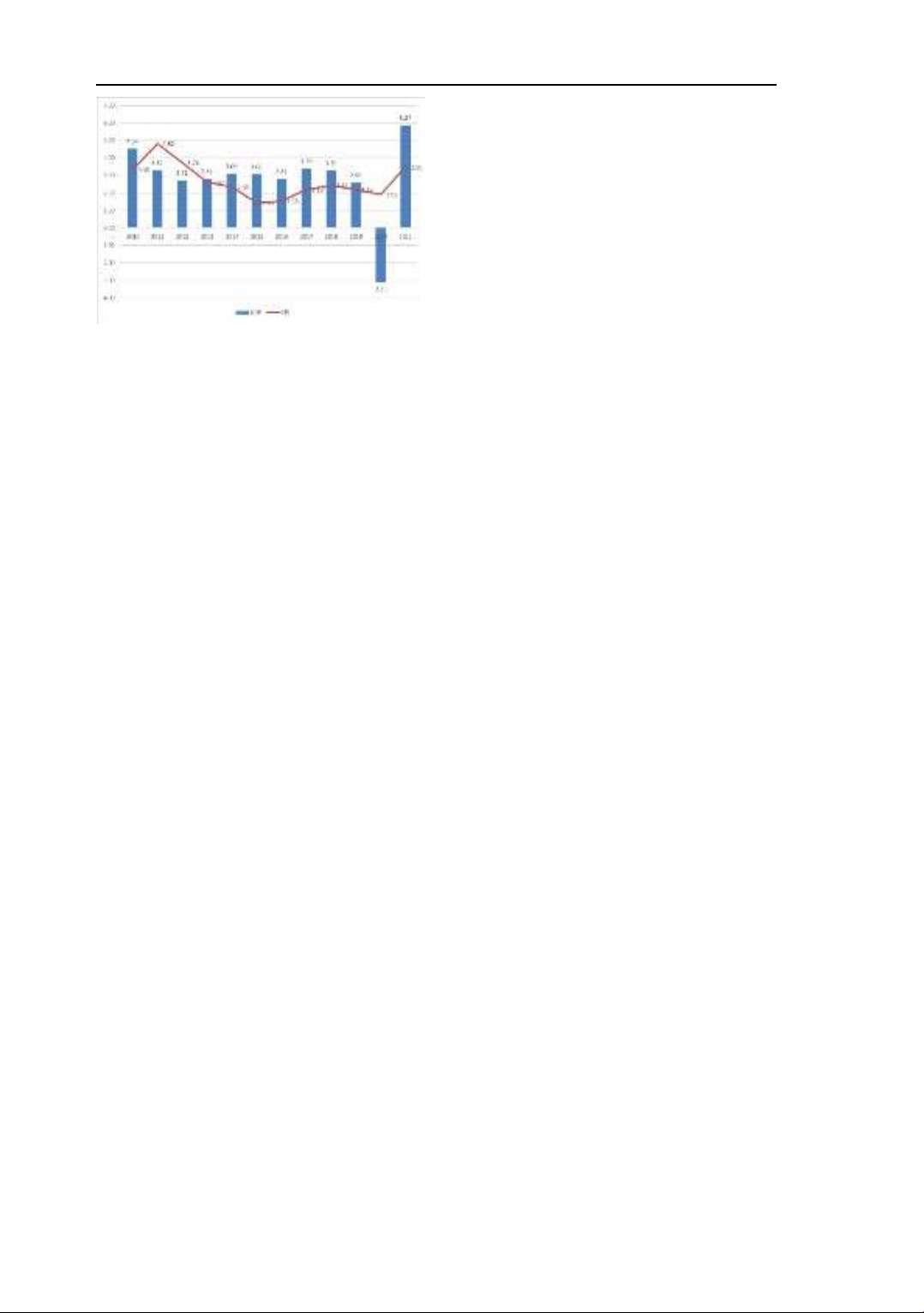
Fig. 1. The graph of the relationship
between GDP and CPI on average in the
world context from 2010-2021 (World
Bank)
This study contributes to the extant
literature that has broad implications for
research on inflation and its relationship
with economic growth. First, it provides
new empirical evidence on the
relationship between inflation and
economic growth in a larger sample of 45
countries over the period 2010-2021,
which are divided into two main groups
of countries. Previous studies have often
focused on a limited number of
countries, which may not provide a
representative picture of the global
situation [12] [9] [11]. This study can
provide a more comprehensive
understanding of the relationship
between inflation and economic growth
by including many countries. Second,
this research incorporates several control
variables that may influence the
relationship between inflation and
economic growth, including inflation
rate, unemployment rate, FDI, economic
openness, lending rate, and population
growth. By controlling for these factors,
we can better isolate the effect of
inflation on economic growth and
provide more accurate estimates of its
impact.
The remainder of this research paper
is structured as follows: Section 2
reviews the literature and develops the
hypothesis. Section 3 describes the data
tables with variables and research
methodology. Our findings and research
results are provided in section 4. Finally,
section 5 contains our summary and
conclusions.
2. Literature review and hypothesis
development
2.1. Literature review
According to the International Monetary
Fund, inflation is the rate of price growth
over a certain time. It generally refers to
a broad metric, like the general rise in
prices or the rise in a nation's cost of
living. But it may also be reckoned more
precisely for some products like food or
services, like a hairstyle. Whatever the
environment, inflation represents how
much more precious the applicable set of
goods and or services has become over a
certain period. Believing that inflation is
expensive, central bankers and most
other observers see price stability as a
worthwhile goal [3]. [13] suggested that
policymakers need to be aware of when
inflation starts to have a negative impact
while [14] found a one-way causal link
connecting inflation and economic
growth.
The relationship between inflation
and economic growth has already been
analyzed in many previous research
papers. Theoretically, inflation can affect
economic growth on both sides,
positively and negatively. High growth,
lower inflation and lower inflation have
made the economy grow. [15] applied
the theoretical framework to show that
inflation had a positive impact through
precautionary savings in the short term.
[16] stated that low inflation promotes
high economic growth and that there is a
positive relationship between inflation
70
Legal perspectives on inflation: Implications for economic growth in 45 nations

uncertainty and economic growth [17].
The inflation rate below the examining
threshold had a positive effect on growth,
3.89% of the inflation rate threshold was
found in Malaysia [18], and 13% of the
inflation rate threshold was examined in
the case of Azerbaijan [19]. [20] has
stated that sometimes there are positive
impacts of GDP on the CPI if the impacts
become stronger during the expansion
phase. Therefore, a country can endure
inflation at a certain level to obtain
positive impacts on economic growth.
In contrast, inflation has a negative
impact on economic growth and
investment [3]. [21] also stated that
inflation significantly negatively
impacted economic growth for Asian
countries. High inflation can cause a
decrease in bank lending and return on
real estate through real interest rates [13].
[14], who used the cointegration and
causality test, bounds test and WALD
test, have shown that there was a
negative significant impact in the short
term between real GDP and CPI
variances. There is a detrimental
inflation-growth impact, which is more
pronounced at lower inflation rates. For
the OECD nations, inflation had a
considerable negative impact, and it was
the same as that of the APEC countries
[7]. In the threshold model, an inflation
rate which is above the inflation rate
threshold according to different
countries or areas will have negative
impacts on economic growth. A higher
than 9% inflation rate has a detrimental
effect on economic expansion [22], a rate
of inflation exceeding 3.89% hurts
economic expansion [18], and a inflation
rate which is between 10 per cent to 20
per cent will have negative impacts on
economic growth [4].
Moreover, it has also been proved that
there is no significant relationship
between inflation and economic growth.
[23] used the nonlinear least square
model (NLLS) to show that a threshold
for an inflation rate of 1 to 3 per cent for
developed nations and 7 to 11 per cent
for developing nations was proposed.
The economic growth was unaffected by
percentages below the range and
negatively affected by percentages
beyond it. Opposite to inflation and
growth theories, there was no
relationship between inflation and
growth in OECD countries [21] [14] has
stated that inflation and economic
growth have no significant long-term
relationship in Turkey.
Previous researchers have used
diverse methods, theories, and models to
analyze the relationship among inflation,
economic growth, and other variances.
[13] and [15] applied the theoretical
framework in their papers. [7] used
cointegration, fixed and random effect
methods with GDP at constant prices, the
annual rate of inflation, and the ratio of
gross domestic investment to GDP
variances contributing to the research
results. In addition, the threshold model
was widely applied to most research to
find the inflation rate threshold affecting
economic growth. [19] used the
threshold model to analyze real GDP per
capita, CPI, and gross fixed capital
formation variances, while [22] used real
GDP, population growth, CPI, and
investment growth rate variances.
Otherwise, [14] applied the
cointegration, causality, bounds, and
WALD tests with real GDP and CPI
variances.
2.2. Hypothesis development
71
Vu Bich Diep et al.



![Trắc nghiệm Luật Kinh Doanh về Hợp Đồng: [Kèm Đáp Án Chi Tiết]](https://cdn.tailieu.vn/images/document/thumbnail/2025/20251127/doduyphong911@gmail.com/135x160/14321764296608.jpg)