
Unit 6. Daily life
III. Listening and speaking
Asking about time
1. Look at the pictures. What can you see?

2. When do these things normally happen in your country?
1. When do shops open? When do they close? Are they open every day?
2. What is a normal working day? What is a normal school day?
3. When do banks usually open and close?
4. What are normal office hours?
5. What time do people usually eat? When do restaurants and bars open and
close?
6. When are museums normally open?
7. When do people normally get up? When do they go to bed?
Shops open at 8 a.m. They close at 7p.m. Yes they are.
A normal working day is at 7.30. A normal school day is at 7.15.
Banks usually open at 8.00 and close at 4.30.
Normal office hours are at 7.00 in the morning and at 1.30 in the afternoon.
People usually have breakfast at 6.30 a.m. Restaurants and bars open at 8.00.
Museum are normally open at 8.00.
They often get up at 6.00. They often go to bed at 10 p.m.
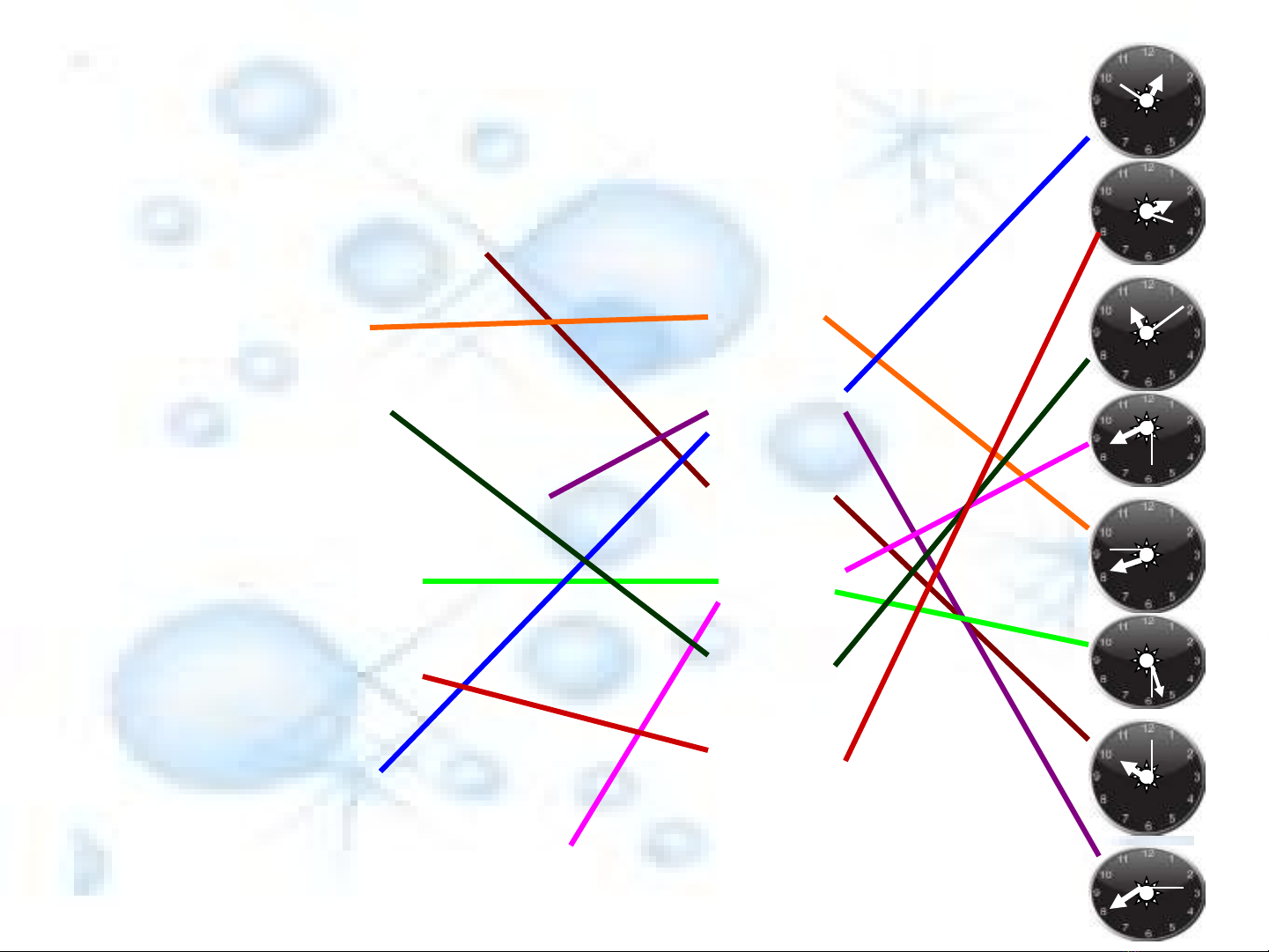
b. Say what happens at each time.
The museum opens at ten o'clock.
The film starts at seven forty-five
The train leaves at ten past eleven.
The programme finishes at quater past eight.
The shops close at five thirty.
The plane arrives at two twenty.
Lessons finish at ten to one.
The supermarket closes at half past eight.

4. Work with a partner. Use the information on the chart and
make conversations.
A: What time does the museum open?
B: It opens at ten o'clock.
A: Thank you.
5. Work with a new partner. Make conversations with this
information. (Make sure you use the correct singular or
plural form.)
a. lessons /start/ 8.15 b. plane/ leave/ 4.25
c. shops/ close/ on Saturday/ 6 p.m d. film/ finish/ this evening/ 11.10
e. train/ arrive/ 3.50 f. banks/ open/ on Mondays/ 10.00
g. the meeting/ start/ this morning/ 12.00
h. visitors/ arrive/ today/ 3.00

![Đề cương học phần Ứng dụng công nghệ thông tin trong giảng dạy ngoại ngữ (Application of Information Technology in Language Teaching) [Mới nhất]](https://cdn.tailieu.vn/images/document/thumbnail/2025/20250212/tuetuebinhan666/135x160/881739332468.jpg)




![Bài tập thì hiện tại hoàn thành [kèm đáp án chi tiết]](https://cdn.tailieu.vn/images/document/thumbnail/2025/20251106/thuthao27062004/135x160/41601762420911.jpg)






![Tài liệu ôn tập Ngữ pháp tiếng Anh [chuẩn/mới nhất/tổng hợp]](https://cdn.tailieu.vn/images/document/thumbnail/2025/20250821/vuongdinhlinh1412@gmail.com/135x160/933_tai-lieu-on-tap-ngu-phap-tieng-anh.jpg)