

TẠP CHÍ KHOA HỌC VÀ CÔNG NGHỆ NĂNG LƯỢNG - TRƯỜNG ĐẠI HỌC ĐIỆN LỰC
(ISSN: 1859 - 4557)
Số 37 97
HÀM MỤC TIÊU CHO BÀI TOÁN ƯỚC LƯỢNG TRẠNG THÁI HỆ THỐNG ĐIỆN KHI SỬ
DỤNG THUẬT TOÁN TỐI ƯU BẦY ĐÀN
OBJECTIVE FUNCTION FOR POWER SYSTEM STATE ESTIMATION WITH
PARTICLE SWARM OPTIMIZATION
Kiều Thị Thanh Hoa, Trần Thanh Sơn
Electric Power University
Ngày nhận bài: 11/3/2025, Ngày chấp nhận đăng: 20/4/2025, Phản biện: TS. Nguyễn Tùng Linh
Tóm tắt:
Bài toán ước lượng trạng thái có mục tiêu là xác định trạng thái gần giống nhất của hệ thống
dựa trên tập các giá trị đo đang có, giúp người vận hành đánh giá hệ thống và đưa ra những quyết
định phù hợp. Để giải quyết bài toán, bài báo trình bày nghiên cứu sáu kết hợp giữa hai thuật toán
(tối ưu bầy đàn, tối ưu bầy đàn với quá trình tách biến) và ba dạng hàm mục tiêu (bình phương cực
tiểu có trọng số, cực tiểu trị tuyệt đối, cực tiểu trị tuyệt đối có trọng số). Bên cạnh đó, việc đánh giá
giá trị các biến trạng thái được thực hiện trong thuật toán thay vì đưa hàm phạt vào hàm mục tiêu
như các nghiên cứu trước đây. Các kết hợp được thực hiện mô phỏng cho lưới điện IEEE 14 nút và
IEEE 30 nút với trường hợp giả sử dữ liệu đo từ thiết bị đo thông thường hoặc từ thiết bị PMU. Các
kết quả mô phỏng cho thấy các thuật toán kết hợp với hàm bình phương cực tiểu có trọng số cho kết
quả ước lượng tốt nhất trong các trường hợp nghiên cứu.
Từ khóa:
Ước lượng trạng thái hệ thống điện, thuật toán tối ưu bầy đàn, tách biến, WLS, LAV, WLAV
Abstract:
The state estimation problem aims to determine the likelihood state of the power system
based on the available measurement values. This helps operators to analyze and evaluate the systems
so they can make appropriate control decisions. This paper examines six combinations of two
algorithms (particle swarm optimization and particle swarm optimization with decoupled variables) and
three objective functions (weighted least squares, least absolute values, and weighted least absolute
values) to solve the power system state estimation. In addition, rather than employing a penalty
function within the objective function as in previous studies, this work use a procedure within the
algorithm to verify whether the state variable values remain within the prescribed boundaries. These
combinations are simulated for 14-bus and 30-bus IEEE power systems, assuming that input data
comes from conventional measuring devices or phasor measurement units. The estimation results
show that using the weighted least square function gives the best estimation results.
Keywords:
Power system state estimation, particle swarm optimization, decoupled variable, WLS, LAV,
WLAV

TẠP CHÍ KHOA HỌC VÀ CÔNG NGHỆ NĂNG LƯỢNG - TRƯỜNG ĐẠI HỌC ĐIỆN LỰC
(ISSN: 1859 - 4557)
98 Số 37
1. INTRODUCTION
Nowadays, the power system scale is
expanding according to the growth of the
load and the addition connecting of
renewable energy sources. Therefore, the
modern power system is developing
towards automation and intelligence to
ensure it operates in a safe, reliable, and
efficient mode. This target requires much
support from computer programs with
input data from the Supervisory Control
and Data Acquisition system (SCADA)
and/or Phasor Measurement Units (PMU).
Currently, measuring devices are not often
placed on all buses, so we can not acquire
all the state parameters. Consequently, we
must solve the power system state
estimation (PSSE) problem to obtain
unknow parameters. This problem target is
to determine the likelihood state of the
power system based on the available
measurement values. The input parameters
include system topology, lines,
transformers, compensation devices, and
measured values such as bus voltage
magnitudes, phase angles, active powers,
reactive powers, branch currents, etc. The
outputs are estimated values of bus voltage
magnitude and phase angle. These values
will help the operators in system analysis
and evaluation. Then, they can make
appropriate control decisions.
We can describe the PSSE problem using
the Weighted Least Squares (WLS)
objective function, which assumes that the
measurement errors are known,
independent, and randomly distributed
according to a Gaussian distribution [1].
However, there may be other parameters
that could affect the estimation results,
whether or not they contain errors. In [2],
the author introduced the concept of M-
estimators, which aim to minimize a
function ρ(r) that quantifies the deviation
between measured and estimated values.
Alternatively, various forms of the
function ρ(r) have been proposed in [3] and
[4]. If p(r) is an absolute value function, it
will correspond to the Least Absolute
Value (LAV) model. Articles [5] and [6]
add a weighting factor to the LAV
function, so p(r) corresponds to the
Weighted Least Absolute Value (WLAV)
function. In [4], the authors propose the
function p(r) with a tuning factor α and
show that the proposed function behaves
like LAV when the tuning factor is small
and like WLS when the tuning factor is
high.
The problem of estimating the state
variable's value with these objective
functions mentioned above can be solved
iteratively by algorithms like Newton.
However, when using the LAV estimator,
the weighting matrix will be zero, so it
must be used other methods, such as
integer programming. In addition, this
problem can also be solved by heuristic
search algorithms, as in some published
papers.
This paper presents the use of Particle
Swarm Optimization (PSO), a heuristic
search algorithm, to address the PSSE
problem. In this algorithm, solutions are

TẠP CHÍ KHOA HỌC VÀ CÔNG NGHỆ NĂNG LƯỢNG - TRƯỜNG ĐẠI HỌC ĐIỆN LỰC
(ISSN: 1859 - 4557)
Số 37 99
primarily derived from the information and
orientation of the objective function value.
An advantage of utilizing PSO, in contrast
to traditional like Newton's method, is that
it does not require the calculation of
derivative matrices, making it a more
efficient and accessible option.
Additionally, the algorithm is not impacted
by zero matrix issues when the LAV
formula is used. However, selecting an
appropriate objective function is critical
for achieving optimal results with the PSO
algorithm. Consequently, this work
conducts a thorough analysis and
evaluation of the PSO algorithm as it
pertains to various types of objective
functions.
The authors in the paper [8-11] performed
state estimation using the PSO algorithm
combined with WLS or WLAV objective
function. In these studies, both WLS and
WLAV incorporated a penalty function
that assigns an infinitely positive value if
the state variable falls outside the defined
search space. In the paper [12], the PSO
algorithm was also applied to the PSSE
problem, and the authors provided insight
regarding the impact of measurements'
type and location on the estimation results.
In [13], PSO and the genetic algorithm
with decoupled variables are presented.
The objective function used in articles [12]
and [13] is also WLS with a penalty
function. By studying the PSO algorithm,
various function combinations can be
employed. For instance, instead of
implementing a penalty function in the
objective function, a particle evaluation
can be performed through a position
update process, ensuring that each one is
within the allowed limits.
The analysis above indicates that few
studies have focused on algorithms that
omit the use of a penalty function within
the objective function. Therefore, further
evaluation from this perspective is
necessary, as the results can serve as basis
for choosing a more accurate objective
function. Moreover, in all previous studies
[8-10] and [12], the application of the PSO
algorithm did not incorporate decoupled
variable techniques. Accordingly, the
following sections of this paper will focus
on the PSO algorithm without and with the
decoupled variables when combined with
the WLS, LAV, and WLAV objective
functions without the penalty function.
The evaluation and proposal of the
objective function rely on simulation
results with IEEE 14-bus and IEEE 30-bus
power systems.
2. OBJECTIVE FUNCTIONS FOR
POWER SYSTEM STATE ESTIMATION
The estimation problem of power system
state variables is formulated using input
data, including system connection details,
line parameters, transformers, measured
values, etc.
Suppose there is a set of m measurements
zi, and the function hi(x1, x2,…, xn)
corresponds to the measurement type of zi.
Then we have:

TẠP CHÍ KHOA HỌC VÀ CÔNG NGHỆ NĂNG LƯỢNG - TRƯỜNG ĐẠI HỌC ĐIỆN LỰC
(ISSN: 1859 - 4557)
100 Số 37
z = h(x)+e
(1)
The constraints of the state variable xi:
ximin ≤ xi ≤ ximax
(2)
where :
• x is the state variable vector which
includes the value of bus voltage
magnitude and phase angle ;
• e is the error of measurement ;
• hi(x) is reactive power function (or active
power function, or branch current, or
voltage, or phase angle) depending on the
type of zi;
2.1. Weighted Least Squares
To determine the state variables x1, x2, . . .,
xn corresponding to the set of measured
values z, the weighted least squares
method minimizes the following objective
function [1]:
J(x) = wi
2(zi−hi(x))2
= ∑ 1
σi
2
m
i=1 ei
2
(3)
where:
• wi=1
σi, with σi is the standard deviation
of the i-th measurement, representing the
expected accuracy of the measuring
device.
• m is number of measurement ;
2.2. Least Absolute Value
The Least Absolute Value objective
function is described as finding the
minimum value of the function F(x) as in
equation (4):
F(x)= ∑|zi−hi(x)|
m
i=1
(4)
2.2. Weighted Least Absolute Value
The Weighted Least Absolute Value
objective function is described as finding
the minimum value of the function F(x) as
in equation (5) [1][5][6]:
F(x)= ∑ 1
σi|zi−hi(x)|
m
i=1
(5)
3. THE ALGORITHM
When employing the Particle Swarm
Optimization (PSO) algorithm to estimate
power system state variables, several terms
within the algorithm are defined as
follows:
- A “particle” denotes a specific set of
values that represent the state variables
associated with bus voltage magnitudes
and/or phase angles.
- The “particle position” refers to the
specific values of the state variables
contained within a single particle.
- “Particle velocity” signifies the amount
added to the current state variable values to
generate new ones. This adjustment
expands the search space and enhances the
likelihood of finding the global optimal
solution.
- A “swarm” represents the collective
group of multiple particles.
3.1. Particle Swarm Optimization
Particle Swarm Optimization is an
algorithm that seeks the optimal solution
TẠP CHÍ KHOA HỌC VÀ CÔNG NGHỆ NĂNG LƯỢNG - TRƯỜNG ĐẠI HỌC ĐIỆN LỰC
(ISSN: 1859 - 4557)
Số 37 101
by leveraging information from a swarm of
particles. In the context of a power grid
with N nodes, each particle represents both
the voltage magnitude and phase angle of
the buses, resulting in a total of (2N-1)
state variables. The algorithm starts by
randomly initializing a specified number
of particles. Each particle has the
capability to remember the best position it
has achieved thus far, as well as the best
position found by the entire swarm. The
particle's movement is then influenced by
its velocity, which is calculated using a
specific formula (referred to as formula (6)
in reference [14]). Subsequently, the
particle's new position is updated
according to formula (7).
vid = χ.(vid + c1.r1.(pib – xid)
+ c2.r2.(pgb – xid))
(6)
xid = xid + vid
(7)
where:
• χ = 0,729; c1 = c2 = 2,05;
• r1 and r2 are random values in the range
(0,1);
• pgb is the global best, referred to the
overall best solution found by the swarm;
• pib is the personal best position of i-th
particle;
The state variable within the search space
has defined limits, specifically a minimum
value (xmin) and a maximum value (xmax).
After updating an individual's position, it
is important to ensure that the state
variable stays within these boundaries. To
achieve this, the algorithm checks the
value of the state variable and makes
necessary adjustments if needed. If the
revised value, xid, falls below ximin or
exceeds ximax, the algorithm will set xid to
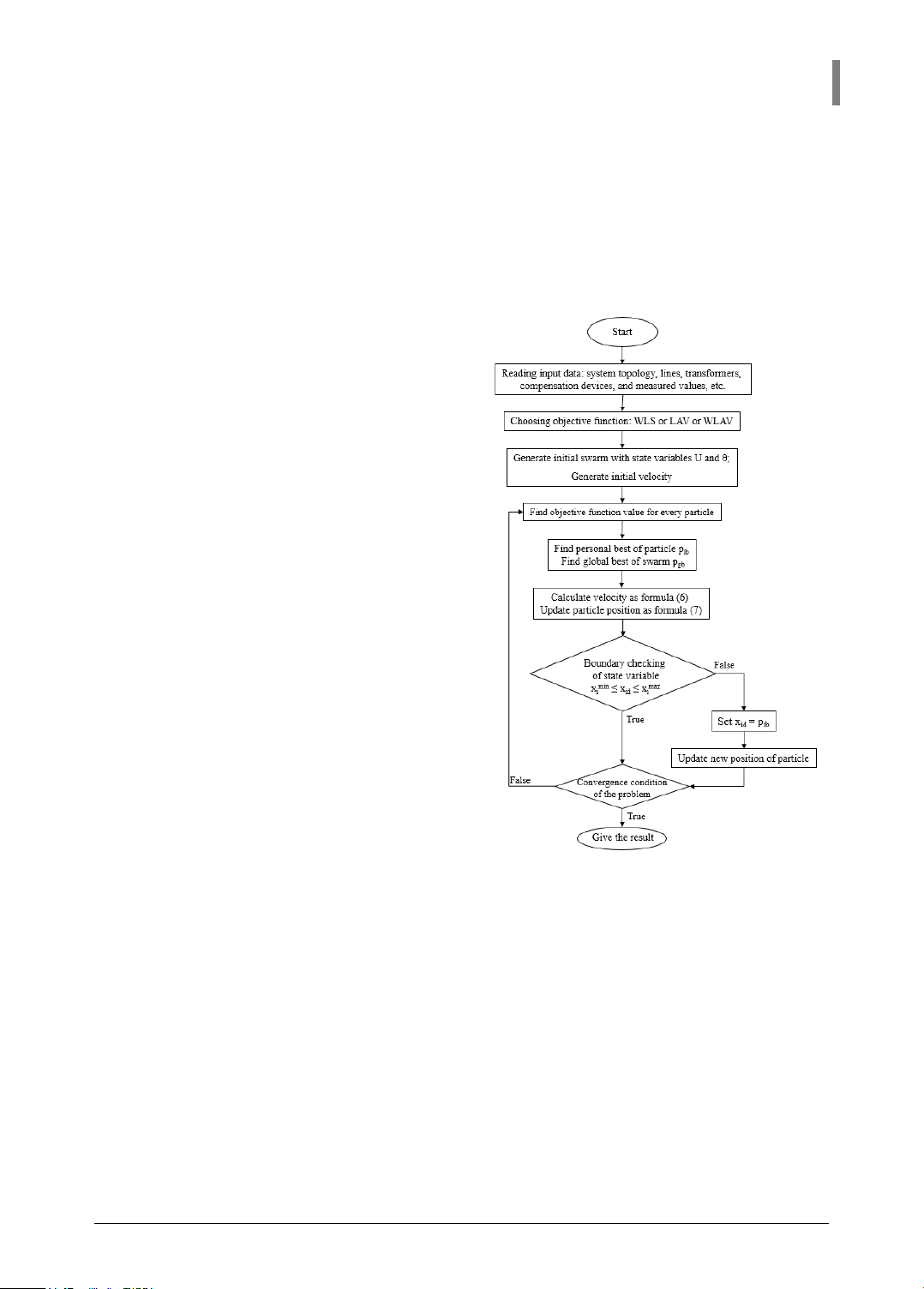
pib. The process of estimating the state
variable value using PSO algorithm is
illustrated in the block diagram shown in
Figure 1.
Figure 1. Diagram of the PSO algorithm
3.2. Separate V-θ estimation using
Particle Swarm Optimization (SPSO)
In this section, we address the problem of
estimating the state variable values using
the SPSO (Separate U-θ estimation
process) algorithm based on the Particle
Swarm Optimization technique. The
distinguishing feature of the SPSO
algorithm is its methodical approach to
estimating state variables separately. In









![Đề cương ôn tập môn Đo lường điện [chuẩn nhất]](https://cdn.tailieu.vn/images/document/thumbnail/2026/20260310/hoaphuong0906/135x160/75761773197829.jpg)
![Giáo trình Máy điện 1 Đại học Bà Rịa - Vũng Tàu [Download PDF]](https://cdn.tailieu.vn/images/document/thumbnail/2026/20260310/hoaphuong0906/135x160/29511773283865.jpg)


![Giáo trình Điện tử số Phần 2: [Mô tả nội dung phần 2, ví dụ: Mạch logic, Thiết kế mạch,...]](https://cdn.tailieu.vn/images/document/thumbnail/2026/20260305/hoatulip2026/135x160/87191773135922.jpg)


