

http://www.iaeme.com/IJMET/index.asp 1525 editor@iaeme.com
International Journal of Mechanical Engineering and Technology (IJMET)
Volume 10, Issue 03, March 2019, pp. 1525–1534, Article ID: IJMET_10_03_153
Available online at http://www.iaeme.com/ijmet/issues.asp?JType=IJMET&VType=10&IType=3
ISSN Print: 0976-6340 and ISSN Online: 0976-6359
© IAEME Publication Scopus Indexed
INFORMATION TECHNOLOGY
ARCHITECTURE DESIGN TO AUTOMATE
ENTERPRISE BUSINESS PROCESS USING
TOGAF ADM
Muhammad Arif Abdul Hakim, Dian Nofita Saputri, Riha Rizanah Warang, Sfenrianto
Information Systems Management Department,
BINUS Graduate Program – Master of Information System Management
Jakarta, Indonesia 11480
ABSTRACT
The purpose of this study is to design information technology architectures to
automate enterprise business processes. The company's IT architecture needs to be
improved to support the vision and mission in accordance with the needs of the ongoing
business process. Therefore, it is very important for companies to create IT blueprints
to facilitate the development of information systems in the future. The IT architecture in
this study was designed using TOGAF ADM, with SOA and ERP as a solution to existing
problems. The results of this study are in the form of IT architecture design to support
the company's strategic plan through the automation of enterprise business processes.
Key words: IT Strategic Planning, IT Architecture, Business Process Automation,
TOGAF ADM, SOA, ERP
Cite this Article: Muhammad Arif Abdul Hakim, Dian Nofita Saputri, Riha Rizanah
Warang, Sfenrianto, Information Technology Architecture Design to Automate
Enterprise Business Process Using TOGAF ADM, International Journal of
Mechanical Engineering and Technology 10(3), 2019, pp. 1525–1234.
http://www.iaeme.com/IJMET/issues.asp?JType=IJMET&VType=10&IType=3
1. INTRODUCTION
In the current era of development of digital information systems, IT plays a role in business
transformation, so that with IT organizations and management can adapt to information
globalization [1]. Implementation of information technology systems in an organization will be
able to increase competitiveness [2]. One strategy in the IT field, an organization needs to
automate business processes. Automation of business processes is a method to support
organizational business activities broadly with better work flow and communication between
workers [3].
But at the development stage, it turns out that there are still many organizations that have
not considered the IT architecture comprehensively. This is because the company implements
information systems partially and is oriented towards the result, the condition is called

Information Technology Architecture Design to Automate Enterprise Business Process Using
TOGAF ADM
http://www.iaeme.com/IJMET/index.asp 1526 editor@iaeme.com
application silo stage [4]. The result is the emergence of different platforms between
information systems, diversity of programming languages, differences in databases, and other
fundamental differences in a company's IT architecture. The development of information
systems that are individual in nature will cause problems when the system must communicate
with each other or be integrated. This condition is certainly ineffective and inefficient for IT
investments in an organization. In building an application system, it is necessary to go through
an information system planning approach in terms of architecture that considers aspects of
usability, scalability, and future development [5].
The research conducted refers to several previous studies relating to the design of IT
architecture with a variety of case study backgrounds. Many IT architectural designs have been
carried out using analytical methods Business System Planning (BSP) introduced by IBM [6]
[7] [8], some are designed using Enterprise Architecture Planning (EAP) which is a
development of the Zachman Framework [9] [10] and there is also the design of the IT
architecture using the TOGAF ADM framework [11] [12] [13]. In automating enterprise
business processes architectural planning needs to be considered [14] [15]. Automation of
business processes can be done by implementing an application system by utilizing software
applications based on Enterprise Resource Planning (ERP) [16] [17]. The use of Service
Oriented Architecture (SOA) concepts can also be used to support existing system integration
[18]. SOA is not hard coded style but has autonomous character and supports reusability and
resource sharing.
2. LITERATURE REVIEW
IT strategies need to be aligned with the organization's business strategy. IT strategic planning
is not only about the technology that will be used, but also must include the relationship between
the choice of technology that will be used and the business strategy to be implemented [19]. IT
strategic planning is part of the information engineering methodology used to identify strategies
for achieving information system vision and mission through the management and development
of information systems [20]. The objectives of IT strategic planning include achieving
economies of scale [21], achieving service excellence [22], achieving supply chain integration
[23] and achieving Key Performance Indicators (KPI) in each division in the organization [24].
Automation of business processes is the incorporation and application of technology to the
process of implementing work on companies that can facilitate communication and
collaboration as well as increase company productivity to achieve business objectives
effectively [25]. The hallmark of business process automation is not changing basic operations
and automating multiple operations [26].
Designing an IT architecture can be done using the Enterprise Architecture Framework
(EAF). With EAF, the techniques for describing architecture become more structured. Some of
the EAFs currently in use include the Open Group Architecture Framework (TOGAF), the
Zachman Framework and Federated Enterprise Architecture (FEA) framework.
The TOGAF framework has a complete process and reference-model guide compared to
other frameworks. So that TOGAF is recommended to be used if the design process is used to
be complete and structured [27]. Therefore, this study uses TOGAF as a framework for
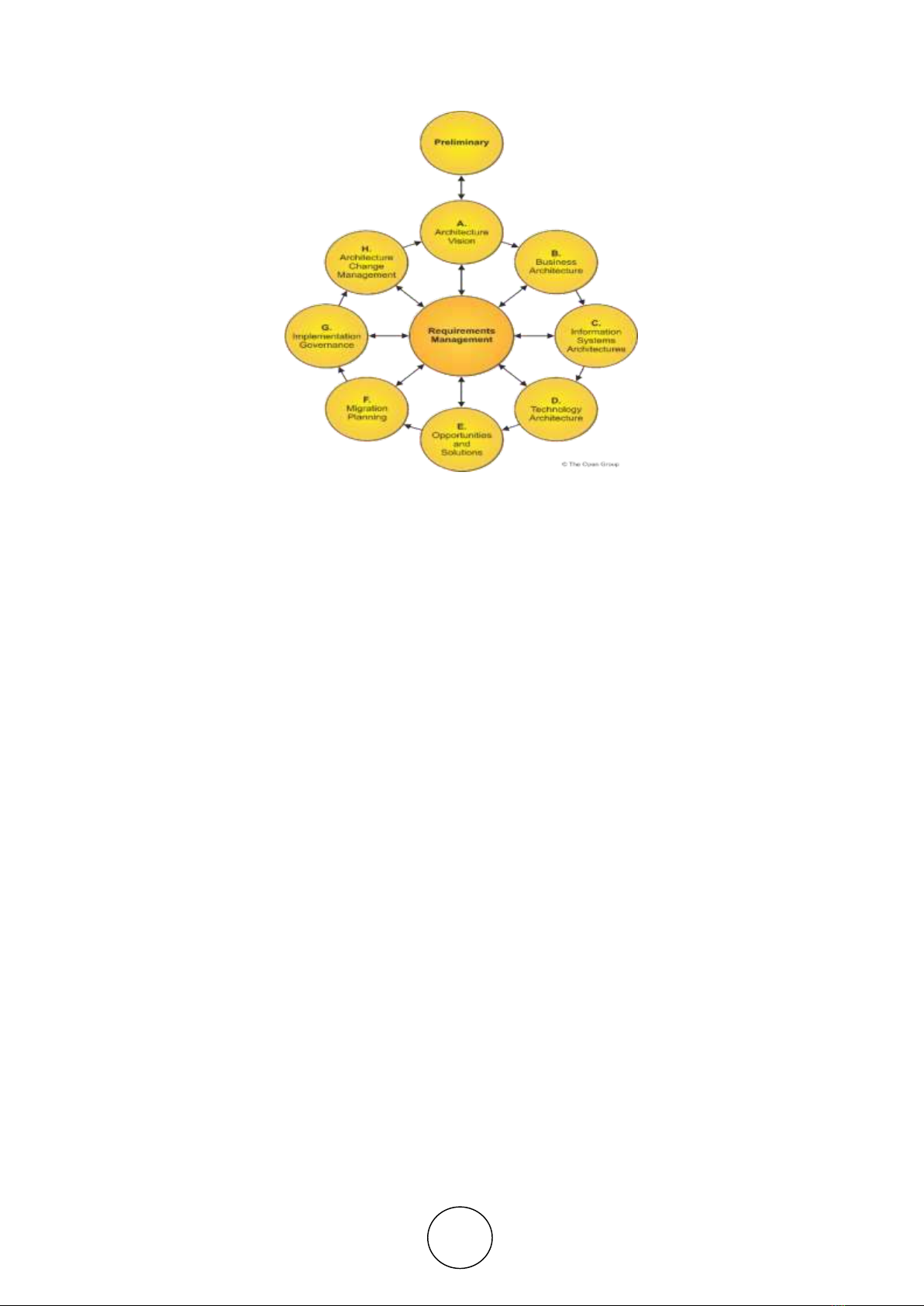
designing IT architecture. The TOGAF consists of three main parts [28]: 1) TOGAF
Architecture Development Method (ADM), 2) Enterprise Continuum and 3) TOGAF Resource
Base. ADM can be said to be a core part of the TOGAF in which there are steps in the form of
cycles and cover the whole part of the development of the IT architecture. ADM steps can be
seen in Figure 1.
Muhammad Arif Abdul Hakim, Dian Nofita Saputri, Riha Rizanah Warang, Sfenrianto
http://www.iaeme.com/IJMET/index.asp 1527 editor@iaeme.com
Figure 1. TOGAF Architecture Development Method (ADM) [29]
The design of IT architecture is aimed at building an adaptive IT infrastructure to adapt to
the rapidly changing business world [30] and forming Enterprise Application Integration (EAI)
[31]. To achieve these two things, there are several IT solutions that can be applied, among
others, with SOA and ERP.
SOA is an approach to building an IT system in the form of parts of a software module
called service. The purpose of developing SOA-based systems is for organizations to develop
systems from simpler modules [28]. Whereas ERP is a system that integrates between design,
management, and all organizational resources which aims to integrate all functional areas of
the organization and get the right flow of information between one functional area and another
functional area [32].
This study took a case study of one IT provider company with the aim of creating a blueprint
for the design of IT architectures to automate business processes at the enterprise level. Current
conditions of the company's architecture include; non-adaptive infrastructure, applications that
are currently silo and do not support the needs of overall business processes and some of the
existing business processes are still done manually so that the process takes a long time. The
application of business process automation is an effort to improve the competitiveness and
excellence of the company through information system strategic planning.
3. THEORETICAL FRAMEWORK
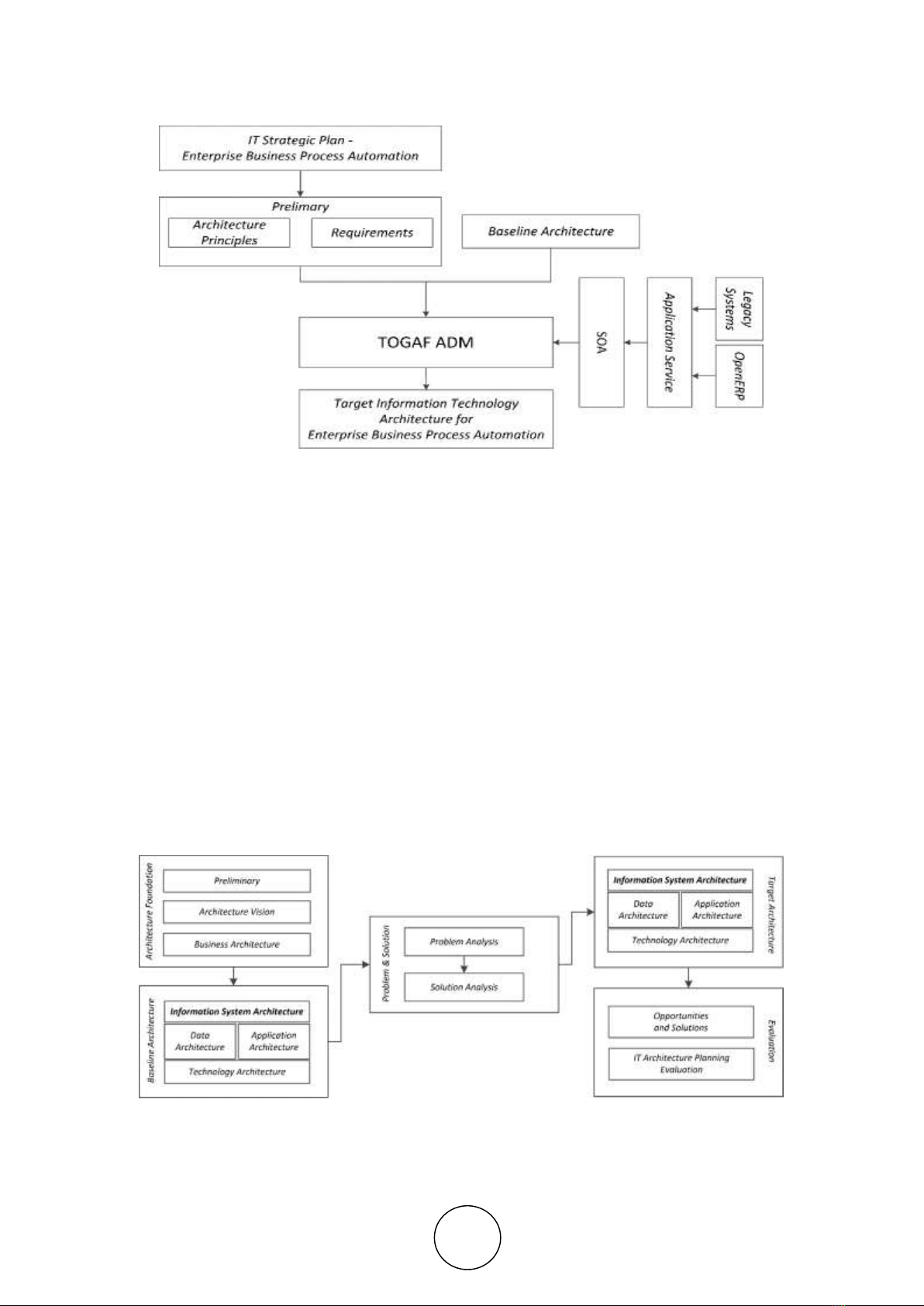
Theoretical framework built in this study relates to the design of IT architectures to automate
enterprise-level business processes that are part of the company's IT strategic plan. The design
of the IT architecture in this study used the TOGAF ADM framework as a guide to work steps
in making a blueprint. The results of this study are in the form of an IT architecture design
summarized in the target IT architecture to answer the need of automating business processes
at the enterprise level. An overview of the theoretical framework can be seen in Figure 2.
Information Technology Architecture Design to Automate Enterprise Business Process Using
TOGAF ADM
http://www.iaeme.com/IJMET/index.asp 1528 editor@iaeme.com
Figure 2 Theoretical Framework
The preliminary phase of TOGAF ADM in designing the IT architecture is to determine the
architecture principles and requirements of the company to achieve the organization's vision
and mission which is then followed by steps in TOGAF ADM. The SOA approach applied at
the architectural design stage is one of the IT solutions for application integration. This will
affect the design of IT architecture both in terms of information systems, technology and
infrastructure used. SOA designs that are made are influenced by services created to support
application integration that is formed from the legacy system or from solutions to application
systems by implementing an ERP module that is open source.
4. METHODOLOGY
This study uses TOGAF ADM as a framework for designing IT architectures. Research is
limited to the design stage, not to the implementation stage. The step in designing the IT
architecture with the TOGAF ADM framework is done through an iterative approach that
defines baseline architecture first, then continues with designing the target architecture. The
presentation of the TOGAF ADM steps used in the study is more easily divided into 5 sections
of the discussion, with illustrations of the flow from the design in Figure 3.
Figure 3 TOGAF ADM Activity in this study
Muhammad Arif Abdul Hakim, Dian Nofita Saputri, Riha Rizanah Warang, Sfenrianto
http://www.iaeme.com/IJMET/index.asp 1529 editor@iaeme.com
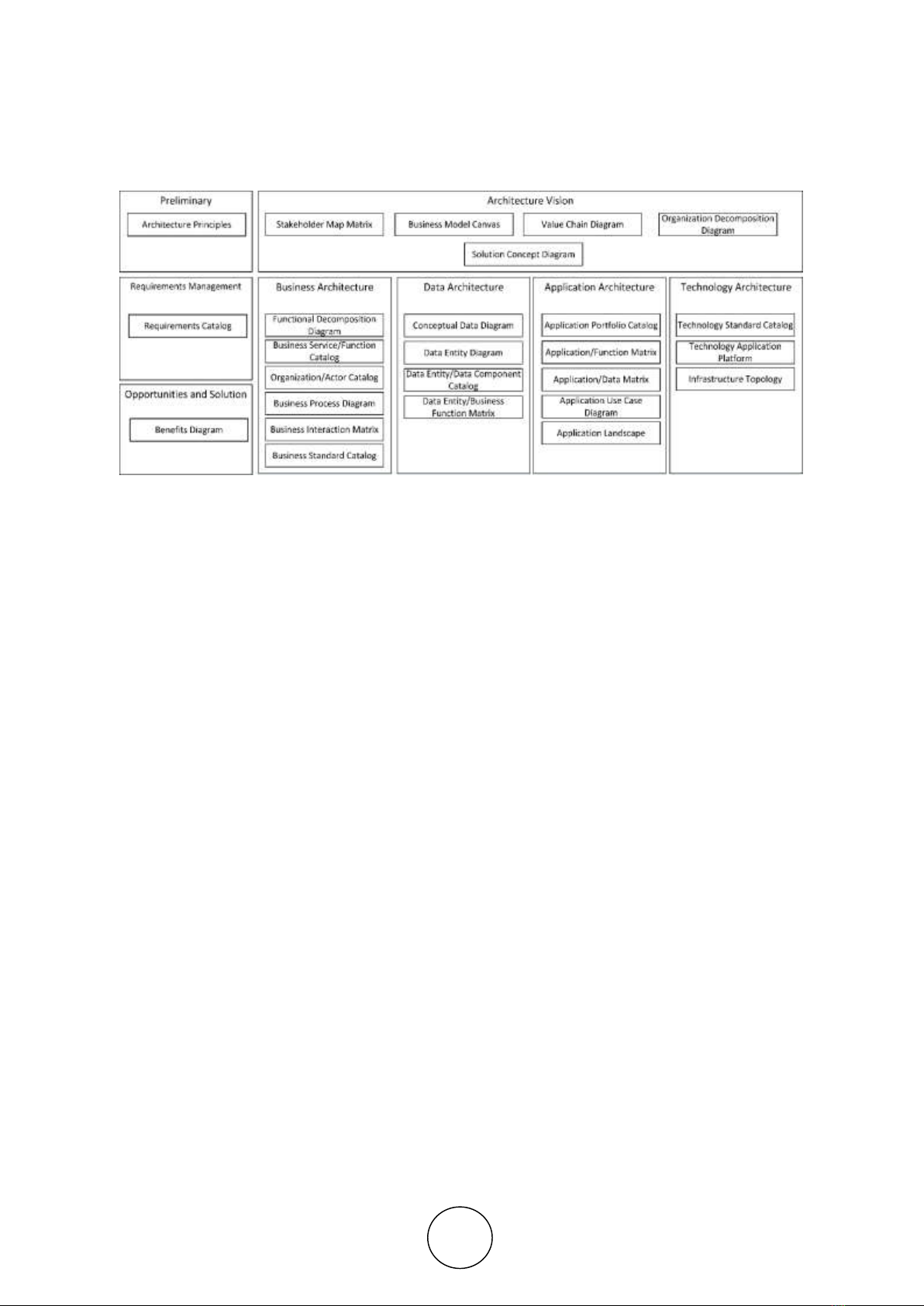
In the TOGAF ADM framework, each phase will obtain artifacts in the form of output
produced during the process of developing enterprise architecture. The output can be text or
table, diagram, matrix or catalog. Figure 4 presents the TOGAF ADM artifact used in the study.
Figure 4 TOGAF ADM artefacts in this study
5. RESULTS AND DISCUSSIONS
In this study the design of IT architecture follows the steps set out in the methodology. The
preliminary stage is the initial stage of designing the IT architecture on TOGAF ADM, which
consists of requirements management and architectural principles. Requirements management,
describing the underlying objectives, needs to be done in the enterprise business process
automation, including: 1) Achieving economies of scale; 2) Achieving excel service; 3)
Achieving digital collaboration; 4) Improving company wide monitoring; 5) Achievement of
predetermined KPIs. The business needs to achieve these objectives include: 1) Having an
adaptive IT infrastructure; 2) Integrated application system; 3) Automation of business
processes; 4) Data sources can be synchronized and used together; 5) Having a robust IT
architecture design using standard best practices. While the architectural principles set out in
the design of the IT architecture to create the concept of business process automation consist
of: 1) Design for Change; 2) Agility and Flexibility; 3) Business Continuity; 4) Integrated
Process; 5) Corporate Data Model; 6) Secure Information; 7) Meet Business Needs; 8) Ease of
Use; 9) Service Orientation; 10) Reusability; 11) Identity and Access Management; and 12)
Interoperability. The architectural principles that have been defined above are supporters of
what is the goal in designing this IT architecture.
Furthermore, at the stage of architecture vision, the solution to the IT architecture to be
achieved in a high-level and comprehensive manner is illustrated through solution concept
diagrams by displaying current conditions with the conditions to be achieved. Based on the case
study, an illustration of the high-level architecture of the baseline is obtained as illustrated in
Figure 5:
![Hệ thống năng lượng mặt trời: Tư vấn, Lắp đặt và Kinh nghiệm [Năm]](https://cdn.tailieu.vn/images/document/thumbnail/2021/20210611/delvostro13/135x160/2451623421933.jpg)






![Đề thi Động cơ đốt trong kết thúc học phần: Tổng hợp [năm]](https://cdn.tailieu.vn/images/document/thumbnail/2026/20260320/hoabattu2026/135x160/24841774320014.jpg)


