

http://www.iaeme.com/IJM/index.asp 13 editor@iaeme.com
International Journal of Management (IJM)
Volume 8, Issue 1, January – February 2017, pp.13–20, Article ID: IJM_08_01_002
Available online at
http://www.iaeme.com/ijm/issues.asp?JType=IJM&VType=8&IType=1
Journal Impact Factor (2016): 8.1920 (Calculated by GISI) www.jifactor.com
ISSN Print: 0976-6502 and ISSN Online: 0976-6510
© IAEME Publication
A STUDY ON IMPACT OF BARCODE AND RADIO
FREQUENCY IDENTIFICATION TECHNOLOGY ON
MAXIMIZED PRODUCTIVITY IN MANUFACTURING
INDUSTRIES AT SIPCOT, CHENNAI
A. Suresh
Ph.D (P.T) Scholar, Research & Development Centre,
Bharathiar University, Coimbatore, India
Dr. N. Somasundaram
Rtd. Associate Professor & Head, Research Department of Business Administration,
APSA College, Tirupattur, India
ABSTRACT
Bar-code technology has now widespread that many customers take it for granted as this
technology continues to offer infinite benefits in a wide extent of businesses. The theoretical frame
work is intended to gain responses with maximum users about automation and optimization of
production using Barcode and RFID; since there is a limited user of RFID, the researcher was
supposed to go with barcode users only. This study observed the importance and implementation of
Barcode in manufacturing industries, how it works and appreciates productivity, its influence over
the manufacturing chain and about its integration among the different units and frames of this
sector.
Key words: Bar-code, RFID, Barcode in manufacturing industries
Cite this Article: A. Suresh and Dr. N. Somasundaram, A Study on Impact of Barcode and Radio
Frequency Identification Technology on Maximized Productivity in Manufacturing Industries at
Sipcot, Chennai. International Journal of Management, 8(1), 2017, pp. 13–20.
http://www.iaeme.com/IJM/issues.asp?JType=IJM&VType=8&IType=1
1. INTRODUCTION
Bar Code techniques have percolated every module of human lives; it is found in grocery stores, hospitals,
department stores, parcel bookings etc. They become an accepted part of our everyday events. In highly
competitive & innovative environment, manufacturers depend on a well-coordinated chain of rolls to make
their operation work effective. Technology rendered greatest advantage by innovating barcode methods
and later the RFID methods. These two are competing technologies while RFID is highly advanced and
much costlier to the former. This study provides an overview of application betterment of bar coding in
manufacturing industries and how manufacturers consider and employ these technologies to have
optimized productivity on a batch or real-time basis.
http://www.iaeme.com/
IJM
1.1. Bar-
Code & RFID Introduced
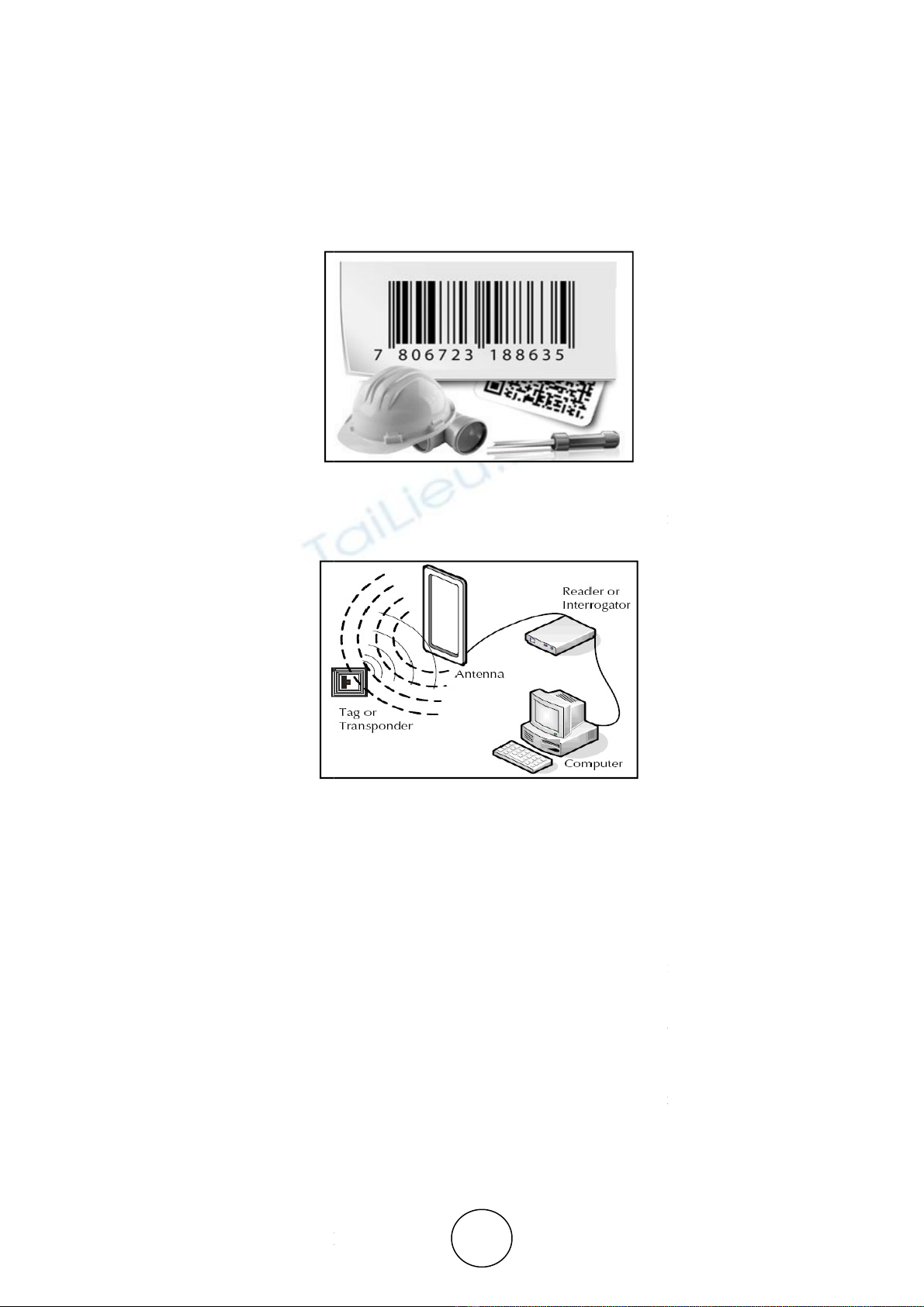
A barcode is an optical, machine
-
about the product or
object that carries the
consists of some narrow bars and some wide
the numbers or characters given
to it. But the actual data
only for references.
Radio frequency
identification (RFID)
identifies the object or person wirelessly, by
distance, unlike barcode technology’s line of sight requirement.
2.
OBJECTIVES OF THE ST
• To study
about the importance of Bar
• To find out major driv
ers for adopting bar
•
To study how it assists manufacturers in process simplification and improve efficiency
•
To evaluate Cost and benefits on implementing the
•
To critically analyze the challenges faced by industries in adopting this technology
•
To offer concrete suggestions to improve bar
3. LIMITATIONS
OF THE
Certain constraints/bottle
necks are unavoidable for which any researcher has to face.
of this study is as follows:
•
Adequate numbers of samples were unable to employ due to time constraint.
• Self-
administered questionnaire is handled as primary data source and thu
information will be less.
•
The views spelt by respondents are their individual experience and perception on bar
the degree of reliability may not be accurate.
A. Suresh and Dr. N. Somasundaram
IJM
/index.asp 14
Code & RFID Introduced
-
scannable, representation
of data; the data usually
object that carries the
barcode. It is constructed with
parallel and adjacent bars. It also
consists of some narrow bars and some wide
bars. The width and height of bar
to it. But the actual data
would be
kept on the bars. These numbers are
identification (RFID)
is a generic definition
, used to define a transmit
identifies the object or person wirelessly, by
enable of radio waves.
RFID identifies the object from a
distance, unlike barcode technology’s line of sight requirement.
OBJECTIVES OF THE ST
UDY
about the importance of Bar
-
Code technology over traditional methods
ers for adopting bar
-coding in manufacturing industries
To study how it assists manufacturers in process simplification and improve efficiency
To evaluate Cost and benefits on implementing the
se technologies
To critically analyze the challenges faced by industries in adopting this technology
To offer concrete suggestions to improve bar
-
code technology on the basis of result of this research
OF THE
STUDY
necks are unavoidable for which any researcher has to face.
Adequate numbers of samples were unable to employ due to time constraint.
administered questionnaire is handled as primary data source and thu
The views spelt by respondents are their individual experience and perception on bar
the degree of reliability may not be accurate.
editor@iaeme.com
of data; the data usually
explains something
parallel and adjacent bars. It also
bars. The width and height of bar
s are declared according to
kept on the bars. These numbers are
, used to define a transmit
ting system that
RFID identifies the object from a
Code technology over traditional methods
To study how it assists manufacturers in process simplification and improve efficiency
To critically analyze the challenges faced by industries in adopting this technology
code technology on the basis of result of this research
necks are unavoidable for which any researcher has to face.
The main limitation
administered questionnaire is handled as primary data source and thu
s probabilities of unbiased
The views spelt by respondents are their individual experience and perception on bar
-code technology. So

A Study on Impact of Barcode and Radio Frequency Identification Technology on Maximized Productivity in
Manufacturing Industries at Sipcot, Chennai
http://www.iaeme.com/IJM/index.asp 15 editor@iaeme.com
• As RFID is not installed in most industries because of its high installation & operational cost, the researcher
is restricted to do survey only to barcode.
• As this study is conducted in Chennai zone, its results cannot be comparable with any other geographic
location
4. BRIEF VIEW OF RESEARCH METHODOLOGY
Survey Plan
Survey Pattern : Exploratory & Descriptive
Target Segment : Industrial Users of Bar-Codes
Sample Size : 310 Respondents
Sample Design : Convenience & Non Probability Sampling
Survey Plot : SIPCOT units, Chennai region
Data Collection Technique
Research Instrument : Primary Data (Questionnaire, Interview-Schedule)
Response Mode : Through Personal Interaction
Questionnaire Type : Open Ended and Multiple Option Questions
Research : Industrial Survey
Data Analysis : Mathematical Tabulation & Interpretation
4.1. Data Analysis and Interpretation
The primary data i.e. responses were gathered from respondents chosen from SIPCOT units in Chennai
including Irungattukottai, Mappedu, Gummidipoondi, Oragadam, Siruseri, Sriperumpudur.
Table 1 Type of Manufacturing Industry
Industry type No. of respondents Percentage
Automobile 96 31
Consumer durable 73 24
FMCG 65 21
Industrial product 76 25
Total 310 100
Source: Survey data of the researcher
Inference
The highest majority 31% of respondents are from automobile industry, followed by them, 25% deals with
industrial product and 24% from consumer durable. Equal importance has been given to all type of
manufacturing industries in fixing respondents for this study. This shows that the researcher is very
cautious in identifying and selecting right respondents, which would give rise to accurate research results.
Table 2 Factors influencing industries to adopt Bar-Code technology
Factors No. of
respondents Percentage
Clients’ request to provide bar-coded tags 17 5
Real-time data collection 139 45
Production control 61 20
Cost-effective track & trace 93 30
Total 310 100
Source: Survey data of the researcher

A. Suresh and Dr. N. Somasundaram
http://www.iaeme.com/IJM/index.asp 16 editor@iaeme.com
Inference
Majority of 139% of respondents adopt bar-code technology because of its real-time data collection. About
93% of industrialists prefer for its cost-effective track & trace. The least of 17% of respondents adopts
because of the demand of client customers.
Table 3 Industrialists’ Choice Selection factors of Bar-Codes over Manual methods
Reasons to adopt bar-codes
Bar-Code method Manual method
No. of
respondents
% of
respondents
No. of
respondents
% of
respondents
Precise Information Tracking 276 89 34 11
Recording inventory data 241 78 69 22
Picking raw material when in work
orders 193 62 117 38
Tracking Work-in-Process (WIP) 294 95 16 5
Unique Product Identification 253 82 57 18
Recording transfer of product to
shipping department 302 97 8 3
JIT Operations 297 96 13 4
Swift Product searching 282 91 28 9
No. of respondents (in average) 267 86 43 14
Source: Survey data of the researcher
Inference
When studied the various factors for respondents to choose bar-code methods over manual methods, an
average of 86% of respondents supported bar-codes for precise information tracking, recording transfer of
product to shipping department etc. A minimum of 14% respondents opine that even though they have
shifted from manual methods, they can’t consider manual methods an absolute one and it has its own
advantage.
Table 4 Respondents’ impression on performance standards of bar-coding
Performance standard
Impression level on performance
Highly
impressed
Just
Impressed
Not
impressed
Fixing codes 259 48 3
Scanning codes using scanners 243 53 14
Decoding and recognizing barcode symbology 277 30 3
Items log at Receiving dock 230 51 29
Automatic data transfer to host computer 286 18 6
No. of respondents (in average) 259 40 11
Source: Survey data of the researcher
Inference
An average of 259 of respondents is highly impressed with overall performance standards. In particular,
230 of the total respondents are highly impressed with working of bar-codes in receiving dock, as because;

A Study on Impact of Barcode and Radio Frequency Identification Technology on Maximized Productivity in
Manufacturing Industries at Sipcot, Chennai
http://www.iaeme.com/IJM/index.asp 17 editor@iaeme.com
item log in receiving department is a crucial task and is simplified by bar-codes and bar-code scanners.
Decoding and recognizing barcode symbology has got second place in impressing respondents.
Table 5 Respondents’ opinion on high price tag
Opinion No. of
respondents
% of
respondents
Affordable 218 70
High, but it is worthy 73 24
Very high 19 6
Total 310 100
Source: Survey data of the researcher
Inference
Majority of 70% of respondents consider cost of price tag as affordable. About 24% respondents said that
though the cost is high, it is worth because of its meritorious features. A very few of 6% of respondents
feel high to bear the cost.
Table 6 Respondents’ Perception on Time Management Using Bar-Codes
Benefits
Perception Level Total
High Average Low
Ease of in-house material handling 192 115 3 310
Quick gauge of in & out shipments 224 84 2 310
Tracking dispatched equipment 219 90 1 310
Track supply lines 231 77 2 310
No. of respondents (in average) 216 92 2.0 310
Source: Survey data of the researcher
Inference
An average of 216 have high perception on Decoding and recognizing barcode symbology, quick gauge of
in & out shipments, tracking dispatched equipment, track supply lines. About 91.5 responses feel average
on the above said factors.
Table 7 Impact of bar-code technology on productivity
Impact %
Increased Decreased
No. of
Respondents
% of
Respondents
No. of
Respondents
% of
Respondents
Upto 10% 211 68 - -
10 to 20% 73 24 - -
20 to 30% 19 6 - -
Above 30% 7 2 - -
Total 310 100 - -
Source: Survey data of the researcher
Inference
A high majority of 68% industrial respondents agreed that their production level has been raised in terms
of output units from 1% to 10% post implementing bar-code technology. About 24% of respondents gained
10 to 20% increased production. And it is really wonder that no respondent has suffered any loss after
turned to bar-code technology.
![Hệ thống năng lượng mặt trời: Tư vấn, Lắp đặt và Kinh nghiệm [Năm]](https://cdn.tailieu.vn/images/document/thumbnail/2021/20210611/delvostro13/135x160/2451623421933.jpg)









![Đề thi Động cơ đốt trong kết thúc học phần: Tổng hợp [năm]](https://cdn.tailieu.vn/images/document/thumbnail/2026/20260320/hoabattu2026/135x160/24841774320014.jpg)


