

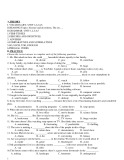
ÔN T P KI M TRA 1 TI T L N 1 H C K IẬ Ể Ế Ầ Ọ Ỳ
TI NG ANH L P 10Ế Ớ
UNIT 1 –3
Mark the letter A, B, C, or D to indicate the word whose underlined part is pronounced
differently from that of the rest in each of the following questions.
Question 1: A like B bit C minute D hit
Question 2: A putB study C but D subject
Question 3: A beat B eating C teacher D breakfast
Mark the letter A, B, C, or D on your answer sheet to indicate the correct answer to each of the
following questions.
Question 4: I go home after work, I usually ____ a short rest, watch TV or listen to the radio.
A take B get C give D spend
Question 5: We woke up at the midnight because the alarm clock suddenly ________.
A exploded B shouted C stood up D went off
Question 6: Miss Jane_________ typing the report when her boss came in.
A doesn’t finish B can’t finish C didn’t finish D hadn’t finished
Question 7: In 1660, Isaac Newton _________to Cambridge University.
A went B had gone C has gone D goes
Question 8: She stays at home because she feels ___________.
A well B sick C fine D strong.
Question 9: Lan: “ Good afternoon !” Nam: “_______________”
A Hello. How are you? B Goodbye. See you later.
C Nice to meet you? D Bye.
Question 10: John often goes to bed early and________ up late.
A to get B got C get D gets
Read the text below and choose the correct word / phrase for each space.
English is a very useful language. If we ___(11)____ English, we can go to any countries we
like. We will not find it hard to make people understand ___(12)___we want to say. English also helps
us to learn all kinds of ___(13)___ . Hundreds of books are written in English every day in __(14)___
countries. English has also helped us to spread ideas and knowledge to all corners of the world.
Therefore, English __(15)___ has helped to spread better understanding and friendship among
countries of the world.
Question 11: A do B want C know D work
Question 12: A when B who C where D what
Question 13: A teachers B people C subjects D friends
Question 14: A the B a C many D much
Question 15: A nation B knowledge C language D countries
Mark the letter A, B, C, or D to indicate the correct answer to each of the following questions.
Question 16: I enjoy __________ to my classmates about their future plans
A told B to talk C talking D talk
Question 17: Maria had gone to the market _________ she got home.
A as soon as B before C after D when
Question 18: Please remember __________ this exercise first, Jane.
A do B to do C doing D to be doing
Question 19: She always goes for a walk with her dog ________ Sunday mornings.
A in B on C at D during
Question 20: She can_________four foreign languages.
A speak B talk C say D tell
1
t

Question 21: I think you don’t have to ________ about your test.
A study B worry C narrow D crowded.
Question 22: We are too late. The plane ___________ off ten minutes ago.
A had taken B took C take D has taken
Question 23: It's not good to avoid____________ the teacher's questions in class.
A answer B answered C to answer D answering
Question 24: During the break I often drink tea_________ my friends.
A from B with C for D to
Read the following passage then do the exercises.
Every morning I get up at six. The first thing I do is to wash my dishes. Then I cook breakfast. I
have breakfast at about seven fifteen a.m.
It takes me about ten minutes to walk to school, and school begins the lesson at seven forty-five.
There are fourty pupils in my class. We study Maths, Geography, History, Music, and English. I like
English best and next to that, Maths. At ten a.m we have a chance to eat an orange and some peanuts.
I go home for lunch, but this time, my sister Patricia gets the meals. After lunch, I usually sleep
for half an hour. In the afternoon, we play tennis.
At about six or six thirty we have dinner. Either my sister or I cook it. The meal is simpler than
the mid-day meal. We eat fruit or rice, and sometimes we have bread and tea. Then in the evening, I do
my homework and go to bed at ten p.m.
* Decide the statements are True ( T) or False ( F ). T F
1. I have breakfast at about seven fifteen minutes.
2. It takes me about seven forty-five minutes to walk to school.
3. I have dinner and eat fruit or rice, sometimes bread and tea.
* Answer the following questions:
4. What is the first thing the girl does when she gets up?
……………………………………………………………………………………………………
5. Which subjects does she like best at school?
……………………………………………………………………………………………………
6. What does she do before going to bed?
……………………………………………………………………………………………………
WRITING (2.5ms)
* Rewrite these sentences base on available information
1, Jackson/ born/ 18th, March, 1993/ Canada.
……………………………………………………………………………………..
2, Everyday/ he/ get / 7.00 am.
………………………………………………………………………………………..
3, He/ go / fish/ his friends/ last weekend.
………………………………………………………………………………………..
4, He/ be/ good at/ play/ piano/ guitar.
…………………………………………………………………………………………
5, , .............................................................................................................. ?
I have stayed here for 5 days.
2
t

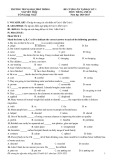
………………… HIGH SCHOOL
FOREIGN LANGUAGE GROUP
Name:________________________.
Class: 10______
THE ENGLISH TEST
No 1
Marks Teacher’s remarks
Câu 1. Choïn töø hoaëc cuïm töø thích hôïp ( A,B,C,D) ñeå hoaøn thaønh caâu
sau:
Don't forget ______ the letter I gave you.
A. post up B. posting C. to post D. post
Câu 2. Choïn töø hoaëc cuïm töø thích hôïp ( A,B,C,D) ñeå hoaøn thaønh caâu
sau:
I'm going to the library to borrow some books.
Sorry, I've got to go, ______!
A. good morning B. not at all C. see you later D. thank you
Câu 3. Choïn töø hoaëc cuïm töø thích hôïp ( A,B,C,D) ñeå hoaøn thaønh caâu
sau:
I ______ to visit my friend in the hospital two days ago.
A. went B. go C. am going D. have gone
Câu 4. Choïn töø hoaëc cuïm töø thích hôïp ( A,B,C,D) ñeå hoaøn thaønh caâu
sau:
She was ______ a Nobel Prize in Chemistry.
A. received B. got C. rewarded D. awarded
Câu 5. Choïn töø maø phaàn gaïch chaân coù caùch phaùt aâm khaùc vôùi caùc
töø coøn laïi:
A. study B. lunch C. humour D. subject
Câu 6. Choïn töø hoaëc cuïm töø thích hôïp ( A,B,C,D) ñeå hoaøn thaønh caâu
sau:
She received some ______ training from her father.
A. scientific B. scientist C. scientists D. science
Câu 7. Choïn töø hoaëc cuïm töø thích hôïp ( A,B,C,D) ñeå hoaøn thaønh caâu
sau:
He forgets ______ my book last week.
A. borrowed B. borrowing C. to borrow D. borrow
Câu 8. Choïn töø hoaëc cuïm töø thích hôïp ( A,B,C,D) ñeå hoaøn thaønh caâu
sau:
Remember ______ to me soon.
A. wrote B. write C. to write D. writing
Câu 9. Choïn töø coù daáu nhaán khaùc vôùi caùc töø coøn laò:
A. subject B. complain C. party D. teaching
Câu 10. Choïn töø hoaëc cuïm töø thích hôïp ( A,B,C,D) ñeå hoaøn thaønh caâu
sau:
Marie Curie was the first woman ______ at the Sorbonne.
A. chemist B. teacher C. professor D. tutor
Câu 11. Choïn töø hoaëc cuïm töø thích hôïp ( A,B,C,D) ñeå hoaøn thaønh caâu
sau:
She ______ French for more than 10 years.
A. has taught B. taught C. teach D. is teaching
Câu 12. Choïn töø hoaëc cuïm töø thích hôïp ( A,B,C,D) ñeå hoaøn thaønh caâu
sau:
______ did you see him ?
I saw him two days ago.
A. which B. why C. what D. when
Câu 13. Choïn töø coù daáu nhaán khaùc vôùi caùc töø coøn laò:
A. student B. attract C. suppose D. discuss
Câu 14. Choïn töø hoaëc cuïm töø thích hôïp ( A,B,C,D) ñeå hoaøn thaønh caâu
sau:
3
t

He lets his wife do everything for him. He's very ______ .
A. careful B. quiet C. bored D. lazy
Câu 15. Choïn töø hoaëc cuïm töø thích hôïp ( A,B,C,D) ñeå hoaøn thaønh caâu
sau:
My teacher ______ reading newspaper.
A. likes B. needs C. would like D. wants
Câu 16. Choïn töø hoaëc cuïm töø thích hôïp ( A,B,C,D) ñeå hoaøn thaønh caâu
sau:
Look ! Smoke ______ out of that window.
A. comes B. is coming C. come D. came
Câu 17. Choïn töø hoaëc cuïm töø thích hôïp ( A,B,C,D) ñeå hoaøn thaønh caâu
sau:
I am very sorry for ______ late.
A. be B. being C. to be D. been
Câu 18. Choïn töø hoaëc cuïm töø thích hôïp ( A,B,C,D) ñeå hoaøn thaønh caâu
sau:
______ French do you understand ? Quite a lot actually.
A. How old B. How many C. How often D. How much
Câu 19. Choïn töø hoaëc cuïm töø thích hôïp ( A,B,C,D) ñeå hoaøn thaønh caâu
sau:
Tom ______ the house before his friend came to see him.
A. leaves B. has left C. left D. had left
Câu 20. Choïn töø maø phaàn gaïch chaân coù caùch phaùt aâm khaùc vôùi caùc
töø coøn laïi:
A. ride B. fifty C. kike D. bike
READING (1.25 ms)
* Read the passage below and choose one correct answer for each sentence.
Edison’s first great interest was chemistry and he read all he could find about it. He was
only ten when he began to grow and sell vegetables so that he could have money to buy
chemicals for making experiments. When he was fifteen, he got a job selling magazines and
fruit on a train and began printing a weekly newspaper on the printing press set up in the
luggage van. But one day, one of his bottles of chemicals broke and set fire to the van. He was
put off the train and lost the job.
1, What was Edison greatly interested in?
A. studying chemistry B. growing vegetables
C. selling magazines D. selling vegetable
2, The word “buy” has the nearest meaning with………
A. establish B. produce C. purchase D. harbour
3, He needed money……………
A. to buy chemicals for experiments B. to grow vegetables
C. to set fire to the van D. to print a weekly magazine
4, He was put off and lost the job because………………
A. he set up the printing press B. he began printing a weekly newspaper
C. he sold magazines and fruit on a train D. he carelessly set fire to the train
5, Which sentence is NOT TRUE?
A. Edison is interested in chemistry.
B. He printed his weekly newspaper in the coffee shop.
C. He began to grow and sell vegetables in very young age.
D. He sold magazines when he was 15 ages.
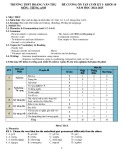
………….. HIGH SCHOOL THE ENGLISH TEST Marks Teacher’s remarks
4
t

FOREIGN LANGUAGE GROUP
Name:________________________.
Class: 10______
No 1
I. PHONETICS
* Choose the word in each group that has the underlined part pronounce differently from the rest.
1. A. thi
nk B. bi
ke C. li
ght D. ni
ght
2. A. card B. start C. warm D. hard
* Choose a word in each line that has different stress pattern.
3. A. happy B. background C. arrive D. student
4. A. location B. personal C. brilliant D. memory
II. VOCABULARY AND GRAMMAR
* Choose the one word or phrase (A, B, C or D) that best completes the sentences or substitutes for
the underlined words or phrases.
5. The…………of our country helps upgrade the citizen’s living standard.
A. develop B. development C. developer D. undeveloped
6. Anna is considered as one of the most brilliant student in her class.
A. lazy B. famous C. popular D. intelligent
7. Peter’s mother is cooking dinner in the………..
A. kitchen B. bath room C. garden D. dining room
8. The students are talking…………their next examination.
A. in B. on C. about D. at
9. “What do you want to drink?” – “……………”
A. A cup of coffee, please. B. I want a comic book.
C. No, I don’t like cake. D. I love to go camping.
10. “…………do you get up every day?” – “Exactly at 6.00 am”
A. Who B. What C. What time D. How
11. He advises us…………..early to the musical concert.
A. come B. to come C. to came D. coming
12. He always avoids…………..his friends in the street.
A. meeting B. met C. to meet D. meet
13. Before you…………, I……………..all the work.
A. come/ do B. come / had done C. came / did D. came/ had done
14. George…………to the movies very often.
A. not go B. don’t go C. doesn’t go D. not to
15. Whenever you come to London, remember calling me.
A B C D
Reading: Choose the best word or phrases to complete the spaces:
Mr. Clark ... (1) … a doctor. He ... (2) … married and ... (3) … in a small home. Every morning
he ... (4) … at 7.15 but he ... (5) … up until 7. 30. He ... (6) … a shower and ... (7) … dressed. After
breakfast he ... (8) … his teeth. He ... (9) … the house at eight o’clock and ... (10) … the 8.15 train to
his hospital.
1. a. is b. be c. has been d. was
2. a. has b. was d. gets d. is not
3. a. living b. live c. lives d. lived
4. a. wakes b. woke c. woken d. waking
5. a. gets b. doesn’t get c. not gets d. not get
6. a. having b. have c. had d. has
7. a. got b. gets c. getting d. is getting
8. a. clean b. brushes c. washing up d. clear
9. a. leaves b. leaved c. left d. leave
10. a. catching b. caught c. catches d. catch
5
t




%20--%3e%3cdefs%3e%3cstyle%3e%20.st0%20{%20fill:%20%23fff;%20}%20.st1%20{%20fill:%20%237800fa;%20}%20%3c/style%3e%3c/defs%3e%3cpath%20class='st1'%20d='M117.78,12.18H43.11c2.9,3.47,4.65,7.94,4.65,12.82,0,5.6-2.3,10.66-6.01,14.29h76.02l7.22-13.56-7.22-13.56Z'/%3e%3cg%3e%3cpath%20class='st0'%20d='M53.58,26.17h-.59v-1.46h.59v-4.96h2.83c1.78,0,2.67.94,2.67,2.82v5.76c0,1.87-.89,2.81-2.67,2.81h-2.83v-4.96ZM55.36,21.37v3.34h1.1v1.46h-1.1v3.34h1.01c.61,0,.91-.37.91-1.1v-5.93c0-.74-.3-1.1-.91-1.1h-1.01Z'/%3e%3cpath%20class='st0'%20d='M65.99,31.14h-1.8l-.31-2.07h-2.19l-.31,2.07h-1.64l1.82-11.39h2.62l1.82,11.39ZM65.28,18.04c-.25.46-.51.77-.75.94-.21.15-.47.22-.79.22-.26,0-.57-.07-.92-.22l-.38-.15c-.14-.05-.26-.07-.37-.07-.3,0-.53.18-.71.54l-.91-.68c.25-.46.51-.77.75-.94.21-.14.48-.21.79-.21.26,0,.57.07.92.21l.38.15c.14.05.26.07.37.07.3,0,.53-.18.71-.54l.91.68ZM61.91,27.52h1.73l-.87-5.76-.87,5.76Z'/%3e%3cpath%20class='st0'%20d='M74.53,26.89v1.52c0,1.91-.89,2.86-2.67,2.86s-2.67-.95-2.67-2.86v-5.93c0-1.91.89-2.86,2.67-2.86s2.67.95,2.67,2.86v1.11h-1.69v-1.22c0-.75-.31-1.12-.93-1.12s-.93.37-.93,1.12v6.15c0,.74.31,1.11.93,1.11s.93-.37.93-1.11v-1.63h1.69Z'/%3e%3cpath%20class='st0'%20d='M81.4,31.14h-1.8l-.31-2.07h-2.19l-.31,2.07h-1.64l1.82-11.39h2.62l1.82,11.39ZM75.9,19.2l1.52-1.91h1.71l1.51,1.91h-1.61l-.76-.95-.75.95h-1.61ZM77.32,27.52h1.73l-.87-5.76-.87,5.76ZM83.1,15.99l-1.76,1.91h-1.26l1.17-1.91h1.86Z'/%3e%3cpath%20class='st0'%20d='M84.86,19.75c1.78,0,2.67.94,2.67,2.82v1.48c0,1.87-.89,2.81-2.67,2.81h-.85v4.28h-1.79v-11.39h2.64ZM84.01,21.37v3.86h.85c.58,0,.87-.36.87-1.08v-1.71c0-.71-.29-1.07-.87-1.07h-.85Z'/%3e%3cpath%20class='st0'%20d='M93.51,19.75c1.78,0,2.67.94,2.67,2.82v1.48c0,1.87-.89,2.81-2.67,2.81h-.85v4.28h-1.79v-11.39h2.64ZM92.66,21.37v3.86h.85c.58,0,.87-.36.87-1.08v-1.71c0-.71-.29-1.07-.87-1.07h-.85Z'/%3e%3cpath%20class='st0'%20d='M98.8,31.14h-1.79v-11.39h1.79v4.88h2.03v-4.88h1.83v11.39h-1.83v-4.88h-2.03v4.88Z'/%3e%3cpath%20class='st0'%20d='M105.36,24.55h2.46v1.62h-2.46v3.34h3.09v1.63h-4.88v-11.39h4.88v1.63h-3.09v3.18ZM108.17,17.29l-1.76,1.91h-1.26l1.17-1.91h1.86Z'/%3e%3cpath%20class='st0'%20d='M112.2,19.75c1.78,0,2.67.94,2.67,2.82v1.48c0,1.87-.89,2.81-2.67,2.81h-.85v4.28h-1.79v-11.39h2.64ZM111.35,21.37v3.86h.85c.58,0,.87-.36.87-1.08v-1.71c0-.71-.29-1.07-.87-1.07h-.85Z'/%3e%3c/g%3e%3ccircle%20class='st1'%20cx='25'%20cy='25'%20r='20'/%3e%3cpath%20class='st0'%20d='M32.78,19.27c2.92,0,4.43,2.55,5.28,5.33l.71,2.17c.14.38-.33.75-.71.75h-5.61c.19-.33.24-.71.09-1.08l-.75-2.45c-.43-1.32-.99-2.64-1.79-3.77.75-.57,1.65-.94,2.78-.94h0ZM25,18.38c3.25,0,4.9,2.78,5.89,5.89l.76,2.45c.14.42-.33.8-.8.8h-11.69c-.42,0-.94-.38-.8-.8l.75-2.45c.99-3.11,2.64-5.89,5.89-5.89h0ZM25,11.35c1.74,0,3.11,1.37,3.11,3.11s-1.37,3.11-3.11,3.11-3.11-1.41-3.11-3.11,1.41-3.11,3.11-3.11h0ZM17.27,19.27c1.08,0,1.98.38,2.73.94-.8,1.13-1.37,2.45-1.74,3.77l-.8,2.45c-.14.38-.05.75.09,1.08h-5.56c-.42,0-.9-.38-.75-.75l.71-2.17c.9-2.78,2.41-5.33,5.33-5.33h0ZM17.27,12.91c1.51,0,2.78,1.27,2.78,2.83s-1.27,2.83-2.78,2.83-2.83-1.27-2.83-2.83,1.27-2.83,2.83-2.83h0ZM32.78,12.91c1.56,0,2.78,1.27,2.78,2.83s-1.23,2.83-2.78,2.83-2.83-1.27-2.83-2.83,1.27-2.83,2.83-2.83h0ZM27.07,28.56v.09c0,.57-.24,1.08-.61,1.46h0v.05c-.38.33-.9.57-1.46.57s-1.08-.24-1.46-.61h0c-.38-.38-.61-.9-.61-1.46v-.09h1.41v.09c0,.19.05.38.19.47v.05c.09.09.28.19.47.19s.38-.09.47-.19v-.05c.14-.09.24-.28.24-.47t-.05-.09h1.41ZM30.99,28.56v.09c0,1.65-.66,3.16-1.74,4.24-1.08,1.08-2.59,1.79-4.24,1.79s-3.16-.71-4.24-1.79l-.05-.05c-1.04-1.08-1.7-2.55-1.7-4.2v-.09h1.41v.09c0,1.27.47,2.4,1.27,3.25h.05c.85.85,1.98,1.37,3.25,1.37s2.4-.52,3.25-1.37c.85-.8,1.37-1.98,1.37-3.25v-.09h1.37ZM34.99,28.56v.09c0,2.78-1.13,5.28-2.92,7.07-1.79,1.79-4.29,2.92-7.07,2.92s-5.23-1.13-7.07-2.92c-1.79-1.79-2.92-4.29-2.92-7.07v-.09h1.41v.09c0,2.4.94,4.53,2.5,6.08,1.56,1.56,3.72,2.5,6.08,2.5s4.52-.94,6.08-2.5c1.56-1.56,2.5-3.68,2.5-6.08v-.09h1.41Z'/%3e%3c/svg%3e)