
Genome sequence of an Australian kangaroo,
Macropus eugenii, provides insight into the
evolution of mammalian reproduction and
development
Renfree et al.
Renfree et al.Genome Biology 2011, 12:R81
http://genomebiology.com/2011/12/8/R81 (29 August 2011)

RESEARCH Open Access
Genome sequence of an Australian kangaroo,
Macropus eugenii, provides insight into the
evolution of mammalian reproduction and
development
Marilyn B Renfree
1,2*†
, Anthony T Papenfuss
1,3,4*†
,JanineEDeakin
1,5
, James Lindsay
6
, Thomas Heider
6
,
Katherine Belov
1,7
, Willem Rens
8
,PaulDWaters
1,5
, Elizabeth A Pharo
2
,GeoffShaw
1,2
,EmilySWWong
1,7
,
Christophe M Lefèvre
9
,KevinRNicholas
9
,YokoKuroki
10
, Matthew J Wakefield
1,3
, Kyall R Zenger
1,7,11
, Chenwei Wang
1,7
,
Malcolm Ferguson-Smith
8
, Frank W Nicholas
7
, Danielle Hickford
1,2
,HongshiYu
1,2
, Kirsty R Short
12
, Hannah V Siddle
1,7
,
Stephen R Frankenberg
1,2
,KengYihChew
1,2
,BrandonRMenzies
1,2,13
, Jessica M Stringer
1,2
, Shunsuke Suzuki
1,2
,
Timothy A Hore
1,14
, Margaret L Delbridge
1,5
,AmirMohammadi
1,5
, Nanette Y Schneider
1,2,15
,YanqiuHu
1,2
,
William O’Hara
6
, Shafagh Al Nadaf
1,5
, Chen Wu
7
, Zhi-Ping Feng
3,16
,BenjaminGCocks
17
, Jianghui Wang
17
,PaulFlicek
18
,
Stephen MJ Searle
19
, Susan Fairley
19
,KathrynBeal
18
,JavierHerrero
18
, Dawn M Carone
6,20
, Yutaka Suzuki
21
,
Sumio Sugano
21
,AtsushiToyoda
22
, Yoshiyuki Sakaki
10
,ShinjiKondo
10
,YuichiroNishida
10
, Shoji Tatsumoto
10
,
Ion Mandiou
23
,ArthurHsu
3,16
, Kaighin A McColl
3
, Benjamin Lansdell
3
, George Weinstock
24
, Elizabeth Kuczek
1,25,26
,
Annette McGrath
25
,PeterWilson
25
, Artem Men
25
, Mehlika Hazar-Rethinam
25
, Allison Hall
25
,JohnDavis
25
,
David Wood
25
, Sarah Williams
25
, Yogi Sundaravadanam
25
,DonnaMMuzny
24
, Shalini N Jhangiani
24
, Lora R Lewis
24
,
Margaret B Morgan
24
, Geoffrey O Okwuonu
24
,SanJuanaRuiz
24
, Jireh Santibanez
24
, Lynne Nazareth
24
,AndrewCree
24
,
Gerald Fowler
24
, Christie L Kovar
24
, Huyen H Dinh
24
,VanditaJoshi
24
,ChynJing
24
, Fremiet Lara
24
, Rebecca Thornton
24
,
Lei Chen
24
, Jixin Deng
24
,YueLiu
24
,JoshuaYShen
24
, Xing-Zhi Song
24
, Janette Edson
25
, Carmen Troon
25
,
Daniel Thomas
25
, Amber Stephens
25
, Lankesha Yapa
25
, Tanya Levchenko
25
, Richard A Gibbs
24
,DesmondWCooper
1,28
,
Terence P Speed
1,3
, Asao Fujiyama
22,27
, Jennifer A M Graves
1,5
,RachelJO’Neill
6
, Andrew J Pask
1,2,6
, Susan M Forrest
1,25
and Kim C Worley
24
Abstract
Background: We present the genome sequence of the tammar wallaby, Macropus eugenii, which is a member of
the kangaroo family and the first representative of the iconic hopping mammals that symbolize Australia to be
sequenced. The tammar has many unusual biological characteristics, including the longest period of embryonic
diapause of any mammal, extremely synchronized seasonal breeding and prolonged and sophisticated lactation
within a well-defined pouch. Like other marsupials, it gives birth to highly altricial young, and has a small number
of very large chromosomes, making it a valuable model for genomics, reproduction and development.
Results: The genome has been sequenced to 2 × coverage using Sanger sequencing, enhanced with additional
next generation sequencing and the integration of extensive physical and linkage maps to build the genome
assembly. We also sequenced the tammar transcriptome across many tissues and developmental time points.
* Correspondence: m.renfree@unimelb.edu.au; papenfuss@wehi.edu.au
†Contributed equally
1
The Australian Research Council Centre of Excellence in Kangaroo
Genomics, Australia
Full list of author information is available at the end of the article
Renfree et al.Genome Biology 2011, 12:R81
http://genomebiology.com/2011/12/8/R81
© 2011 Renfree et al.; licensee BioMed Central Ltd. This is an open access article distributed under the terms of the Creative Commons
Attribution License (http://creativecommons.org/licenses/by/2.0), which permits unrestricted use, distribution, and reproduction in
any medium, provided the original work is properly cited.

Our analyses of these data shed light on mammalian reproduction, development and genome evolution: there is
innovation in reproductive and lactational genes, rapid evolution of germ cell genes, and incomplete, locus-specific
X inactivation. We also observe novel retrotransposons and a highly rearranged major histocompatibility complex,
with many class I genes located outside the complex. Novel microRNAs in the tammar HOX clusters uncover new
potential mammalian HOX regulatory elements.
Conclusions: Analyses of these resources enhance our understanding of marsupial gene evolution, identify
marsupial-specific conserved non-coding elements and critical genes across a range of biological systems,
including reproduction, development and immunity, and provide new insight into marsupial and mammalian
biology and genome evolution.
Background
The tammar wallaby holds a unique place in the natural
history of Australia, for it was the first Australian marsu-
pial discovered, and the first in which its special mode of
reproduction was noted: ‘their manner of procreation is
exceeding strange and highly worth observing; below the
belly the female carries a pouch into which you may put
your hand; inside the pouch are her nipples, and we have
found that the young ones grow up in this pouch with the
nipples in their mouths. We have seen some young ones
lying there, which were only thesizeofabean,thoughat
the same time perfectly proportioned so that it seems cer-
tain that they grow there out of the nipples of the mam-
mae from which they draw their food, until they are
grown up’[1]. These observations were made by Fran-
cisco Pelseart, Captain of the ill-fated and mutinous
Dutch East Indies ship Batavia in 1629, whilst ship-
wrecked on the Abrolhos Islands off the coast of Gerald-
ton in Western Australia. It is therefore appropriate that
the tammar should be the first Australian marsupial sub-
ject to an in-depth genome analysis.
Marsupials are distantly related to eutherian mammals,
having shared a common ancestor between 130 and 148
million years ago [2-4]. The tammar wallaby Macropus
eugenii is a small member of the kangaroo family, the
Macropodidae, within the genus Macropus,whichcom-
prises 14 species [5] (Figure 1). The macropodids are the
most specialized of all marsupials. Mature females weigh
about 5 to 6 kg, and males up to 9 kg. The tammar is
highly abundant in its habitat on Kangaroo Island in
South Australia, and is also found on the Abrolhos
Islands, Garden Island and the Recherche Archipelago,
all in Western Australia, as well as a few small areas in
the south-west corner of the continental mainland. These
populations have been separated for at least 40,000 years.
Its size, availability and ease of handling have made it the
most intensively studied model marsupial for a wide vari-
ety of genetic, developmental, reproductive, physiological,
biochemical, neurobiological and ecological studies
[6-13].
In the wild, female Kangaroo Island tammars have a
highly synchronized breeding cycle and deliver a single
young on or about 22 January (one gestation period
after the longest day in the Southern hemisphere, 21 to
22 December) that remains in the pouch for 9 to 10
months. The mother mates within a few hours after
birth but development of the resulting embryo is
delayed during an 11 month period of suspended anima-
tion (embryonic diapause). Initially diapause is main-
tained by a lactation-mediated inhibition, and in the
second half of the year by photoperiod-mediated inhibi-
tion that is removed as day length decreases [14]. The
anatomy, physiology, embryology, endocrinology and
genetics of the tammar have been described in detail
throughout development [6,11-13,15].
The marsupial mode of reproduction exemplified by
the tammar with a short gestation and a long lactation
does not imply inferiority, nor does it represent a transi-
tory evolutionary stage, as was originally thought. It is a
successful and adaptable lifestyle. The maternal invest-
ment is minimal during the relatively brief pregnancy
and in early lactation, allowing the mother to respond to
altered environmental conditions [11,12,15]. The tam-
mar, like all marsupials, has a fully functional placenta
that makes hormones to modulate pregnancy and par-
turition, control the growth of the young, and provide
signals for the maternal recognition of pregnancy
[14,16-18]. The tammar embryo develops for only 26
days after diapause, and is born when only 16 to 17 mm
long and weighing about 440 mg at a developmental
stage roughly equivalent to a 40-day human or 15-day
mouse embryo. The kidney bean-sized newborn has well-
developed forelimbs that allow it to climb up to the
mother’s pouch, where it attaches to one of four available
teats. It has functional, though not fully developed, olfac-
tory, respiratory, circulatory and digestive systems, but it
is born with an embryonic kidney and undifferentiated
immune, thermoregulatory and reproductive systems, all
of which become functionally differentiated during the
lengthy pouch life. Most major structures and organs,
including the hindlimbs, eyes, gonads and a significant
portion of the brain, differentiate while the young is in
the pouch and are therefore readily available for study
[11,12,19-24]. They also have a sophisticated lactational
Renfree et al.Genome Biology 2011, 12:R81
http://genomebiology.com/2011/12/8/R81
Page 2 of 25
Gondwanaland
South
America
Australia
Didelphidae
Vombatidae
Phascolarctidae
Pseudocheiridae
Macropodidae
Thylacomyidae
Peramelidae
Dasyuridae
Macropodidae
P. xanthopus
T. thetis
M. rufus
M. robustus
M. antilopinus
W. bicolor
M. parma
M. rufogriseus
M. agilis
M. eugenii
0
MnoilliYsraeAog
Mesozoic Cenozoic
146
65
Tarsipedidae (1)
11
0
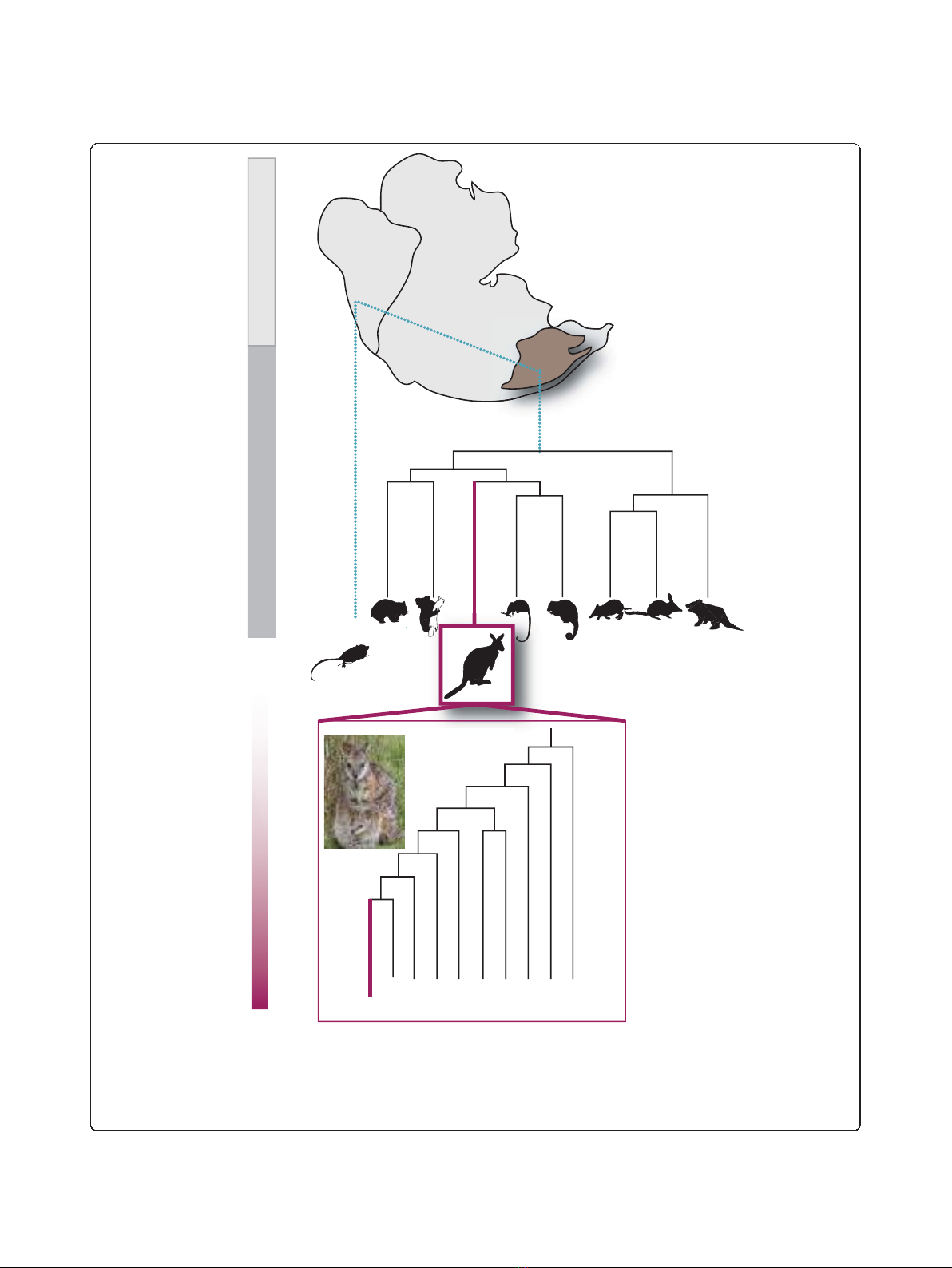
Figure 1 Phylogeny of the marsupials. Phylogenetic relationships of the orders of Marsupialia. Top: the placement of the contemporary
continents of South America and Australia within Gondwanaland and the split of the American and Australian marsupials. Relative divergence in
millions of years shown to the left in the context of geological periods. The relationship of the Macropodide within the Australian marsupial
phylogeny shown is in purple with estimated divergence dates in millions of years [5,162,163]. Representative species from each clade are
illustrated. Inset: phylogeny of the genus Macropus within the Macropodidae showing the placement of the model species M. eugenii (purple)
based on [59]. Outgroup species are Thylogale thetis and Petrogale xanthopus.
Renfree et al.Genome Biology 2011, 12:R81
http://genomebiology.com/2011/12/8/R81
Page 3 of 25

physiology with a milk composition that changes
throughout pouch life, ensuring that nutrient supply is
perfectly matched for each stage of development [25].
Adjacent teats in a pouch can deliver milk of differing
composition appropriate for a pouch young and a young-
at-foot [26].
Kangaroo chromosomes excited some of the earliest
comparative cytological studies of mammals. Like other
kangaroos, the tammar has a low diploid number (2n =
16) and very large chromosomes that are easily distin-
guished by size and morphology. The low diploid number
of marsupials makes it easy to study mitosis, cell cycles
[27], DNA replication [28], radiation sensitivity [29], gen-
ome stability [30], chromosome elimination [31,32] and
chromosome evolution [33,34]. Marsupial sex chromo-
somes are particularly informative. The X and Y chromo-
somes are small; the basic X chromosome constitutes only
3% of the haploid genome (compared with 5% in euther-
ians) and the Y is tiny. Comparative studies show that the
marsupial X and Y are representative of the ancestral
mammalian X and Y chromosomes [35]. However, in the
kangaroos, a large heterochromatic nucleolus organizer
region became fused to the X and Y. Chromosome paint-
ing confirms the extreme conservation of kangaroo chro-
mosomes [36] and their close relationship with karyotypes
of more distantly related marsupials [37-40] so that gen-
ome studies are likely to be highly transferable across mar-
supial species.
The tammar is a member of the Australian marsupial
clade and, as a macropodid marsupial, is maximally diver-
gent from the only other sequenced model marsupial, the
didelphid Brazilian grey short-tailed opossum, Monodel-
phis domestica [41]. The South American and Australasian
marsupials followed independent evolutionary pathways
after the separation of Gondwana into the new continents
of South America and Australia about 80 million years
ago and after the divergence of tammar and opossum
(Figure 1) [2,4]. The Australasian marsupials have many
unique specializations. Detailed knowledge of the biology
of the tammar has informed our interpretation of its gen-
ome and highlighted many novel aspects of marsupial
evolution.
Sequencing and assembly (Meug_1)
ThegenomeofafemaletammarofKangarooIsland,
South Australia origin was sequenced using the whole-
genome shotgun (WGS) approach and Sanger sequen-
cing. DNA isolated from the lung tissue of a single tam-
mar was used to generate WGS libraries with inserts of 2
to6kb(TablesS1andS2inAdditionalfile1).Sanger
DNA sequencing was performed at the Baylor College of
Medicine Human Genome Sequencing Center (BCM-
HGSC), and the Australian Genome Research Facility
using ABI3730xl sequencers (Applied BioSystems, Foster
City, CA, USA). Approximately 10 million Sanger WGS
reads, representing about 2 × sequence coverage, were
submitted to the NCBI trace archives (NCBI BioProject
PRJNA12586; NCBI Taxonomy ID 9315). An additional
5.9 × sequence coverage was generated on an ABI SOLiD
sequencer at BCM-HGSC. These 25-bp paired-end data
with average mate-pair distance of 1.4 kb (Table S3 in
Additional file 1) [SRA:SRX011374] were used to correct
contigs and perform super-scaffolding. The initial tam-
mar genome assembly (Meug_1.0) was constructed using
only the low coverage Sanger sequences. This was then
improved with additional scaffolding using sequences
generated with the ABI SOLiD (Meug_1.1; Table 1;
Tables S4 to S7 in Additional file 1). The Meug_1.1
assembly had a contig N50 of 2.6 kb and a scaffold N50
of 41.8 kb [GenBank:GL044074-GL172636].
The completeness of the assembly was assessed by com-
parison to the available cDNA data. Using 758,062 454
FLX cDNA sequences [SRA:SRX019249, SRA:SRX019250],
76% are found to some extent in the assembly and 30% are
found with more than 80% of their length represented
(Table S6 in Additional file 1). Compared to 14,878 San-
ger-sequenced ESTs [GenBank:EX195538-EX203564, Gen-
Bank:EX203644-EX210452], more than 85% are found in
the assembly with at least one half their length aligned
(Table S7 in Additional file 1).
Table 1 Comparison of Meug genome assemblies
Assembly version
1.0 1.1 2.0
Contigs (million) 1.211 1.174 1.111
N50 (kb) 2.5 2.6 2.91
Bases (Mb) 2546 2,536 2,574
Scaffolds 616,418 277,711 379,858
Max scaffold size NA 472,108 324,751
Gaps (Mb) NA 539 619
N50 (kb) NA 41.8 34.3
Complex scaffolds NA 128,563 124,674
Singleton scaffolds NA 149,148 255,184
Co-linear with BACs NA 87.2% (418) 93.4% (298)
Co-linear with ESTs NA 82.3% (704) 86.7% (454)
Summary statistics for the tammar genome assemblies. These statistics
indicate the extension and merging of contigs done to improve the assembly.
The larger number of scaffolds and smaller scaffold N50 is a consequence of
higher stringency in the 2.0 scaffolding workflow. The higher stringency
isolated many contigs. However, the number of complex (that is, useful)
scaffolds is similar between the assemblies. For co-linear estimates, the
scaffolds were linearized and BACs and cDNA libraries were mapped against
them. The 1.1 and 2.0 assemblies were validated against 169 BAC contigs and
84,718 ESTs (that were not incorporated into either genome assembly). We
determined the percentage of contigs where the scaffolding matched the
order and orientation when compared to BACs or ESTs (co-linear with BACs/
ESTs). Parentheses indicate the total number of contigs identified after
alignment to BAC contigs or ESTs.
Renfree et al.Genome Biology 2011, 12:R81
http://genomebiology.com/2011/12/8/R81
Page 4 of 25






%20--%3e%3cdefs%3e%3cstyle%3e%20.st0%20{%20fill:%20%23fff;%20}%20.st1%20{%20fill:%20%237800fa;%20}%20%3c/style%3e%3c/defs%3e%3cpath%20class='st1'%20d='M117.78,12.18H43.11c2.9,3.47,4.65,7.94,4.65,12.82,0,5.6-2.3,10.66-6.01,14.29h76.02l7.22-13.56-7.22-13.56Z'/%3e%3cg%3e%3cpath%20class='st0'%20d='M53.58,26.17h-.59v-1.46h.59v-4.96h2.83c1.78,0,2.67.94,2.67,2.82v5.76c0,1.87-.89,2.81-2.67,2.81h-2.83v-4.96ZM55.36,21.37v3.34h1.1v1.46h-1.1v3.34h1.01c.61,0,.91-.37.91-1.1v-5.93c0-.74-.3-1.1-.91-1.1h-1.01Z'/%3e%3cpath%20class='st0'%20d='M65.99,31.14h-1.8l-.31-2.07h-2.19l-.31,2.07h-1.64l1.82-11.39h2.62l1.82,11.39ZM65.28,18.04c-.25.46-.51.77-.75.94-.21.15-.47.22-.79.22-.26,0-.57-.07-.92-.22l-.38-.15c-.14-.05-.26-.07-.37-.07-.3,0-.53.18-.71.54l-.91-.68c.25-.46.51-.77.75-.94.21-.14.48-.21.79-.21.26,0,.57.07.92.21l.38.15c.14.05.26.07.37.07.3,0,.53-.18.71-.54l.91.68ZM61.91,27.52h1.73l-.87-5.76-.87,5.76Z'/%3e%3cpath%20class='st0'%20d='M74.53,26.89v1.52c0,1.91-.89,2.86-2.67,2.86s-2.67-.95-2.67-2.86v-5.93c0-1.91.89-2.86,2.67-2.86s2.67.95,2.67,2.86v1.11h-1.69v-1.22c0-.75-.31-1.12-.93-1.12s-.93.37-.93,1.12v6.15c0,.74.31,1.11.93,1.11s.93-.37.93-1.11v-1.63h1.69Z'/%3e%3cpath%20class='st0'%20d='M81.4,31.14h-1.8l-.31-2.07h-2.19l-.31,2.07h-1.64l1.82-11.39h2.62l1.82,11.39ZM75.9,19.2l1.52-1.91h1.71l1.51,1.91h-1.61l-.76-.95-.75.95h-1.61ZM77.32,27.52h1.73l-.87-5.76-.87,5.76ZM83.1,15.99l-1.76,1.91h-1.26l1.17-1.91h1.86Z'/%3e%3cpath%20class='st0'%20d='M84.86,19.75c1.78,0,2.67.94,2.67,2.82v1.48c0,1.87-.89,2.81-2.67,2.81h-.85v4.28h-1.79v-11.39h2.64ZM84.01,21.37v3.86h.85c.58,0,.87-.36.87-1.08v-1.71c0-.71-.29-1.07-.87-1.07h-.85Z'/%3e%3cpath%20class='st0'%20d='M93.51,19.75c1.78,0,2.67.94,2.67,2.82v1.48c0,1.87-.89,2.81-2.67,2.81h-.85v4.28h-1.79v-11.39h2.64ZM92.66,21.37v3.86h.85c.58,0,.87-.36.87-1.08v-1.71c0-.71-.29-1.07-.87-1.07h-.85Z'/%3e%3cpath%20class='st0'%20d='M98.8,31.14h-1.79v-11.39h1.79v4.88h2.03v-4.88h1.83v11.39h-1.83v-4.88h-2.03v4.88Z'/%3e%3cpath%20class='st0'%20d='M105.36,24.55h2.46v1.62h-2.46v3.34h3.09v1.63h-4.88v-11.39h4.88v1.63h-3.09v3.18ZM108.17,17.29l-1.76,1.91h-1.26l1.17-1.91h1.86Z'/%3e%3cpath%20class='st0'%20d='M112.2,19.75c1.78,0,2.67.94,2.67,2.82v1.48c0,1.87-.89,2.81-2.67,2.81h-.85v4.28h-1.79v-11.39h2.64ZM111.35,21.37v3.86h.85c.58,0,.87-.36.87-1.08v-1.71c0-.71-.29-1.07-.87-1.07h-.85Z'/%3e%3c/g%3e%3ccircle%20class='st1'%20cx='25'%20cy='25'%20r='20'/%3e%3cpath%20class='st0'%20d='M32.78,19.27c2.92,0,4.43,2.55,5.28,5.33l.71,2.17c.14.38-.33.75-.71.75h-5.61c.19-.33.24-.71.09-1.08l-.75-2.45c-.43-1.32-.99-2.64-1.79-3.77.75-.57,1.65-.94,2.78-.94h0ZM25,18.38c3.25,0,4.9,2.78,5.89,5.89l.76,2.45c.14.42-.33.8-.8.8h-11.69c-.42,0-.94-.38-.8-.8l.75-2.45c.99-3.11,2.64-5.89,5.89-5.89h0ZM25,11.35c1.74,0,3.11,1.37,3.11,3.11s-1.37,3.11-3.11,3.11-3.11-1.41-3.11-3.11,1.41-3.11,3.11-3.11h0ZM17.27,19.27c1.08,0,1.98.38,2.73.94-.8,1.13-1.37,2.45-1.74,3.77l-.8,2.45c-.14.38-.05.75.09,1.08h-5.56c-.42,0-.9-.38-.75-.75l.71-2.17c.9-2.78,2.41-5.33,5.33-5.33h0ZM17.27,12.91c1.51,0,2.78,1.27,2.78,2.83s-1.27,2.83-2.78,2.83-2.83-1.27-2.83-2.83,1.27-2.83,2.83-2.83h0ZM32.78,12.91c1.56,0,2.78,1.27,2.78,2.83s-1.23,2.83-2.78,2.83-2.83-1.27-2.83-2.83,1.27-2.83,2.83-2.83h0ZM27.07,28.56v.09c0,.57-.24,1.08-.61,1.46h0v.05c-.38.33-.9.57-1.46.57s-1.08-.24-1.46-.61h0c-.38-.38-.61-.9-.61-1.46v-.09h1.41v.09c0,.19.05.38.19.47v.05c.09.09.28.19.47.19s.38-.09.47-.19v-.05c.14-.09.24-.28.24-.47t-.05-.09h1.41ZM30.99,28.56v.09c0,1.65-.66,3.16-1.74,4.24-1.08,1.08-2.59,1.79-4.24,1.79s-3.16-.71-4.24-1.79l-.05-.05c-1.04-1.08-1.7-2.55-1.7-4.2v-.09h1.41v.09c0,1.27.47,2.4,1.27,3.25h.05c.85.85,1.98,1.37,3.25,1.37s2.4-.52,3.25-1.37c.85-.8,1.37-1.98,1.37-3.25v-.09h1.37ZM34.99,28.56v.09c0,2.78-1.13,5.28-2.92,7.07-1.79,1.79-4.29,2.92-7.07,2.92s-5.23-1.13-7.07-2.92c-1.79-1.79-2.92-4.29-2.92-7.07v-.09h1.41v.09c0,2.4.94,4.53,2.5,6.08,1.56,1.56,3.72,2.5,6.08,2.5s4.52-.94,6.08-2.5c1.56-1.56,2.5-3.68,2.5-6.08v-.09h1.41Z'/%3e%3c/svg%3e)