95
TẠP CHÍ KHOA HỌC VÀ CÔNG NGHỆ TRƯỜNG ĐẠI HỌC HÙNG VƯƠNG Tập 11, Số 3 (2025): 95 - 104
*Email: cd.ha@vnu.edu.vn
TẠP CHÍ KHOA HỌC VÀ CÔNG NGHỆ
TRƯỜNG ĐẠI HỌC HÙNG VƯƠNG
Tập 11, Số 3 (2025): 95 - 104
HUNG VUONG UNIVERSITY
JOURNAL OF SCIENCE AND TECHNOLOGY
Vol. 11, No. 3 (2025): 95 - 104
Email: tapchikhoahoc@hvu.edu.vn Website: www.jst.hvu.edu.vn
EVALUATION OF THE EFFECTS OF MAGNETIC FIELD TREATMENT
ON THE GERMINATION AND VEGETATIVE GROWTH
OF SOYBEAN (GLYCINE MAX) IN COLD CONDITIONS
Than Gia Bao1, Nguyen Duc Hai2, Dong Huy Gioi1, La Viet Hong3,
Le Thi Ngoc Quynh4, Chu Duc Ha2*, Le Huy Ham2
1Vietnam National University of Agriculture, Hanoi
2University of Engineering and Technology, Vietnam National University Hanoi, Hanoi
3Hanoi Pedagogical University 2, Phu Tho
4Thuyloi University, Hanoi
Received: 11 September 2025; Revised: 18 Sepember 2025; Accepted: 22 September 2025
DOI: https://doi.org/10.59775/1859-3968.344
Abstract
Soybean (Glycine max L.) is vulnerable to cold stress during germination and early vegetative growth, leading
to poor establishment and reduced productivity. This study examined the potential of static magnetic field
(MF) treatment to enhance cold tolerance in the Vietnamese soybean variety DT84. Seeds were exposed to a
static MF before sowing and evaluated under both optimal and low-temperature conditions. Results showed that
MF treatment improved germination dynamics, reduced abnormal seedlings, and enhanced seedling vigor under
cold stress. During vegetative development, MF-treated plants exhibited greater emergence, improved hypocotyl
elongation, larger leaf area, increased plant height, stronger root systems, higher biomass accumulation, and
greater chlorophyll content compared with untreated controls. Although the treatment did not fully restore
growth to the level observed at optimal temperature, it consistently alleviated the inhibitory effects of cold stress
and narrowed the performance gap across developmental stages. These findings indicate that MF treatment is
a simple, low-cost, and environmentally sustainable approach to improve soybean establishment under cold
conditions and holds promise as a practical strategy for enhancing crop resilience in early-season sowing.
Keywords: Soybean, cold stress, magnetic field, germination and growth.
1. Introduction
Soybean (Glycine max L.) is a strategic
source of plant protein and vegetable oil and
a key component of global food, feed, and
bioeconomy value chains [1]. Successful
stand establishment and early vegetative
growth underpin final yield and quality.
Low temperature threatens these stages in
temperate and subtropical regions and during
early-season cold spells [2]. Cold stress delays
radicle protrusion, slows hypocotyl and root
elongation, and restricts leaf expansion.
Cellular injuries arise from membrane phase
transitions, impaired enzyme kinetics, and
an imbalance between abscisic acid and

96
TẠP CHÍ KHOA HỌC VÀ CÔNG NGHỆ TRƯỜNG ĐẠI HỌC HÙNG VƯƠNG Than Gia Bao et al.
gibberellin. Oxidative stress follows because
reactive oxygen species accumulate faster
than antioxidant systems can remove them.
Photosystem II suffers photoinhibition under
low temperature with light. Nutrient uptake
declines, and phloem loading becomes
inefficient [3]. These processes converge on
weaker seedlings, heterogeneous canopies,
and persistent yield penalties.
Magnetic field exposure represents a
low-cost, non-chemical intervention with
growing evidence in crop science [4].
Both static magnetic fields and pulsed
electromagnetic fields have shown benefits
in cereals, vegetables, and legumes at
intensities commonly between tens and a
few hundred millitesla [5]. Reported effects
include faster water uptake in dry seeds,
higher activities of key hydrolytic and
antioxidant enzymes, improved ion transport,
and enhanced photosynthetic performance
[6]. Mechanistic explanations reference
radical-pair reactions, modulation of calcium
signaling, stabilization of membranes, and
transcriptional shifts in stress-response
pathways. Magnetic pretreatment of seeds
and early seedling exposure integrates
easily with standard nursery or laboratory
protocols, requires modest equipment, and
leaves no chemical residues [7]. Responses
often follow dose and time “windows,”
which underscores the need for crop- and
stage-specific optimization.
The present study investigates whether
exposure to a static magnetic field can mitigate
cold stress in soybeans during germination
and early growth. The objectives are to
quantify effects on germination dynamics,
seedling vigor, root and shoot development,
chlorophyll content, membrane integrity,
and antioxidant status under a defined
low-temperature regime, and to compare
responses between magnetically treated
and untreated controls. We hypothesize that
static magnetic field treatment improves cold
tolerance in soybean and yields measurable
gains in early growth and physiological traits.
2. Method
2.1. Plant material and seed preparation
Seeds of the Vietnamese soybean variety
DT84, developed by the Agricultural
Genetics Institute (Viet Nam) [8], were
used in this study. Certified seed lots were
obtained from a licensed commercial supplier
and produced in the 2023 growing season.
According to the supplier’s certificate, the
seed lot had a laboratory germination rate
of 96% and a moisture content of 10.8% at
the time of purchase. Uniform, undamaged
seeds were selected by visual inspection
before use. Seeds were surface-sterilized
in 70% ethanol for 60 s, then rinsed twice
with sterile distilled water before immersion
in 2% sodium hypochlorite for 10 min as
previously described with minor adjustment
[9]. After disinfection, seeds were rinsed five
times with sterile distilled water to remove
residual chlorine. Excess surface moisture
was blotted off with sterile filter paper, and
seeds were air-dried under sterile laminar
flow for 15 min at room temperature (25
± 1oC) to standardize moisture conditions
before magnetic field exposure. Sterile
distilled water served as the wetting medium
for all pre-sowing procedures.
2.2. Magnetic field treatment
The field strength of the magnetic field
at the seed plane was 150 mT and remained
stable within ± 2 mT, as verified with a
Gaussmeter before each run as recently
reported [10]. Seeds were placed in a single
layer in non-metallic Petri dishes and exposed
for 30 min at room temperature (25 ± 1oC).
Control seeds were placed in identical dishes
outside the field for the same duration.
2.3. Cold stress treatment
Cold stress was imposed at 12oC during
both germination and early seedling growth
as recently described [3] with minor changes.
A programmable growth chamber (Model:

97
TẠP CHÍ KHOA HỌC VÀ CÔNG NGHỆ TRƯỜNG ĐẠI HỌC HÙNG VƯƠNG Tập 11, Số 3 (2025): 95 - 104
MLR-352H, Sanyo/Panasonic Biomedical,
Japan) provided controlled environmental
conditions with 12oC during the dark period
and 14oC during the light period to emulate
a mild diurnal fluctuation. Relative humidity
was maintained at 60 ± 5%, while the control
temperature was 25oC (dark) and 27oC
(light). Photosynthetic photon flux density
was 200 µmol m-2 s-1 at canopy height with
a 14 h light/10 h dark photoperiod. Relative
humidity was continuously monitored using
a digital capacitive humidity probe (Vaisala
HMP110, Finland) integrated into the
chamber’s control system. Calibration was
verified against an external hygrometer (Testo
608-H2, Germany) before each experiment.
Recorded humidity values remained within
the target range throughout all runs, with
maximum deviations not exceeding ±3%.
Measurements were verified prior to each
run using a digital thermocouple array (Testo
176 T4, Germany) positioned at multiple
points across vertical and horizontal planes.
Temperature variation did not exceed ± 1.0°C
for all replicates throughout the experiment.
2.4. Soybean cultivation protocol
Germination occurred in the dark on
moistened, sterile germination paper in 15-cm
Petri dishes. Each dish received 25 seeds and 7
mL sterile water, and papers were kept moist by
periodic addition of sterile water. Germination
counts were recorded every 12 h up to 72 h.
Seedlings that reached a radicle length of at
least 2 mm after 48 hours were transferred to
hydroponic culture. Hydroponic cultivation
was chosen instead of soil because it provided
precise control over nutrient composition,
temperature, and moisture. Seedlings grew in
opaque polypropylene tubs with floating foam
rafts. Each raft had 12 evenly spaced holes that
held inert foam plugs supporting seedlings at
the collar. The nutrient solution contained half-
strength Hoagland medium adjusted to pH
6.0 ± 0.1. Aeration was supplied continuously
through aquarium pumps equipped with sterile
air filters and fine-pore diffusers. Both pH
and electrical conductivity were measured
daily using calibrated meters (HI9811-5,
Hanna Instruments, Italy) and adjusted when
necessary. Electrical conductivity remained
within 1.1 - 1.3 mS cm-1, and the solution
temperature followed the chamber’s settings.
The nutrient solution was replaced every three
days. Seedlings developed to the VE - V2
stages under the specified light and temperature
conditions [11].
2.5. Experimental design and treatment
structure
The study employed a factorial
arrangement with two magnetic field
levels (exposed and unexposed) and two
temperature regimes (cold stress and
control) in a completely randomized design.
Each treatment combination consisted of
four biological replicates. Each replicate
comprised one independent hydroponic pot
block, containing 10 pots per block. Each
block was considered a separate experimental
unit to verify biological independence.
To minimize positional effects within the
growth chamber, all pots were re-randomized
every 48 hours. Environmental parameters,
including temperature, humidity, and light
intensity, were continuously monitored to
confirm uniform exposure across replicates.
Data from individual plants within each
replicate were averaged before statistical
analysis to represent the mean response of
that experimental unit.
2.6. Measurement of germination and
growth parameters
Germination and early growth were
assessed using quantitative parameters that
describe seed vigor, seedling morphology, and
physiological performance under both optimal
and cold stress conditions. All measurements
were performed on four biological replicates
per treatment. The germination percentage
(%) was determined according to the standard

98
TẠP CHÍ KHOA HỌC VÀ CÔNG NGHỆ TRƯỜNG ĐẠI HỌC HÙNG VƯƠNG Than Gia Bao et al.
protocol. Seeds were considered germinated
when the radicle reached at least 2 mm in
length. The percentage was calculated as the
ratio of sprouted seeds to the total number
of seeds sown, multiplied by 100. Mean
germination time (hours) was computed using
the formula below: Mean germination time
= ∑(ni × ti )/ ∑ni, where n₁, n₂,... represent
the number of seeds germinated at each time
interval t₁, t₂,... Germination counts were
recorded every 12 hours up to 72 hours. The
germination index was calculated according
to the formula below: Germination index =
∑ (Gt/Dt), where Gₜ is the number of seeds
germinated on day t and Dₜ is the corresponding
day of counting. Radicle length (mm) wasere
measured 7 days after sowing using a digital
caliper (Mitutoyo 500-196-30, Japan) with a
precision of ±0.01 mm. Measurements were
taken from the seed junction to the radicle tip
and from the seed junction to the shoot apex,
respectively. Next, ten seedlings per replicate
were blotted to remove surface moisture,
and total fresh weight was recorded using
an analytical balance (Sartorius Entris II,
Germany) with ±0.001 g accuracy. Dry weight
was determined after oven-drying the samples
at 70oC for 48 hours until a constant weight was
achieved. Leaf area was measured at the V2
and V5 growth stages using a leaf area meter
(LI-3100C, LI-COR Biosciences, USA). The
mean value per plant was computed based on
three representative trifoliate leaves. Relative
chlorophyll content was estimated in vivo
using a portable chlorophyll meter (SPAD-502
Plus, Konica Minolta, Japan) by averaging
three readings per leaf on the third and fifth
trifoliate leaves. At each vegetative stage, the
entire root system was carefully washed and
straightened before measurement with a digital
caliper (Mitutoyo 500-196-30, Japan).
2.7. Statistical analysis
All statistical analyses were conducted
using SPSS Statistics version 26.0 (IBM
Corp., Armonk, NY, USA). Data wereas
analyzed by one-way analysis of variance
(ANOVA) with magnetic field exposure.
When significant main were detected (p-value
< 0.05), Tukey’s Honestly Significant
Difference (HSD) test was applied for
post-hoc pairwise comparisons. Data are
presented as mean ± standard error based
on four biological replicates per treatment
combination.
3. Results and Discussions
3.1. Evaluation of the effect of the magnetic
field on the germination process of soybean
plants under cold stress
Cold stress clearly reduced the
germination ability of DT84 soybean seeds,
but exposure to a magnetic field helped
lessen this negative effect. Under optimal
temperature, both treated and untreated seeds
achieved the same high germination rate of
97 ± 1%, showing that the magnetic field
did not influence normal conditions (Figure
1A). When exposed to cold, however,
the germination rate of untreated seeds
dropped sharply to 69 ± 3%. Seeds treated
with a magnetic field still reached 86 ± 2%
(p-value < 0.05), a clear improvement of
17 percentage points. This result shows that
magnetic treatment helped the seeds maintain
their ability to germinate despite the low
temperature. Cold conditions also caused
more abnormal seedlings. The percentage of
deformed or weak seedlings rose from 2 ±
0.5% under optimal temperature to 21 ± 3%
under cold stress (Figure 1B). Seeds treated
with the magnetic field showed only 11 ± 2%
abnormal seedlings (p-value < 0.05), which
indicates that the treatment helped protect
early seedling development and maintained
better structural stability during germination.
A similar trend has been recorded in mean
germination time (Figure 1C). The pace
of germination slowed under cold stress.
Untreated seeds required 49.5 ± 1.2 hours
to finish germination, with a time to 50%
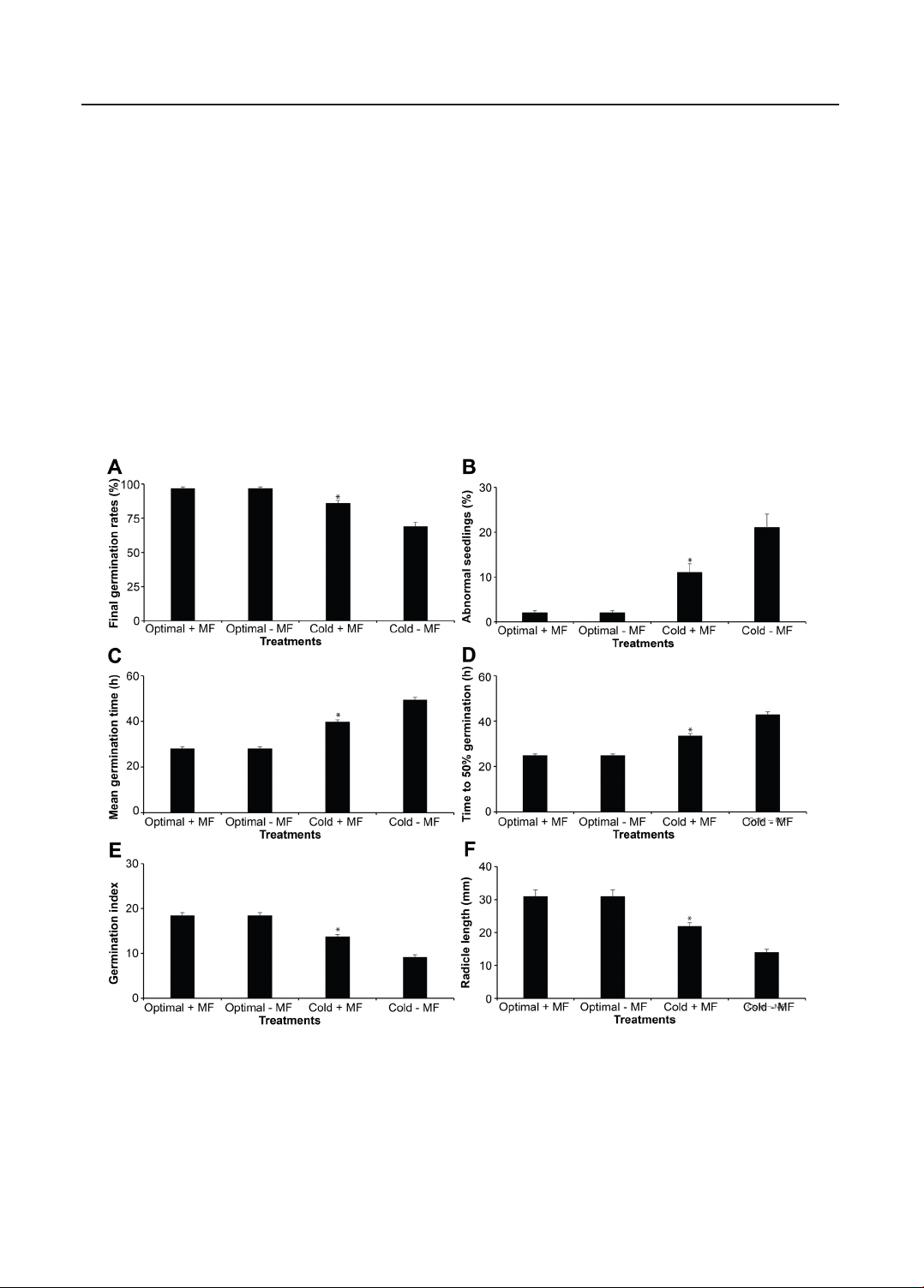
99
TẠP CHÍ KHOA HỌC VÀ CÔNG NGHỆ TRƯỜNG ĐẠI HỌC HÙNG VƯƠNG Tập 11, Số 3 (2025): 95 - 104
germination of 43.0 ± 1.1 hours (Figure 1D).
Under optimal conditions, these values were
much shorter, by 28.2 ± 0.7 hours and 24.9
± 0.6 hours, respectively. When exposed
to the magnetic field under cold stress,
seeds germinated faster, reaching a mean
germination time of 39.8 ± 1.0 hours and a
T₅₀ of 33.6 ± 0.9 hours (p-value < 0.05). The
germination index also demonstrated this
improvement. It fell from 18.5 ± 0.6 under
optimal conditions to 9.2 ± 0.5 under cold
stress, but magnetic field treatment increased
it to 13.8 ± 0.4 (Figure 1E). The same
trend appeared in root development. Under
cold stress, the radicle length of untreated
seedlings was only 14 ± 1 mm, while treated
seeds significantly reached 22 ± 1 mm
(Figure 1F). Under optimal temperature,
radicle length was 31 ± 2 mm in both groups.
Together, these results support a positive
effect of static magnetic field on both the rate and
completeness of germination of DT84 soybean
under cold stress, with negligible effects at
optimal temperature. Our study indicated that
static magnetic exposure improved both the
rate and the completeness of DT84 germination
under cold stress and reduced abnormal
seedling formation (Figure 2), while exerting
Figure 1. Effect of static magnetic field treatment on the germination of soybean
under optimal and cold conditions
(A) Final germination percentage (%). (B) Abnormal seedlings (%). (C) Mean germination time (h). (D) Time to 50%
germination (T₅₀, h). (E) Germination index. (F) Radicle length (mm). Bars represent mean ± SE (n = 4). Asterisks (*)
indicate significant differences compared with the corresponding cold-stressed control (p-value < 0.05),