CHAPTER 7: EVAPORATOR
Lecturer : ThS.Nguyễn Duy Tuệ
Lecturer : ThS Nguyễn Duy Tuệ
1 12/2015 Chapter 7 : Evaporator ThS.Nguyễn Duy Tuệ
OBJECTIVES
structure,
function
of
some
to the
In this chapter, student can:
In this chapter st dent can
- understand
evaporators
evaporators
- calculate and choose evaporator met
requirements
q
12/2015 Chapter 7 : Evaporator ThS.Nguyễn Duy Tuệ 2
REFERENCES
[1]. Refrigeration and Air Conditioning A. R.
[1]. Refrigeration and Air-Conditioning - A. R.
Trott and T. Welch
[2]. Evaporator catalogue
12/2015 Chapter 7 : Evaporator ThS.Nguyễn Duy Tuệ 3
CONTENT
GENERAL
GENERAL
AIR COOLING EVAPORATOR
AIR COOLING EVAPORATOR
LIQUID COOLING EVAPORATOR
LIQUID COOLING EVAPORATOR
PLATE EVAPORATOR
PLATE EVAPORATOR
DEFROSTING
DEFROSTING
12/2015 Chapter 7 : Evaporator ThS.Nguyễn Duy Tuệ 4
CONTENT
CALCULATE AND CHOOSE EVAPORATOR
CALCULATE AND CHOOSE EVAPORATOR
12/2015 Chapter 7 : Evaporator ThS.Nguyễn Duy Tuệ 5
GENERAL
The purpose of the evaporator is to receive low-
pressure, low temperature fluid from the expansion
pressure low temperature fluid from the expansion
valve and to bring it in close thermal contact with the
load. The refrigerant takes up its latent heat from the
load. The refrigerant takes up its latent heat from the
load and leaves the evaporator as a dry gas.
Evaporators are classified according to their
refrigerant flow pattern and their function.
12/2015 Chapter 7 : Evaporator ThS.Nguyễn Duy Tuệ 6
AIR COOLING EVAPORATOR
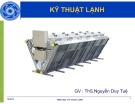
- Air cooling evaporators for coldrooms, blast
freezers, air-conditioning…will have finned pipe
air conditioning will have finned pipe
freezers
coils
12/2015 Chapter 7 : Evaporator ThS.Nguyễn Duy Tuệ 7
AIR COOLING EVAPORATOR
- Construction materials will be the same as for
air-cooled condensers. Aluminium fins on copper
air cooled condensers Aluminium fins on copper
tube are the most common for the halocarbons, with
stainless steel or aluminium tube for ammonia.
stainless steel or aluminium tube for ammonia.
- Frost or condensed water will form on the fin
surface and must be drained away. To permit this,
fins will be vertical and the air flow horizontal, with a
drain tray provided under.
i
Th
f th t b
h th t th
l
- The size of the tube will be such that the velocity
it
ill b
of the boiling fluid within it will cause turbulence to
promote heat transfer. Tube diameters will vary from
promote heat transfer Tube diameters will vary from
9 mm to 32 mm, according to the size of coil.
12/2015 Chapter 7 : Evaporator ThS.Nguyễn Duy Tuệ 8
AIR COOLING EVAPORATOR
- Fin spacings will vary from 2 mm on a compact
to 12 mm on a low-temperature
to 12 mm on a low temperature
airconditioner
airconditioner
coldroom coil.
- Some evaporator haven’t got fin and fan; so we
Some evaporator haven t got fin and fan; so we
call “natural evaporator”
12/2015 Chapter 7 : Evaporator ThS.Nguyễn Duy Tuệ 9
LIQUID COOLING EVAPORATOR
1. Shell and tube evaporator :
Liquid cooling is mostly in shell-and-tube or
Liquid cooling is mostly in shell and tube or
In the shell-and-tube
shell-and-coil evaporators.
type, the liquid is usually in the pipes and the shell is
type, the liquid is usually in the pipes and the shell is
the liquid, boiling
some three-quarters full of
refrigerant. A number of tubes is omitted at the top
of the shell to give space for the suction gas to
escape clear of the surface without entraining
12/2015 Chapter 7 : Evaporator ThS.Nguyễn Duy Tuệ 10
LIQUID COOLING EVAPORATOR
The speed of the liquid within the tubes should
to promote internal
be about 1 m/s or more,
be about 1 m/s or more to promote internal
turbulence for good heat transfer. End cover baffles
will constrain the flow to a number of passes, as
will constrain the flow to a number of passes, as
with the shell-and-tube condenser.
12/2015 Chapter 7 : Evaporator ThS.Nguyễn Duy Tuệ 11
LIQUID COOLING EVAPORATOR
this general
Evaporators of
type with dry
expansion circuits will have the refrigerant within the
expansion circuits will have the refrigerant within the
in order to maintain a suitable continuous
tubes,
velocity for oil transport, and the liquid in the shell
velocity for oil transport, and the liquid in the shell
12/2015 Chapter 7 : Evaporator ThS.Nguyễn Duy Tuệ 12
LIQUID COOLING EVAPORATOR
+ Sprayed tube liquid chiller : The spray chiller
operates with a much lower refrigerant charge than
operates with a much lower refrigerant charge than
a conventional flooded evaporator does.
12/2015 Chapter 7 : Evaporator ThS.Nguyễn Duy Tuệ 13
LIQUID COOLING EVAPORATOR
- The liquid refrigerant level
in the surge drum
shell is kept below the tubes and liquid is pumped to
shell is kept below the tubes and liquid is pumped to
spray nozzles which ensure that the tube surfaces
are covered with an evaporating liquid film.
are covered with an evaporating liquid film.
- The overall heat-transfer coefficient of
the
sprayed tube evaporator usually exceeds that of the
flooded type, the additional complexity of the pump
and spray assembly usually dissuaded designers
from choosing them.
f
th
h
i
12/2015 Chapter 7 : Evaporator ThS.Nguyễn Duy Tuệ 14
LIQUID COOLING EVAPORATOR
- The improvement in heat-transfer coefficient in
comparison to a flooded evaporator occurs because
comparison to a flooded evaporator occurs because
the sprayed tube permits easy escape of the vapor
Bubbles
Bubbles
sprayed-tube
yields
that
th fl
f th
t
t
l
i
- In fact, there is an optimum circulation rate in
the
evaporator
the
maximum boiling coefficient. When the flow rate is
too high, the liquid film becomes thick and insulates
the tubes. When the flow rate is too low some of the
th t b Wh
tube surfaces do not become wetted. A typical
circulation rate is 5 times the rate evaporated.
circulation rate is 5 times the rate evaporated
12/2015 Chapter 7 : Evaporator ThS.Nguyễn Duy Tuệ 15
LIQUID COOLING EVAPORATOR
For these reasons the brine can be cooled to a
temperature close to its freezing point. Water can be
temperature close to its freezing point Water can be
chilled to a temperature of less than 1°C with an
evaporating temperature close to 2 C.
evaporating temperature close to -2°C.
12/2015 Chapter 7 : Evaporator ThS.Nguyễn Duy Tuệ 16
LIQUID COOLING EVAPORATOR
2. Evaporator with open tank:
Liquid cooling evaporators may comprise a pipe
Liquid cooling evaporators may comprise a pipe
coil in an open tank, and can have flooded or dry
expansion circuitry. Flooded coils will be connected
expansion circuitry. Flooded coils will be connected
to a combined liquid accumulator and suction
separator (usually termed the surge drum), in the
form of a horizontal or vertical drum
12/2015 Chapter 7 : Evaporator ThS.Nguyễn Duy Tuệ 17
LIQUID COOLING EVAPORATOR
12/2015 Chapter 7 : Evaporator ThS.Nguyễn Duy Tuệ 18
LIQUID COOLING EVAPORATOR
12/2015 Chapter 7 : Evaporator ThS.Nguyễn Duy Tuệ 19
LIQUID COOLING EVAPORATOR
12/2015 Chapter 7 : Evaporator ThS.Nguyễn Duy Tuệ 20
LIQUID COOLING EVAPORATOR
12/2015 Chapter 7 : Evaporator ThS.Nguyễn Duy Tuệ 21
LIQUID COOLING EVAPORATOR
+ Evaporator for tube ice making
12/2015 Chapter 7 : Evaporator ThS.Nguyễn Duy Tuệ 22
LIQUID COOLING EVAPORATOR
12/2015 Chapter 7 : Evaporator ThS.Nguyễn Duy Tuệ 23
LIQUID COOLING EVAPORATOR
12/2015 Chapter 7 : Evaporator ThS.Nguyễn Duy Tuệ 24
LIQUID COOLING EVAPORATOR
12/2015 Chapter 7 : Evaporator ThS.Nguyễn Duy Tuệ 25
LIQUID COOLING EVAPORATOR
3. Baudelot cooler :
- Another type comprises a bank of corrugated
Another type comprises a bank of corrugated
plates, forming alternative paths for refrigerant and
liquid. Where water is to be cooled close to its
liquid. Where water is to be cooled close to its
risk of damage to the
freezing point without
evaporator, the latter is commonly arranged above
the water-collection tank and a thin film of water
runs over the tubes.
H t t
hi h ith
thi
f
i
i
- Heat transfer is very high with a thin moving
film of liquid and, if any ice forms, it will be on the
free to expand-> not damage the tube.
outside,
outside free to expand-> not damage the tube
Such an evaporator is termed a Baudelot cooler.
12/2015 Chapter 7 : Evaporator ThS.Nguyễn Duy Tuệ 26
LIQUID COOLING EVAPORATOR
- It may be open, enclosed in dust-tight shields to
avoid contamination of the product (as in surface
avoid contamination of the product (as in surface
milk and cream coolers), or may be enclosed in a
pressure vessel as in the Mojonniér cooler for soft
pressure vessel as in the Mojonniér cooler for soft
drinks, which pressurizes with carbon dioxide at the
same time
12/2015 Chapter 7 : Evaporator ThS.Nguyễn Duy Tuệ 27
LIQUID COOLING EVAPORATOR
- It may be open, enclosed in dust-tight shields to
avoid contamination of the product (as in surface
avoid contamination of the product (as in surface
milk and cream coolers), or may be enclosed in a
pressure vessel as in the Mojonniér cooler for soft
pressure vessel as in the Mojonniér cooler for soft
drinks, which pressurizes with carbon dioxide at the
same time
12/2015 Chapter 7 : Evaporator ThS.Nguyễn Duy Tuệ 28
LIQUID COOLING EVAPORATOR
4. Plate evaporator:
12/2015 Chapter 7 : Evaporator ThS.Nguyễn Duy Tuệ 29
LIQUID COOLING EVAPORATOR
- Plate heat exchanger evaporators are now
widely used. A heat exchanger of this type consists
widely used A heat exchanger of this type consists
of a number of herringbone corrugated plates
assembled to form a pack
assembled to form a pack
t h
f i
k
l
- The volume of refrigerant contained in a heat
exchanger of this type is approximately 2 litres for
each square metre of cooling area, which is up to 10
times lower than for multi-tube designs. This helps
low and offers a
l
to keep refrigerant charge level
t
d ff
l
rapid response to changes in energy demand.
12/2015 Chapter 7 : Evaporator ThS.Nguyễn Duy Tuệ 30
LIQUID COOLING EVAPORATOR
- The turbulence induced by the pattern of the
transfer coeffi
channels results in very high heat
transfer coeffi
channels results in very high heat
cients, typically three to four times greater than with
conventional tubular designs. Why?????
conventional tubular designs. Why?????
- The counter flow gives temperature differences
close to the ideal.
that
th t
ft
ti
i
l
i
- When used as a direct expansion evaporator the
refrigerant velocity should be high enough to entrain
remains after evaporation is complete.
oil
il
t
Where conditions give rise to non-miscibility,
the
formation of oil film on the wetted surface can impair
formation of oil film on the wetted surface can impair
(reduce) heat transfer.
12/2015 Chapter 7 : Evaporator ThS.Nguyễn Duy Tuệ 31
LIQUID COOLING EVAPORATOR
5. Plate evaporator for freezing :
- Plate evaporators are formed by cladding
Plate evaporators are formed by cladding
(cover) a tubular coil with sheet metal, welding
together two embossed plates, or from aluminium
together two embossed plates, or from aluminium
extrusions.
- The extended flat
d t b
d ti
lid
t
t
i
l
face may be used for air
cooling, for liquid cooling if immersed in a tank, or
as a Baudelot cooler, but the major use for flat plate
evaporators is to cool a solid product by conduction,
the product being formed in rectangular packages
and held close between a pair of adjacent plates.
and held close between a pair of adjacent plates
12/2015 Chapter 7 : Evaporator ThS.Nguyễn Duy Tuệ 32
LIQUID COOLING EVAPORATOR
- In the horizontal plate freezer ;the plates are
the
the
arranged in a stack on slides, so that
so that
arranged in a stack on slides
intermediate spaces can be opened and closed.
- Trays, boxes or cartons of
Trays, boxes or cartons of
the product are
the product are
loaded between the plates and the stack is closed to
give good contact on both sides. When the
necessary cooling is complete,
the plates are
opened and the product removed.
12/2015 Chapter 7 : Evaporator ThS.Nguyễn Duy Tuệ 33
LIQUID COOLING EVAPORATOR
Figure of contact freezer :
12/2015 Chapter 7 : Evaporator ThS.Nguyễn Duy Tuệ 34
DEFROSTING
- Air cooling evaporators working below 0°C
will accumulate frost which must be removed
will accumulate frost which must be removed
transfer.
periodically, since it will obstruct heat
Where the surrounding air is always at
4 C or
4°C or
Where the surrounding air is always at
higher, it will be sufficient to stop the refrigerant for a
period and allow the frost to melt off.
th t it d i
M th d
d
- For lower temperatures, heat must be applied
the frost within a reasonable time and
to melt
ensure that it drains away. Methods used are as
follows:
12/2015 Chapter 7 : Evaporator ThS.Nguyễn Duy Tuệ 35
DEFROSTING
- Electric resistance heaters: Elements are
within the coil or directly under it.
within the coil or directly under it
12/2015 Chapter 7 : Evaporator ThS.Nguyễn Duy Tuệ 36
DEFROSTING
- Hot gas: A branch pipe from the compressor
discharge feeds superheated gas to the coil. The
discharge feeds superheated gas to the coil The
compressor must still be working on another
evaporator to make hot gas available.
evaporator to make hot gas available.
12/2015 Chapter 7 : Evaporator ThS.Nguyễn Duy Tuệ 37
DEFROSTING
12/2015 Chapter 7 : Evaporator ThS.Nguyễn Duy Tuệ 38
DEFROSTING
- Reverse cycle: The direction of
flow of
the
refrigerant is reversed to make the evaporator act
refrigerant is reversed to make the evaporator act
as a condenser.
12/2015 Chapter 7 : Evaporator ThS.Nguyễn Duy Tuệ 39
DEFROSTING
- Water defrost
12/2015 Chapter 7 : Evaporator ThS.Nguyễn Duy Tuệ 40
DEFROSTING
In each of these cases, arrangements must be
made to remove cold refrigerant from the coil while
made to remove cold refrigerant from the coil while
defrosting is in progress. Drip trays and drain pipes
may require supplementary heating.
may require supplementary heating.
12/2015 Chapter 7 : Evaporator ThS.Nguyễn Duy Tuệ 41
CALCULATE AND CHOOSE
O
EVAPORATOR
O
Heat transfer equation:
F = Qo / k.∆t
F = Q / k ∆t
,
Qo : Evaporator capacity, W
k : Overal heat coefficience, W/m2.K
∆t : Logarit temperature difference, K
F : heat transfer area; (m2)
12/2015 Chapter 7 : Evaporator ThS.Nguyễn Duy Tuệ 42
CALCULATE AND CHOOSE
O
EVAPORATOR
O
Experence of some evaporator heat
transfer
coefficiences :
coefficiences :
12/2015 Chapter 7 : Evaporator ThS.Nguyễn Duy Tuệ 43
CALCULATE AND CHOOSE
O
EVAPORATOR
O
- With air cooling evaporator,
temperature
difference between room and refrigerant is usually
difference between room and refrigerant is usually
10K
- Heat transfer coefficience:
+ Room temperature:
k 12 8 W/
-40oC -> k=11,6 W/m2.K
-20oC -> k=12,8 W/m2.K
2 K
20 C
-10oC -> k=14 W/m2.K
0oC -> k= 17,5 W/m2.K
0oC > k= 17 5 W/m2 K
Note : If we want to have more exactly result,
please refer to manufacturer catalogue
please refer to manufacturer catalogue
12/2015 Chapter 7 : Evaporator ThS.Nguyễn Duy Tuệ 44
CALCULATE AND CHOOSE
O
EVAPORATOR
O
Data of air cooling evaporator :
12/2015 Chapter 7 : Evaporator ThS.Nguyễn Duy Tuệ 45
CALCULATE AND CHOOSE
O
EVAPORATOR
O
12/2015 Chapter 7 : Evaporator ThS.Nguyễn Duy Tuệ 46
CALCULATE AND CHOOSE
O
EVAPORATOR
O
Catalog
dàn
lạnh
hãng Gao
Xiang
http://www.alibaba.com/showroom/gaoxiang-
http://www alibaba com/showroom/gaoxiang-
evaporator.html
12/2015 Chapter 7 : Evaporator ThS.Nguyễn Duy Tuệ 47
CALCULATE AND CHOOSE
O
EVAPORATOR
O
12/2015 Chapter 7 : Evaporator ThS.Nguyễn Duy Tuệ 48
CALCULATE AND CHOOSE
O
EVAPORATOR
O
12/2015 Chapter 7 : Evaporator ThS.Nguyễn Duy Tuệ 49
CALCULATE AND CHOOSE
O
EVAPORATOR
O
12/2015 Chapter 7 : Evaporator ThS.Nguyễn Duy Tuệ 50
CALCULATE AND CHOOSE
O
EVAPORATOR
O
12/2015 Chapter 7 : Evaporator ThS.Nguyễn Duy Tuệ 51
CALCULATE AND CHOOSE
O
EVAPORATOR
O
12/2015 Chapter 7 : Evaporator ThS.Nguyễn Duy Tuệ 52
CALCULATE AND CHOOSE
O
EVAPORATOR
O
12/2015 Chapter 7 : Evaporator ThS.Nguyễn Duy Tuệ 53
CALCULATE AND CHOOSE
O
EVAPORATOR
O
12/2015 Chapter 7 : Evaporator ThS.Nguyễn Duy Tuệ 54
CALCULATE AND CHOOSE
O
EVAPORATOR
O
12/2015 Chapter 7 : Evaporator ThS.Nguyễn Duy Tuệ 55
O
CALCULATE AND CHOOSE
O
EVAPORATOR
Ví dụ 1 : Tính chọn dàn lạnh cho kho lạnh có
nhiệt độ không khí vào dàn lạnh là 15oC, nhiệt độ
nhiệt độ không khí vào dàn lạnh là -15oC, nhiệt độ
không khí ra khỏi dàn lạnh -20oC; năng suất lạnh
Qo=2,5kW; nhiệt độ bay hơi của môi chất R22 trong
ốống là -28oC.
12/2015 Chapter 7 : Evaporator ThS.Nguyễn Duy Tuệ 56
CALCULATE AND CHOOSE
O
EVAPORATOR
O
:
10,29oC -> Dàn lạnh 2B020 -> Kiểm tra lại Qo ?
ạ
ạ
Giải:
Cách 1 :
Cách 1 :
- Tìm được độ chênh lệch nhiệt độ logarit
,
Cách 2 : Ước lượng lại hệ số truyền nhiệt k của
hãng chế tạo -> F=?
12/2015 Chapter 7 : Evaporator ThS.Nguyễn Duy Tuệ 57
CALCULATE AND CHOOSE
O
EVAPORATOR
O
Ví dụ 2 : Tính chọn thiết bị bay hơi
ệ
ộ
;
làm lạnh
nước cấp cho các FCU với nhiệt độ nước vào
nước cấp cho các FCU với nhiệt độ nước vào
TBBH là 12oC; nhiệt độ nước ra khỏi là 7oC; năng
suất lạnh TBBH là 100 kW; nhiệt độ sôi của môi
ạ
chất là 0 oC.
12/2015 Chapter 7 : Evaporator ThS.Nguyễn Duy Tuệ 58
CALCULATE AND CHOOSE
O
EVAPORATOR
O
Giải:
Độ chênh lệch nhiệt độ logarit : 9,26oC
Độ chênh lệch nhiệt độ logarit : 9,26oC
Hệ số truyền nhiệt k chọn 350W/m2.K
Diện tích truyền nhiệt : 30,85 m2
Chọn TBBH mã hiệu ??????????
12/2015 Chapter 7 : Evaporator ThS.Nguyễn Duy Tuệ 59
CALCULATE AND CHOOSE
O
EVAPORATOR
O
12/2015 Chapter 7 : Evaporator ThS.Nguyễn Duy Tuệ 60
CALCULATE AND CHOOSE
O
EVAPORATOR
O
12/2015 Chapter 7 : Evaporator ThS.Nguyễn Duy Tuệ 61








%20--%3e%3cdefs%3e%3cstyle%3e%20.st0%20{%20fill:%20%23fff;%20}%20.st1%20{%20fill:%20%237800fa;%20}%20%3c/style%3e%3c/defs%3e%3cpath%20class='st1'%20d='M117.78,12.18H43.11c2.9,3.47,4.65,7.94,4.65,12.82,0,5.6-2.3,10.66-6.01,14.29h76.02l7.22-13.56-7.22-13.56Z'/%3e%3cg%3e%3cpath%20class='st0'%20d='M53.58,26.17h-.59v-1.46h.59v-4.96h2.83c1.78,0,2.67.94,2.67,2.82v5.76c0,1.87-.89,2.81-2.67,2.81h-2.83v-4.96ZM55.36,21.37v3.34h1.1v1.46h-1.1v3.34h1.01c.61,0,.91-.37.91-1.1v-5.93c0-.74-.3-1.1-.91-1.1h-1.01Z'/%3e%3cpath%20class='st0'%20d='M65.99,31.14h-1.8l-.31-2.07h-2.19l-.31,2.07h-1.64l1.82-11.39h2.62l1.82,11.39ZM65.28,18.04c-.25.46-.51.77-.75.94-.21.15-.47.22-.79.22-.26,0-.57-.07-.92-.22l-.38-.15c-.14-.05-.26-.07-.37-.07-.3,0-.53.18-.71.54l-.91-.68c.25-.46.51-.77.75-.94.21-.14.48-.21.79-.21.26,0,.57.07.92.21l.38.15c.14.05.26.07.37.07.3,0,.53-.18.71-.54l.91.68ZM61.91,27.52h1.73l-.87-5.76-.87,5.76Z'/%3e%3cpath%20class='st0'%20d='M74.53,26.89v1.52c0,1.91-.89,2.86-2.67,2.86s-2.67-.95-2.67-2.86v-5.93c0-1.91.89-2.86,2.67-2.86s2.67.95,2.67,2.86v1.11h-1.69v-1.22c0-.75-.31-1.12-.93-1.12s-.93.37-.93,1.12v6.15c0,.74.31,1.11.93,1.11s.93-.37.93-1.11v-1.63h1.69Z'/%3e%3cpath%20class='st0'%20d='M81.4,31.14h-1.8l-.31-2.07h-2.19l-.31,2.07h-1.64l1.82-11.39h2.62l1.82,11.39ZM75.9,19.2l1.52-1.91h1.71l1.51,1.91h-1.61l-.76-.95-.75.95h-1.61ZM77.32,27.52h1.73l-.87-5.76-.87,5.76ZM83.1,15.99l-1.76,1.91h-1.26l1.17-1.91h1.86Z'/%3e%3cpath%20class='st0'%20d='M84.86,19.75c1.78,0,2.67.94,2.67,2.82v1.48c0,1.87-.89,2.81-2.67,2.81h-.85v4.28h-1.79v-11.39h2.64ZM84.01,21.37v3.86h.85c.58,0,.87-.36.87-1.08v-1.71c0-.71-.29-1.07-.87-1.07h-.85Z'/%3e%3cpath%20class='st0'%20d='M93.51,19.75c1.78,0,2.67.94,2.67,2.82v1.48c0,1.87-.89,2.81-2.67,2.81h-.85v4.28h-1.79v-11.39h2.64ZM92.66,21.37v3.86h.85c.58,0,.87-.36.87-1.08v-1.71c0-.71-.29-1.07-.87-1.07h-.85Z'/%3e%3cpath%20class='st0'%20d='M98.8,31.14h-1.79v-11.39h1.79v4.88h2.03v-4.88h1.83v11.39h-1.83v-4.88h-2.03v4.88Z'/%3e%3cpath%20class='st0'%20d='M105.36,24.55h2.46v1.62h-2.46v3.34h3.09v1.63h-4.88v-11.39h4.88v1.63h-3.09v3.18ZM108.17,17.29l-1.76,1.91h-1.26l1.17-1.91h1.86Z'/%3e%3cpath%20class='st0'%20d='M112.2,19.75c1.78,0,2.67.94,2.67,2.82v1.48c0,1.87-.89,2.81-2.67,2.81h-.85v4.28h-1.79v-11.39h2.64ZM111.35,21.37v3.86h.85c.58,0,.87-.36.87-1.08v-1.71c0-.71-.29-1.07-.87-1.07h-.85Z'/%3e%3c/g%3e%3ccircle%20class='st1'%20cx='25'%20cy='25'%20r='20'/%3e%3cpath%20class='st0'%20d='M32.78,19.27c2.92,0,4.43,2.55,5.28,5.33l.71,2.17c.14.38-.33.75-.71.75h-5.61c.19-.33.24-.71.09-1.08l-.75-2.45c-.43-1.32-.99-2.64-1.79-3.77.75-.57,1.65-.94,2.78-.94h0ZM25,18.38c3.25,0,4.9,2.78,5.89,5.89l.76,2.45c.14.42-.33.8-.8.8h-11.69c-.42,0-.94-.38-.8-.8l.75-2.45c.99-3.11,2.64-5.89,5.89-5.89h0ZM25,11.35c1.74,0,3.11,1.37,3.11,3.11s-1.37,3.11-3.11,3.11-3.11-1.41-3.11-3.11,1.41-3.11,3.11-3.11h0ZM17.27,19.27c1.08,0,1.98.38,2.73.94-.8,1.13-1.37,2.45-1.74,3.77l-.8,2.45c-.14.38-.05.75.09,1.08h-5.56c-.42,0-.9-.38-.75-.75l.71-2.17c.9-2.78,2.41-5.33,5.33-5.33h0ZM17.27,12.91c1.51,0,2.78,1.27,2.78,2.83s-1.27,2.83-2.78,2.83-2.83-1.27-2.83-2.83,1.27-2.83,2.83-2.83h0ZM32.78,12.91c1.56,0,2.78,1.27,2.78,2.83s-1.23,2.83-2.78,2.83-2.83-1.27-2.83-2.83,1.27-2.83,2.83-2.83h0ZM27.07,28.56v.09c0,.57-.24,1.08-.61,1.46h0v.05c-.38.33-.9.57-1.46.57s-1.08-.24-1.46-.61h0c-.38-.38-.61-.9-.61-1.46v-.09h1.41v.09c0,.19.05.38.19.47v.05c.09.09.28.19.47.19s.38-.09.47-.19v-.05c.14-.09.24-.28.24-.47t-.05-.09h1.41ZM30.99,28.56v.09c0,1.65-.66,3.16-1.74,4.24-1.08,1.08-2.59,1.79-4.24,1.79s-3.16-.71-4.24-1.79l-.05-.05c-1.04-1.08-1.7-2.55-1.7-4.2v-.09h1.41v.09c0,1.27.47,2.4,1.27,3.25h.05c.85.85,1.98,1.37,3.25,1.37s2.4-.52,3.25-1.37c.85-.8,1.37-1.98,1.37-3.25v-.09h1.37ZM34.99,28.56v.09c0,2.78-1.13,5.28-2.92,7.07-1.79,1.79-4.29,2.92-7.07,2.92s-5.23-1.13-7.07-2.92c-1.79-1.79-2.92-4.29-2.92-7.07v-.09h1.41v.09c0,2.4.94,4.53,2.5,6.08,1.56,1.56,3.72,2.5,6.08,2.5s4.52-.94,6.08-2.5c1.56-1.56,2.5-3.68,2.5-6.08v-.09h1.41Z'/%3e%3c/svg%3e)