
For
presentation
at
the
GCC
CIGRÉ
9th
Symposium,
Abu
Dhabi,
October
28-29,
1998
1
DESIGN
AND
TESTING
OF
POLYMER-HOUSED
SURGE
ARRESTERS
by
Minoo
Mobedjina Bengt
Johnnerfelt Lennart
Stenström
ABB
Switchgear
AB,
Sweden
Abstract
Since
some
years,
arresters
with
polymer-housings
have
been
available
on
the
market
for
distribution
and
medium
voltage
systems.
In
recent
years,
this
type
of
arresters
have
been
introduced
also
on
higher
voltage
systems
up
to
and
including
550
kV.
However,
the
international
standardisation
work
is
far
behind
this
rapid
development
and
many
of
existing
designs
with
polymer-housings
for
high-
voltage
systems
have
only
been
tested
according
to
the
existing
IEC
standard,
IEC
99-4
of
1991,
which
in
general
only
covers
arresters
with
porcelain
housings.
The
existing
IEC
standard
lacks
suitable
test
procedures
to
ensure
an
acceptable
service
performance
and
life
time
of
a
polymer-housed
surge
arrester.
In
particular,
tests
to
verify
the
mechanical
strength,
short-circuit
performance
and
life
time
of
the
arresters
are
missing.
In
this
report,
different
design
alternatives
are
discussed
and
compared
and
relevant
definitions
and
tests
procedures
regarding
mechanical
properties
of
polymer-housed
arresters
are
presented.
Necessary
design
criteria
and
tests
to
verify
a
sufficiently
long
life-time
as
well
as
operating
duty
tests
to
prove
the
arrester
performance
with
respect
to
possible
energy
and
current
stresses
are
given.
The
advantages
of
silicon
insulators
under
polluted
conditions
are
discussed
Finally,
this
report
presents
some
new
areas
of
applications
which
open
up
due
to
the
introduction
of
polymer-housed
arrester
designs.
One
such
is
protection
of
transmission
lines
against
lightning/switching
surges
so
as
to
increase
the
reliability
and
security
of
the
transmission
system.
1.
INTRODUCTION
1.1
SHORT
HISTORICAL
BACKGROUND
Surge
arresters
constitute
the
primary
protection
for
all
other
equipment
in
a
network
against
overvoltages
which
may
occur
due
to
lightning,
system
faults
or
switching
operations.
The
most
advanced
gapped
SiC
arresters
in
the
middle
of
1970s
could
give
a
good
protection
against
overvoltages
but,
the
technique
had
reached
its
limits.
It
was
very
difficult,
e.g.,
to
design
arresters
with
several
parallel
columns
to
cope
with
the
very
high
energy
requirements
needed
for
HVDC
transmissions.
The
statistical
scatter
of
the
sparkover
voltage
was
also
a
limiting
factor
with
respect
to
the
accuracy
of
the
protection
levels.
Metal-oxide
(ZnO)
surge
arresters
were
introduced
in
the
mid
of
and
late
1970s
and
proved
to
be
a
solution
to
the
problems
which
not
could
be
solved
with
the
old
technology.
The
protection
level
of
a
surge
arrester
was
no
longer
a
statistical
parameter
but
could
be
accurately
given.
The
protective
function
was
no
longer
dependent
on
the
installation
or
vicinity
to
other
apparatus
as
compared
to
SiC
arresters
which
sparkover
voltage
could
be
affected
by
the
surrounding
electrical
fields.
The
ZnO
arresters
could
be
designed
to
meet
virtually
any
energy
requirements
just
by
connecting
ZnO
varistors
in
parallel
even
though
the
technique
to
ensure
a
sufficiently
good
current
sharing,
and
thus
energy
sharing,
between
the
columns
was
sophisticated.
The
possibility
to
design
protective
equipment
against
very
high
energy
stresses
also
opened
up
new
application
areas
as,
e.g.,
protection
of
series
capacitors.
The
ZnO
technology
was
developed
further
during
1980s
and
in
the
beginning
of
1990s
towards
higher
voltage
stresses
of
the
material,
higher
specific
energy
absorption
capabilities
and
better
current
withstand
strengths.

2
New
polymeric
materials,
superseding
the
traditional
porcelain
housings,
started
to
be
used
1986-1987
for
distribution
arresters.
At
the
end
of
1980s
polymer-
housed
arresters
were
available
up
to
145
kV
system
voltages
and
today
polymer-housed
arresters
have
been
accepted
even
up
to
550
kV
system
voltages.
Almost
all
of
the
early
polymeric
designs
included
EPDM
rubber
as
an
insulator
material
but
during
the
1990s
more
and
more
manufacturers
have
changed
to
silicon
rubber
which
is
less
affected
by
environmental
conditions,
e.g.,
UV
radiation
and
pollution.
1.2
DIMENSIONING
OF
ZNO
SURGE
ARRESTERS
There
are
a
variety
of
parameters
influencing
the
dimensioning
of
an
arrester
but
the
demands
as
required
by
a
user
can
be
divided
into
two
main
categories:
•
Protection
against
overvoltages
•
High
reliability
and
a
long
service
life
In
addition
there
are
requirements
such
as
that,
in
the
event
of
an
arrester
overloading,
the
risk
of
personal
injury
and
damage
to
adjacent
equipment
shall
be
low.
The
above
two
main
requirements
are
somewhat
in
contradiction
to
each
other.
Aiming
to
minimise
the
residual
voltage
normally
leads
to
the
reduction
in
the
capability
of
the
arrester
to
withstand
power-frequency
overvoltages.
An
improved
protection
level,
therefore,
may
be
achieved
by
slightly
increasing
the
risk
of
overloading
the
arresters.
The
increase
of
the
risk
is,
of
course,
dependent
on
how
well
the
amplitude
and
time
of
the
temporary
overvoltage
(TOV)
can
be
predicted.
The
selection
of
an
arrester,
therefore,
always
is
a
compromise
between
protection
levels
and
reliability.
A
more
detailed
classification
could
be
based
on
what
stresses
a
surge
arrester
normally
is
subjected
to
and
what
continuous
stresses
it
shall
withstand,
e.g.
•
Continuous
operating
voltage
•
Operation
temperature
•
Rain,
pollution,
sun
radiation
•
Wind
and
possible
ice
loading
as
well
as
forces
in
line
connections
and
additional,
non-frequent,
abnormal
stresses,
e.g..
•
Temporary
overvoltages,
TOV
•
Overvoltages
due
to
transients
which
affect
-thermal
stability
&
ageing
-energy
&
current
withstand
capability
-external
insulation
withstand
•
Large
mechanical
forces
from,
e.g.,
earthquakes
•
Severe
external
pollution
and
finally
what
the
arrester
can
be
subjected
to
only
once:
•
Internal
short-circuit
For
transient
overvoltages
the
primary
task
for
an
arrester,
of
course,
is
to
protect
but
it
must
normally
also
be
dimensioned
to
handle
the
current
through
it
as
well
as
the
heat
generated
by
the
overvoltage.
The
risk
of
an
external
flashover
must
also
be
very
low.
Detailed
test
requirements
are
given
in
International
and
National
Standards
where
the
surge
arresters
are
classified
with
respect
to
various
parameters
such
as
energy
capability,
current
withstand,
short-circuit
capability
and
residual
voltage.
2.
IMPORTANT
COMPONENTS
OF
ZNO
SURGE
ARRESTERS
A
ZnO
surge
arrester
for
high
voltage
applications
constitutes
mainly
of
the
following
components
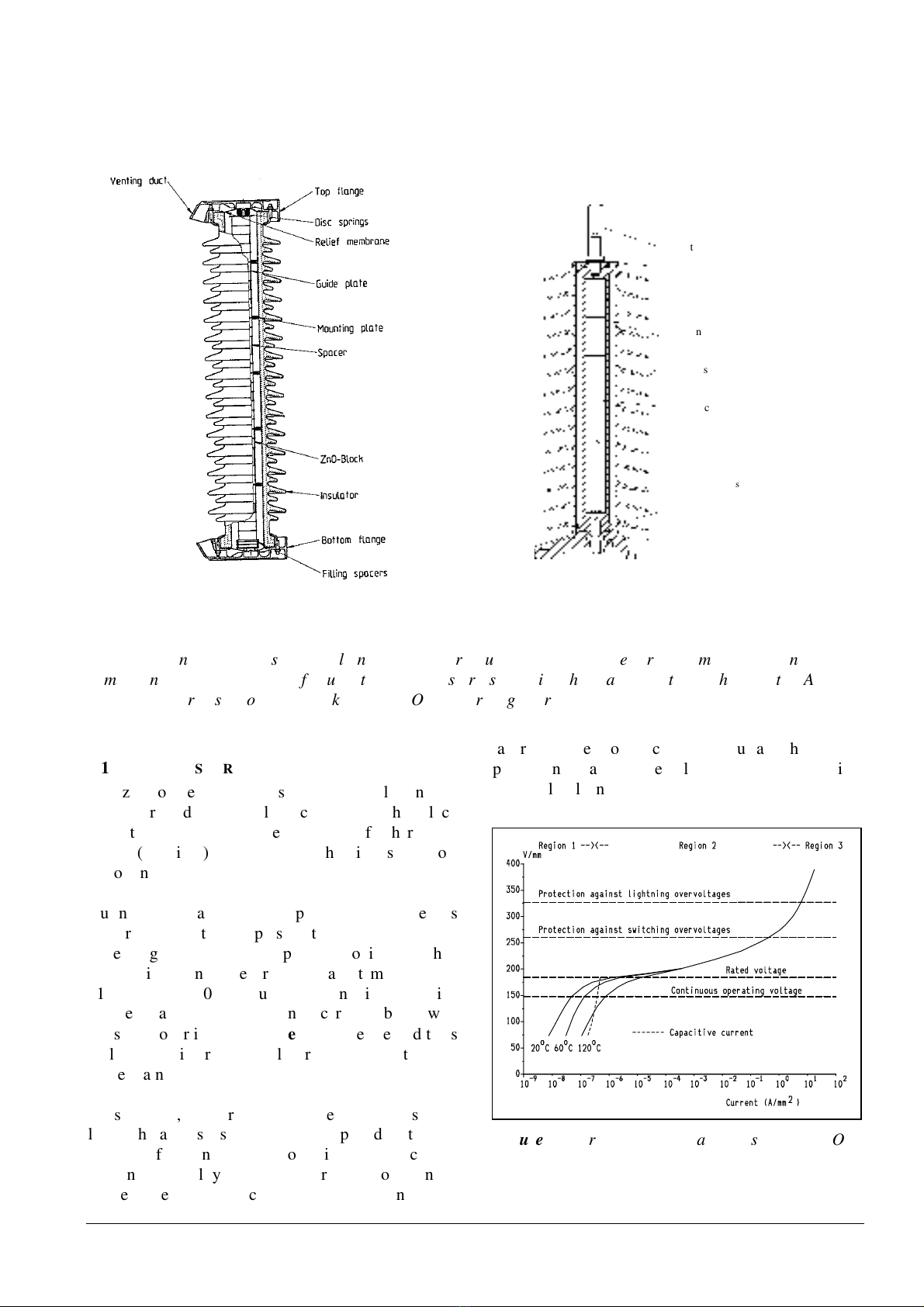
See
figure
a.
•
ZnO
varistors
(blocks)
•
Internal
parts
•
Pressure
relief
devices
(normally
not
included
for
arresters
with
polymer-housings
since
these
do
not
include
any
enclosed
gas
volume.
The
short-circuit
capability
of
a
polymer-housed
arrester
must
therefore
be
solved
as
an
integrated
part
of
the
entire
design).
•
Housing
of
porcelain
or
polymeric
material
with
end
fittings
(flanges)
of
metal
•
A
grading
ring
arrangement
where
necessary
3
L
ine
t
erminal
C
ap
I
nner
i
nsulator
O
uter
i
nsulator
Z
nO
b
locks
S
pacer
F
ibreglass
loops
Y
oke
B
ase
Figure
A:Principal
designs
of
porcelain-
and
polymer-housed
ZnO
surge
arresters.
The
most
important
component
in
the
arresters
is
of
course
the
ZnO
varistor
itself
giving
the
characteristics
of
the
arrester.
All
other
details
are
used
to
protect
or
keep
the
ZnO
varistors
together
2.1
ZNO
VARISTORS
The
zinc
oxide
(ZnO)
varistor
is
a
densely
sintered
block,
pressed
to
a
cylindrical
body.
The
block
consists
of
90%
zinc
oxide
and
10%
of
other
metal
oxides
(additives)
of
which
bismuth
oxide
is
the
most
important.
During
the
manufacturing
process
a
powder
is
prepared
which
then
is
pressed
to
a
cylindrical
body
under
high
pressure.
The
pressed
bodies
are
then
sintered
in
a
kiln
for
several
hours
at
a
temperature
of
1100
°C
to
1
200
°C.
During
the
sintering
the
oxide
powder
transforms
to
a
dense
ceramic
body
with
varistor
properties
(see
figure
b)
where
the
additives
will
form
an
inter-granular
layer
surrounding
the
zinc
oxide
grains.
These
layers,
or
barriers,
give
the
varistor
its
non-
linear
characteristics.
Aluminium
is
applied
on
the
end
surfaces
of
the
finished
varistor
to
improve
the
current
carrying
capability
and
to
secure
a
good
contact
between
series-
connected
varistors.
An
insulating
layer
is
applied
to
the
cylindrical
surface
thus
giving
protection
against
external
flashover
and
against
chemical
influence.
Figure
B:
Current-voltage
characteristic
for
a
ZnO-
varistor.

4
2.2
INTERNAL
PARTS
OF
A
SURGE
ARRESTER
AND
DESIGN
PRINCIPLES
FOR
HIGH
SHORT-CIRCUIT
CAPABILITY
For
all
the
different
types
of
housings,
the
ZnO
blocks
are
manufactured
in
the
same
manner.
The
internal
parts,
however,
differ
considerably
between
a
porcelain-housed
arrester
and
a
polymer-housed
arrester.
The
only
thing
common
between
these
two
designs
is
that
both
include
a
stack
of
series-connected
zinc
oxide
varistors
together
with
components
to
keep
the
stack
together
but
there
the
similarities
end.
A
porcelain-housed
arrester
contains
normally
a
large
amount
of
dry
air
or
inert
gas
while
a
polymer-housed
arrester
normally
does
not
have
any
enclosed
gas
volume.
This
means
that
the
requirements
concerning
short-circuit
capability
and
internal
corona
must
be
solved
quite
differently
for
the
two
designs.
There
is
a
possibility
that
porcelain-housed
arresters,
containing
an
enclosed
gas
volume,
might
explode
due
to
the
internal
pressure
increase
caused
by
a
short-
circuit,
if
the
enclosed
gas
volume
is
not
quickly
vented.
To
satisfy
this
important
condition,
the
arresters
must
be
fitted
with
some
type
of
pressure
relief
system.
In
order
to
prevent
internal
corona
during
normal
service
conditions,
the
distance
between
the
block
column
and
insulator
must
be
sufficiently
large
to
ensure
that
the
radial
voltage
difference
between
the
blocks
and
insulator
will
not
create
any
partial
discharges.
Polymer-housed
arresters
differ
depending
on
the
type
of
design.
Presently
these
arresters
can
be
found
in
one
of
the
following
three
groups:
I.
Open
or
cage
design
II.
Closed
design
III.
Tubular
design
with
an
annular
gas-gap
between
the
active
parts
and
the
external
insulator
In
the
first
group,
the
mechanical
design
may
consist
of
loops
of
glass-fibre,
a
cage
of
glass-fibre
weave
or
glass-fibre
rods
around
the
block
column.
The
ZnO
blocks
are
then
utilised
to
give
the
design
some
of
its
mechanical
strength.
A
body
of
silicon
rubber
or
EPDM
rubber
is
then
moulded
on
to
the
internal
parts.
An
outer
insulator
with
sheds
is
then
fitted
or
moulded
on
the
inner
body.
This
outer
insulator
can
also
be
made
in
the
same
process
as
used
for
the
inner
body.
Such
a
design
lacks
an
enclosed
gas
volume.
At
a
possible
internal
short-circuit,
material
will
be
evaporated
by
the
arc
and
cause
a
pressure
increase.
Since
the
open
design
deliberately
has
been
made
weak
for
internal
overpressure,
the
rubber
insulator
will
quickly
tear,
partly
or
along
the
whole
length
of
the
insulator.
The
air
outside
the
insulator
will
be
ionised
and
the
internal
arc
will
commutate
to
the
outside.figure
m
illustrates
this
property
vividly.
Surge
arresters
in
group
II
have
been
mechanically
designed
not
to
include
any
direct
openings
enabling
a
pressure
relief
during
an
internal
short-circuit.
The
design
might
include
a
glass-fibre
weave
wounded
directly
on
the
block
column
or
a
separate
tube
in
which
the
ZnO
blocks
are
mounted.
In
order
to
obtain
a
good
mechanical
strength
the
tube
must
be
made
sufficiently
strong
which,
in
turn,
might
lead
to
a
too
strong
design
with
respect
to
short-circuit
strength.
The
internal
overpressure
could
rise
to
a
high
value
before
cracking
the
tube
which
may
lead
to
an
explosive
failure
with
parts
thrown
over
a
very
large
area.
To
prevent
a
violent
shattering
of
the
housing,
a
variety
of
solutions
have
been
utilised,
e.g.,
slots
on
the
tubes.
When
glass-fibre
weave,
wound
on
the
blocks
to
give
the
necessary
mechanical
strength,
is
used,
an
alternative
has
been
to
arrange
the
windings
in
a
special
manner
to
obtain
weaknesses
that
may
crack.
These
weaknesses
ensure
pressure
relief
and
commutation
of
the
internal
arc
to
the
outside
thus
preventing
an
explosion.
The
tubular
design
finally,
is
designed
more
or
less
in
the
same
way
as
a
standard
porcelain
arrester
but
where
the
porcelain
has
been
substituted
by
an
insulator
of
a
glass-fibre
reinforced
epoxy
tube
with
an
outer
insulator
of
silicon-
or
EPDM
rubber.
The
internal
parts,
in
general,
are
almost
identical
to
those
used
in
an
arrester
with
porcelain
housing
with
an
annular
gas-gap
between
the
block
column
and
the
insulator.
The
arrester
must,
obviously,
be
equipped
with
some
type
of
pressure
relief
device
similar
to
what
is
used
on
arresters
with
porcelain
housing.
This
design
has
its
advantages
and
disadvantages
compared
to
other
polymeric
designs.
One
advantage
is
that
is
easier
to
obtain
a
high
mechanical
strength.
Among
the
disadvantages
are,
e.g.,
a
less
efficient
cooling
of
the
ZnO
blocks
and
an
increased
risk
of
exposure
of
the
polymeric
material
to
corona
that
may

5
occur
between
the
inner
wall
of
the
insulator
and
the
block
column
during
external
pollution.
This
latter
problem
can
be
solved
by
ensuring
that
the
gap
between
the
block
column
and
insulator
is
very
large
but
this
leads
to
a
costly
and
thermally
even
worse
design.
Polymer-housed
arresters
lacking
the
annular
gas-gap
normally
do
not
have
any
problem
with
corona
during
normal
service
conditions
in
dry
and
clean
conditions.
The
design
must
be
made
corona-free
during
such
conditions
and
this
is
normally
verified
in
a
routine
test.
However,
during
periods
of
wet
external
pollution
on
the
insulator
the
radial
stresses
increase
considerably.
This
necessitates
that
the
insulator
must
be
free
from
cavities
to
prevent
internal
corona
in
the
material
which
might
create
problems
in
the
long
run.
The
thickness
of
the
material
must
also
be
sufficient
to
prevent
the
possibility
of
puncturing
of
the
insulator
due
to
radial
voltage
stresses
or
material
erosion
due
to
external
leakage
currents
on
the
outer
surface
of
the
insulator.
The
effects
of
external
pollution
are
dealt
with
later
on
in
the
paper.
See
art.
3.2.5.
2.3
SURGE
ARRESTER
HOUSING
As
mentioned
before,
the
housings
of
the
surge
arresters
traditionally
have
been
made
of
porcelain
but
the
trend
today
is
towards
use
of
polymeric
insulators
for
arresters
for
both
distribution
systems
as
well
as
for
medium
voltage
systems
and
recently
even
for
HV
and
EHV
system
voltages.
There
are
mainly
three
reasons
why
polymeric
materials
have
been
seen
as
an
attractive
alternative
to
porcelain
as
an
insulator
material
for
surge
arresters:
•
Better
behaviour
in
polluted
areas
•
Better
short-circuit
capability
with
increased
safety
for
other
equioment
and
personnel
nearby.
•
Low
weight
•
Non-brittle
It
is
quite
possible
to
design
an
arrester
fulfilling
these
criteria
but
it
is
wrong,
however,
to
believe
that
all
polymer-housed
arresters
automatically
have
all
of
these
features
just
because
the
porcelain
has
been
replaced
by
a
rubber
insulator.
The
design
must
be
scrutinised
carefully
for
each
case.
Polymeric
materials
generally
perform
better
in
polluted
environments
compared
to
porcelain
insulator.
This
is
mainly
due
to
the
hydrophobic
behaviour
of
the
polymeric
material,
i.e.,
the
ability
to
prevent
wetting
of
the
insulator
surface.
However,
it
shall
be
noted
that
not
all
of
the
polymeric
insulators
are
equally
hydrophobic.
Two
commonly
used
materials
are
silicon-
and
EPDM
rubber
together
with
a
variety
of
additives
to
achieve
desired
material
features,
e.g.,
fire-retardant,
stable
against
UV
radiation
etc.
Polymeric
materials
can
more
easily
be
affected
by
ageing
due
to
partial
discharges
and
leakage
currents
on
the
surface,
UV
radiation,
chemicals
etc.
compared
to
porcelain
which
is
a
non-organic
material.
Both
silicon-
and
EPDM
rubber
show
hydrophobic
behaviour
when
new.
The
insulator
made
of
EPDM
rubber,
however,
will
lose
its
hydrophobicity
quickly
and
is
thus
often
regarded
as
a
hydrophilic
insulator
material.
Hydrophobicity
results
in
reduced
creepage
currents
during
external
pollution,
minimising
electrical
discharges
on
the
surface;
thereby
reducing
the
effects
of
ageing
phenomena.
The
material
can
lose
its
hydrophobicity
if
the
insulator
has
been
subjected
to
high
leakage
currents
during
a
long
time
due
to
severe
pollution,
e.g.,
salt
in
combination
with
moisture.
The
silicon
rubber,
though,
will
recover
its
hydrophobicity
through
diffusion
of
low
molecular
silicones
to
the
surface
restoring
the
original
hydrophobic
behaviour.
The
EPDM
rubber
lacks
this
possibility
completely
and
hence
the
material
is
very
likely
to
lose
its
hydrophobicity
completely
with
time.
A
safe
short-circuit
performance
is
not
achieved
only
by
using
a
polymeric
insulator.
The
design
must
take
into
consideration
what
might
happen
at
a
possible
failure
of
the
ZnO
blocks.
This
can
be
solved,
depending
on
the
type
of
design,
in
different
ways
as
described
in
article
2.2.
Unfortunately,
lack
of
relevant
standardised
test
procedures
for
polymer-housed
arresters
has
made
it
possible
to
uncritically
use
test
methods
only
intended
for
porcelain
designs
[1,2].
This
has
led
to
the
belief,
incorrectly,
that
”all”
polymer-housed
arresters,
irrespective
of
design,
are
capable
of
carrying
enormous
short-circuit
currents.
The
work
within
IEC
to
specify
short-circuit
test
procedures
suitable
for
polymer-housed
arresters
will
be
finalised
soon
[3].
The
test
procedures
most
likely
to
be
adopted
will,
hopefully
soon
enough,
clean
the
market
from
polymer-housed
arresters
not
having
a
sufficient
short-circuit
capability.
![Cẩm Nang Xây Dựng: Quy Định Pháp Luật Cần Biết [Chuẩn Nhất]](https://cdn.tailieu.vn/images/document/thumbnail/2025/20251225/tangtuy08/135x160/80661766722918.jpg)





![Cẩm nang Gia công kim loại Việt Nam [mới nhất]](https://cdn.tailieu.vn/images/document/thumbnail/2026/20260513/baobinh_011/135x160/7971778670576.jpg)


%20--%3e%3cdefs%3e%3cstyle%3e%20.st0%20{%20fill:%20%23fff;%20}%20.st1%20{%20fill:%20%237800fa;%20}%20%3c/style%3e%3c/defs%3e%3cpath%20class='st1'%20d='M117.78,12.18H43.11c2.9,3.47,4.65,7.94,4.65,12.82,0,5.6-2.3,10.66-6.01,14.29h76.02l7.22-13.56-7.22-13.56Z'/%3e%3cg%3e%3cpath%20class='st0'%20d='M53.58,26.17h-.59v-1.46h.59v-4.96h2.83c1.78,0,2.67.94,2.67,2.82v5.76c0,1.87-.89,2.81-2.67,2.81h-2.83v-4.96ZM55.36,21.37v3.34h1.1v1.46h-1.1v3.34h1.01c.61,0,.91-.37.91-1.1v-5.93c0-.74-.3-1.1-.91-1.1h-1.01Z'/%3e%3cpath%20class='st0'%20d='M65.99,31.14h-1.8l-.31-2.07h-2.19l-.31,2.07h-1.64l1.82-11.39h2.62l1.82,11.39ZM65.28,18.04c-.25.46-.51.77-.75.94-.21.15-.47.22-.79.22-.26,0-.57-.07-.92-.22l-.38-.15c-.14-.05-.26-.07-.37-.07-.3,0-.53.18-.71.54l-.91-.68c.25-.46.51-.77.75-.94.21-.14.48-.21.79-.21.26,0,.57.07.92.21l.38.15c.14.05.26.07.37.07.3,0,.53-.18.71-.54l.91.68ZM61.91,27.52h1.73l-.87-5.76-.87,5.76Z'/%3e%3cpath%20class='st0'%20d='M74.53,26.89v1.52c0,1.91-.89,2.86-2.67,2.86s-2.67-.95-2.67-2.86v-5.93c0-1.91.89-2.86,2.67-2.86s2.67.95,2.67,2.86v1.11h-1.69v-1.22c0-.75-.31-1.12-.93-1.12s-.93.37-.93,1.12v6.15c0,.74.31,1.11.93,1.11s.93-.37.93-1.11v-1.63h1.69Z'/%3e%3cpath%20class='st0'%20d='M81.4,31.14h-1.8l-.31-2.07h-2.19l-.31,2.07h-1.64l1.82-11.39h2.62l1.82,11.39ZM75.9,19.2l1.52-1.91h1.71l1.51,1.91h-1.61l-.76-.95-.75.95h-1.61ZM77.32,27.52h1.73l-.87-5.76-.87,5.76ZM83.1,15.99l-1.76,1.91h-1.26l1.17-1.91h1.86Z'/%3e%3cpath%20class='st0'%20d='M84.86,19.75c1.78,0,2.67.94,2.67,2.82v1.48c0,1.87-.89,2.81-2.67,2.81h-.85v4.28h-1.79v-11.39h2.64ZM84.01,21.37v3.86h.85c.58,0,.87-.36.87-1.08v-1.71c0-.71-.29-1.07-.87-1.07h-.85Z'/%3e%3cpath%20class='st0'%20d='M93.51,19.75c1.78,0,2.67.94,2.67,2.82v1.48c0,1.87-.89,2.81-2.67,2.81h-.85v4.28h-1.79v-11.39h2.64ZM92.66,21.37v3.86h.85c.58,0,.87-.36.87-1.08v-1.71c0-.71-.29-1.07-.87-1.07h-.85Z'/%3e%3cpath%20class='st0'%20d='M98.8,31.14h-1.79v-11.39h1.79v4.88h2.03v-4.88h1.83v11.39h-1.83v-4.88h-2.03v4.88Z'/%3e%3cpath%20class='st0'%20d='M105.36,24.55h2.46v1.62h-2.46v3.34h3.09v1.63h-4.88v-11.39h4.88v1.63h-3.09v3.18ZM108.17,17.29l-1.76,1.91h-1.26l1.17-1.91h1.86Z'/%3e%3cpath%20class='st0'%20d='M112.2,19.75c1.78,0,2.67.94,2.67,2.82v1.48c0,1.87-.89,2.81-2.67,2.81h-.85v4.28h-1.79v-11.39h2.64ZM111.35,21.37v3.86h.85c.58,0,.87-.36.87-1.08v-1.71c0-.71-.29-1.07-.87-1.07h-.85Z'/%3e%3c/g%3e%3ccircle%20class='st1'%20cx='25'%20cy='25'%20r='20'/%3e%3cpath%20class='st0'%20d='M32.78,19.27c2.92,0,4.43,2.55,5.28,5.33l.71,2.17c.14.38-.33.75-.71.75h-5.61c.19-.33.24-.71.09-1.08l-.75-2.45c-.43-1.32-.99-2.64-1.79-3.77.75-.57,1.65-.94,2.78-.94h0ZM25,18.38c3.25,0,4.9,2.78,5.89,5.89l.76,2.45c.14.42-.33.8-.8.8h-11.69c-.42,0-.94-.38-.8-.8l.75-2.45c.99-3.11,2.64-5.89,5.89-5.89h0ZM25,11.35c1.74,0,3.11,1.37,3.11,3.11s-1.37,3.11-3.11,3.11-3.11-1.41-3.11-3.11,1.41-3.11,3.11-3.11h0ZM17.27,19.27c1.08,0,1.98.38,2.73.94-.8,1.13-1.37,2.45-1.74,3.77l-.8,2.45c-.14.38-.05.75.09,1.08h-5.56c-.42,0-.9-.38-.75-.75l.71-2.17c.9-2.78,2.41-5.33,5.33-5.33h0ZM17.27,12.91c1.51,0,2.78,1.27,2.78,2.83s-1.27,2.83-2.78,2.83-2.83-1.27-2.83-2.83,1.27-2.83,2.83-2.83h0ZM32.78,12.91c1.56,0,2.78,1.27,2.78,2.83s-1.23,2.83-2.78,2.83-2.83-1.27-2.83-2.83,1.27-2.83,2.83-2.83h0ZM27.07,28.56v.09c0,.57-.24,1.08-.61,1.46h0v.05c-.38.33-.9.57-1.46.57s-1.08-.24-1.46-.61h0c-.38-.38-.61-.9-.61-1.46v-.09h1.41v.09c0,.19.05.38.19.47v.05c.09.09.28.19.47.19s.38-.09.47-.19v-.05c.14-.09.24-.28.24-.47t-.05-.09h1.41ZM30.99,28.56v.09c0,1.65-.66,3.16-1.74,4.24-1.08,1.08-2.59,1.79-4.24,1.79s-3.16-.71-4.24-1.79l-.05-.05c-1.04-1.08-1.7-2.55-1.7-4.2v-.09h1.41v.09c0,1.27.47,2.4,1.27,3.25h.05c.85.85,1.98,1.37,3.25,1.37s2.4-.52,3.25-1.37c.85-.8,1.37-1.98,1.37-3.25v-.09h1.37ZM34.99,28.56v.09c0,2.78-1.13,5.28-2.92,7.07-1.79,1.79-4.29,2.92-7.07,2.92s-5.23-1.13-7.07-2.92c-1.79-1.79-2.92-4.29-2.92-7.07v-.09h1.41v.09c0,2.4.94,4.53,2.5,6.08,1.56,1.56,3.72,2.5,6.08,2.5s4.52-.94,6.08-2.5c1.56-1.56,2.5-3.68,2.5-6.08v-.09h1.41Z'/%3e%3c/svg%3e)