
TNU Journal of Science and Technology
229(12): 108 - 115
http://jst.tnu.edu.vn 108 Email: jst@tnu.edu.vn
AN INVESTIGATION INTO ENGLISH SPEAKING LEARNING OF
2ND YEAR STUDENTS AT NATIONAL ACADEMY OF PUBLIC ADMINISTRATION
AND SOME SUGGESTIONS
Lam Thi Thuan*
National Academy of Public Administration
ARTICLE INFO
ABSTRACT
Received:
25/4/2024
This article aims to find out the 2nd year non-English major students’
learning at National Academy of Public Administration towards the
speaking skills in the textbook “Face2face, Pre-intermediate” with the
focus on students’ difficulties, preferences and demands in learning
speaking skill. The study is conducted with 150 second year students
during the first semester of school year 2023 - 2024. A questionnaire
consisting of 8 open ended questions was distributed to the students. In
addition, classroom observation was carried out in 5 lessons with these
students. The data in the questionnaire were analyzed by calculating
percentages and frequencies. Data collected from the questionnaire and
the observations were analyzed using both quantitative and qualitative
techniques. The results of the study reveal the students’ bad
performances with passive learning experiences and low level of
proficiency, then they have negative attitudes towards the speaking skill
whereas their preferences and demands.
Revised:
08/8/2024
Published:
08/8/2024
KEYWORDS
Foreign language
Speaking skill
Learning attitude
Proficiency
Non-major
NGHIÊN CỨU VIỆC HỌC KỸ NĂNG NÓI TIẾNG ANH CỦA SINH VIÊN
KHÔNG CHUYÊN TẠI HỌC VIỆN HÀNH CHÍNH QUỐC GIA
VÀ MỘT SỐ ĐỀ XUẤT
Lâm Thị Thuân
Học viện Hành chính Quốc gia
THÔNG TIN BÀI BÁO
TÓM TẮT
Ngày nhận bài:
25/4/2024
Bài viết này nhằm mục đích tìm hiểu những khó khăn và nhu cầu trong
việc học tập và thực hành kỹ năng nói tiếng Anh của sinh viên năm hai
khối không chuyên ngữ tại Học viện Hành chính Quốc gia theo giáo
trình học Face2face, Pre-intermediate. Nghiên cứu được thực hiện với
150 sinh viên không chuyên năm thứ hai trong học kỳ đầu tiên của
năm học 2023 - 2024. Dữ liệu của nghiên cứu được thu thập thông qua
việc phát bảng câu hỏi điều tra gồm 8 câu hỏi mở và việc quan sát lớp
học trong 5 bài học với nhóm 150 sinh viên này. Bằng phương pháp
tổng hợp các câu trả lời của sinh viên theo phương pháp định lượng và
định tính, các kết quả thu thập được cho thấy thực trạng việc thực hành
kỹ năng nói tiếng Anh nói riêng và học tập ngoại ngữ là tiếng Anh nói
chung của sinh viên năm hai khối không chuyên tại Học viện Hành
chính Quốc gia còn ở mức độ thấp. Trình độ sinh viên chưa cao, khả
năng giao tiếp tiếng Anh kém và việc luyện kỹ năng khá thụ động dẫn
đến thái độ của người học đối môn học chưa tích cực mặc dù họ ý thức
được vai trò quan trọng và xác định được nhu cầu cần thiết của mình
đối với môn học.
Ngày hoàn thiện:
08/8/2024
Ngày đăng:
08/8/2024
TỪ KHÓA
Học ngoại ngữ
Kỹ năng nói
Thái độ học
Năng lực
Sinh viên không chuyên
DOI: https://doi.org/10.34238/tnu-jst.10216
*Email: lamthuan83@gmail.com

TNU Journal of Science and Technology
229(12): 108 - 115
http://jst.tnu.edu.vn 109 Email: jst@tnu.edu.vn
1. Introduction
Communicative Language Teaching Approach (CLT) focuses on functional language usage and
learners’ ability to express their own ideas, feelings, attitudes, desires and needs. Learners’ success in
language learning as well as the effectiveness of their English course are mainly based on how well
their spoken language proficiency has been improved. Therefore, teaching speaking skill plays an
important role in the curriculum of most English courses. To develop learners’ oral ability, teachers
follow 3 phases: presentation, practice and production. However, whether the process works or not
also depends on various factors like aptitude, opportunity, method and motivation as Carroll suggests
[1]. In addition, Hutchinson and Torres [2] claims “…no teaching-learning situation, it seems, is
complete until it has its relevant textbook.” Also, Burns and Joyce [3] concludes learning
experiences were one of the factors making learners reluctant to speak up in class.
In Vietnam, learning English in general and English-speaking skill in particular are becoming
more and more essential in the era of modernization and integration. Research on improving
learners’ English speaking is blossoming; however, the matter is still given much concern. During
the foreign language learning process, Vietnamese learners are facing a number of difficulties such
as inhibition, nothing to say, mother tongue [4], limitation of vocabulary and grammar, lack of
English-speaking environment and weak teaching methods [5]. In fact, teaching and learning
speaking skill in a foreign language is considered to be not a simple job, both teachers and learners
need to be active through cooperative activities [6]. Besides the textbook, using other materials
are also beneficial as taking advantages of supplementary sources will promote students'
motivation and interest [7]. Furthermore, it is time to adapt teaching methods as grammar and
vocabulary should be taught in real life situations in order to train the habit of using correct
grammatical structures and the authentic use of target language [8]. Also, learning motivation
seems to be very vital to learners of languages for it can be considered as both the cause and the
result of language learning achievement. The more actively and voluntarily they join in the class
activity, the more knowledgeable and confident they are to cope with the real-life situations [9].
At National Academy of Public Administration (NAPA), in General English (GE) for students of
non-English specializations, speaking skill is being taught together with other skills based on the
textbook “Face2face, Pre-intermediate” by Nicholas Tims with Chris Redston & Gillie Cunningham
for three semesters with the total of 210 class hours. These courses aim at providing students with
general knowledge of English grammar, vocabulary as well as developing students’ four language
skills. At the end of each semester, students are assessed based on a written test of listening, reading
and writing skills for 90 minutes and an oral test from 10 to 12 minutes. In comparison with other
skills, speaking skill has still been facing difficulties and the students’ proficiency is rather weak.
Many learners have been getting undesirable grades and feel dissatisfied with it. Therefore, the
author expects to find out the students’ attitudes, performances, levels of proficiency and their
preferences or demands so that withdrawn recommendations can really support in this case.
2. Methods of the study
The study was conducted with 150 second year students from the NAPA during the first
semester of school year 2023 – 2024 to find out the facts of teaching and learning this skill after
the two first courses of 150 class hours. A questionnaire was distributed, consisting of 8 open
ended questions, and collected data was analyzed by calculating percentages and frequencies can
help find out the students’ attitudes towards speaking skill, their preferences and their demands
so as to make methodological recommendations for the case. In addition, classroom observation
was carried out in 5 lessons during the first semester of school year 2023 – 2024, in which
candidates practised their speaking skill, then the observation data based on the three criteria:
teacher’s presentation, teacher’s methods and teacher- student interaction were analyzed by using
qualitative techniques to supplement to the questionnaire’s data about the students’ attitudes,
performances, levels of proficiency and their preferences or demands.
TNU Journal of Science and Technology
229(12): 108 - 115
http://jst.tnu.edu.vn 110 Email: jst@tnu.edu.vn
3. Findings and results
3.1. Learners’ attitudes and participating degrees in speaking lessons
Like students at other universities, NAPA’s students may come from all parts of the country
with age ranges from 18 to over 20 and mixed levels of English language proficiency. As can be
seen, speaking is an important skill in CLT to show how proficient learners are. However, the
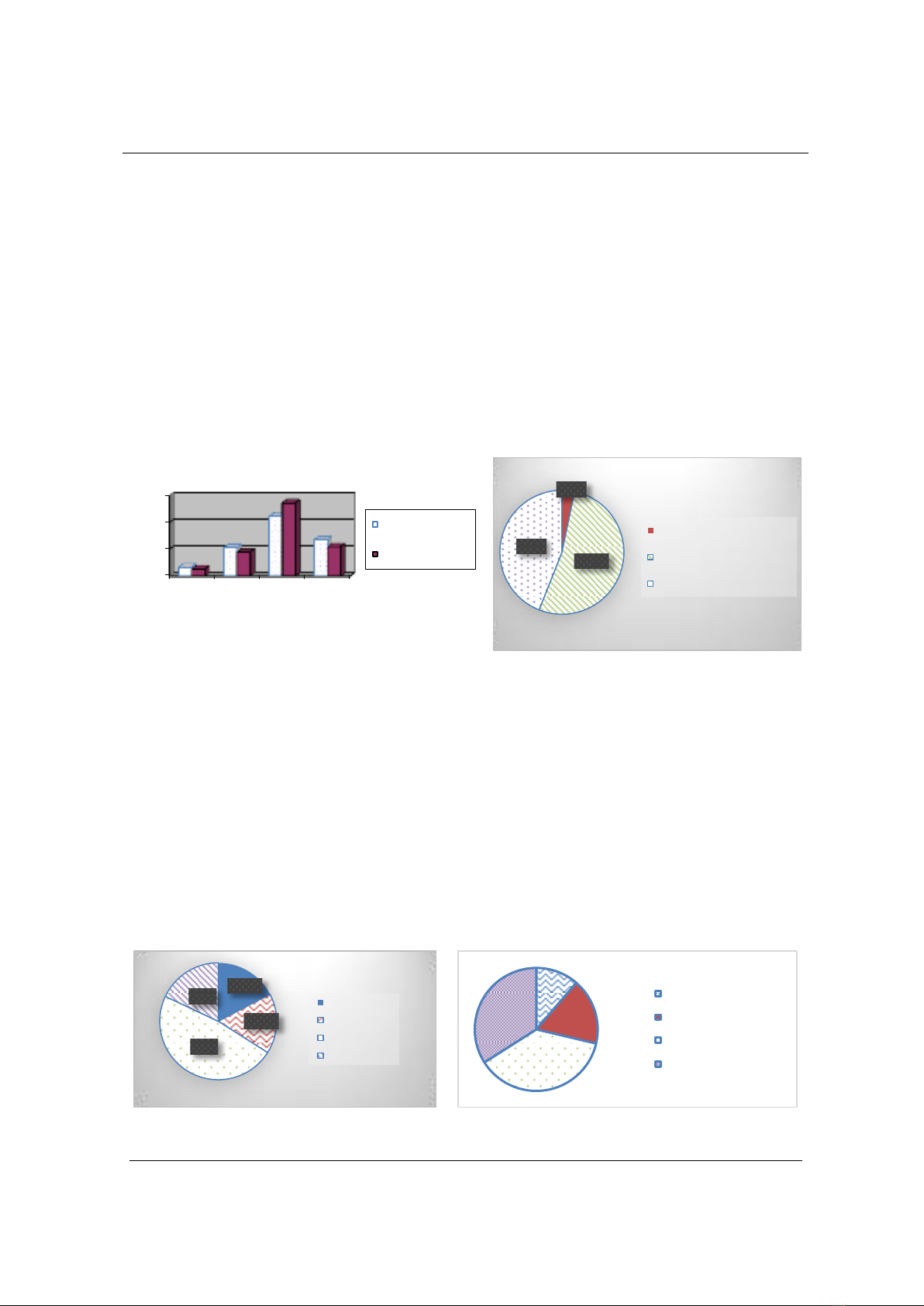
data collected from the questionnaire distributed to 150 students of 2nd year at NAPA reveals an
uninteresting fact that only 28% of the respondents’ state that they speak English willingly, while
the percentage of the informants who feel reluctant to speak accounts for 72%. When they are
asked how interested and satisfied they are in speaking lessons, nearly three fourth of the
respondents (72%) reveal their low levels of interest, in which 27.3% (41 respondents) said they
are not interested in learning this skill at all and 44.7% give little interest to it. The number of
respondents who are eager (very and rather keen on the skill) accounts for less than a third (28%),
with only 6.7% feel really like the skill. Figure 1 shows that the less interest learners have in
speaking practice, the less satisfied they feel in learning the skill.
Figure 1. The learners’ attitudes towards speaking
skill (%)
Figure 2. The learners’ opinions towards
speaking topics and activities in Face2face,
Pre-intermediate (%)
In addition, a textbook that is relevant and meets learners’ needs is also very important to
reflect learners’ attitudes to the skill learning. Learners’ opinions about speaking topics and
activities in the course-book “Face2face, Pre-intermediate” are shown in the following figure.
None of the respondents say that the topics and activities are very interesting and suitable. Only
3.3% find these topics and activities very interesting but unsuitable. Whereas, more than a half
(52.7%) claim these to be rather interesting and quite suitable. The rest of respondents (44%)
answer that they are too difficult.
Although over a half of respondents consider speaking topics and activities to be rather
interesting and quite suitable, their participation in speaking lessons is a little quite surprising to
the researcher. The result shows that nearly a half (48%) find that they need more time to practice
the skill; whereas, only a third of the students are satisfied with the time given to speaking
activities, even up to 18% think that they are given too little time to speak as shown in Figure 3.
Figure 3. The learners’ opinions in time given to
speaking activities (%)
Figure 4. The learners’ participating degree in
speaking activities (%)
0
20
40
60
Very Rather Little Not at
all
6.7
21.3
44.7
27.3
5.33
18
54.67
22 Degrees of interest
Degrees of satisfaction
3.3%
52.7%
44%
Very interesting but unsuitable
Rather interesting and suitable
Too difficult
17.3%
16.7%
48%
18% Much
Rather enough
Rather little
Too little
11.3%
17.3%
37.3%
34%
Very enthusiastic
Rather enthusiastic
Little enthusiastic
None (just when asked)

TNU Journal of Science and Technology
229(12): 108 - 115
http://jst.tnu.edu.vn 111 Email: jst@tnu.edu.vn
Moreover, learners’ participation in speaking activities is also quite reluctant. As seen in
Figure 4, there are only 11.3% of respondents enthusiastically involved and 17.4% of them are a
little more positive. These two active groups account for less than a third of participants.
However, the passive learning groups are nearly 2.5 times with about a half (34% of respondents)
only speaking when the teachers ask them and the rest (37.3% of respondents) feel just little
enthusiastic to take part in the activities.
Obviously, the topics and activities in the speaking lessons are not too demanding but quite
suitable but there are many learners having difficulties in practising this skill. There are large
numbers of students are not really concerned in learning the skill. As a result, they are not
satisfied with what they have been gaining from the skill. Therefore, the questions raised here are
what causes these and how the teachers can improve this situation.
3.2. Learners’ difficulties in speaking lessons
Regarding learners’ difficulties in the subject, many of them give more than one choice. As
we can see from Table 1 below, lack of vocabulary and structures to express the ideas, poor
listening and reading abilities resulting poor speaking, lack of confidence or shyness and lack of
time due to crowded class are choices with highest percentages of respondents experiencing,
approximate and more than 90%. Especially, among 93.3% of the students that are worried about
lack of vocabulary and structures to express their ideas, the number of the students ranking this
difficulty the first accounts for 31.3%. Among 97.3% of the respondents who often feel shy when
speaking, the number of the students ranking it the first is up to 30.7%.
Samples to imitate or general knowledge in the discussed topics are not the main difficulties of
respondents as only about a half choose these. In fact, only 2.7% of the students rank samples and
4% rank needed knowledge as their first difficulties. Besides, 3.3% of the respondents raise their
voice of other difficulties they have, in which mixed ability among learners that is quite popular in
NAPA’s language classes is mentioned by 2% and lack of motivation in lessons is claimed by 1.3%.
These other difficulties are also being ranked as the fourth and the fifth. It can be concluded that the
respondents facing all difficulties raised by the researcher and the most common are the lack of
vocabulary and structures, low proficiency in skills, lack of confidence and insufficient time.
Table 1. The students’ difficulties in speaking lessons
Question: What difficulties are you facing in learning
speaking with the textbook Face2face, Pre-Intermediate?
(You can choose more than one and rank your options in
order of importance, at least three).
Degrees of importance (1 = the most, 7= the
least) - Number of respondents (%)
1
2
3
4
5
6
7
Options:
A. Lack of vocabulary and structures
47
(31.3)
42
(28)
26
(17.3)
12
(8)
13
(8.7)
0
(0)
0
(0)
B. Poor listening and reading abilities resulting poor
speaking ability
19
(12.7)
13
(8.7)
28
(18.7)
32
(21.3)
24
(16)
9
(6)
8
(5.3)
C. Lack of samples to imitate
4
(2.7)
7
(4.7)
21
(14)
11
(7.3)
19
(12.7)
12
(8)
7
(4.7)
D. Lack of general knowledge in the discussed topics
6
(4)
3
(2)
22
(14.7)
13
(8.7)
11
(7.3)
15
(10)
21
(14)
E. Lack of confidence or shyness
46
(30.7)
39
(26)
34
(22.7)
12
(8)
7
(4.7)
3
(2)
5
(3.3)
F. Lack of time due to crowded class
28
(18.7)
46
(30.7)
19
(12.7)
23
(15.3)
12
(8)
8
(5.3)
5
(3.3)
G. Others:
+ Mixed ability class
0
(0)
0
(0)
0
(0)
3
(2)
0
(0)
0
(0)
0
(0)
+ Lack of motivation
0
(0)
0
(0)
0
(0)
0
(0)
2
(1.3)
0
(0)
0
(0)

TNU Journal of Science and Technology
229(12): 108 - 115
http://jst.tnu.edu.vn 112 Email: jst@tnu.edu.vn
3.3. Classroom observations in lessons with the respondents
The respondents of the research were 150 second-year learners from 3 different classes,
each of which included from 48 to 53 students and class observations were done in 5 speaking
lessons of each class during the first semester of the school year 2023-2024. While observing,
the researcher noted key points of the teachers’ presentation, the teachers’ methods and the
teacher - student interaction. These notes were the supplement to questionnaire data of
students’ weak performances with passive learning experiences and negative attitudes towards
the speaking skill.
Teachers’ presentation: The researcher finds that the teachers in the classes chosen are quite
keen on teaching and enthusiastic with the students. However, their instructions are given in
English and the majority of the students cannot understand clearly. Then, the teachers translate
them immediately into Vietnamese and their students are able to do the tasks. Surprisingly,
samples or suggestions are also translated so the students use their mother tongue a lot, they
translate everything into Vietnamese and also find their answers in Vietnamese first. This wastes
a lot of time and seems inappropriate in CLT. In addition, most of the lessons are just concerned
only textbook activities for real-life situations are rarely applied or recommended.
Teacher’s methods: In total 15 speaking lessons visited, the researcher finds that the teachers
sometimes move around in the class during learners’ practice taking place but not very often.
Classes in the context of the study are mixed and quite crowded, so it is challenging for them to
have enough time to support all students. When getting the students’ answers, the teachers stop
them immediately for error corrections. Examples, illustrations, and drills are quickly conducted
through mainly pair or group work but these do not work effectively. The learners’ talking time is
limited and most of them do not actively join in conversations and discussions but imitate the
samples, even some do nothing.
Teacher - student interaction: The teachers - students interaction is also a big concern in these
speaking lessons. As focused in CLT, teachers play the role of facilitators whereas students are
communicators but it seems to fail. The researcher sees that teachers’ talking time is
overwhelmed the students’ and the teachers tend to have to do too much to raise their learners up
but they are still too passive. The teachers try to control and direct the classes to complete the
lesson plans according to the curriculum while the majority of the students sit quietly, pretend to
concentrate on the book but they do nothing or reluctantly give the answers to finish their tasks.
There are very few students that actively and effectively communicate as the majority say that
they do not understand or do not know how to deal with the tasks. No students ask questions,
disagree or express their own ideas. As a result, the teacher - student interaction in these classes
seems to be just one way and teaching – learning process is not effective.
3.4. Expectations from the learners
The things that can improve students’ ability in speaking are interesting and suitable topics,
chances to practise speaking, teachers’ methods of teaching, teachers’ feedback and variety of
activities or techniques such as songs or games to motivate students. Obviously, most of the
students in the study were not very satisfied with their speaking learning. The topics and
activities in the textbook are not too difficult for the majority but it is really a problem for the
learners when practicing speaking with the textbook for various other reasons in term of
methods, levels and motivation. It is very necessary to adapt the methods and textbook
activities as well so that these can be more suitable to these students’ levels and needs. When
the respondents are asked for their opinions on important factors contributing to successful
speaking lessons, the matter of methods and learners’ performance are considered more than
others as can be seen from Table 2.












![Đề cương môn Tiếng Anh 1 [Chuẩn Nhất/Mới Nhất]](https://cdn.tailieu.vn/images/document/thumbnail/2025/20251130/cubabep141@gmail.com/135x160/51711764555685.jpg)










![Mẫu thư Tiếng Anh: Tài liệu [Mô tả chi tiết hơn về loại tài liệu hoặc mục đích sử dụng]](https://cdn.tailieu.vn/images/document/thumbnail/2025/20250814/vinhsannguyenphuc@gmail.com/135x160/71321755225259.jpg)