RESEARC H Open Access
Degeneracy: a link between evolvability,
robustness and complexity in biological systems
James M Whitacre
*
* Correspondence:
jwhitacre79@yahoo.com
School of Computer Science,
University of Birmingham,
Edgbaston, UK
Abstract
A full accounting of biological robustness remains elusive; both in terms of the
mechanisms by which robustness is achieved and the forces that have caused robust-
ness to grow over evolutionary time. Although its importance to topics such as
ecosystem services and resilience is well recognized, the broader relationship between
robustness and evolution is only starting to be fully appreciated. A renewed interest in
this relationship has been prompted by evidence that mutational robustness can play
a positive role in the discovery of adaptive innovations (evolvability) and evidence of
an intimate relationship between robustness and complexity in biology.
This paper offers a new perspective on the mechanics of evolution and the origins
of complexity, robustness, and evolvability. Here we explore the hypothesis that
degeneracy, a partial overlap in the functioning of multi-functional components,
plays a central role in the evolution and robustness of complex forms. In support of
this hypothesis, we present evidence that degeneracy is a fundamental source of
robustness, it is intimately tied to multi-scaled complexity, and it establishes condi-
tions that are necessary for system evolvability.
Introduction
Complex adaptive systems (CAS) are omnipresent and are at the core of some of
society’s most challenging and rewarding endeavours. They are also of interest in their
own right because of the unique features they exhibit such as high complexity, robust-
ness, and the capacity to innovate. Especially within biological contexts such as the
immune system, the brain, and gene regulation, CAS are extraordinarily robust to var-
iation in both internal and external conditions. This robustness is in many ways unique
because it is conferred through rich distributed responses that allow these systems to
handle challenging and varied environmental stresses. Although exceptionally robust,
biological systems can sometimes adapt in ways that exploit new resources or allow
them to persist under unprecedented environmental regime shifts.
These requirements to be both robust and adaptive appear to be conflicting. For
instance, it is not entirely understood how organisms can be phenotypically robust to
genetic mutations yet also can generate the range of phenotypic variability that is
needed for evolutionary adaptations to occur. Moreover, on rare occasions genetic
changes can result in increased system complexity however it is not known how these
increasingly complex forms are able to evolve without sacrificing robustness or the
Whitacre Theoretical Biology and Medical Modelling 2010, 7:6
http://www.tbiomed.com/content/7/1/6
© 2010 Whitacre; licensee BioMed Central Ltd. This is an Open Access article distributed under the terms of the Creative Commons
Attribution License (http://creativecommons.org/licenses/by/2.0), which permits unrestricted use, distribution, and reproduction in
any medium, provided the original work is properly cited.
propensity for future beneficial adaptations. To put it more distinctly, it is not known
how biological evolution is scalable [1].
A deeper understanding of CAS thus requires a deeper understanding of the condi-
tions that facilitate the coexistence of high robustness, growing complexity, and the
continued propensity for innovation or what we refer to as evolvability. This reconcilia-
tion is not only of interest to biological evolution but also to science in general because
variability in conditions and unprecedented shocks are a challenge faced across many
facets of human enterprise.
In this opinion paper, we explore and expand upon the hypothesis first proposed in
[2,3] that a system property known as degeneracy plays a central role in the relation-
ships between these properties. Most importantly, we argue that only robustness
through degeneracy will lead to evolvabilityortohierarchicalcomplexityinCAS.An
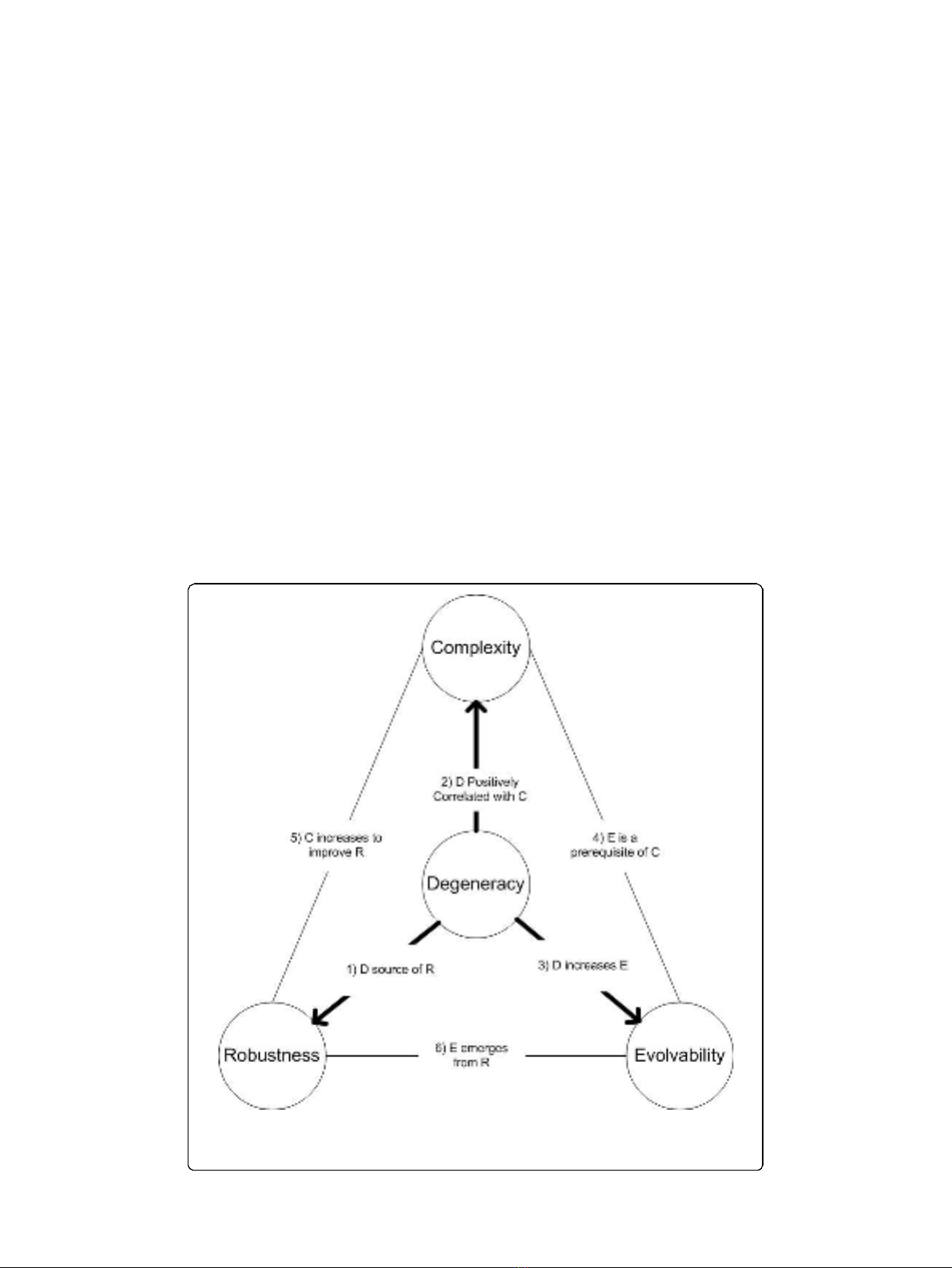
overview of our main arguments is shown in Figure 1 with Table 1 summarizing pri-
mary supporting evidence from the literature. Throughout this paper, we refer back to
Figure 1 so as to connect individual discussions with the broader hypothesis being pro-
posed. For instance, we refer to “Link 6”in the heading of Section 2 in reference to the
connection between robustness and evolvability that is to be discussed and also that is
shown as the sixth link in Figure 1.
Figure 1 high level illustration of the relationships between degeneracy, complexity, robustness,
and evolvability. The numbers in column one of Table 1 correspond with the abbreviated descriptions
shown here. This diagram is reproduced with permission from [3].
Whitacre Theoretical Biology and Medical Modelling 2010, 7:6
http://www.tbiomed.com/content/7/1/6
Page 2 of 17

Table 1 Overview of key studies on the relationship between degeneracy, robustness, complexity and evolvability.
Relationship Summary Context Ref
1) Unknown whether degeneracy is a
primary source of robustness in
biology
Distributed robustness (and not pure redundancy) accounts for a large
proportion of robustness in biological systems (Kitami, 2002), (Wagner, 2005).
Although many traits are stabilized through degeneracy (Edelman and Gally,
2001) its total contribution is unknown.
Large scale gene deletion studies and other biological
evidence (e.g. cryptic genetic variation)
[43,61,2]
2) Degeneracy has a strong positive
correlation with system complexity
Degeneracy is positively correlated and conceptually similar to complexity.
For instance degenerate components are both functionally redundant and
functionally independent while complexity describes systems that are
functionally integrated and functionally segregated.
Simulation models of artificial neural networks are evaluated
based on information theoretic measures of redundancy,
degeneracy, and complexity
[33]
3) Degeneracy is a precondition for
evolvability and a more effective
source of robustness
Accessibility of distinct phenotypes requires robustness through degeneracy Abstract simulation models of evolution [3]
4) Evolvability is a prerequisite for
complexity
All complex life forms have evolved through a succession of incremental
changes and are not irreducibly complex (according to Darwin’s theory of
natural selection). The capacity to generate heritable phenotypic variation
(evolvability) is a precondition for the evolution of increasingly complex forms.
Theory of natural selection [62]
5) Complexity increases to improve
robustness
According to the theory of highly optimized tolerance, complex adaptive
systems are optimized for robustness to common observed variations in
conditions. Moreover, robustness is improved through the addition of new
components/processes that are integrated with the rest of the system and
add to the complexity of the organizational form.
Based on theoretical arguments that have been applied to
biological evolution and engineering design (e.g. aircraft,
internet)
[29,35,30]
6) Evolvability emerges from
robustness
Genetic robustness reflects the presence of a neutral network. Over the long-
term this neutral network provides access to a broad range of distinct
phenotypes and helps ensure the long-term evolvability of a system.
Simulation models of gene regulatory networks and RNA
secondary structure.
[6,4]
The information is mostly taken (with permission) from [3]
Whitacre Theoretical Biology and Medical Modelling 2010, 7:6
http://www.tbiomed.com/content/7/1/6
Page 3 of 17
The remainder of the paper is organized as follows. We begin by reviewing the para-
doxical relationship between robustness and evolvability in biological evolution. Start-
ing with evidence that robustness and evolvability can coexist, in Section 2 we present
argumentsforwhythisisnotalwaysthecase in other domains and how degeneracy
might play an important role in reconciling these conflicting properties. Section 3 out-
lines further evidence that degeneracy is causally intertwined within the unique rela-
tionships between robustness, complexity, and evolvability in CAS. We discuss its
prevalence in biological systems, its role in establishing robust traits, and its relation-
ship with information theoretic measures of hierarchical complexity. Motivated by
these discussions, we speculate in Section 4 that degeneracy may provide a mechanistic
explanation for the theory of natural selection and particularly some more recent
hypotheses such as the theory of highly optimized tolerance.
Robustness and Evolvability (Link 6)
Phenotypic robustness and evolvability are defining properties of CAS. In biology, the
term robustness is often used in reference to the persistence of high level traits, e.g. fit-
ness, under variable conditions. In contrast, evolvability refers to the capacity for heri-
table and selectable phenotypic change. More thorough descriptions of robustness and
evolvability can be found in Appendix 1.
Robustness and evolvability are vital to the persistence of life and their relationship is
vital to our understanding of it. This is emphasized in [4] where Wagner asserts that,
“understanding the relationship between robustness and evolvability is key to understand
how living things can withstand mutations, while producing ample variation that leads to
evolutionary innovations“. At first, robustness and evolvability appear to be in conflict as
suggested in the study of RNA secondary structure evolution by Ancel and Fontana [5].
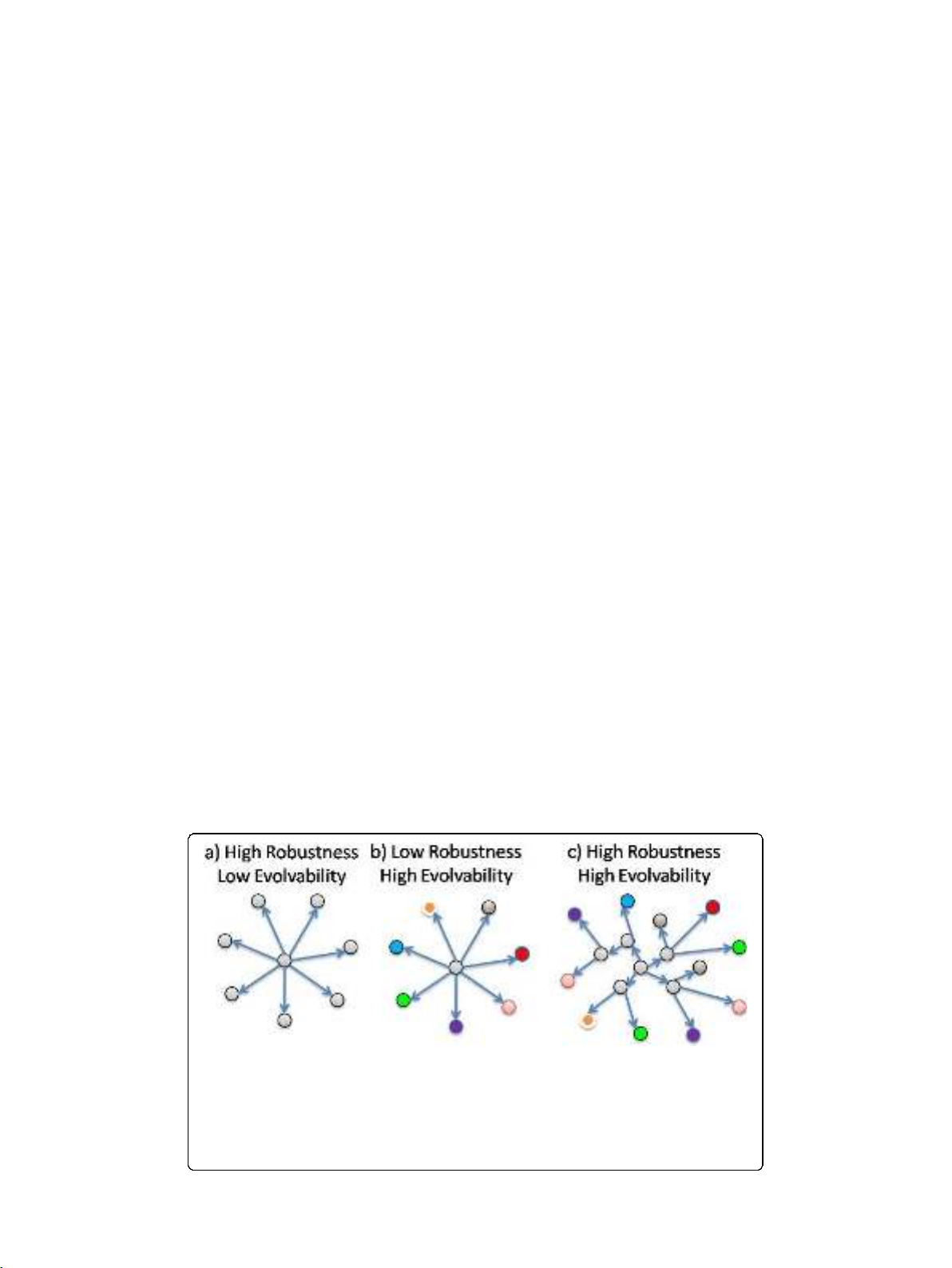
As an illustration of this conflict, the first two panels in Figure 2 show how high pheno-
typic robustness appears to imply a low production of heritable phenotypic variation [4].
These graphs reflect common intuition that maintaining developed functionalities while at
the same time exploring and finding new ones are contradictory requirements of
evolution.
Figure 2 The conflicting properties of robustness and evolvability and their proposed resolution.A
system (central node) is exposed to changing conditions (peripheral nodes). Robustness of a function
requires minimal variation in the function (panel a) while the discovery of new functions requires the
testing of a large number of functional variants (panel b). The existence of a neutral network may allow for
both requirements to be met (panel c). In the context of a fitness landscape, movement along edges of
each graph would reflect changes in genotype while changes in color would reflect changes in
phenotype.
Whitacre Theoretical Biology and Medical Modelling 2010, 7:6
http://www.tbiomed.com/content/7/1/6
Page 4 of 17

Resolving the robustness-evolvability conflict
However, as demonstrated in [4] and illustrated in panel c of Figure 2, this conflict is
unresolvable only when robustness is conferred in both the genotype and the phenotype.
On the other hand, if the phenotype is robustly maintained in the presence of genetic
mutations, then a number of cryptic genetic changes may be possible and their accumu-
lation over time might expose a broad range of distinct phenotypes, e.g. by movement
across a neutral network. In this way, robustness of the phenotype might actually
enhance access to heritable phenotypic variation and thereby improve long-term
evolvability.
The work by Ciliberti et al [6] represents a useful case study for understanding this
resolution of the robustness/evolvability conflict, although we note that earlier studies
arguably demonstrated similar phenomena [7,8]. In [6], the authors use models of gene
regulatory networks (GRN) where GRN instances represent points in genotype space
and their expression pattern represents an output or phenotype. Together the genotype
and phenotype define a fitness landscape. With this model, Ciliberti et al find that a
large number of genotypic changes to the GRN have no phenotypic effect, thereby
indicating robustness to such changes. These phenotypically equivalent systems con-
nect to form a neutral network NN in the fitness landscape. A search over this NN is
able to reach nodes whose genotypes are almost as different from one another as ran-
domly sampled GRNs. The authors also find that the number of distinct phenotypes
that are in the local vicinity of NN nodes is extremely large, indicating a wide variety
of accessible phenotypes that can be explored while remaining close to a viable pheno-
type. The types of phenotypes that are accessible from the NN depend on where in the
network that the search takes place. This is evidence that cryptic genetic changes
(along the NN) eventually have distinctive phenotypic consequences.
In short, the study presented in [6] suggests that the conflict between robustness and
evolvability is resolved through the existence of a NN that extends far throughout the
fitness landscape. On the one hand, robustness is achieved through a connected net-
work of equivalent (or nearly equivalent) phenotypes. Because of this connectivity,
some mutations or perturbations will leave the phenotype unchanged, the extent of
which depends on the local NN topology. On the other hand, evolvability is achieved
over the long-term by movement across a neutral network that reaches over truly
unique regions of the fitness landscape.
Robustness and evolvability are not always compatible
A positive correlation between robustness and evolvability is widely believed to be con-
ditional upon several other factors, however it is not yet clear what those factors are.
Some insights into this problem can be gained by comparing and contrasting systems
in which robustness is and is not compatible with evolvability.
In accordance with universal Darwinism [9], there are numerous contexts where
heritable variation and selection take placeandwhereevolutionaryconceptscanbe
successfully applied. These include networked technologies, culture, language, knowl-
edge,music,markets,andorganizations.Although a rigorous analysis of robustness
and evolvability has not been attempted within any of these domains, there is anecdo-
tal evidence that evolvability does not always go hand in hand with robustness. Many
technological and social systems have been intentionally designed to enhance the
robustness of a particular service or function, however they are often not readily
Whitacre Theoretical Biology and Medical Modelling 2010, 7:6
http://www.tbiomed.com/content/7/1/6
Page 5 of 17


![Báo cáo seminar chuyên ngành Công nghệ hóa học và thực phẩm [Mới nhất]](https://cdn.tailieu.vn/images/document/thumbnail/2025/20250711/hienkelvinzoi@gmail.com/135x160/47051752458701.jpg)