

REVIEW ARTICLE
Review of Euratom projects on design, safety assessment,
R&D and licensing for ESNII/Gen-IV fast neutron systems
Konstantin Mikityuk
1,*
, Luca Ammirabile
2
, Massimo Forni
3
, Jacek Jagielski
4
, Nathalie Girault
5
,
Akos Horvath
6
, Jan-Leen Kloosterman
7
, Mariano Tarantino
8
, and Alfredo Vasile
9
1
PSI, Forschungsstrasse 111, 5232 Villigen PSI, Switzerland
2
JRC, Westerduinweg 3, 1755 LE Petten, The Netherlands
3
ENEA, Via Martiri di Monte Sole, 4, 40129 Bologna, Italy
4
NCBJ, A. Soltana 7, 05-400 Otwock/Swierk, Poland
5
IRSN, 13115 St-Paul-lez-Durance, France
6
MTA EK, Konkoly Thege M.
ut 29-33, 1121 Budapest, Hungary
7
TU DELFT, Mekelweg 15, 2629 JB Delft, The Netherlands
8
ENEA, FSN-ING, C.R. Brasimone, 40032 Camugnano, Italy
9
CEA, 13115 St-Paul-lez-Durance, France
Received: 12 March 2019 / Accepted: 4 June 2019
Abstract. Nine Euratom projects started since late 2011 in support of the infrastructure and R&D of the seven
fast reactor systems are briefly presented in the paper in terms of key objectives, results and recommendations.
1 Introduction
In November 2010 Sustainable Nuclear Energy Technology
Platform (SNETP) set up a Task Force comprising
research organisations and industrial partners to develop
the European Sustainable Nuclear Industrial Initiative
(ESNII) addressing the need for demonstration of Genera-
tion-IV Fast Neutron Reactor technologies, together with
the supporting research infrastructures, fuel facilities and
research and development (R&D) work.
SNETP has prioritised the different Generation-IV
systems and is proposing to develop the following projects:
the sodium-cooled fast neutron reactor technology
ASTRID as the reference solution; the lead-cooled fast
reactor ALFRED supported by a lead-bismuth irradiation
facility project MYRRHA as a first alternative; the gas-
cooled fast reactor ALLEGRO as a second alternative. The
Molten Salt Fast Reactor (MSFR) is considered as a very
attractive long-term option.
The EU framework programs have supported the R&D
activities on these five systems as well as on two other
Generation-IV technologies: European Sodium Fast
Reactor (ESFR) and Swedish Advanced Lead Reactor
(SEALER). All seven fast neutron systems are presented
in Figure 1.
The paper briefly presents in terms of key objectives,
results and recommendations nine Euratom projects
started since late 2011 in support of the infrastructure
and R&D of the seven fast reactor systems presented above
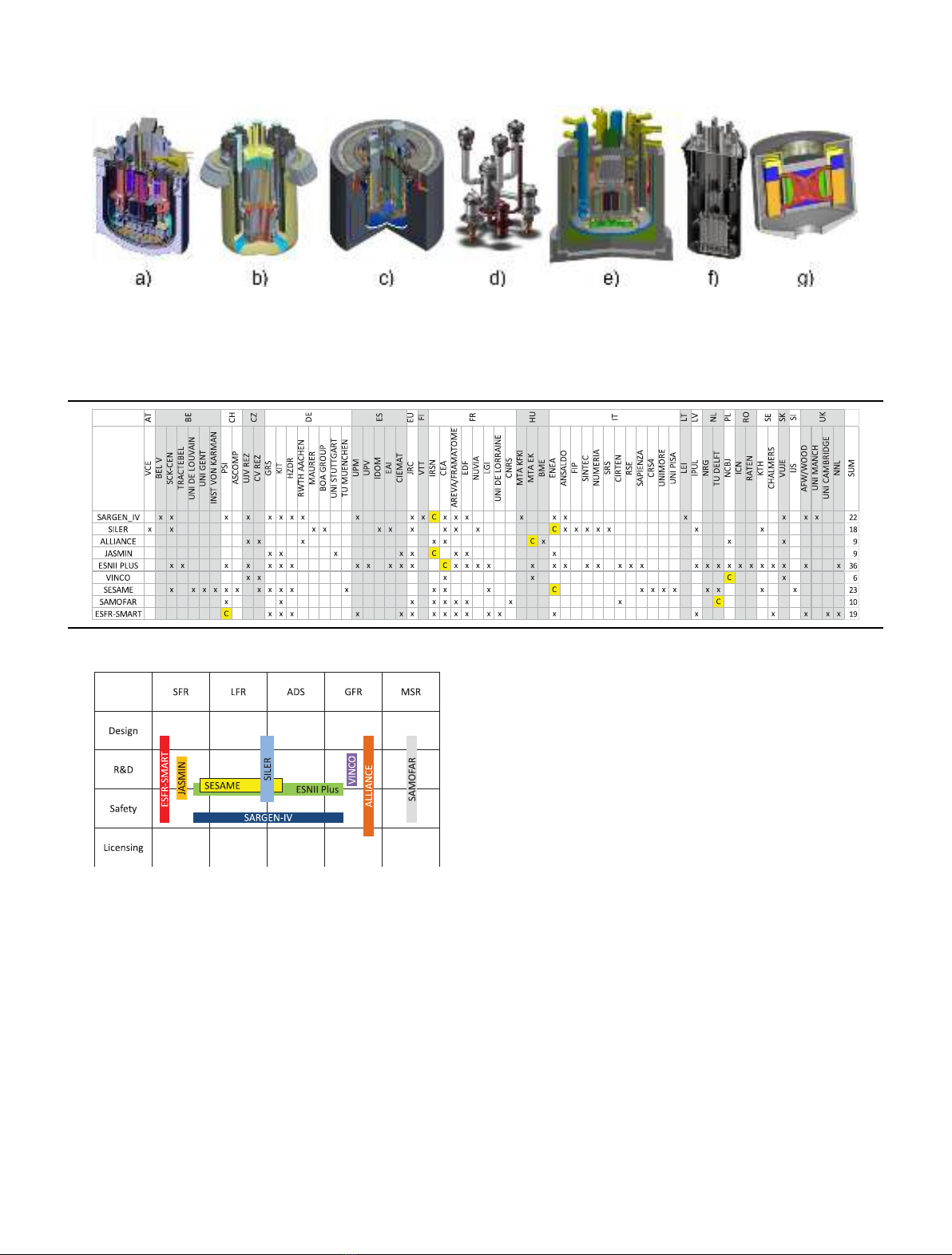
(see Fig. 1). Table 1 presents the list of the project
acronyms, participants and coordinators. Figure 2 presents
domains and categories of advanced systems, while Table 2
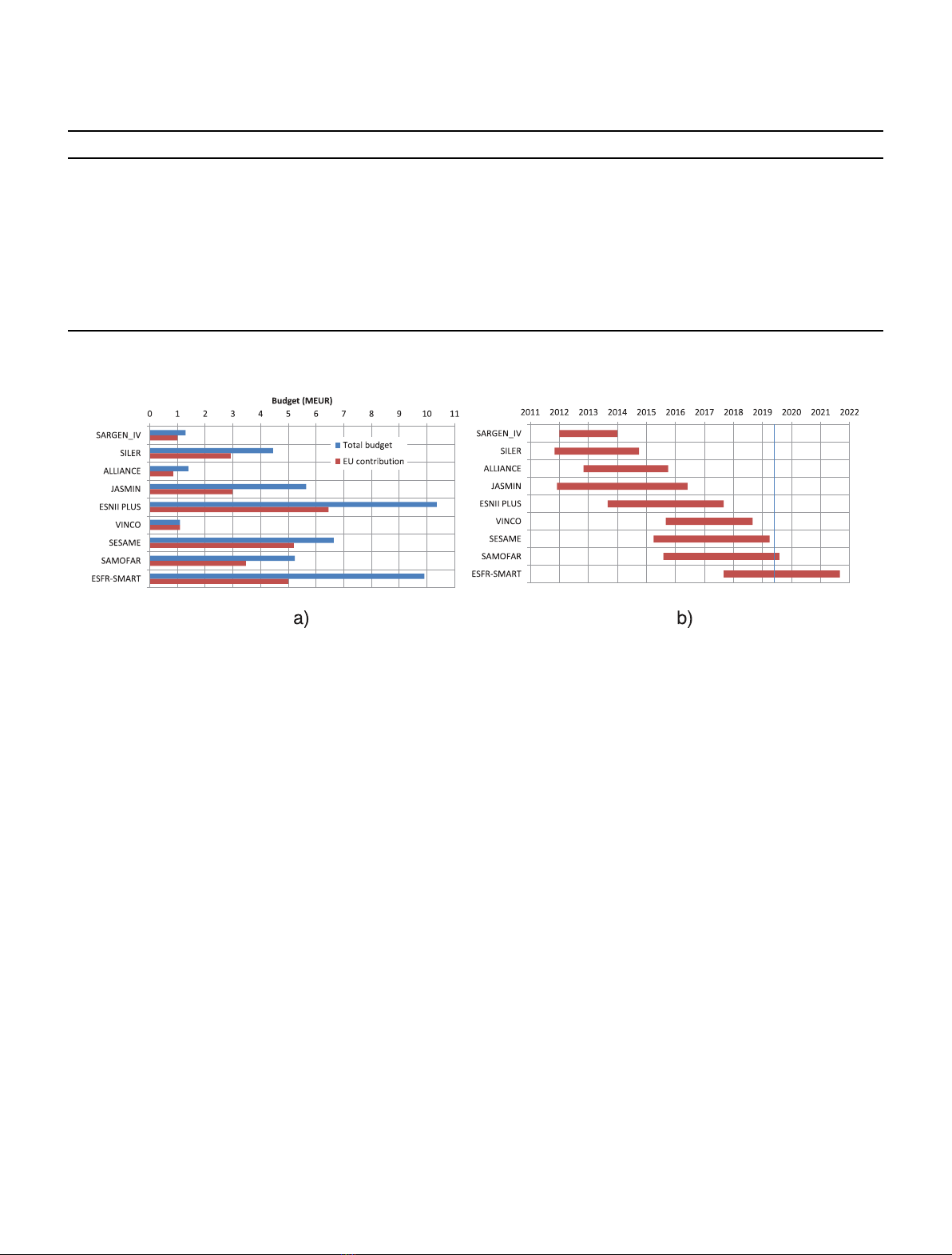
gives more details about the R&D areas. Finally, Figure 3
presents the budgets and time spans of the presented
projects.
2 SARGEN_IV: Proposal for a harmonized
European methodology for the safety
assessment of innovative reactors with fast
neutron spectrum planned to be built
in Europe
2.1 Key objectives
The safety of innovative reactors needs to be addressed in a
comprehensive and robust manner while demonstrating a
level of safety acceptable for the general public. Having a
European consensus on the methodology and safety criteria
that will be used to assess innovative reactors becomes of
prime importance with an impact on any further design
activities.
*e-mail: konstantin.mikityuk@psi.ch
EPJ Nuclear Sci. Technol. 6, 36 (2020)
©K. Mikityuk et al., published by EDP Sciences, 2020
https://doi.org/10.1051/epjn/2019007
Nuclear
Sciences
& Technologies
Available online at:
https://www.epj-n.org
This is an Open Access article distributed under the terms of the Creative Commons Attribution License (http://creativecommons.org/licenses/by/4.0),
which permits unrestricted use, distribution, and reproduction in any medium, provided the original work is properly cited.
With the goal of preparing the future assessment of
these advanced reactor concepts, the European project
SARGEN_IV gathered safety experts from 22 partners
from 12 EU Member States: recognized European Techni-
cal Safety Organizations (TSOs), the Joint Research
Centre of the EC, Designers and Vendors as well as from
Research Institutes and Universities in order to:
–identify the critical safety features of the selected Genera-
tion-IV concepts, relying on the outcomes from existing
projects from the 7th Framework Programme (FP7);
–develop and provide a tentative commonly agreed
methodology for the safety assessment, relying on the
outcomes of the investigations carried out within
international organizations (such as IAEA, WENRA,
OECD/NEA), on national practices presently in use and
on practices proposed within other European Framework
Programs projects;
–identify open issues in the safety area, mainly addressing
and focusing on assessment relevant ones, detect and
underline new fields for R&D in the safety area
(addressing methodological, theoretical and experimen-
tal issues, as well) in order to provide a roadmap and
preliminary deployment plan for the fast reactor safety-
related R&D.
The project partners were convinced that fostering the
harmonization of the various European safety approaches
would have been very beneficial and would have stream-
lined Euratom contribution to Generation-IV Internation-
al Forum in the safety field. It was also meant to improve
relationship between safety assessment needs and research
programmes efficiency in the development of new concepts.
A particular attention was addressed to take into
account the lessons learned from the Fukushima-Daiichi
nuclear accident that will impact significantly the
research and development needed for demonstration of
Generation-IV reactor safety.
2.2 Key results
2.2.1 WP2: identification of the major safety features
In the project, a review on the safety issues was performed
for each ESNII concept: SFR, LFR, GFR and MYRRHA
Fig. 1. Seven fast neutron systems supported by the considered EU project: ASTRID (a); ALFRED (b); MYRRHA (c);
ALLEGRO (d); ESFR (e); SEALER (f); MSFR (g).
Table 1. Participants and coordinators of the considered EU projects.
Fig. 2. Domains and advanced systems of interests of the
considered EU project.
2 K. Mikityuk et al.: EPJ Nuclear Sci. Technol. 6, 36 (2020)
FASTEF. A list of the initiating events was also identified
and categorised according to their occurrence frequency.
A conclusive deliverable [1] gathered the main results for
each of the three concepts and a focus was performed to
identify phenomena able to affect more than one concept, i.e.
–for the coolant: sensitivity to impurities, coolant activity,
retention of fissions products, toxicity, opacity;
–for the structural materials: corrosion, erosion, irradia-
tion behaviour;
–issues in relation with fast reactors: sensitivity to
blockage, power density, core compaction, reactivity
void effects, handling hazards, failure of the core
supporting structures;
–management of the three safety functions (reactivity
control, decay heat removal, containment);
–capability to cool the core by natural circulation;
–sensitivity to external events (flooding, earthquake);
–considerations on the Fukushima-Daiichi TEPCO events
(extreme flooding, extreme earthquake, total loss of
electric supply, accident management);
–categorisation of initiating event organised by challenges:
challenge to clad integrity, challenge to reactor bound-
ary, containment challenge.
This work gave a useful guidance for the identification
and the prioritisation of the R&D needs respective to the
identified safety issues. In particular it was pointed out that
efforts have to be performed to define the severe accident
for each concept and to develop requirements for the
containment in order to practically eliminate large and
early releases.
2.2.2 Develop and provide a tentative commonly agreed
methodology for the safety assessment
In the scope of the development and the licensing of the
above mentioned ESNII prototypes in Europe, it appeared
crucial to develop a tentative commonly agreed assessment
methodology able to be applied to each of the four above
mentioned concepts and based on the safety issues
identified.
Firstly, it performed a review of the safety methodolo-
gies proposed by international organizations and those
issued from national practices and European consortia.
This included:
–INPRO methodology proposed by IAEA and ISAM
proposed by the GIF;
–experience feedback for safety assessment from national
TSOs approaches (from Finland, France, Belgium,
Spain, Germany);
–safety approach proposed for European projects related
to gas cooled, lead cooled and sodium cooled fast reactors;
–safety approach proposed by international organisations
(IAEA, WENRA, NEA/MDEP).
Table 2. R&D areas of the considered EU project.
TH & CFD Neutronics Fuel Seismic Multiphysics
SILER x
ALLIANCE x x
JASMIN x x x
ESNII Plus x x x x x
VINCO x
SESAME x
SAMOFAR x x x
ESFR-SMART x x x x
Focus of SARGEN_IV project is safety assessment
Fig. 3. Budget (a) and time span (b) of the considered EU project.
K. Mikityuk et al.: EPJ Nuclear Sci. Technol. 6, 36 (2020) 3

2.3 Recommendations for the future
On the basis of the reviews mentioned above that led to
numerous recommendations, the SARGEN_IV consor-
tium prepared a proposal [2] for the safety assessment
practices targeting the Generation-IV prototypes to be
built in Europe.
Some of the most important recommendations are as
follows:
–the safety assessment should cover the whole nuclear
plant (reactor, fresh and spent fuel storage);
–the entire life on the plant (from commissioning to
decommissioning) should be addressed;
–safety assessment should integrate the security/safe-
guards aspects;
–the consequences of chemical releases have to be taken
into account in the design;
–the defence-in-depth (DiD) principle remains a funda-
mental principle for the safety of innovative reactors and
an important topic is to define accurately the level 4 of
DiD for each concept;
–accident sequences that could lead to large or early
releases have to be practically eliminated.
3 SILER: Seismic-Initiated Events Risk
Mitigation in Lead-cooled Reactors
SILER is a collaborative project, partially funded by the
European Commission in the 7th Framework Programme,
aimed at studying the risk associated with seismic-initiated
events in Generation-IV Heavy Liquid Metal reactors, and
developing adequate protection measures. The attention of
SILER is focused on the evaluation of the effects of
earthquakes, with particular regards to beyond-design
seismic events, and to the identification of mitigation
strategies, acting both on structures and components
design. Special efforts are devoted to the development of
seismic isolation devices and related interface components.
Two reference designs, at the state of development
available at the beginning of the project and coming from
the 6th Framework Programme, have been considered:
ELSY (European Lead Fast Reactor) for the Lead Fast
Reactors (LFR), and MYRRHA (Multi-purpose hYbrid
Research Reactor for High-tech Applications) for the
Accelerator-Driven Systems (ADS).
3.1 Key objectives
One of the main goals of SILER was the development and
experimental qualification of seismic isolators for lead-
cooled reactors (but applicable to any other nuclear plant).
3.2 Key results
Two device typologies have been considered: High Damp-
ing Rubber Bearings (HDRBs) and Lead Rubber Bearings
(LRBs). Both isolators have been designed (for ELSY and
MYRRHA, respectively), manufactured and tested in
different sizes, even to the full scale, which results to be
greater than one meter, due to the huge mass of the reactor
buildings. In particular, a prototype has been subjected to
three-directional dynamic tests (at the Department of
Structural Engineering of the San Diego University) under
the real service loads up to failure, which occurred well
beyond the design conditions.
The adoption of base isolation provides a great
reduction of the acceleration and inertial forces in the
structure, providing very important benefits to the
components and the structure itself, but introduces
significant relative displacements between the isolated
and conventionally founded parts of the plant. Thus, a
seismic gap of suitable width shall surround the entire
isolated “island”. Of course, it shall be adequately protected
from bad weather (included floods) and other possible
damages, and kept free during the whole life of the
structure, in order to allow for relative movements in case
of earthquake. Moreover, all the service networks and
pipelines crossing the seismic gap shall be provided with
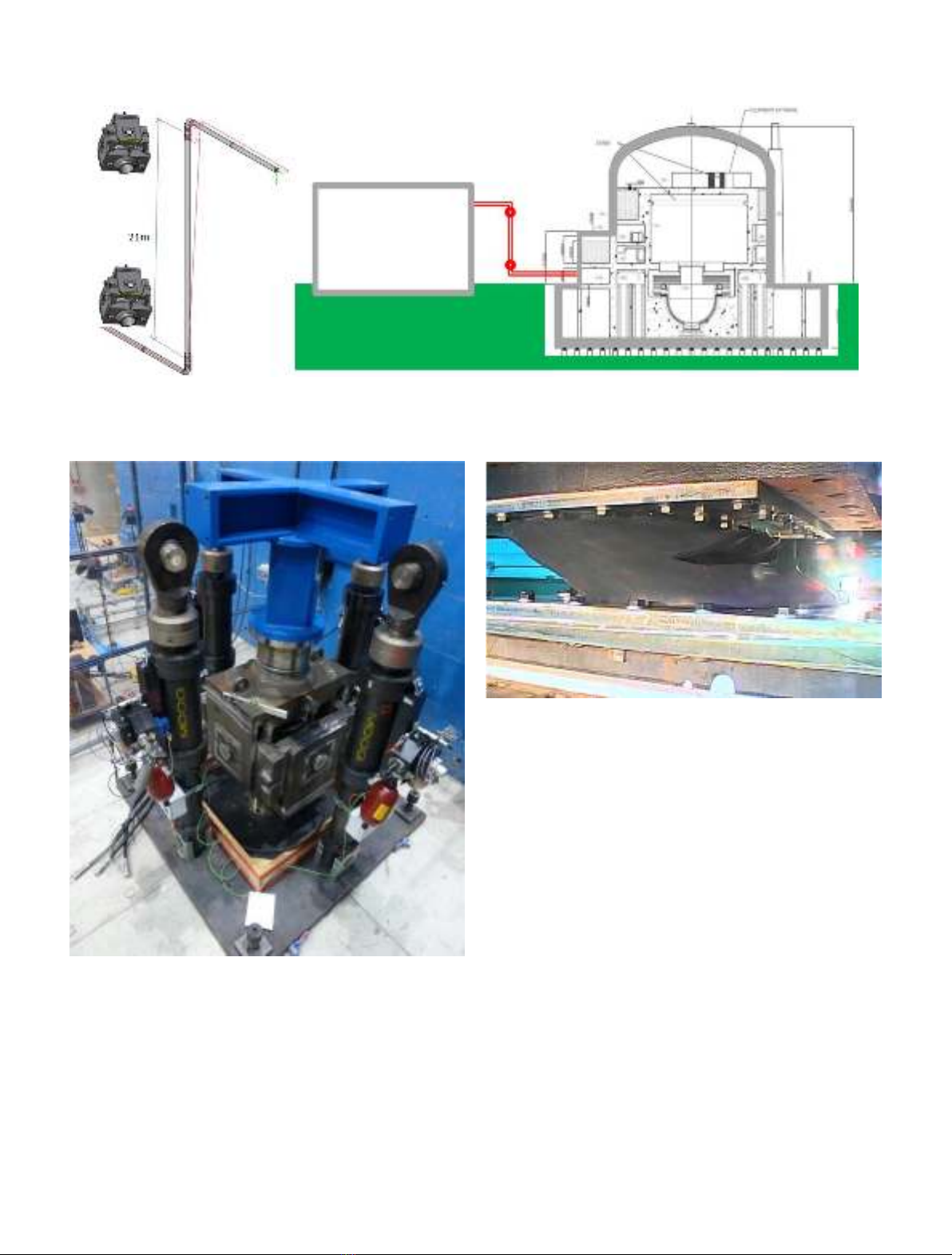
suitable expansion joints. In SILER, both devices have
been developed and successfully tested in full scale and in
real operational conditions, even beyond the design limit
(see Figs. 4–6). It is worth noting that, due the severe
seismic condition assumed in the design of nuclear plants,
the relative displacement can reach 0.7–0.8 m in beyond-
design situations.
In SILER, several critical components of ELSY and
MYRRHA (like vessel, pumps, proton beam, etc.) have
been numerically modelled and carefully analysed under
severe seismic conditions, taking also into account the
effects of the sloshing of the liquid lead and the soil-
structure interaction.
Particular attention has been devoted to the cost-
benefit analysis related to the adoption of seismic isolation,
which resulted to be positive. Moreover, according to the
indication of EC, the main results of the project have been
disseminated through the organization of seminars,
courses, workshops and the implementation of a web site
(http://www.siler.eu).
3.3 Recommendations for the future
In particular, guidelines for design, manufacturing,
qualification, installation and maintenance of seismic
isolators for nuclear plants have been delivered. This
document is particularly important, due to the lack of
international rules regarding the seismic isolation of
nuclear plants (at the time of the project at least).
More information about the SILER Project main
results can be founded in references [3,4].
4 ALLIANCE: Preparation of ALLEGRO
implementing advanced nuclear fuel cycle
in central Europe
Gas cooled fast reactors (GFR) represent one of the three
European candidate fast reactor types, the two other being
sodium cooled fast reactor (SFR) and lead cooled fast
reactor (LFR). Technically, GFR is a realistic and
promising complementary option thanks to its specific
4 K. Mikityuk et al.: EPJ Nuclear Sci. Technol. 6, 36 (2020)
advantages connected with high temperatures. The GFR
concept was mainly based on studies performed in France
in the late 1990s and was further developed within the EU
5th and 6th Framework Programmes, respectively. It also
included the development and safety assessment of a small
experimental plant called at the time ETDR (Experimen-
tal Technology Demonstration Reactor). This plant was
regarded as a necessary stepping-stone to a full-sized GFR
in order to test the high-temperature fuel required by the
latter. The concept was further analysed and refined by the
EU FP7 GoFastR project: the ETDR has been renamed
ALLEGRO (see Fig. 8) and a number of design changes
were introduced, e.g. the power was raised from the original
50 MWth to 75 MWth. ALLEGRO would function not only
as a demonstration reactor hosting GFR technological
experiments, but also as a test pad of using the high
temperature coolant of the reactor in a heat exchanger for
generating process heat for industrial applications and a
research facility which, thanks to the fast neutron
spectrum, makes it attractive for fuel and material
development and testing of some special devices or other
research works.
The three respective nuclear research institutes of the
Central European region (
UJV, Řež, Czech Republic,
MTA EK, Budapest, Hungary, and V
UJE, a.s., Trnava,
Slovakia) agreed in 2010 to start a joint project aiming at
the preparation of the basic documents in order to form the
Fig. 6. Three-directional dynamic test performed at SRMD on a
full-scale (1350 mm diameter) HDRB. After partial damage
occurred close to 300% shear strain (almost three times the design
value), the isolator was successfully subjected to a full cycle under
the design load at the design conditions.
Fig. 4. Sketch of the pipeline connecting the seismically isolated reactor building of ELSY and the turbine, provided with two flexible
joints to adjust the relative displacements.
Fig. 5. Full scale pipeline expansion joint during seismic tests at
the ELSA laboratory of the JRC of Ispra.
K. Mikityuk et al.: EPJ Nuclear Sci. Technol. 6, 36 (2020) 5


![Bài giảng Thử nghiệm và kiểm định kỹ thuật ô tô [Mới nhất]](https://cdn.tailieu.vn/images/document/thumbnail/2025/20250723/kimphuong1001/135x160/11971753240182.jpg)




![Đề thi Động cơ đốt trong kết thúc học phần: Tổng hợp [năm]](https://cdn.tailieu.vn/images/document/thumbnail/2026/20260320/hoabattu2026/135x160/24841774320014.jpg)


