MINISTRY OF EDUCATION AND TRAINING
NATIONAL ECONOMICS UNIVERSITY
-----------------------------------
HOANG MANH HUNG
MODELS TO ANALYZE THE IMPACT OF FOREIGN
DIRECT INVESTMENT ON ECONOMIC RESTRUCTURING
IN VIETNAM
MAJOR: ECONOMICS
(MATHEMATICAL ECONOMICS)
Code: 9310101_TKT
ABSTRACT OF ECONOMICS DOCTORIAL THESIS
HANOI - 2020
THIS THESIS SUBMITTED IN FULFILLMENT
IN NATIONAL ECONOMICS UNIVERSITY
Supervisor: PROF.DR. NGUYEN KHAC MINH
Reviewer 1:
Reviewer 2:
Reviewer 3:
The dissertation is defended at the Council of thesis
National Economics University
At: (time, date)
The dissertation can be found at:
- National Library
- Library of National Economics University

1
INTRODUCTION
1. The reason for choosing the topic
The operations of multinational companies (MNEs) have increased
dramatically worldwide in recent years in connection with strong inflows of
foreign direct investment (FDI) in many countries. Participating in the economy
and often operating in relatively efficient regions, MNEs can pull economic
activities away from industries having low productivity, and thus contribute to
economic restructuring effectively. Besides, the potential link between FDI and
structural transformation is related to a development policy because structural
change has been identified as a key factor in economic development.
Vietnam is one of the successful countries in attracting this capital for the
development process. FDI has strongly contributed to promote the process of
economic restructuring in our country. Since the inflow of FDI has flow into, it
has brought about the appearance of many new economic sectors and industries.
Labor productivity of many industries has increased significantly, contributing to
increase the proportion of these industries in the economy, in which there is a
large contribution of FDI from promoting technical and engineering levels from
these industries.
Quantitative assessment of the effects of FDI on the process of economic
restructuring in our country in the current international economic integration is a
very necessary, significant, and highly practical. Those assessments allow us to
propose feasible solutions to promote the positive effects and limit the negative
effects of this capital source on economic restructuring. The thesis "Models to
analyze the impact of foreign direct investment on economic restructuring in
Vietnam" is implemented to partly solve the above urgent problems.
2. Research objectives
The general objective of the thesis is to appoint and select suitable models
for analyzing the impact of FDI on economic restructuring, in which the thesis
focus on the level of transformation and structural imbalance. From then, the
author gives some recommendations on policy to improve the contribution
efficiency of FDI on the process of economic restructuring in our country.
2
3. Object and scope of the study
- Research object: models to analyze the effects of FDI on the process of
economic restructuring.
- Research scope: the space is 60 provinces and cities; the time is the period
2000-2017.
4. Method of research
- Methods of synthesis, comparison and statistical analysis.
- The method of quantitative research. The thesis uses appropriately
designated models to estimate the impact of FDI on economic restructuring.
5. Scientific and practical significance
- The thesis has clarified a number of theories about economic restructuring
as well as the theory of the impact of FDI on the restructuring process of the host
country.
- Clearly analyze the current situation of FDI inflows and the process of
economic restructuring in Vietnam to highlight the effects of FDI on the shaping
of structural industries in our economy through the allocation of this capital
inflow.
- Synthesize and analyze a relatively diverse of the different methods of
measuring economic restructuring, which are widely used in current research in
the world.
- Analysis to clarify the characteristics and advantages of the estimation
methods used in estimating models to see the effectiveness as well as to ensure
the reliability when using the estimation results to support the analysis of
economic relationships.
- Quantify the effects of FDI along with other factors on the level of
economic restructuring in Vietnam including short and long term effects obtained
from dynamic panel data models, direct and indirect effects from spatial dynamic
panel data models.
- Evaluate the level of imbalance and factors affecting the imbalance in the
structure of each sector and of the whole economy. These are useful scientific
evidence for the managers in making policies on attracting FDI and allocating
resources for the process of economic restructuring in Vietnam.
3
Chapter 1
THEORETICAL BASIS AND RESEARCH OVERVIEW ON THE
IMPACTS OF FDI TO ECONOMIC RESTRUCTURING
1.1. Sector structure and economic restructuring
1.1.1 Economic structure
The structure of the economic can be understood as "the correlation between
the sectors in the whole economy, showing the organic relationship and the
interaction in both quantity and quality among sectors. These relationships are
formed in certain socio-economic conditions, always moving towards and
targeting specific goals ”(Ngo Thang Loi, 2013, p.162).
1.1.2. Economic restructuring
The economic restructuring refers to changes in the sectoral structure of an
economy and can be defined as a transition from sectors having low productivity
and labor-intensive to the sectors with higher productivity and the industries that
consume many skills or knowledge of an economy. The structure here refers to
the relative proportion of the agriculture, industry and service in the economy in
terms of added value, job creation, and the final consumption of goods and
service.
1.1.3. Factors leading the change in sector structure
- The change in demand for goods comes from a change in income.
- Differences in TFP growth across sectors.
- The difference in the elasticity of output by input between sectors.
- Movement in the production of intermediate goods between sectors.
- The change of comparative advantage through trade.
1.2. Some theoretical models of economic restructuring
1.2.1. Arthur Lewis's two-sector model
The two-sector Lewis model focuses on economic restructuring of the
economy mainly on self-sufficiency (Todaro and Smith, 2009). This model
became the general theory of development in developing countries with surplus
labor in the 1960s and early 1970s. Arthur Lewis described economic
development as a result of a change of structure in the two main sectors of the
developing economy. The traditional agricultural sector, characterized by an
4
abundant and unskilled workforce, whose marginal productivity (MPL) is close
to zero, and the modern sector is characterized by higher wages, advanced
techniques production and positive marginal productivity of labor.
1.2.2. A model of stages in economic growth by Walt Rostow
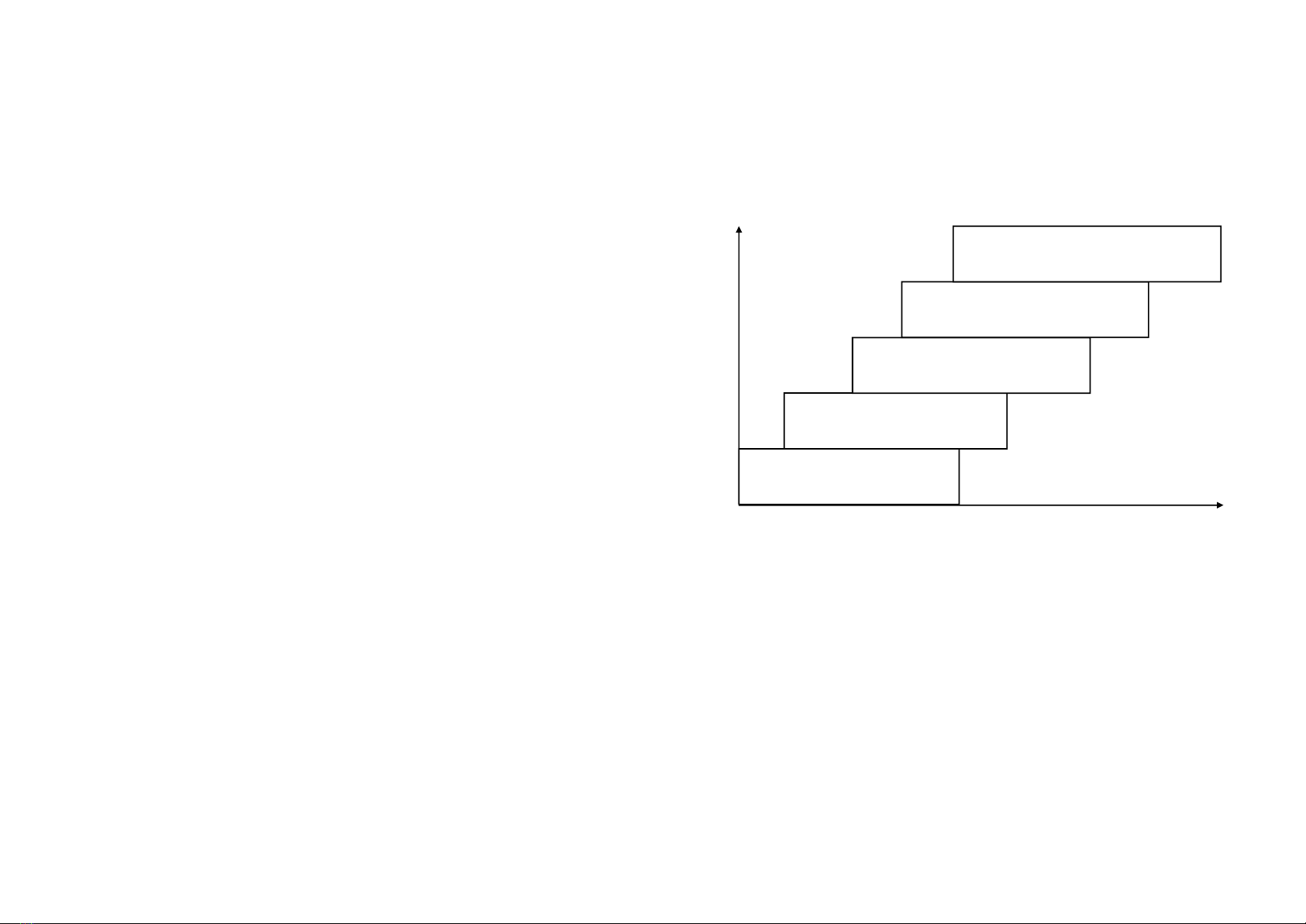
Summary of 5 stages of development of Walt Rostow over time is shown in
figure 1.3.
Figure 1.3 Diagram of Rostow's 5 stages of development
1.3. Theory of impacts of foreign direct investment on economic
restructuring
1.3.1. Theory of the Investment Development Path
The theory of Investment Development Path (IDP) hypothesizes that there is
a relationship between a country's net of foreign direct investment and its level of
economic development. The premise of this theory has two sides: it sees economic
development as a process of structural change and this structural change affects
the morphology of both foreign direct investment in and outbound, and thus,
affecting the position of the net of foreign direct investment. In the stylized form
of IDP theory, countries develop through the five stages. This evolution took place
in response to the changing conditions of specific advantages of the country’s
location, and thus, on the one hand, its appeal to foreign investors, on the other
hand, it gradually upgrades the characteristic advantages of ownership of
domestic enterprises. According to IDP theory, when moving along the stages of
Time
Development level
Traditional social period
(livelihoods, bartering, agriculture)
Period of Transition
(specialization, surplus, infrastructure)
Period of taking off
(Industrialization, increased investment, regional
growth, political change)
Mature period
(diversification, innovation, less dependence on
imports and investment)
Period of high level of consumption (consumer
oriented, prosperous durable goods, dominant service
sector)

5
development, the economic structure of both the investment country and the FDI
recipient country has shifted. In the process of outward investment as well as
accepting investment, the comparative advantage of these countries will shift to
respond to and to create new advantages to attract FDI. In the opposite direction,
the participation of the FDI inflow and outflow also adjust the economic structure
of the accepting investment country and country implementing investment.
1.3.2. The "flying geese" model
The "flying geese" model showed that differences in the importance of
production factors in the stages of development of products gave rise to the law
of advantage shift. In order to restructure the economy, innovate the technical
structure, modernize the economy, focus on research and development of key
industries to dominate and control the world economy, the leading countries
always have a need to shift “outdated industries”, outdated techniques, and “aged
products” to the following countries in order to focus capital on developing new
industries and technologies, at the same time, extending the "lifespan" of our
technologies and products, thereby generating high profits. Similarly, the
following countries also have a need to shift investment in technology and
products for which they have lost their comparative advantage to less developed
countries. This process of transferring technology takes place in many different
forms, which may be through the form of FDI. And it has changed the face of
economies at a lower level of technology, accelerating the process of regional
assignment and cooperation and regional linkage. In addition, it also created a
shift in the economic structure of the countries participating in the "flying geese",
in particular a shift towards industrialization and modernization of the economy.
1.3.3. Model of upgrading the sector
An improved version of the "flying geese" model was the industrial
upgrading model, in which it described the structural change of Japan since 1950
and clearly demonstrated the role of FDI as a moderator of structural change.
According to this model, a country's industrial structure undergoes four
successive transitions. In each stage, there is a specific group of industries that
dominate the industrial structure by possessing comparative advantages. Ozawa
also found that there was a specific correspondence according to the stages
between structural upgrading and forms of FDI that lead to a model of similar
phases in FDI activity.
6
1.4. Overview of empirical studies on the effects of FDI on economic
restructuring
Studies in the world on the effects of FDI on economic restructuring have
been carried out for groups of countries (Kalotay, 2010; Gui-Diby and Renard,
2015; Ssozi and Bbaale, 2019, ...) as well as individual countries (Blomström et
al., 2000 for Japan; Zorska, 2005 for Poland; Liang and Bing, 2010 for Korea;
Huang Na, 2011 and Jiang, 2014 for China,…). These studies have been based on
various research methods from qualitative research to quantitative research with
the use of the models of time series regression and the panel regression model.
The results obtained largely support the assumption that FDI positively supported
the economic restructuring of the host country in the direction of increasing the
proportion of the industrial and service sectors, and gradually reducing the
proportion of the agricultural sector, in both output and labor.
Besides, a number of other studies have also examined the impact of FDI on
the restructuring of the industry and the structure of international trade of the host
country.
Research on the effects of FDI on economic restructuring in Vietnam is still
limited. In terms of methodology, the studies available were classified into two
groups. The first group mainly focused on theoretical basis as well as on
descriptive statistics to make judgments about the effects of FDI on economic
restructuring. The second group provided results based on quantitative models.
The conclusions of these studies all had a unified point that confirmed the positive
effects of FDI on the process of the economic restructuring. Most of the
aforementioned studies all used the proportion of industries representing
economic restructuring, the proportion of which only shows the economic
structure at a static time and the sectors were independent of each other. This
seems unreasonable when the economic structure is often shown as a dynamic
object and needs to be considered the economic restructuring in the general
context of all sectors in the economy. Therefore, it is necessary to continue to
clarify this relationship under different approaches to get more accurate
conclusions for the dynamic relationship between FDI and the economic
restructuring.

7
Chapter 2
METHOD OF RESEARCH
2.1. Measure the economic restructuring
- Proportion of the sectors
- Absolute value index (NAV)
=0,5.|
|, =2,…,;=1,… , 1
- Modified Lilien index
=
.
.
,
>0;
>0
- Measure the speed of restructuring based on vector method
cosθ=∑a
a
∑a
.∑a
- Some other approaches
+ Use a component in the disintergration of overall productivity, considering
it represents the change in labor structure
=
=
+
+ The index "changing structure efficiently " of Vu (2017)
=0.5 ∑|
|
∈ ,
={}
sao cho
>0
in which,
iT
S
and
0i
S
are the labor proportion of industry i at time T and 0; Ci is
identified by
=
+
2.2. Measure the imbalance of the economic structure
Let
and
respectively the added value and labor of industry i Ando and
Nassar (2017) defined the following values:
∑
∑
,
8
Thus, each
reflects the difference between the proportion of labor and the
proportion of industrial productivity of the industry i. The distance d = 0 equates
to equal productivity across sectors.
2.3. Several panel models
2.3.1. Static panel data models
=
+
+
The thesis in turn examines the model with estimates including POLS, FE,
RE and FGLS to choose a suitable model for static panel data model.
2.3.2. Dynamic panel data models
=
,
+
+
+
The dynamic of restructuring is considered under dynamic panel data model.
The appearance of the lag variable of the dependent variable as an independent
variable giving rise to endogenous problem. The thesis uses the method of
estimating GMM to overcome this problem including IV-GMM, D-GMM and S-
GMM.
2.4. Spatial econometrics models
2.4.1. Static spatial panel models
=∑
+
+
+
()
=
+
+
,
=∑
+
()
=∑
+
+∑
+
+
()
2.4.2. Dynamic spatial panel models
Dynamic spatial panel models under consideration include the SAR and
SDM model.
=
,
+
+
,
+
+
+
()
=
,
+
+
,
+
+
+
+
()