

TNU Journal of Science and Technology
229(03): 66 - 74
http://jst.tnu.edu.vn 66 Email: jst@tnu.edu.vn
DEVELOPING A BALANCED SCORECARD FOR AUTOMOBILE
AND MOTORCYCLE MANUFACTURERS: A CASE STUDY AT
HONDA VIETNAM COMPANY
To Thi Ngoc Lan, Le Thi Tu Oanh, Ta Thi Thuy Hang*, Tran Thi Kim Chi
University of Labor and Social Affairs
ARTICLE INFO
ABSTRACT
Received:
04/9/2023
The Balanced Scorecard (BSC) is seen as an effective administrative tool
for enterprises to achieve their strategic objectives. Thanks to the
streamlined design of the four main perspectives including Finance,
Customer, Internal process, Learning and Growth, enterprises can
successfully realize strategic expectations. This paper aims to propose a
strategic map and key performance indicators (KPIs) in a balanced
scorecard that are consistent with the characteristics of Vietnam’s
automobile and motorcycle manufacturers, with an empirical study at a
typical enterprise, Honda Vietnam Company. The study was conducted
through surveys as well as in-depth interviews of 75 specialists,
representing the Sales, Planning, Manufacturing, Accounting, Customer
Care and Human Resources departments. Research results show that all
strategy targets receive high consensus from experts at a level above
"agree" (mean from 3.04 to 4.92). All 39/39 indicators to measure 21
strategy targets of Honda Vietnam Company were evaluated by experts
with an average value ≥ 3.5. Based on survey results, a balanced
scorecard was proposed with detailed steps, from designing the strategic
map and KPIs to integrating them into the management system in line
with Honda Vietnam Company’s strategic objectives.
Revised:
24/10/2023
Published:
24/10/2023
KEYWORDS
Balanced Scorecard
Honda Vietnam Company
Strategy target
Key performance indicators
Management system
XÂY DỰNG THẺ ĐIỂM CÂN BẰNG CHO DOANH NGHIỆP SẢN XUẤT Ô TÔ,
XE MÁY: NGHIÊN CỨU ĐIỂN HÌNH TẠI CÔNG TY HONDA VIỆT NAM
Tô Thị Ngọc Lan, Lê Thị Tú Oanh, Tạ Thị Thúy Hằng*, Trần Thị Kim Chi
Trường Đại học Lao động – Xã hội
THÔNG TIN BÀI BÁO
TÓM TẮT
Ngày nhận bài:
04/9/2023
Thẻ điểm cân bằng (BSC) được xem là một công cụ quản trị hữu hiệu giúp
cho doanh nghiệp đạt được mục tiêu chiến lược. Bằng sự thiết kế hợp lý của
bốn viễn cảnh chính là tài chính, khách hàng, quy trình nội bộ, học hỏi và
phát triển, các doanh nghiệp có thể thu được thành công, đáp ứng kỳ vọng
chiến lược. Mục đích của nghiên cứu này là đề xuất một bản đồ chiến lược
và các chỉ tiêu đánh giá hiệu quả (KPIs) theo thẻ điểm cân bằng phù hợp
với đặc thù của các doanh nghiệp sản xuất ô tô, xe máy tại Việt Nam, với
nghiên cứu thực nghiệm tại doanh nghiệp điển hình là Công ty Honda Việt
Nam. Nghiên cứu được thực hiện thông qua khảo sát kết hợp với phỏng vấn
sâu của 75 chuyên gia, đại diện cho các bộ phận Bán hàng, Lập kế hoạch,
Sản xuất, Kế toán, Chăm sóc khách hàng và Nhân sự. Kết quả nghiên cứu
cho thấy tất cả các mục tiêu đều nhận được sự đồng thuận cao của các
chuyên gia ở mức trên “đồng ý” (giá trị trung bình từ 3,04 đến 4,92). Tất cả
39/39 chỉ số để đo lường 21 mục tiêu chiến lược của Công ty Honda Việt
Nam đều được các chuyên gia đánh giá với giá trị trung bình ≥ 3,5. Dựa
trên kết quả khảo sát, một thẻ điểm cân bằng đã được đề xuất với các bước
chi tiết, từ thiết kế bản đồ chiến lược, các thước đo và tích hợp vào hệ thống
quản lý cho phù hợp với mục tiêu chiến lược của Công ty Honda Việt Nam.
Ngày hoàn thiện:
24/10/2023
Ngày đăng:
24/10/2023
TỪ KHÓA
Thẻ điểm cân bằng
Công ty Honda Việt Nam
Mục tiêu chiến lược
Chỉ tiêu đánh giá hiệu quả
Hệ thống quản lý
DOI: https://doi.org/10.34238/tnu-jst.8675
* Corresponding author. Email: hangulsa@gmail.com

TNU Journal of Science and Technology
229(03): 66 - 74
http://jst.tnu.edu.vn 67 Email: jst@tnu.edu.vn
1. Introduction
Balanced scorecard (BSC) was first known in 1992 as introduced by Kaplan and Norton.
Accordingly, a balanced scorecard is a planning and performance measurement tool, aiming to
transform the overall vision and strategy of the organization or enterprise into specific objectives,
clear indicators and targets [1]. A balanced scorecard provides a system of key performance
indicators that complement traditional financial financial measures of customer satisfaction,
internal processes, learning and growth activities.
A balanced scorecard is an administrative tool that has been widely applied around the world
in many fields. According to a survey by Bain & Company, 62% of 708 participating companies
used the balanced scorecard in administration, much higher than other management accounting
tools such as the value chain and activity-based costing [2]. The BSC model can be applied in an
enterprise from four perspectives: Finance, Customer, Learning and Growth, and Internal process
to accomplish the enterprise’s objectives [3].
A large number of scholars were attracted to both theoretical and empirical BSC studies. The
focus of most studies was evaluating factors affecting the application of BSC in an enterprise or the
relationship between BSC and business performance. One of the most recent studies on Vietnamese
enterprises is by Thuong and Singh with surveys of 265 Vietnamese enterprises, all of which apply
BSC in business administration [4]. The results showed a meaningful relationship between the
application of BSC and business performance. Accordingly, as key elements in BSC were changed,
the overall performance level of the enterprise also varied in correspondence. Loan et al. [5]
examined the relationship between directors’ management competence and the performance of small
and medium enterprises (SMEs) from a BSC perspective in 419 enterprises. The study had shown
the impact of management competence on specific business operational results from each BSC
perspective. Ha et al. [6] conducted research on factors affecting the adoption of BSC in Vietnam’s
SMEs such as top leadership participation, innovation culture, product innovation strategies,
organizational resources, competitive environment, business operations, business network support,
etc. Tuan [7] conducted research with 109 questionnaires for managers and department heads of
Vietnamese commercial banks. The research has shown that BSC from 4 perspectives positively
impacts the performance of Vietnamese commercial banks. According to the results, support from
the business network was another important determinant of BSC adoption level, along with the
position and experience of the business owner. Several similar studies were conducted by Duc Huu
et al. [8], Ta et al. [9], etc. Therefore, BSC development for peculiar enterprises, such as automobile
and motorcycle manufacturers, remains an open topic for empirical studies.
Honda Vietnam Company (HVN) is a joint venture between Honda Motor Company (Japan),
Asian Honda Motor Company (Thailand) and Vietnam Engine and Agricultural Machinery
Corporation, established in 1996, with 2 major product lines: motorcycles and automobiles [10].
During nearly 30 years in Vietnam, Honda Vietnam Company has seen constant development and
become one of the leading companies among prestigious motorcycle and automobile manufacturers
in the Vietnamese market. Although affected by the Covid-19 epidemic, HVN Company's
performance in the recent 3 years (2020-2022) still achieved growth in revenue, and profit and
obtained the targets [11] - [13].
The goal of HVN is to maintain the leading position in Vietnam’s automobile and motorcycle
market, even after the society’s transition to the “automobile” period [10]. However, most
automobile and motorcycle manufacturing enterprises in Vietnam (including HVN) need to
import components from abroad, hence becoming dependent on raw material sources, while
facing a shortage of skilled assembly labor. Enterprises need to plan clear strategies, outline
action plans to take advantage of opportunities and overcome challenges, turn strategies into
actions, and evaluate them against their own standards, which should be based on values from not
only financial but also customer, internal process, learning and growth perspectives that provide
competitive advantages for enterprises.

TNU Journal of Science and Technology
229(03): 66 - 74
http://jst.tnu.edu.vn 68 Email: jst@tnu.edu.vn
This study aims to examine the demand and required conditions to build BSC for HVN, based
on its mission, vision, and strategic objectives, thereby suggesting BSC conformed to HVN. In
addition to the introduction, the remaining part of this paper is arranged as follows: Section 2 will
relate to methodology. Section 3 will present results and discussion. Section 4 will give a
conclusion of the study.
2. Research methods
2.1. Data collection methods
The research data were collected using survey forms sent to Honda Vietnam Company’s
directors and managers. The surveyed team included representatives of the department heads,
heads or deputy heads of divisions.
The questionnaire was divided into 3 main sections: (i) a general judgment of strategic
objectives and strategic map of HVN; (ii) a detailed evaluation of KPIs under 04 BSC
perspectives; (iii) respondent information. For questions in sections 1 and 2, a Likert scale of 5
degrees which ranges from “strongly disagree” to “strongly agree” was applied. The
questionnaire content was inherited from previous BSC studies by Kaplan and Norton [14], Mai
Xuan Thuy [15] with additional department-specific details. In section 3, questions were related
to general information of the respondent, including department, position, gender, age, and year of
employment. The scale in use was the nominal scale.
The Strategic Mapping Survey was conducted from 12/03/2023 to 14/03/2023 at the Vietnam
Honda Factory (Address: Phuc Thang ward, Phuc Yen city, Vinh Phuc province) and Honda
Vietnam representative office (Address: 7th Floor, VietTower Building).
The 75 surveyed specialists were department managers in HVN. Seventy-five survey
questions were sent to specialists to determine the consensus on the objective system by email
and Zalo. The valid forms collected for analysis counted to 75.
In addition, the authors conducted in-depth interviews through Google Meet with 03 HVN
leaders including the Chief Executive Officer, the First Motorcycle Plant Director and the Gear
Workshop Head, representing 3 levels of HVN management and 01 Chief Accountant, 01
Accountant to better clarify objectives, KPIs, metrics, and their integration into management
systems. The interviews were conducted with pre-designed survey forms which included closed
and open questions directly related to the criteria for a balanced scorecard. The information is
recorded for analysis in research results.
2.2. Data analysis methods
The survey results were processed through the SPSS 20 software analysis tool that combines
analysis and comparison to the collected secondary data set to achieve research goals.
A balanced scorecard needs to be applied throughout from top to bottom levels, from setting
objective to developing strategies and implementing strategies. This process should be initiated
by the HVN leadership and communicated to subordinates. These are specific steps to build a
balanced scorecard for HVN:
Step 1: Determine mission, vision and strategies
Step 2: Develop a strategic map
Step 3: Develop Key Performance Indicators
Step 4: Integrate the balanced scorecard into the management systems
3. Research results and discussion
3.1. Mission, Vision, and Strategic objectives of Honda Vietnam Company
Aiming to lead a healthy traffic society in Vietnam, Honda Vietnam has always strived to
pioneer and navigate the traffic society by providing quality products and services beyond

TNU Journal of Science and Technology
229(03): 66 - 74
http://jst.tnu.edu.vn 69 Email: jst@tnu.edu.vn
customer expectations. At the same time, it also desires to lead in efforts to reduce emissions and
realize a safe traffic society.
By promoting the spirit “The Power of Dreams” – believing in dreams, it wishes to bring joy
and smiles to people. It is always ready to embrace challenges and create new values with the
passion and courage to make dreams come true.
According to in-depth interview results, HVN’s mission, vision, and strategic objectives were
communicated to each employee, on the company’s website and during celebrations as well as
annual summaries.
3.2. Strategic map for Honda Vietnam Company
Based on R. S. Kaplan and D. P. Norton’s strategic map model, we outlined the HVN
Company’s strategic map from 4 perspectives: Finance, Customer, Internal process and Learning
and growth [14].
Survey results of participating specialists on the company’s objectives from 4 perspectives are
shown in Table 1. All objectives received high consensus with a mean value from 3.04 to 4.92,
above the “agree” level.
Table 1. The objective evaluation survey at Honda Vietnam Company
No.
Perspective
Objective
Mean
Note
1
Financial
perspective
Increased sales
4.64
Accepted
2
Increased profit/sales
4.72
Accepted
3
Effective cost management
4.48
Accepted
4
Resource utilization efficiency
4.36
Accepted
5
Customer
perspective
Honda Exclusive Authorized Dealer (HEAD)/Dealer (DLR)
network expansion
4.12
Accepted
6
New customer engagement
3.92
Accepted
7
Product diversification
4.60
Accepted
8
Product quality assurance
4.80
Accepted
9
Brand and product identification
3.04
Removed
10
Market share of motorcycles and automobiles
4.64
Accepted
11
Customer satisfaction
4.72
Accepted
12
Time to resolve a customer complaint
4.52
Accepted
13
Internal process
perspective
Internal process finalization
3.88
Accepted
14
Increased production
4.36
Accepted
15
Safe production, explosion prevention
4.24
Accepted
16
Waste treatment upgrade
4.16
Accepted
17
Upgrade task management systems
4.88
Accepted
18
Learning and
growth
perspective
Periodic HR training
4.28
Accepted
19
HR coordination to appropriate positions
4.08
Accepted
20
Increased employee satisfaction
4.12
Accepted
21
Professional working culture promotion
4.00
Accepted
22
KPI application to each employee
4.20
Accepted
(Source: Prepared by the authors, 2023)
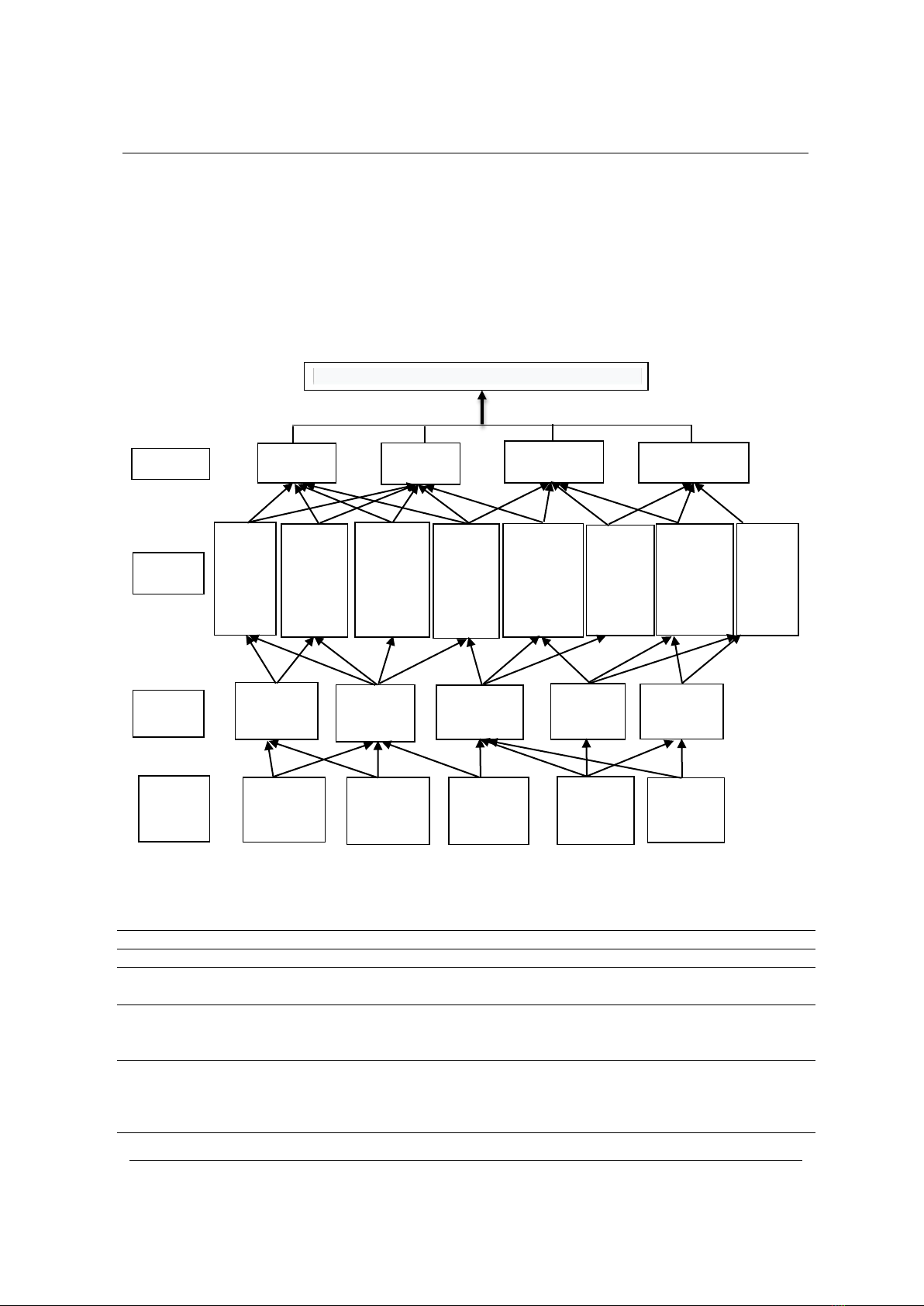
After the specialists reached a consensus on the objective system (Table 1), we outlined the
strategic map of the HVN Company (Figure 1).
3.3. Develop Key Performance Indicators
The objectives on the HVN Company Strategic Map were detailed into KPIs to help evaluate
how the company’s objectives were executed. The indicators were developed on the basis of
criteria used by the board of directors to evaluate performance. In addition, the authors proposed
some additional indicators based on 2 criteria: The indicator must be associated with the
company’s strategic objectives to evaluate the performance of these objectives, and also be
understandable and measurable.
TNU Journal of Science and Technology
229(03): 66 - 74
http://jst.tnu.edu.vn 70 Email: jst@tnu.edu.vn
Thereby, the authors developed a total of 39 KPIs to measure 21 strategic objectives of the
HVN Company. All 39/39 indicators received specialists’ consensus with an average value of ≥
3.5, and no new indicator was added by specialists.
The KPI system achieved specialists’ consensus with a total of 39 indicators. These indicators
were detailed into specific criteria and formulas. The criterion for each KPI was based on the
strategic objectives of the HVN Company. A number of criteria were also proposed by the
authors (based on the direction of development, business history, and potential of the company),
following the SMART principle:
S - Specific: particular, understandable; M - Measurable: quantitative; A - Achievable:
challenging; R - Realistic: practical; T - Time-bound: within a deadline.
Figure 1. Strategic map of the HVN Company
(Source: Prepared by the authors, 2023)
The formulas of the indicators are illustrated in Table 2.
Table 2. KPI weight on the Balanced Scorecard
Objective
KPI
Unit
Formula
Financial perspective
Increased
sales
Sales increase
VND
(Current year sales - Last year sales)
Sales growth rate (GRW)
%
(Current year sales - Last year sales)/Last year sales
Increased
profit/sales
Return on equity (ROE)
%
(Current year ROE - Last year ROE)
Return on assets (ROA)
%
(Current year ROA - Last year ROA)
Profit growth rate (GRW)
%
(Current year profit - Last year profit)/Last year profit
Effective cost
management
Percentage of unreasonable costs
out of total costs
%
Unreasonable costs/total costs
Percentage of costs of sales and
business management out of total costs
%
Costs of sales and business management/total costs
Periodic HR
training
Leading the healthy moving society in Vietnam
Financial
Increased
sales
Increased
profit/sales
Effective cost
management
Resource utilization
efficiency
Customer
Time to
resolve a
customer
complaint
Customer
satisfaction
New
customer
engagement
Honda
Exclusive
Authorized
Dealer
(HEAD)/
Dealer
(DLR)
network
expansion
Product
diversification
Brand and
product
identification
Product
quality
assurance
Internal
process
Internal
process
finalization
Upgrade task
management
systems
Increased
production
Safe
production,
explosion
prevention
Waste
treatment
upgrade
Market
share of
motorcycles
and
automobiles
Learning
and growth
HR
coordination to
appropriate
positions
Professional
working
culture
promotion
Increased
employee
satisfaction
KPI
application to
each
employee




![Câu hỏi ôn tập Truyền động điện [mới nhất]](https://cdn.tailieu.vn/images/document/thumbnail/2025/20250613/laphong0906/135x160/88301768293691.jpg)
![Giáo trình Kết cấu Động cơ đốt trong – Đoàn Duy Đồng (chủ biên) [Phần B]](https://cdn.tailieu.vn/images/document/thumbnail/2025/20251120/oursky02/135x160/71451768238417.jpg)


![Tài liệu học tập Công nghệ sản xuất và lắp ráp ô tô [mới nhất]](https://cdn.tailieu.vn/images/document/thumbnail/2025/20251231/kimphuong1001/135x160/50151767942304.jpg)

![Đề cương ôn tập môn Nguyên lý động cơ đốt trong [mới nhất]](https://cdn.tailieu.vn/images/document/thumbnail/2025/20251231/cuchoami2510/135x160/99621767694770.jpg)


