Hindawi Publishing Corporation
EURASIP Journal on Information Security
Volume 2007, Article ID 48179, 16 pages
doi:10.1155/2007/48179
Research Article
Transmission Error and Compression Robustness of
2D Chaotic Map Image Encryption Schemes
Michael Gschwandtner, Andreas Uhl, and Peter Wild
Department of Computer Sciences, Salzburg University, Jakob-Haringerstr. 2, 5020 Salzburg, Austria
Correspondence should be addressed to Andreas Uhl, uhl@cosy.sbg.ac.at
Received 30 March 2007; Revised 10 July 2007; Accepted 3 September 2007
Recommended by Stefan Katzenbeisser
This paper analyzes the robustness properties of 2D chaotic map image encryption schemes. We investigate the behavior of such
block ciphers under different channel error types and find the transmission error robustness to be highly dependent on the type
of error occurring and to be very different as compared to the effects when using traditional block ciphers like AES. Additionally,
chaotic-mixing-based encryption schemes are shown to be robust to lossy compression as long as the security requirements are
not too high. This property facilitates the application of these ciphers in scenarios where lossy compression is applied to encrypted
material, which is impossible in case traditional ciphers should be employed. If high security is required chaotic mixing loses its
robustness to transmission errors and compression, still the lower computational demand may be an argument in favor of chaotic
mixing as compared to traditional ciphers when visual data is to be encrypted.
Copyright © 2007 Michael Gschwandtner et al. This is an open access article distributed under the Creative Commons Attribution
License, which permits unrestricted use, distribution, and reproduction in any medium, provided the original work is properly
cited.
1. INTRODUCTION
A significant amount of encryption schemes specifically tai-
lored to visual data types has been proposed in literature dur-
ing the last years (see [9,20] for extensive overviews). The
most prominent reasons not to stick to classical full encryp-
tion employing traditional ciphers like AES [6]forsuchap-
plications are the following:
(i) to reduce the computational effort(whichisusually
achieved by trading offsecurity as it is the case in par-
tial or soft encryption schemes);
(ii) to maintain bitstream compliance and associated func-
tionalities like scalability (which is usually achieved
by expensive parsing operations and marker avoidance
strategies);
(iii) to achieve higher robustness against channel or storage
errors.
Using invertible two-dimensional chaotic maps (CMs)
on a square to create symmetric block encryption schemes
for visual data has been proposed [4,8] mainly to serve the
first purpose, that is, to create encryption schemes with low
computational demand. CMs operate in the image domain
which means that in some sense bitstream compliance is not
an issue, however, they cannot be combined in a straightfor-
ward manner with traditional compression techniques.
Compensating errors in transmission and/or storage of
data, especially images, is fundamental to many applications.
One example is digital video broadcast or RF transmissions
which are also prone to distortions from atmosphere or in-
terfering objects. On the one hand, effective error conceal-
ment techniques already exist for most current file formats,
but when image data needs to be encrypted, these techniques
only partly apply since they usually depend on the data for-
mat which is not accessible in encrypted form. On the other
hand, error correction codes may be applied at the network
protocol level or directly to the data but these techniques ex-
hibit several drawbacks which may be not acceptable in cer-
tain application scenarios.
(i) Processing overhead: applying error correction codes
before transmission causes additional computational
demand which is not desired if the acquiring and send-
ing device has limited processing capability (like any
mobile device).
(ii) Data rate increase: error correction codes add redun-
dancy to data; although this is done in a fairly efficient

2EURASIP Journal on Information Security
manner, data rate increase is inevitable. In case of low-
bandwidth network links (like any wireless network)
this may not be desired.
One famous example for an application scenario of that
type are RF surveillance cameras with their embedded pro-
cessors, which are used to digitize the signal and encrypt it
using state-of-the-art ciphers. If further error correction can
be avoided, the remaining processing capacity (if any) can be
used for image enhancement and higher network capacity al-
lows better quality images to be transmitted. In this work we
investigate a scenario where neither error concealment nor
error correction techniques are applied, the encrypted visual
data is transmitted as it is due to the reasons outlined above.
Due to intrinsic properties (e.g., the avalanche effect)
of cryptographically strong block ciphers (like AES), such
techniques are very sensitive to channel errors. Single bits
lost or destroyed in encrypted form cause large chunks of
data to be lost. For example, it is well known that a single
bit failure of AES-encrypted ciphertext destroys at least one
whole block plus further damage caused by the encryption
mode architecture. Permutations have been suggested to be
used in time-critical applications since they exhibit signif-
icantly lower computational cost as compared to other ci-
phers, however, this comes at a significantly reduced security
level (this is the reason why applying permutations is said
be a type of “soft encryption”). Hybrid pay-TV technology
has extensively used line permutations (e.g., in the Nagravi-
sion/Syster systems), many other suggestions have been made
to employ permutations in securing DCT-based [21,22]or
wavelet-based [14,23] data formats. In addition to being very
fast, permutations have been identified to be a class of cryp-
tographic techniques exhibiting extreme robustness in case
transmission errors occur [19].
Bearing in mind that CM crypto systems mainly rely on
permutations makes them interesting candidates for the use
in error-prone environments. Taken this fact together with
the very low computational complexity of these schemes,
wireless and mobile environments could be potential appli-
cation fields. While the expected conclusion that the higher
security level of cryptographically strong ciphers implies
higher sensitivity to errors compared to CM crypto systems
is nothing new, we investigate the impact of different error
models on image quality to obtain a quantifiable tradeoffbe-
tween security and transmission error robustness. The rise of
wireless local area networks and its diversity of errors enforce
the development of new transmission methods to achieve
good quality of transmitted image data at a certain protec-
tion level.
Accepting the drawback of a possibly weaker protection
mechanism, it may be possible to achieve better quality re-
sults in the decrypted image after transmission over noisy
channels as compared to classical ciphers. In this work we
compare the impact of different types of distortions of trans-
mission links (i.e., channel errors) on the transmission of im-
ages using block cipher encryption with CM encryption (see
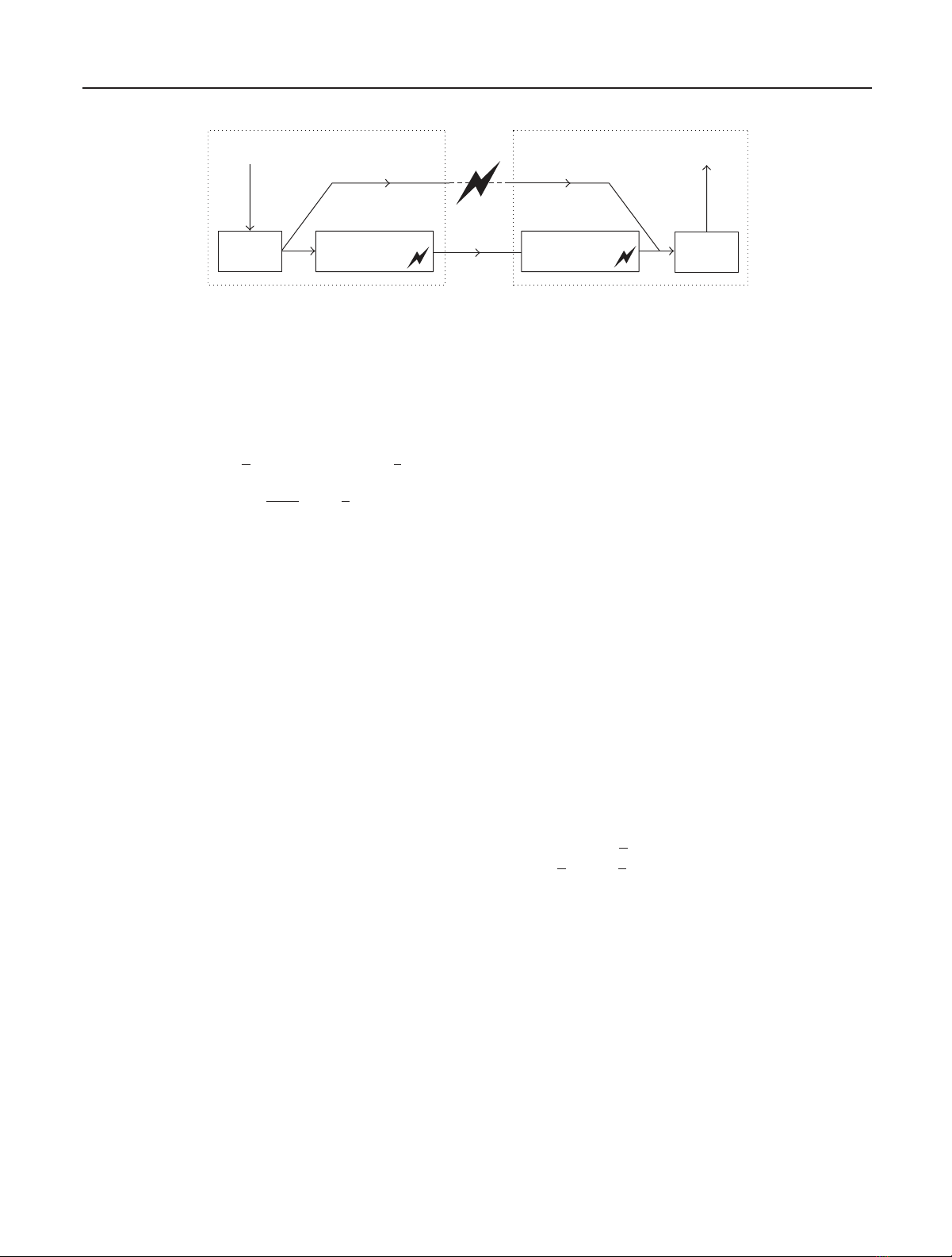
Figure 1,partA).
Additionally (see Figure 1, part B), we focus on an is-
sue different to those discussed so far at first sight, however,
this topic is related to the CMs’ robustness against a specific
type of errors (value errors): we investigate the lossy com-
pression of encrypted visual material [10]. Clearly, data en-
crypted with classical ciphers cannot be compressed well: due
to the statistical properties of encrypted data no data reduc-
tion may be expected using lossless compression schemes,
lossy compression schemes cannot be employed since the re-
constructed material cannot be decrypted any more due to
compression artifacts. For these reasons, compression is al-
ways required to be performed prior to encryption when
classical ciphers are used. However, for certain types of ap-
plication scenarios it may be desirable to perform lossy com-
pression after encryption (i.e., in the encrypted domain).
CMs are shown to be able to provide this functionality to a
certain extent due to their robustness to random value errors.
We will experimentally evaluate different CM configurations
with respect to the achievable compression rates and quality
of the decompressed and decrypted visual data.
A brief introduction to chaotic maps and their respec-
tive advantages and disadvantages as compared to classical
ciphersisgiveninSection 2. Experimental setup and used
image quality assessment methods are presented in Section 3.
Section 4 discusses the robustness properties of CM block ci-
phers with respect to different types of network errors and
compares the results to the respective behavior of a classi-
cal block cipher (AES) in these environments. Section 5 dis-
cusses possible application scenarios requiring compression
to be performed after encryption and provides experimental
results evaluating a JPEG compression, a JPEG 2000 com-
pression and finally JPEG 2000 with wavelet packets, all with
varying quality applied to CM encrypted data. Section 6 con-
cludes the paper.
2. CHAOTIC MAP ENCRYPTION SCHEMES
Using CMs as a (mainly) permutation-based symmetric
block cipher for visual data was introduced by Scharinger
[17] and Fridrich [8]. CM encryption relies on the use of dis-
crete versions of chaotic maps. The good diffusion properties
of chaotic maps, such as the baker map or the cat map,soon
attracted cryptographers. Turning a chaotic map into a sym-
metric block cipher requires three steps, as [8] points out.
(1) Generalization. Once the chaotic map is chosen, it
is desirable to vary its behavior through parameters.
These are part of the key of the cipher.
(2) Discretization. Since chaotic maps usually are not dis-
crete, a way must be found to apply the map onto a
finite square lattice of points that represent pixels in an
invertible manner.
(3) Extension to 3D. As the resulting map after step two is a
parameterized permutation, an additional mechanism
is added to achieve substitution ciphers. This is usually
done by introducing a position-dependent gray level
alteration.
In most cases a final diffusion step is performed, often
achieved by combining the data line or column wise with the
output of a random number generator.
Michael Gschwandtner et al. 3
Sender
Raw image data
A) Transmission error
B) Lossy compression
CM/AES
encryption
JPEG/JPEG 2000
compression
Distortion
Distorted raw image data
Receiver
JPEG/JPEG 2000
decompression
CM/AES
decryption
Figure 1: Experimental setup examining (A) transmission error resistance and (B) lossy compression robustness of CM and AES encryption
schemes.
The most famous example of a chaotic map is the stan-
dard baker map:
B: [0, 1]2−→ [0, 1]2,
B(x,y)=⎧
⎪
⎪
⎪
⎨
⎪
⎪
⎪
⎩
2x,y
2if 0 ≤x<1
2,
2x−1, y+1
2if 1
2≤x≤1.
(1)
This corresponds geometrically to a division of the unit
square into two rectangles [0, 1/2[×[0, 1] and [1/2, 1]×[0, 1]
that are stretched horizontally and contracted vertically. Such
a scheme may easily be generalized using kvertical rectangles
[Fi−1Fi[×[0, 1[ each having an individual width pisuch that
Fi=i
j=1pj,F0=0, Fk=1. The corresponding vertical
rectangle sizes pi, as well as the number of iterations, intro-
duced parameters. Another choice of a chaotic map is the
Arnold Cat map:
C: [0, 1]2−→ [0, 1]2,
C(x,y)=11
12
x
ymod 1, (2)
where xmod 1 denotes the fractional part of a real num-
ber xby subtracting or adding an appropriate integer. This
chaotic map can be generalized using a Matrix Aintroduc-
ing two integers a,bsuch that det(A)=1 as follows:
Cgen(x,y)=Ax
ymod 1, A=1a
bab+1
.(3)
Now each generalized chaotic map needs to be modified
to turn into a bijective map on a square lattice of pixels. Let
N:={0, ...,N−1}, the modification is to transform do-
main and codomain to N2. Discretized versions should avoid
floating point arithmetics in order to prevent an accumula-
tion of errors. At the same time they need to preserve sen-
sitivity and mixing properties of their continuous counter-
parts. This challenge is quite ambitious and many questions
arise, whether discrete chaotic maps really inherit all impor-
tant aspects of chaos by their continuous versions. An im-
portant property of a discrete version Fof a chaotic map f
is
lim
N→∞ max
0≤i,j<N
f(i/N,j/N)−F(i,j)
=0.(4)
Discretizing a chaotic Cat map is fairy simple and intro-
ducedin[
4]. Instead of using the fractional part of a real
number, the integer modulo arithmetic is adopted:
Cdisc :N2−→ N2,
Cdisc(x,y)=Ax
ymod N,A=1a
bab+1
.(5)
Finally, an extension to 3D is inserted that may be applied
to any two-dimensional chaotic map. As all chaotic maps
preserve the image histogram (and with it all correspond-
ing statistical moments), a procedure to result in a uniform
histogram after encryption is desired. The extension of a two
dimensional discrete chaotic map F:N2→N2to three di-
mensions consists of a position-dependent grey-level shift
(assuming Lgrey levels L:={0, ...,L−1})ateachlevel
of iteration:
F3D:N2×L−→ N2×L
F3Di,j,gij=⎛
⎜
⎝
i′
j′
hi,j,gij⎞
⎟
⎠,i′
j′=F(i,j).(6)
The map hmodifies the grey level of a pixel and is a function
of the initial position and initial grey level of the pixel, that
is, h(i,j,gij)=gij +h(i,j)modL. There are various possible
choices of h,weuseh(i,j)=i·j.
Since chaotic maps after step two or three are bijections
of a square lattice of pixels, an additional spreading of lo-
cal information over the whole image is desirable. Otherwise
the cipher is extremely vulnerable to known plaintext attacks,
since each pixel in the encrypted image corresponds exactly
to one pixel in the original. The diffusion step is often real-
ized as a linewise process, for example,
v(i,j)∗=v(i,j)+Gv(i,j−1)∗mod L,(7)
where v(i,j) is the not-yet modified pixel at position (i,j),
v(i,j)∗is the modified pixel at that position, and Gis an ar-
bitrarily chosen random lookup table.
Concerning robustness against transmission errors, CMs
of course are expected to be more robust when diffusion steps
are avoided (compare results). If local information is spread

4EURASIP Journal on Information Security
Table 1: Cardinality of key spaces K(N).
N=20 N=25 N=128 N=512
Baker map keyset1 83343 571 1031 10126
Baker map keyset2 524288 16777216 1038 10153
Cat map 400 625 16384 262144
AES128 1038 1038 1038 1038
AES256 1077 1077 1077 1077
during encryption, that is, in diffusion steps, a single pixel
error in the encrypted image causes several pixel errors in the
original image. For this reason, we investigate both settings
with and without diffusion.
It should be clear that chaotic maps have different prop-
erties when compared to conventional block ciphers. Typi-
cally, conventional block encryption schemes like AES work
on block sizes of 128, 256, or 512 bit. key space contains 2n
elements, where nis the number of key bits, which is usually
often 1 : 1 to block size.
As the main property of CM is permutation, it operates
on larger units, that are full (square) images. Their smallest
element to be permuted is a pixel. To encrypt an N×Nim-
age, N2! permutations exist. However, the key space available
to parameterize the chaotic map is often orders of magni-
tude smaller. Another drawback is dependency on image size.
There are configurations where a small change in image size
causes key space to shrink dramatically (see keyset1 and key-
set2 in Table 1). In Table 1, cardinalities of key spaces K(N)
for Baker map,Cat map,andAES are compared choosing a
representative N×Ngrey-scale image. While the number of
iterations and parameters for the diffusion step is usually part
of the key for chaotic encryption algorithms they have been
neglected for this comparison. It is evident that key space, es-
pecially for smaller image sizes, is insufficient. In this case or
for problematic image sizes, padding should be used to pre-
vent a guessing of all possible key combinations. At this point
a main drawback of the Cat map becomes evident: its pa-
rameters offer little combinations compared to other chaotic
maps.
Chaotic maps are generally sensitive to initial conditions
and parameters. But some discrete versions bear unexpected
behavior when using similar keys. While classical encryp-
tion algorithms are sensitive to keys, chaotic maps such as
the Baker map exhibit a set of keys S(K)foreachkeyK,
such that the image encrypted with Kand decrypted using
k∈S(K), k=Kis close to its original. We get similar results
when using keys that are derived from the original by replac-
ing a large parameter by two smaller ones or merging two
small parameters into a larger one. This has been observed
by [8]. Accepting the drawback of a further limitation of key
space (the intruder may be content to find a key that pro-
duces acceptable approximations of original images and con-
tinues with refinement), this may also be seen as a feature of
the encryption system. Transmission errors destroying single
bits of the key do not necessarily lead to fully destroyed de-
cryption. Heuristics could produce a similar key, that allows
decryption at a low but probably sufficient quality.
Table 2: Tested image encryption algorithms for part A.
Name Description
2DCatMap Cat map
2DBMap Baker map
3DCatMap Cat map with 3D extension
2DCatDiffCat map with diffusion step
AES128ECB AES using ECB on 128 bit blocks
AES128CBC Same as AES128ECB, using CBC
Table 3: Tested image encryption algorithms for part B.
Name Description
2DCatMap5/7/10 Cat map with 5/7/10 iterations
2DCatDiff5 Cat map with diffusion step and five iterations
3DCatMap5 Cat map with 3D extension and five iterations
2DBMap5/17 Baker map with 5/17 iterations
Table 4: Employed keys/parameters for experiments.
Name Value
BakerMapKey1 192,32,32
BakerMapKey2 32,64,32,16,32,32,16,8,8,8,8
AES IV 10111213141516171819202122232425
AESKey 000102030405060708090A0B0C0D0E0F
CatMapKey 2,3,1,1
3. EXPERIMENTAL SETUP
We analyze both transmission error resistence (part A) and
compression robustness (part B) of three different flavors of
the chaotic Cat map algorithm, a simple 2D version of the
Baker map and AES using different block encryption modes
(see Tables 2,3). All chaotic ciphers use 10 iteration rounds,
if not specified differently.
Since the number of iterations used in CM algorithms
largely affects the distribution of distortions caused by lossy
compression, we examine the impact of this parameter on
image quality. The diffusion step has been excluded from all
chaotic maps, except CatDiff. All algorithms are applied to a
set of 10 natural and 6 synthetic 256 ×256 images with 256
grey levels referenced in Figure 2 (only 13 of 16 pictures are
shown due to copyright restrictions) using two sets of rep-
resentative encryption keys (keyset2 represents a strong key
whereas keyset1 exhibits certain weaknesses with respect to
security). Key parameters for the visual quality experiment
are given in Table 4.
3.1. Setup
A flow chart to illustrate the test procedure for both part A
and part B is depicted in Figure 1. Recapitulating, the test
procedureisasfollows.
(i) Part A: transmission error robustness. After encryption,
a specific type of error as introduced in Section 4.1 is
applied to the encrypted image data. Finally, the image
is decrypted and the result is compared to the original.

Michael Gschwandtner et al. 5
(ii) Part B: compression robustness. After encryption, three
different compression algorithms (JPEG, JPEG 2000,
and JPEG 2000 with wavelet packets) are applied to
the encrypted image data. To assess the behavior of the
described processing pipeline, the image is finally de-
compressed, decrypted and the result is compared to
the original image and the achieved compression ratio
(using the encrypted image as reference) is recorded.
3.2. Image quality assessment
It is difficult to find reliable tools to measure quality of dis-
torted images. This is especially true in a low-quality sce-
nario. Several metrics exist, such as the signal-to-noise ra-
tio (SNR), peak SNR (PSNR), or mean-square error (MSE),
which are frequently used in quantifying distortions (see
[3,7]). Mao and Wu [11] propose a measure specifically tai-
lored to encrypted imagery that separates evaluation of lumi-
nance and edge information into a luminance similarity score
(LSS) and an edge similarity score (ESS), reflecting properties
of the human visual system. According to the authors, this
measure is well suited for assessing distortion of low-quality
images. LSS behaves in a way very similar to PSNR. ESS is
the more interesting part in the context of the survey pre-
sented here, as it reflects the extent for structural distortion.
ESS is computed by block-based gradient comparison and
ranges, with increasing similarity, between 0 and 1. However,
reliable assessment of low-quality images should be made by
human observers in a subjective rating as this cannot be ac-
complished in a sensible way using the metrics above. Subjec-
tive visual assessment of transmissions yields a mean opin-
ion score (MOS) [1] evaluating gradings of human observers
according to strictly specified testing conditions. Such con-
ditions are specified in, for example, [2] for the subjective
assessment of the quality of television pictures. These meth-
ods can be extended to the assessment of images in general
and are frequently adopted, such as in [5]. Recommendation
ITU-R-BT500-11 [2] introduces both double stimulus (with
reference picture) and single stimulus (without reference pic-
ture) assessment methods with a strictly defined testing envi-
ronment, that is, quality and impairment scales, lighting con-
ditions and also restrictions regarding selection of observers.
We have decided to adopt only a subset of features, in partic-
ular,
(i) we adopt to a simultaneous double stimulus method
(SDSCE) with reference and test pictures being shown
at the same time;
(ii) we employ the specified five-graded quality scale (see
Table 5).
Additionally, we conform the specified condition, that at
least fifteen subjects, nonexperts, should be employed.
Since [2] specifies subjective video quality assessment
methods, it should be noticed that observers evaluate the av-
erage quality of the frames displayed. In our case still images
are evaluated. Therefore, we let the observer vote for the av-
erage quality of three different test pictures (encrypted using
the same algorithm, but different keys) with respective origi-
Table 5: ITU-R-BT500-11 subjective quality rating scales.
Quality Description
5Excellent
4 Good
3Fair
2Poor
1Bad
nals being shown at the same time, that is, in one assessment
step, using the quality levels introduced in Table 5.
In the following section we give a short description of
the observed results with respect to distortions. In order to
complement the subjective ratings, we also report the refer-
ence PSNR value. While it is clear, that in some cases further
error correction by means of denoising might be useful and
thus better results can be achieved, we do not concentrate on
postprocessing techniques at this point.
4. TRANSMISSION ERROR ROBUSTNESS
In this section, our goal is to provide a comparison of two
completely different block ciphers with respect to their be-
havior in the transmission of encrypted visual data over noisy
channels. Therefore, this section introduces a set of distor-
tion models we believe are practical and illustrative for ap-
plications.
4.1. Classification of used error models
Much work has already been done to classify transmission
errors occurring at wireless data transmission and a variety
of sophisticated network simulators already exist. To focus
on a generally applicable comparison of the two encryption
mechanisms CM and AES, we arrange simulations that can
be described by the following model: a sender Stransmits
asequences0,s1,s2,...,snof n+ 1 bytes over a lossy chan-
nel. Receiver Rreceives a sequence r0,r1,r2,...,rmof bytes,
that is possibly different to s0,s1,s2,...,sn. There are situa-
tions where n=m. We identify two categories of observable
errors.
(i) Value errors, where n=mand r0,r1,...,rnare derived
from the original sequence alternating selected bytes.
More formally, there exists a set A⊂{0, ...,n}and
error function fsuch that for all i∈{0, ...,n}
ri=f(si)ifi∈A;
sielse. (8)
Note that fmay depend on additional random variables.
(ii) Buffer errors, where bytes are changed, inserted, re-
moved, and possibly resorted. There exists a set A⊂
{0, ...,m}and error function fsuch that a received



![Thuyết minh tính toán kết cấu đồ án Bê tông cốt thép 1: [Mô tả/Hướng dẫn/Chi tiết]](https://cdn.tailieu.vn/images/document/thumbnail/2016/20160531/quoccuong1992/135x160/1628195322.jpg)