
Annals of Mathematics
Basic properties
of SLE
By Steffen Rohde* and Oded Schramm

Annals of Mathematics,161 (2005), 883–924
Basic properties of SLE
By Steffen Rohde* and Oded Schramm
Dedicated to Christian Pommerenke on the occasion of his 70th birthday
Abstract
SLEκis a random growth process based on Loewner’s equation with driv-
ing parameter a one-dimensional Brownian motion running with speed κ. This
process is intimately connected with scaling limits of percolation clusters and
with the outer boundary of Brownian motion, and is conjectured to correspond
to scaling limits of several other discrete processes in two dimensions.
The present paper attempts a first systematic study of SLE. It is proved
that for all κ= 8 the SLE trace is a path; for κ∈[0,4] it is a simple path; for
κ∈(4,8) it is a self-intersecting path; and for κ>8 it is space-filling.
It is also shown that the Hausdorff dimension of the SLEκtrace is almost
surely (a.s.) at most 1 + κ/8 and that the expected number of disks of size ε
needed to cover it inside a bounded set is at least ε−(1+κ/8)+o(1) for κ∈[0,8)
along some sequence εց0. Similarly, for κ≥4, the Hausdorff dimension of
the outer boundary of the SLEκhull is a.s. at most 1 + 2/κ, and the expected
number of disks of radius εneeded to cover it is at least ε−(1+2/κ)+o(1) for a
sequence εց0.
1. Introduction
Stochastic Loewner Evolution (SLE) is a random process of growth of a
set Kt. The evolution of the set over time is described through the normal-
ized conformal map gt=gt(z) from the complement of Kt. The map gtis
the solution of Loewner’s differential equation with driving parameter a one-
dimensional Brownian motion. SLE, or SLEκ, has one parameter κ≥0, which
is the speed of the Brownian motion. A more complete definition appears in
Section 2 below.
The SLE process was introduced in [Sch00]. There, it was shown that
under the assumption of the existence and conformal invariance of the scaling
limit of loop-erased random walk, the scaling limit is SLE2. (See Figure 9.1.)
It was also stated there without proof that SLE6is the scaling limit of the
*Partially supported by NSF Grants DMS-0201435 and DMS-0244408.
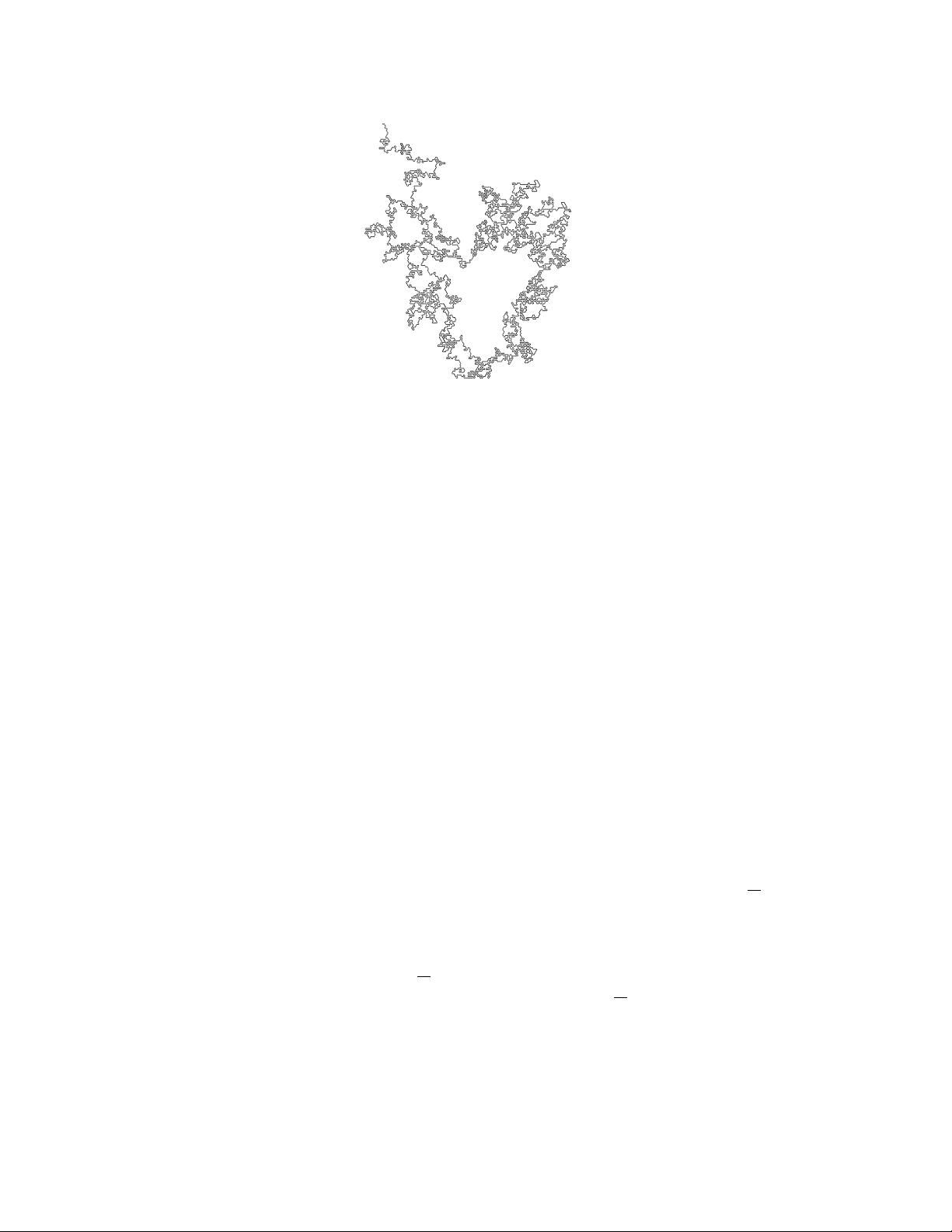
884 STEFFEN ROHDE AND ODED SCHRAMM
Figure 1.1: The boundary of a percolation cluster in the upper half plane, with
appropriate boundary conditions. It converges to the chordal SLE6trace.
boundaries of critical percolation clusters, assuming their conformal invariance.
Smirnov [Smi01] has recently proved the conformal invariance conjecture for
critical percolation on the triangular grid and the claim that SLE6describes
the limit. (See Figure 1.1.) With the proper setup, the outer boundary of SLE6
is the same as the outer boundary of planar Brownian motion [LSW03] (see
also [Wer01]). SLE8has been conjectured [Sch00] to be the scaling limit of the
uniform spanning tree Peano curve (see Figure 9.2), and there are various fur-
ther conjectures for other parameters. Most of these conjectures are described
in Section 9 below. Also related is the work of Carleson and Makarov [CM01],
which studies growth processes motivated by DLA via Loewner’s equation.
SLE is amenable to computations. In [Sch00] a few properties of SLE
have been derived; in particular, the winding number variance. In the series of
papers [LSW01a], [LSW01b], [LSW02], a number of other properties of SLE
have been studied. The goal there was not to investigate SLE for its own sake,
but rather to use SLE6as a means for the determination of the Brownian
motion intersection exponents.
As the title suggests, the goal of the present paper is to study the funda-
mental properties of SLE. There are two main variants of SLE, chordal and
radial. For simplicity, we concentrate on chordal SLE; however, all the main
results of the paper carry over to radial SLE as well. In chordal SLE, the set
Kt,t≥0, called the SLE hull, is a subset of the closed upper half plane H
and gt:H\Kt→His the conformal uniformizing map, suitably normalized
at infinity.
We show that with the possible exception of κ= 8, a.s. there is a (unique)
continuous path γ:[0,∞)→Hsuch that for each t>0 the set Ktis the
union of γ[0,t] and the bounded connected components of H\γ[0,t]. The path
γis called the SLE trace. It is shown that limt→∞ |γ(t)|=∞a.s. We also

BASIC PROPERTIES OF SLE 885
describe two phase transitions for the SLE process. In the range κ∈[0,4], a.s.
Kt=γ[0,t] for every t≥0 and γis a simple path. For κ∈(4,8) the path
γis not a simple path and for every z∈Ha.s. z/∈γ[0,∞) but z∈t>0Kt.
Finally, for κ>8 we have H=γ[0,∞) a.s. The reader may wish to examine
Figures 9.1, 1.1 and 9.2, to get an idea of what the SLEκtrace looks like for
κ= 2, 6 and 8, respectively.
We also discuss the expected number of disks needed to cover the SLEκ
trace and the outer boundary of Kt. It is proved that the Hausdorff dimension
of the trace is a.s. at most 1 + κ/8,and that the Hausdorff dimension of the
outer boundary ∂Ktis a.s. at most 1 + 2/κ if κ≥4. For κ∈[0,8),we also
show that the expected number of disks of size εneeded to cover the trace
inside a bounded set is at least ε−(1+κ/8)+o(1) along some sequence εց0.
Similarly, for κ≥4,the expected number of disks of radius εneeded to cover
the outer boundary is at least ε−(1+2/κ)+o(1) for a sequence of εց0. Richard
Kenyon has earlier made the conjecture that the Hausdorff dimension of the
outer boundary is a.s. 1 + 2/κ. These results offer strong support for this
conjecture.
It is interesting to compare our results to recent results for the deter-
ministic Loewner evolution, i.e., the solutions to the Loewner equation with
a deterministic driving function ξ(t). In [MR] it is shown that if ξis H¨older
continuous with exponent 1/2 and small norm, then Ktis a simple path. On
the other hand, there is a function ξ, H¨older continuous with exponent 1/2
and having large norm, such that Ktis not even locally connected, and there-
fore there is no continuous path γgenerating Kt. In this example, Ktspirals
infinitely often around a disk D, accumulating on ∂D, and then spirals out
again. It is easy to see that the disk Dcan be replaced by any compact con-
nected subset of H. Notice that according to the law of the iterated logarithm,
a.s. Brownian motion is not H¨older continuous with exponent 1/2. Therefore,
it seems unlikely that the results of the present paper can be obtained from
deterministic results.
Our results are based on the computation and estimates of the distribution
of |g′
t(z)|where z∈H. Note that in [LSW01b] the derivatives g′
t(x) are studied
for x∈R.
The organization of the paper is as follows. Section 2 introduces the basic
definitions and some fundamental properties. The goal of Section 3 is to obtain
estimates for quantities related to E|g′
t(z)|a, for various constants a(another
result of this nature is Lemma 6.3), and to derive some resulting continuity
properties of g−1
t. Section 4 proves a general criterion for the existence of a
continuous trace, which does not involve randomness. The proof that the SLEκ
trace is continuous for κ= 8 is then completed in Section 5. There, it is also
proved that g−1
tis a.s. H¨older continuous when κ= 4. Section 6 discusses the
two phase transitions κ= 4 and κ= 8 for SLEκ. Besides some quantitative

886 STEFFEN ROHDE AND ODED SCHRAMM
properties, it is shown there that the trace is a.s. a simple path if and only if
κ∈[0,4], and that the trace is space-filling for κ>8. The trace is proved to
be transient when κ= 8 in Section 7. Estimates for the dimensions of the trace
and the boundary of the hull are established in Section 8. Finally, a collection
of open problems is presented in Section 9.
Update. Since the completion and distribution of the first version of this
paper, there has been some further progress. In [LSW] it was proven that
the scaling limit of loop-erased random walk is SLE2and the scaling limit of
the UST Peano path is SLE8. As a corollary of the convergence of the UST
Peano path to SLE8, it was also established there that SLE8is generated by a
continuous transient path, thus answering some of the issues left open in the
current paper. However, it is quite natural to ask for a more direct analytic
proof of these properties of SLE8.
Recently, Vincent Beffara [Bef] has announced a proof that the Hausdorff
dimension of the SLEκtrace is 1 + κ/8 when 4 =κ≤8.
The paper [SS] proves the convergence of the harmonic explorer to SLE4.
2. Definitions and background
2.1. Chordal SLE.Let Btbe Brownian motion on R, started from B0=0.
For κ≥0 let ξ(t):=√κBtand for each z∈H\{0}let gt(z) be the solution
of the ordinary differential equation
∂tgt(z)= 2
gt(z)−ξ(t),g
0(z)=z.(2.1)
The solution exists as long as gt(z)−ξ(t) is bounded away from zero. We
denote by τ(z) the first time τsuch that 0 is a limit point of gt(z)−ξ(t)as
tրτ. Set
Ht:= z∈H:τ(z)>t
,K
t:= z∈H:τ(z)≤t.
It is immediate to verify that Ktis compact and Htis open for all t. The
parametrized collection of maps (gt:t≥0) is called chordal SLEκ. The sets
Ktare the hulls of the SLE. It is easy to verify that for every t≥0 the map
gt:Ht→His a conformal homeomorphism and that Htis the unbounded
component of H\Kt. The inverse of gtis obtained by flowing backwards from
any point w∈Haccording to the equation (2.1). (That is, the fact that gtis
invertible is a particular case of a general result on solutions of ODE’s.) One
only needs to note that in this backward flow, the imaginary part increases,
hence the point cannot hit the singularity. It also cannot escape to infinity in
finite time. The fact that gt(z) is analytic in zis clear, since the right-hand
side of (2.1) is analytic in gt(z).