

A. Theory
- Ng âm, t v ng Unit 1, 2, 3, 4, 5ữ ừ ự
- Các c u trúc câu dùng trong giao ti p. Ph n speaking Unit 1, 2, 3, 4,5ấ ế ầ
- C u trúc ng pháp Unit 1, 2, 3, 4, 5ấ ữ
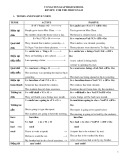
1. Simple present (Hi n t i đn):ệ ạ ơ
Be-> am/ is/ are Have-> have/ has
Kh ng đnhẳ ị Ph đnhủ ị Nghi v nấ
He/ she/ it + V-s/es
I/ You/ We/ They + V
He/ she/ it + doesn’t + V
I/ You/ We/ They +don’t + V
Does + he/ she/ it +V?
Do + I/ you/ we/ they +V?
Use:
-. Di n t thói quen hi n t i: -. Di n t s th t, chân líễ ả ở ệ ạ ễ ả ự ậ
Tr ng t th ng g pạ ừ ườ ặ : never, sometimes, usually, often, always, as a rule, normally…
Ex: Mr Vy usually gets up at 4:40 a.m
2. Present continuous (Hi n t i ti p di n)ệ ạ ế ễ S + am/ is/ are + Ving
Use:
-. Di n t hành đng đang x y ra th i đi m nói -. Di n t d đnh t ng lai có m c th i gian c th .ễ ả ộ ả ở ờ ể ễ ả ự ị ươ ố ờ ụ ể
Tr ng t th ng g p: ạ ừ ườ ặ now, at present, at this moment, right now
Ex: - I’m learning English now
3. Present perfect (Hi n t i hoàn thành):ệ ạ S+ have/ has/ + PP
kh ng đnhẳ ị ph đnhủ ị nghi v nấ
He/ She/ It + has + PP
I/ You/ We/ They + have + PP
He/ She/ It +hasn’t +PP
I/ You/ We/ They + haven’t + PP
Has + He/ She/ It + PP?
Have + I/ You/ We/ They + PP?
Use:
-. Di n t hành đng x y ra trong quá kh kéo dài đn hi n t i ễ ả ộ ả ứ ế ệ ạ
-. Di n t hành đng x y ra trong quá kh đ l i k t qu hi n t i -. Di n t kinh nghi mễ ả ộ ả ứ ể ạ ế ả ở ệ ạ ễ ả ệ
Tr ng t th ng g pạ ừ ườ ặ : never, just, ever, recently, already, yet, lately, for, since, so far….
Ex: - They have just built a hospital in this area
4. Simple past (Quá kh đn)ứ ơ
Be-> was/ were Have/ has-> had
kh ng đnhẳ ị ph đnhủ ị nghi v nấ
S + V-ed/V2 S + didn’t + V Did + S + V?
Use: Di n t hành đng x y ra và k t thúc trong quá kh . ễ ả ộ ả ế ứ
S GD & ĐT HÀ N IỞ Ộ
Tr ng THPT Phúc Thườ ọ
Đ C NG ÔN T P H C K 1Ề ƯƠ Ậ Ọ Ỳ
TI NG ANH L P 10Ế Ớ
Năm h c 2019-2020ọ

Tr ng t th ng g pạ ừ ườ ặ : yestersay, ago, last….
Ex: - I went to Hue three day ago.
5. Past continuous (Quá kh ti p di n)ứ ế ễ : S+ was/ were + Ving
Use: Di n t hành đng đang x y ra t i 1 th i đi m quá khễ ả ộ ả ạ ờ ể ứ
Ex: - I was watching TV at 5 p.m yesterday.
- Were they having lunch when you called?
7. Simple future (t ng lai đn):ươ ơ
kh ng đnhẳ ị ph đnhủ ị nghi v nấ
S + will + V1 S + won’t + V1 Will + S + V1?
Use: Di n t hành đng s x y ra trong t ng lai .ễ ả ộ ẽ ả ươ
Tr ng t th ng g pạ ừ ườ ặ : Tomorrow, next…….
Ex: - Will you go to university after you finish school?
8. Near future tense ( thì t ng lai g n) ươ ầ S + is/am/are + going to + Vinfinitive
Cách s d ngử ụ Ví dụ
- Di n đt 1 k ho ch, d đnh ( intention, plan)ễ ạ ế ạ ự ị Ex 1 : He is going to get married this year.
Ex 2: We are going to take a trip to Da nang city this
weekend.
- Di n đt 1 l i d đoán d a vào b ng ch ng ( evidence)ễ ạ ờ ự ự ằ ứ
hi n t i ở ệ ạ Ex1 : Look at those dark clouds ! It is going to rain
Ex2: Are you going to cook dinner? I have seen a lot of
vegetables on the table.
* D u hi u nh n bi t ấ ệ ậ ế
D u hi u nh n bi tấ ệ ậ ế thì t ng lai g nươ ầ bao g m các tr ng t ch th i gian t ng lai gi ng d u hi u nh n bi t thìồ ạ ừ ỉ ờ ở ươ ố ấ ệ ậ ế
t ng lai đn. Nh ng có thêm nh ng căn c hay nh ng d n ch ng c th .ươ ơ ư ữ ứ ữ ẫ ứ ụ ể
in + th i gian: trong … n a (in 5 minutes: trong 5 phút n a)ờ ữ ữ , tomorrow: ngày mai , Next day: ngày t iớ
Next week/ next month/ next year: Tu n t i/ tháng t i/ năm t iầ ớ ớ ớ
Ex:Tomorrow I am going to visit my parents in Da Nang. / Ngày mai tôi s đi thăm b m Đà N ng.ẽ ố ẹ ở ẵ
9. Passive voice ( câu b đng)ị ộ
S+ BE+ PP+ BY+ O
Cách chuy n t câu ch đng sang câu b đng: ể ừ ủ ộ ị ộ
S + V + O
S + be+ PP + BY + O
- B đng hi n t i đn: S + is/ am/ are + PP + BY + by Oị ộ ệ ạ ơ
- B đng quá kh đn: S+ was/ were + PP + BY + by Oị ộ ứ ơ
- B đng hi n t i hoàn thành: S + have/ has + been + PP + by Oị ộ ệ ạ
- B đng t ng lai đn: S + will + be + PP + by Oị ộ ươ ơ
- B đng thì t ng lai g n : S + be + going to be + PP + by Oị ộ ươ ầ
10. Gerund and to infinitive: Danh đng t và đng t nguyên m u có toộ ừ ộ ừ ẫ
Danh đng tộ ừ đng t nguyên m u có toộ ừ ẫ
1. Đng sau m t s đng t : keep, like, enjoy,ứ ộ ố ộ ừ
mind, practise, delay, miss, suggest, understand,
finish, admit, look forward to.......
1. Đng sau m t s đng t : hope, seem, expect, plan,ứ ộ ố ộ ừ
decide, agree, refuse, wish, offer, promise....
Ex: We hope to see you again

Ex: - He likes swimming
2. Đng sau gi i t (in, at, on, to, from, about...)ứ ớ ừ
- She is afraid of going there
2. Đng sau tính t , danh t , t h i, đi t b t đnh,ứ ừ ừ ừ ỏ ạ ừ ấ ị
ch m c đíchỉ ụ
- It is difficult to do this exercise
- It is time to go
- I don't know what to do
- Do you have something to eat?
- She went to the library to borrow some books
11. Adjective of attitude (tính t ch thái đ)ừ ỉ ộ
- Tính t ch thái đ là các tính t mô t thái đ ho c c m xúc c a m t ng i (đi v i ng i , v t , ho c s vi c nàoừ ỉ ộ ừ ả ộ ặ ả ủ ộ ườ ố ớ ườ ậ ặ ự ệ
đó). Tính t ch thái đ đc thành l p b ng cách l y ừ ỉ ộ ượ ậ ằ ấ verb + ed ho c verb + ing.ặ
-Present participle (verb + ing) : dùng đ di n đt m t ý nghĩa ch đng. ể ễ ạ ộ ủ ộ
-Past participle (verb + ed) : dùng đ di n đt m t ý nghĩa b đng. Nó thu ng đi v i danh t ch ng i.ể ễ ạ ộ ị ộ ờ ớ ừ ỉ ườ
Ex1: It is an amusing story. Ex2: I am bored with my job.
12. Compound noun ( câu ghép )
Câu ghép trong ti ng Anh đc hình thành b i ít nh t 2 m nh đ đc l p, th ng đc n i b i liên t k t h p vàế ượ ở ấ ệ ề ộ ậ ườ ượ ố ở ừ ế ợ
thêm d u ph yấ ẩ tr c liên t k t h p đó. ướ ừ ế ợ ( m nh đ 1, liên t k t h p, m nh đ 2) ệ ề ừ ế ợ ệ ề
Ex1: He is very handsome, and he speaks English very well.
Ex2: She is a talented singer, so many people admire her.
* Liên t k t h p trong câu ghépừ ế ợ
- Trong ti ng Anh có 7 liên t k t h p, đó là:ế ừ ế ợ for, and, nor, but, or, yet, so
- Chúng ta ghi nh b ng c m FANBOYS (các ch cái đu c a các t ).ớ ằ ụ ữ ầ ủ ừ
B. Do exercises
I. Choose the word whose underlined part is pronounced differently from that of the others.
1. A. psychologist B. duty C. laundry D. grocery
2. A. meaningful B. finance C. society D. advice
3. A. breadwinner B. heavy C. break D. instead
4. A. sister B. grocery C. family D. wife
5. A. excited B. talented C. supported D. watched
6. A. suggestion B. organization C. application D. communication
7. A. experience B. dedicated C. enthusiast D. result
8. A. statement B. movement C. evident D. comment
9. A. fortunate B. considerate C. nominate D. passionate
10. A. circulate B. create C. indicate D. fortunate
II. Choose the word whose stress is placed differently from that of the others.
1. A. police B. result C. correct D. traffic
2. A. invest B. major C. perform D. machine
3. A. leather B. account C. adapt D. decide
4. A. enormous B. vulnerable C. contribute D. exactly
5. A. healthy B. disease C. cancer D. balance
6. A. muscle B. vessel C. consume D. organ
7. A. homeless B. needy C. donate D. teacher
8. A. excited B. irregular C. attachment D. charity
9. A. highlight B. enjoy C. reverse D. review
10. A. police B. suppose C. decide D. finish
III. Choose the best option to complete the following sentences.
1. When you do something good for others, you will find your life _______.
A. meaningless B. hopeless C. harmful D. meaningful
2. Internet helps us interact _______ people all around the world.
A. on B. in C. with D. of
3. We all feel _______ about going on tours around Hanoi.
A. interested B. excited C. bored D. tired
4. I really wanted to take part in this contest, _______ my parents allowed me to.
A. and B. or C. so D. but
5. - “What do you think of this song?” - “It sounds _______. I don’t like it”
A. interested B. bored C. boring D. interesting
6. Yesterday I got to the station late, but _______, the train was late, too.

A. fortunately B. fortunate C. unfortunate D. unfortunately
7. Someone _____ her purse while she ___________on the bus.
A. steal/was getting B. stole/was getting
C. was stealing/was getting D. was stealing/got
8. That’s a very nice dress you’re wearing. - _____.
A. I’m glad you like it B. That’s all right
C. That’s nice D. You’re quite right
9. ______ is the member of a family who earns the money that the family needs.
A. Husband B. Breadwinner C. Women D. Homemaker
10. This system of the body lets us breathe in oxygen with our _______ and breathe out carbon dioxide.
A. heart B. lungs C. brain D. intestine
11. “You look beautiful with your new hairstyle!” - “_________”.
A. Not at all B. It’s kind of you to say so
C. Very kind of your part D. Willingly
12.____is the controller of the body. Led by the brain and nerves, it allows us to move, talk and feel emotions.
A. Circulatory system B. Digestive system
C. Nervous system D. Skeletal system
13. I often ______ at the market near her house.
A. clean the house B. shop for grocery C. do the cooking D. feed the cat
14. Suoi Mo”, the debut album by Trinh Cong Son, is sweet and gentle.
A. first B. second C. third D. new
15. A lot of fans gathered at their idol’s home to see her after the contest.
A. contestant B. competitors C. judges D. devotees
16. Volunteer work is a great way to _______ experience in a broad range of fields.
A. take B. gain C. do D. make
17. We regret _________that we cannot approve your suggestion.
A. inform B. informing C.to be inform D. to inform
18. He lost the key, _he couldn’t get into the house.
A. so B. and C. yet D. but
19. “Can I get you something to drink?” - “_________”
A. I’d like some Coke, thanks. B. Thank you. You’re welcome
C. Yes, why not? D. Yes, you can, of course
20.Mike: “A motorbike knocked Tim down”. Mary: “_________”
A. How terrific! B. Poor him! C. Why do you say so? D. What a cheap motorbike!
21.Mr John: “What do you do for a living?” Mr Mike: “_________”.
A. I work in a bank B. I want to be a doctor
C. It’s hard work, you know D. I get a high salary, you know
22. Mary: “Can you tell me how to find material for my science report, professor?” - Professor: “_______”.
A. I like it that you understand B. Try your best, Mary
C. You can borrow books from the library D. You mean the podcasts from other students?
23. Mary: “It’s a nice day today. Let’s play a game of tennis.” Linda: “__________”
A. Will we not play? B. Why not do we play? C. Why not D. Shall not we play?
24. Mark: “What a lovely house you have!” Phil: “________”
A. No problem. B. Thank you. Hope you will drop in.
C. I think so. D. Of course not, it’s not costly.
25. “You look beautiful with your new hairstyle!” - “_________”.
A. Not at all B. It’s kind of you to say so C. Very kind of your part D. Willingly
26. "Oops! I’m sorry for stepping on your foot" – “___________.”
A. You don't mind B. You're welcome C. That's fine D. Never mind
27. Would you mind ___________me a hand with these bags ?
A. gave B. to giving C. giving D. give
28. We regret _________that we cannot attend your lesson.
A. inform B. informing C. to be inform D. to inform
29. You should feel happy because your mum and dad always encourage you ________hard.
A. work B. to work C. worked D. working
30. It took my teacher nearly three years __________ his research on motivating students in learning English by using
wore games.
A complete B. to completing C. completed D. to complete
31. He is looking forward ______________ the result from this contest.

A. receive B. receiving C. to receive D. to receiving
32. John ............a book when I saw him.
A. is reading B. read C. was reading D. reading
33. I didn't like the foods at that restaurant, especially the soup. It was _________.
A. tasteful B. tasted C. tasteless D. tasting
34. She has lived in six ________ countries, so she knows a lot about cultures and their people's ways of life.
A. differences B. different C. differently D. differ
35. To record your voice, you can download a mobile _________.
A. application B. apply C. applicant D. applying
36. Due to modern __________, mirrors are not applied in many fields these days.
A. technological B. technology C. technologies D. technologing
37. It’s a great movie. I _________ that movie many times.
A. saw B. have seen C. see D. has seen
38. After taking part in public activities in their community, they realized that they had been ignorant or _______ before.
A. narrow-minded B. large-minded C. full-minded D. thin-minded
39. Linda is ____________ in buying a new house for her parents.
A. interest B. interested C. interesting D. interestingly
40. ___________ is the state where things are equal weight or force.
A. Balance B. Changing C. Moving D. Importance
Choose the word/ phrase that is CLOSEST in meaning to the underlined part in the following sentences.
41. This will be a hopeful season of this entertainment format to air in the near future.
A. breathe out B. breathe in C. broadcast D. inhale
42. They donate to the Red Cross every year.
A. contribute B. go C. reply D. make
43. They try to imitate the wings and shape of animals in nature to produce parts of vehicles.
A. irritate B. irrigate C. paste D. copy
Choose the word/ phrase that is OPPOSITE in meaning to the underlined part in the following sentences
44. Young people are now getting more and more concerned about environmental problems.
A. worried B. nervous C. unconcerned D. uneasy
45. We try to create an atmosphere of comfort and security for our children.
A. harmony B. safety C. danger D. shelter
IV. Reading the following passage then answer the questions by circling the letters A, B, C or D.
John Fisher, a builder, and his wife Elizabeth wanted more living space, so they left their small flat for
an old 40-metre-high castle tower. They have spent five years turning it into a beautiful home with six floors,
winning three architectural prizes.
‘I love the space, and being private,' Elizabeth says. 'You feel separated from the world. If I'm in the
kitchen, which is 25 metres above the ground floor, and the doorbell rings, I don't have to answer it because
visitors can't see I'm in!'
'There are 142 steps to the top, so I go up and down five or six times a day, it's very good exercise! But
having to carry heavy things to the top is terrible, so I never buy two bags of shopping from the supermarket at
a time. Apart from that, it's a brilliant place to live.'
'When we first saw the place, I asked my father's advice about buying it, because we couldn't decide.
After paying for it, we were a bit worried because it looked awful. But we really loved it, and knew how we
wanted it to look.'
'Living here can be difficult - yesterday I climbed a four-metre ladder to clean the windows. But when
you stand on the roof you can see all the way out to sea on a clear day, and that's a wonderful experience. I'm
really glad we moved.'
1. What is the writer trying to do in the text?
A. Describe how to turn an old tower into a house. B. Recommend a particular builder.
C. Describe what it is like to live in a tower. D. Explain how to win prizes for building work.
2. From this text, a reader can find out_____________.
A. Why visitors are not welcome at John and Elizabeth's house.
B. Why Elizabeth exercises every day.
C. Why Elizabeth asked her father to buy the tower.
D. Why John and Elizabeth left the flat.
3. Which of the following best describes Elizabeth's feelings about the tower?
A. She wanted it as soon as she saw it. B. She likes most things about it.
C. She has been worried since they paid for it. D. She finds it unsuitable to live in.










%20--%3e%3cdefs%3e%3cstyle%3e%20.st0%20{%20fill:%20%23fff;%20}%20.st1%20{%20fill:%20%237800fa;%20}%20%3c/style%3e%3c/defs%3e%3cpath%20class='st1'%20d='M117.78,12.18H43.11c2.9,3.47,4.65,7.94,4.65,12.82,0,5.6-2.3,10.66-6.01,14.29h76.02l7.22-13.56-7.22-13.56Z'/%3e%3cg%3e%3cpath%20class='st0'%20d='M53.58,26.17h-.59v-1.46h.59v-4.96h2.83c1.78,0,2.67.94,2.67,2.82v5.76c0,1.87-.89,2.81-2.67,2.81h-2.83v-4.96ZM55.36,21.37v3.34h1.1v1.46h-1.1v3.34h1.01c.61,0,.91-.37.91-1.1v-5.93c0-.74-.3-1.1-.91-1.1h-1.01Z'/%3e%3cpath%20class='st0'%20d='M65.99,31.14h-1.8l-.31-2.07h-2.19l-.31,2.07h-1.64l1.82-11.39h2.62l1.82,11.39ZM65.28,18.04c-.25.46-.51.77-.75.94-.21.15-.47.22-.79.22-.26,0-.57-.07-.92-.22l-.38-.15c-.14-.05-.26-.07-.37-.07-.3,0-.53.18-.71.54l-.91-.68c.25-.46.51-.77.75-.94.21-.14.48-.21.79-.21.26,0,.57.07.92.21l.38.15c.14.05.26.07.37.07.3,0,.53-.18.71-.54l.91.68ZM61.91,27.52h1.73l-.87-5.76-.87,5.76Z'/%3e%3cpath%20class='st0'%20d='M74.53,26.89v1.52c0,1.91-.89,2.86-2.67,2.86s-2.67-.95-2.67-2.86v-5.93c0-1.91.89-2.86,2.67-2.86s2.67.95,2.67,2.86v1.11h-1.69v-1.22c0-.75-.31-1.12-.93-1.12s-.93.37-.93,1.12v6.15c0,.74.31,1.11.93,1.11s.93-.37.93-1.11v-1.63h1.69Z'/%3e%3cpath%20class='st0'%20d='M81.4,31.14h-1.8l-.31-2.07h-2.19l-.31,2.07h-1.64l1.82-11.39h2.62l1.82,11.39ZM75.9,19.2l1.52-1.91h1.71l1.51,1.91h-1.61l-.76-.95-.75.95h-1.61ZM77.32,27.52h1.73l-.87-5.76-.87,5.76ZM83.1,15.99l-1.76,1.91h-1.26l1.17-1.91h1.86Z'/%3e%3cpath%20class='st0'%20d='M84.86,19.75c1.78,0,2.67.94,2.67,2.82v1.48c0,1.87-.89,2.81-2.67,2.81h-.85v4.28h-1.79v-11.39h2.64ZM84.01,21.37v3.86h.85c.58,0,.87-.36.87-1.08v-1.71c0-.71-.29-1.07-.87-1.07h-.85Z'/%3e%3cpath%20class='st0'%20d='M93.51,19.75c1.78,0,2.67.94,2.67,2.82v1.48c0,1.87-.89,2.81-2.67,2.81h-.85v4.28h-1.79v-11.39h2.64ZM92.66,21.37v3.86h.85c.58,0,.87-.36.87-1.08v-1.71c0-.71-.29-1.07-.87-1.07h-.85Z'/%3e%3cpath%20class='st0'%20d='M98.8,31.14h-1.79v-11.39h1.79v4.88h2.03v-4.88h1.83v11.39h-1.83v-4.88h-2.03v4.88Z'/%3e%3cpath%20class='st0'%20d='M105.36,24.55h2.46v1.62h-2.46v3.34h3.09v1.63h-4.88v-11.39h4.88v1.63h-3.09v3.18ZM108.17,17.29l-1.76,1.91h-1.26l1.17-1.91h1.86Z'/%3e%3cpath%20class='st0'%20d='M112.2,19.75c1.78,0,2.67.94,2.67,2.82v1.48c0,1.87-.89,2.81-2.67,2.81h-.85v4.28h-1.79v-11.39h2.64ZM111.35,21.37v3.86h.85c.58,0,.87-.36.87-1.08v-1.71c0-.71-.29-1.07-.87-1.07h-.85Z'/%3e%3c/g%3e%3ccircle%20class='st1'%20cx='25'%20cy='25'%20r='20'/%3e%3cpath%20class='st0'%20d='M32.78,19.27c2.92,0,4.43,2.55,5.28,5.33l.71,2.17c.14.38-.33.75-.71.75h-5.61c.19-.33.24-.71.09-1.08l-.75-2.45c-.43-1.32-.99-2.64-1.79-3.77.75-.57,1.65-.94,2.78-.94h0ZM25,18.38c3.25,0,4.9,2.78,5.89,5.89l.76,2.45c.14.42-.33.8-.8.8h-11.69c-.42,0-.94-.38-.8-.8l.75-2.45c.99-3.11,2.64-5.89,5.89-5.89h0ZM25,11.35c1.74,0,3.11,1.37,3.11,3.11s-1.37,3.11-3.11,3.11-3.11-1.41-3.11-3.11,1.41-3.11,3.11-3.11h0ZM17.27,19.27c1.08,0,1.98.38,2.73.94-.8,1.13-1.37,2.45-1.74,3.77l-.8,2.45c-.14.38-.05.75.09,1.08h-5.56c-.42,0-.9-.38-.75-.75l.71-2.17c.9-2.78,2.41-5.33,5.33-5.33h0ZM17.27,12.91c1.51,0,2.78,1.27,2.78,2.83s-1.27,2.83-2.78,2.83-2.83-1.27-2.83-2.83,1.27-2.83,2.83-2.83h0ZM32.78,12.91c1.56,0,2.78,1.27,2.78,2.83s-1.23,2.83-2.78,2.83-2.83-1.27-2.83-2.83,1.27-2.83,2.83-2.83h0ZM27.07,28.56v.09c0,.57-.24,1.08-.61,1.46h0v.05c-.38.33-.9.57-1.46.57s-1.08-.24-1.46-.61h0c-.38-.38-.61-.9-.61-1.46v-.09h1.41v.09c0,.19.05.38.19.47v.05c.09.09.28.19.47.19s.38-.09.47-.19v-.05c.14-.09.24-.28.24-.47t-.05-.09h1.41ZM30.99,28.56v.09c0,1.65-.66,3.16-1.74,4.24-1.08,1.08-2.59,1.79-4.24,1.79s-3.16-.71-4.24-1.79l-.05-.05c-1.04-1.08-1.7-2.55-1.7-4.2v-.09h1.41v.09c0,1.27.47,2.4,1.27,3.25h.05c.85.85,1.98,1.37,3.25,1.37s2.4-.52,3.25-1.37c.85-.8,1.37-1.98,1.37-3.25v-.09h1.37ZM34.99,28.56v.09c0,2.78-1.13,5.28-2.92,7.07-1.79,1.79-4.29,2.92-7.07,2.92s-5.23-1.13-7.07-2.92c-1.79-1.79-2.92-4.29-2.92-7.07v-.09h1.41v.09c0,2.4.94,4.53,2.5,6.08,1.56,1.56,3.72,2.5,6.08,2.5s4.52-.94,6.08-2.5c1.56-1.56,2.5-3.68,2.5-6.08v-.09h1.41Z'/%3e%3c/svg%3e)