

* Corresponding author.
E-mail address: mcabuhtto@seu.ac.lk (M. C. Alibuhtto)
© 2020 by the authors; licensee Growing Science, Canada.
doi: 10.5267/j.dsl.2019.8.002
Decision Science Letters 9 (2020) 51–58
Contents lists available at GrowingScience
Decision Science Letters
ho
mepage: www.GrowingScience.com/d
sl
Distance based k-means clustering algorithm for determining number of clusters for high
dimensional data
Mohamed Cassim Alibuhttoa* and Nor Idayu Mahatb
aDepartment of Mathematical Sciences, Faculty of Applied Sciences, South Eastern University of Sri Lanka, Sri Lanka
bDepartment of Mathematics and Statistics, School of Quantitative Sciences, Universiti Utara Malaysia, Malaysia
C H R O N I C L E A B S T R A C T
Article history:
Received March 23, 2019
Received in revised format:
August 12, 2019
Accepted August 12, 2019
Available online
August
12
,
201
9
Clustering is one of the most common unsupervised data mining classification techniques for
splitting objects into a set of meaningful groups. However, the traditional k-means algorithm is
not applicable to retrieve useful information / clusters, particularly when there is an
overwhelming growth of multidimensional data. Therefore, it is necessary to introduce a new
strategy to determine the optimal number of clusters. To improve the clustering task on high
dimensional data sets, the distance based k-means algorithm is proposed. The proposed algorithm
is tested using eighteen sets of normal and non-normal multivariate simulation data under various
combinations. Evidence gathered from the simulation reveal that the proposed algorithm is
capable of identifying the exact number of clusters.
.
by the authors; licensee Growing Science, Canada 2020©
Keywords:
Clustering
High Dimensional Data
K-means algorithm
Optimal Cluster
Simulation
1. Introduction
The amount of data collected daily is increasing, but only part of the data that can be used to extract
information which are valuable. This has led to data mining, a process of extracting interesting and
useful information in the form of relations, and pattern (knowledge) from huge amount of data
(Ramageri, 2010; Thakur & Mann, 2014). Some common functions in data mining are association,
discrimination, classification, clustering, and trend analysis. Clustering is unsupervised learning in the
field of data mining, which deals with an enormous amount of data. It aims to assist users to determine
and understand the natural structure of data sets and to extract the meaning of huge data sets
(Kameshwaran & Malarvizhi, 2014; Kumar & Wasan, 2010; Yadav & Dhingra, 2016). In this light,
clustering is the task of dividing objects which are similar to each other within the same cluster, whereas
objects from distinct clusters are dissimilar (Jain & Dubes, 2011). Cluster methods are increasingly
used in many areas, such as biology, astronomy, geography, pattern recognition, customer
segmentation, and web mining (Kodinariya & Makwana, 2013). These applications use clusters to
produce a suitable pattern from the data that may assist users and researchers to make wise decisions.
In general, the clustering algorithms can be classified into hierarchical (Agglomerative & divisive
clustering), partition (k-means, k-medoids, CLARA, CLARANS), density based, grid-based, and model
based clustering methods (Han et al., 2012; Kaufman & Rousseeuw, 1990; Visalakshi & Suguna,
2009).

52
The k-means algorithm is a very simple and fast commonly used unsupervised non-hierarchical
clustering technique. This technique has been proven to obtain good clustering results in many
applications. In recent years, many researchers have conducted various studies to determine the correct
number of clusters using traditional and modified k-means algorithm (Kane & Nagar, 2012; Muca &
Kutrolli, 2015), where the centroids are sometimes based on early guessing. However, very few studies
have been performed to determine optimal number of clusters using k-means algorithm for high
dimensional data set. Furthermore, in the common k-means clustering algorithm, ordinary steps
encounter some drawbacks when the number of iterations of uncertainty can be processed to determine
the optimal number of clusters, especially when using unmatched centroids (k). Selecting the
appropriate cluster number (k) is essential for creating a meaningful and homogeneous cluster when
using the k-means cluster algorithm for two-dimensional or multidimensional datasets. The selection
of k is a major task to create meaningful and consistent clusters where subsequently, the k-means
clustering algorithm is applied to high dimensional datasets. Mehar et al. (2013) introduced a novel k-
means clustering algorithm with internal validation measures (sum of square errors) that can be used
to find the suitable number of clusters (k). Alibuhtto and Mahat (2019) also proposed a new distance-
based k-means algorithm to determine the ideal number of clusters for the multivariate numerical data
set. It was found that while the proposed algorithm works well, but the study was limited to small sets
of multivariate simulation data with only two clusters (such as k=2 and k=3). Hence, this study aims
to introduce a new algorithm to determine the number of optimal clusters using the k-means clustering
algorithm based on the distance of high dimensional numerical data set.
2. Methodology
2.1 Data Simulation
In this study, the proposed k-means algorithm was tested by generating twelve sets of random normal
multivariate numerical data for different sizes of the cluster (k=2,3,5) with n objects (n=10000, 20000),
p number of variables (p=10, 20) where the variables are having a multivariate normal distribution with
different mean vectors
i
, and covariance matrix. These multivariate normal data were generated
using mvrnorm () function in R package in the combination of k, n, and p (Say Data1-Data12).
Whereas, the proposed algorithm was tested by a generated six non-normal multivariate data sets for
different sizes of cluster (k=2,3,5) with n=1000 and p=10 using montel () function in R (Say Data13-
Data18).
2.2. K-means Algorithm
The k-means algorithm is an iterative algorithm that attempts to divide the data sets into k pre-defined
non-overlapping sets of clusters. In this case, each data point belongs to one group. It tries to create the
inter-cluster data points as similar as possible while at the same time, keeping the clusters as different
as possible. It assigns data points to a cluster, so that the sum of the squared distance between the data
points and the cluster’s centroid is minimum.
The following steps can be used to perform k-means algorithm.
1. Randomly produce predefined value of k centroids
2. Allocate each object to the closest centroids
3. Recalculate the positions of the k centroids, when all objects have been assigned.
4. Repeat steps 2 and 3 until the sum of distances between the data objects and their corresponding
centroid is minimized.
2.3. The Proposed Approach
Determining the optimal number of clusters in a data set is the foremost problem in the k-means cluster
algorithm for high dimensional data set. In this regard, users are required to determine number of
clusters to be generated. Therefore, this study proposes the use of k-means algorithm based on
M. C. Alibuhtto and N. I. Mahat / Decision Science Letters 9 (2020)
53
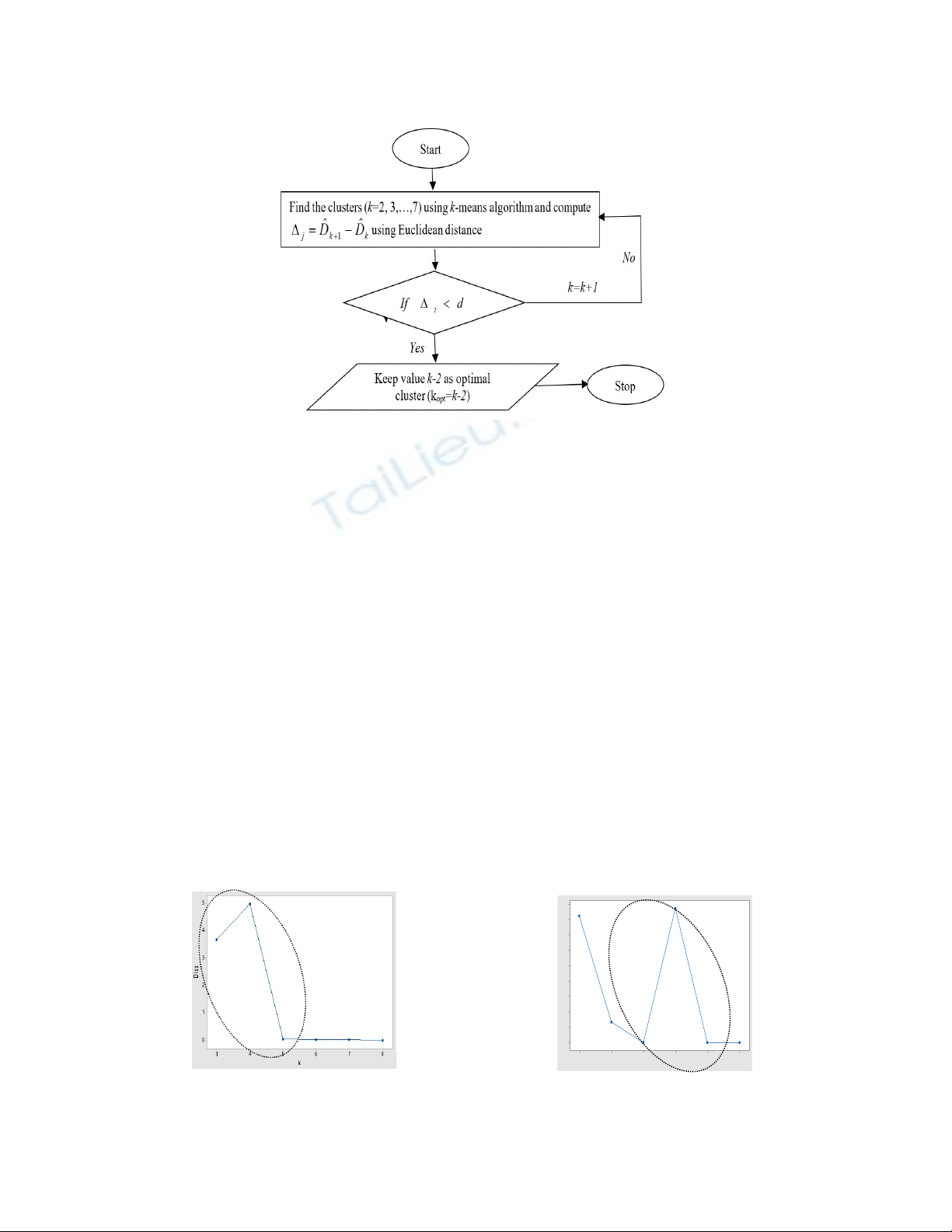
Euclidean distance measures to identify the exact number of optimal number of clusters from the data.
The proposed structure of the study is shown in Fig. 1.
Fig. 1. Structure of proposed k-means clustering algorithm
The constant value (d) in Fig. 1 represents the test value, where that the objects are repeatedly clustered
if the value j
is greater than d (j=k+1,k+2,..). Whereas, j
is the computed minimum distance
between centres of kth clusters (k=2,3,…,7). In this proposed algorithm, the Euclidean distance was
chosen as a measurement of separation between objects due to its straightforward computation for
numerical high dimensional data set. The following steps can be used to achieve the suitable number
of clusters.
1. Set the minimal number of k = 2
2. Perform k-means clustering and compute Euclidean distance between centroids of each clusters
3. Increase the number of clusters as k+1, perform again k-means clustering and compute the
distance between clusters.
4. Compare two consecutive distances at k and k+1
5. If the difference is acceptable, then the best optimal cluster is k-2. Otherwise, repeat Step 3.
2.4. Identify the test value (d)
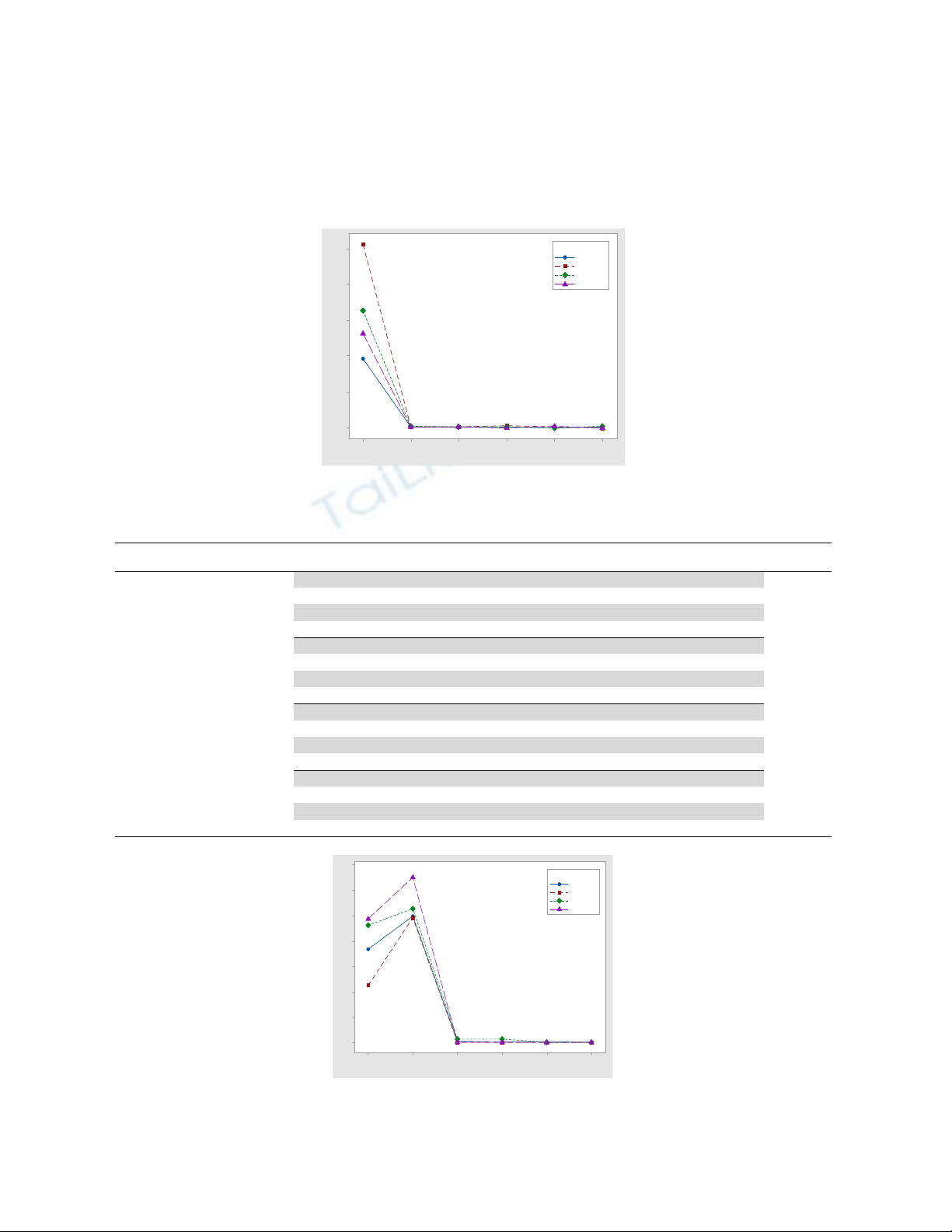
The constant value (d) was determined using the scatter plot [difference between cluster centroids
j
vs cluster number (k)] through the points close to the peak point in different conditions. The value d
was computed by obtaining the average of three points close to the peak point (succeeding and
preceding points). For instance,
Fig. 2. Scatter plot for j
vs k Fig. 3. Scatter plot for j
vs k
876543
9
8
7
6
5
4
3
2
1
0
k
D
i
s
s

54
In Fig. 2, the peak value can be seen when k=4. Not much fluctuations were observed afterwards.
Therefore, the constant value d1 was computed (taking average of 3 neighboring points close to the
peak point) using formula 1. Likewise, as shown in Fig. 3, after the first point, the peak point is at k=6.
Hence, the d2 was calculated by using formula 2.
3
)( 543
1
d, (1)
3
)( 765
2
d. (2)
2.5. Cluster Validity Indices
Cluster validation measure is important for evaluating the quality of clusters (Maulik &
Bandyopadhyay, 2002). Different quality measures have been used to assess the quality of the
discovered clusters. In this study, Dunn and Calinksi-Harbaz indices were used to assess the cluster
results, and they are briefly described in section 2.51 and 2.5.2.
2.5.1. Dunn Index (DI)
This index is described as the ratio between the minimal intra cluster distances to maximal inter cluster
distance. The Dunn index is as follows:
kl l
ji
kjiki cdiam
ccdist
DI
1
11 max
,
minmin ,
(3)
where
ji
cxandcx
ji xxdccdist
jjii
,min),(
is the distance between clusters ci and cj ;
ji xxd , is the
distance between data objects xi and xj ; diam(cl) is diameter of cluster cl, as the maximum distance
between two objects in the cluster. The maximum value of the Dunn index identifies that k is the
optimal number of clusters.
2.5.2 Calinski-Harabasz Index (CH)
This index is commonly used to evaluate the cluster validity and is defined as the ratio of the between-
cluster sum of squares (BCSS) and within-cluster sum of squares (WCSS) (Calinski & Harabasz, 1974).
This index can be calculated by the following formula:
WCSSk
BCSSkn
CH 1
, (4)
where n is the number of objects and k is the number of clusters. The maximum value of CH indicates
that k is the optimal number of clusters.
3. Results and Discussions
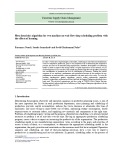
The proposed algorithm was tested using twelve sets of normal multivariate simulated data (Data1-
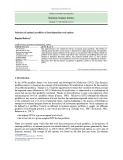
Data12) with two, three, and five clusters to determine the exact number of clusters. Fig. 4 to Fig. 6
present the scatter plot of differences between cluster centroids ( j
) against cluster number (k) for data
sets with k=2, 3 and 5. The test value (d) was calculated from Fig. 4 to Fig. 6, as described in section
2.4. The validity index (DI and CH), the difference between consecutive clusters centroids ( j
), test
value (d) for each data set (Data1-Data4) are presented in Table 1. The maximum value of DI and CH
was obtained when k=2, which confirms that the number of clusters of data sets is 2. In addition, the
M. C. Alibuhtto and N. I. Mahat / Decision Science Letters 9 (2020)
55
j
is less than at k=4. According to section 2.4 and Fig. 1, the optimal number of cluster for each data
set (Data1-Data4) is 2. Similarly, Table 2, and Table 3 report the maximum values of DI and CH
obtained for k=3 and k=5. Also, the j
is less than at k=5 and 7 for data sets (Data5-Data8) with three
clusters and data set (Data9-Data12) with five clusters respectively. These results indicate that the
optimal number of clusters for each data set is 3 and 5, respectively. Therefore, the proposed algorithm
is more appropriate for finding the correct number of clusters for high dimensional normal data.
Fig. 4. Scatter plot for distance between cluster centroids (DBCD) vs k for Data1-Data4
Table 1
Clustering results for Data1-Data4 with 2 clusters
Data
Set
n p k Clusters of sizes DI CH j
d
Data1
10000 10
2 10000,10000 0.784 124429.40 -
1.325
3 10000,5026,4974 0.066 65104.39 3.869
4 3306,10000,3290,3404 0.060 44809.81 0.055
5 4892,3442,5108,3278,3280 0.053 35347.62 0.051
Data2
2 10000,10000 2.628 642046.60 -
3.449
3 4827,5173,10000 0.072 333190.30 10.259
4 3142,10000,3417,3441 0.069 227474.30 0.044
5 3265,3342,5040,3393,4960 0.062 177709.80 0.044
Data3
25000 20
2 25000,25000 1.124 301828.70 -
2.231
3 25000,12629,12371 0.143 155192.60 6.566
4 8520,25000,8214,8266 0.127 105574.90 0.084
5 8864,12357,12643,7568,8568 0.130 8040750 0.043
Data4
2 25000,25000 0.922 203144.10 -
1.803
3 12572,25000,12428 0.131 104749.70 5.269
4 8279,8382,8339,25000 0.128 71299.03 0.073
5 6226,25000,6158,6160,6456 0.128 54334.43 0.068
Fig. 5. Scatter plot for distance between cluster centroids (DBCD) vs k for Data5-Data8
876543
10
8
6
4
2
0
k
D
B
C
D
Data1
Data2
Data3
Data4
Data
876543
7
6
5
4
3
2
1
0
k
D
B
C
D
Data5
Data6
Data7
Data8
Data

![Định mức kinh tế - kỹ thuật nghề Cơ khí hàn [chuẩn nhất]](https://cdn.tailieu.vn/images/document/thumbnail/2025/20251225/tangtuy08/135x160/695_dinh-muc-kinh-te-ky-thuat-nghe-co-khi-han.jpg)
![Tài liệu huấn luyện An toàn lao động ngành Hàn điện, Hàn hơi [chuẩn nhất]](https://cdn.tailieu.vn/images/document/thumbnail/2025/20250925/kimphuong1001/135x160/93631758785751.jpg)



![Giáo trình Cấu trúc dữ liệu và giải thuật - Trường CĐ Cơ điện Hà Nội [Mới nhất]](https://cdn.tailieu.vn/images/document/thumbnail/2026/20260323/lionelmessi01/135x160/58171774381670.jpg)


![Giáo trình Tiện nâng cao (Nghề Cắt gọt kim loại, Trình độ Cao đẳng) - Trường Cao đẳng Cơ điện Hà Nội [Mới nhất]](https://cdn.tailieu.vn/images/document/thumbnail/2026/20260323/lionelmessi01/135x160/48101774403543.jpg)


