

* Corresponding author.
E-mail address: taufikdjatna@apps.ipb.ac.id (T. Djatna)
© 2020 by the authors; licensee Growing Science, Canada.
doi: 10.5267/j.dsl.2019.7.002
Decision Science Letters 9 (2020) 91–106
Contents lists available at GrowingScience
Decision Science Letters
ho
mepage: www.GrowingScience.com/d
sl
Bi-objective freight scheduling optimization in an integrated forward/reverse logistic network
using non-dominated sorting genetic algorithm-II
Taufik Djatnaa* and Guritno A. M. Amienb
aPost Graduate Program, Department of Agro-industrial Technology, IPB University, Bogor, Indonesia
bDepartment of Agro-industrial Technology , IPB University, Bogor, Indonesia
C H R O N I C L E A B S T R A C T
Article history:
Received June 15, 2019
Received in revised format:
June 20, 2019
Accepted July 27, 2019
Available online
J
uly
27
,
201
9
Simultaneous products distribution and items retrieval in an integrated forward/reverse logistics
network faces a complex freight-scheduling problem due to the constraints involved. In the high
to intermediate network level, the problem usually exists in the form of single stop transportation.
To reach a higher level of performances, there is a need to model and optimize the freight
schedule. This research proposes a model to optimize a freight-scheduling problem. The
proposed model of this paper based on Non-dominated sorting genetic algorithm-II is formulated
to solve a conflicting bi-objective optimization and optimizes a real-world case study. A solution
from the model demonstrates the solution interpretation in the form of delivery schedule,
distribution as well as retrieval route, and vehicle assignment. Moreover, the solutions are also
comparable to some current manual solution by its similarity. The results show that the model
was capable of generating feasible solutions while satisfying all of its constraints.
.by the authors; licensee Growing Science, Canada 2020©
Keywords:
Bi-objective optimization
Freight scheduling
Integrated forward/reverse
logistic network
Non-dominated sorting genetic
algorithm
-
II
1. Introduction
Freight scheduling is a series of transportations of a bulk/large quantity of goods in a limited time.
Freight scheduling problem is considered as a sub-discussion of freight management that involves
vehicle routing, vehicle scheduling and dispatching, freight network flow, freight consolidation, etc.
(Gudehus & Kotzab 2009). Freight scheduling is important because it manages transportation of items
in a logistic network. Transportation itself occupies one third of the amount of the logistics cost and
hugely influences the performance of logistics system. Therefore, optimization of a freight schedule is
important to reduce the overall logistics cost and enhances the logistic system’s performance (Parkhi
et al., 2014; Tseng et al., 2005). Many real world problems are recently involved with optimization of
multiple conflicting objectives (de Oliveira & Saramago, 2010). Hence freight schedule optimization
is also preferably to be optimized with more than one objective. For example, minimizing transportation
cost and maximizing order responsiveness. In this case, there are two conflicting objectives, thus the
optimization is called bi-objective optimization.
Freight schedule optimization exists in forward and reverse logistics. Forward logistics is described as
the processes (including planning, implementing, and controlling) involved in the movement of
materials (including raw materials, in-process inventory, finished goods, and related information) from
the point of origin towards the point of consumption. The opposite term of it is reverse logistics, which

92
is described as processes involved in the movement of materials from the point of consumption to the
point of origin for the purpose of recapturing or creating value or proper disposal (Rogers & Tibben-
Lembke, 1999). Enterprises are interested in implementing reverse logistics because it is one of the
most common driving force, that is economic factor. A reverse logistics program might bring direct
benefit to companies by decreasing the use of raw materials, adding value with recovery, or reducing
disposal costs (de Brito & Dekker, 2003). Freight scheduling optimization in any logistics network is
a critical problem to solve, be it forward or reverse logistics. However, optimization in a separate
forward and reverse logistics network may result in a sub-optimal solution. Therefore, an Integrated
Reverse Logistic Problem (IRLP) was introduced. IRLP is a logistics network type where the forward
and reverse logistic are designed or managed in an integrated manner in terms of facility, transportation
route, or transportation schedule. The integration was performed to evade the sub-optimality (Pishvaee
et al., 2009).
In order to optimize a freight schedule in an IRLP, a Graph Theory is potentially used to model the
network. The node or vertex is used to represent the facility while the arc or edge is used to represent
the shortest route connecting two facilities. The optimization in freight schedule is performed by
determining the lowest cost route (similar to Minimum Spanning Tree/MST) and also the quantity of
distribution and retrieval. Classical minimum spanning tree techniques such as Kruskal’s algorithm,
Boruvka’s algorithm, and Prim’s algorithm are not suitable for a multi objectives optimization that is
addressed in this research. Furthermore, these techniques failed to solve a large scale problem that
usually involve multi-dimensionality which is addressed in this research in the form of multi products
and multi-capacitated vehicles. However, an advanced optimization approach, such as Non-dominated
Sorting Genetic Algorithm-II (NSGA-II) is suitable for multi objectives optimization and capable of
solving a large scale problem (Rao & Savsani 2012). NSGA-II was proposed to solve the high
computational complexity, lack of elitism, and specifying of the sharing parameter of NSGA. In
NSGAII, a selection operator is designed by creating a mating pool to combine the parent population
and offspring population. Non-dominated sort and crowding distance ranking are also implemented in
the algorithm. Therefore, it is potentially used to solve the problem on this research.
This research tried to model, to optimize a vehicle routing, and to network flow in an IRLP. The
research focus is only in the high to intermediate network level, which is between manufacturer and
distribution centers. The objectives of this research is to formulate a transportation optimization model,
which utilizes a Non-dominated Sorting Genetic Algorithm II (NSGA-II), and to optimize a given case
study using the proposed model.
The remainder of this paper is organized as follows. In section 2, the literature reviews related to the
field of research are discussed. In section 3, the research problem and also its assumptions are described.
Then in section 4, a mathematical model and optimization approach are proposed. In section 5, a Java
code that is implemented to solve the problem is elaborated and in section 6, the result and discussion
of applying the code to a case study are presented. The model is further interpreted for solutions
similarity, advantages, disadvantages, and managerial impacts are presented in section 7. Finally, the
conclusion of this research and recommendation for future works are presented in section 8.
2. Literature review
Transportation system is a collection of components or elements that work together to provide a safe
and efficient movement of people and goods. A transportation network often is represented using Graph
Theory. Graph is a pair 𝐺=(𝑉,𝐸) where 𝑉 is the set of vertices (or nodes, or points) of the graph G,
and 𝐸 is the set of edges (or arcs, or lines) formed by pairs of vertices (Diestel 2005). Various studies
have been conducted on the field of graph theory for the last few years. Likaj et al. (2013) presented
the use of Dijkstra’s and Kruskal’s algorithm to find the shortest path and minimum spanning tree
which minimized the shipment cost. Barwaldt et al. (2014) studied the use of graph theory for the

T. Djatna and G. A. M. Amien/ Decision Science Letters 9 (2020)
93
implementation of bike lane in a small town. They found out that by using the graph theory, the bike
lane was successfully generated by minimizing the cost and time of implementation. Price and Ostfeld
(2014) also presented the use of Successive Shortest Path (SSP) algorithm to solve the minimum-cost
flow problem for a water system. They compared the results generated from the SSP algorithm with
the results generated from linear programming and reported that by using the SSP algorithm, the water
would be held for fewer hours in the water tanks before consumption, which yiels to improve the water
quality dispatch to consumers. The use of graph theory on reverse logistics was presented by Agrawal
et al. (2016). They attempted to find the various disposition alternatives and developed an approach for
the selection of best disposition alternative using graph theory and matrix approach. They proved that
the proposed approach was capable of selecting the best disposition alternative in a case study.
Recently, Démare et al. (2017) presented the use of a dynamic graph to model and simulate logistics
system. They claimed that the proposed model might be implemented to simulate many logistics
systems. The graph theory that have been explained above only worked well in not complex scema
(Guidice 2013). The optimization of transportation system might be performed using classical or
advanced techniques. The utilization of genetic algorithm as one of advanced techniques in the field of
transportation system have been researched quite a lot. Siregar (2012) developed a model to optimize
a vehicle routing problem without time windows in a forward logistics network using basic genetic
algorithm. Zaki et al. (2012) developed an efficient approach to solve a transportation, assignment, or
transshipment problem in a forward logistics context using hybrid genetic algorithm with local search
algorithm. Cataruzza et al. (2013) proposed a procedure that outperforms some common algorithm to
solve a Multi Trip Vehicle Routing Problem (MTVRP) in a forward logistic network. The proposed
procedure consisted of splitting procedure, genetic algorithm, and local search.
Numerous studies have been conducted in the field of freight scheduling that was related to
transportation system in both forward or reverse logistics and even in the integrated logistics network
issues. Fleischmann et al. (2001) developed a model to integrate reverse logistics network design in
case of facility location’s determination to an existing multi echelons logistic structures. Lee and Dong
(2008) developed a method to efficiently solve the location-allocation and network flow in a multi
echelon IRLP with single product multiple components using Tabu search approach. Khajavi et al.
(2011) proposed a model to optimize a capacity and location problem in a multi echelon IRLP with
single product using branch and bound algorithm. Baumik (2015) designed a formulation of minimum
cost in routing reverse logistics form warehouse to retail stores. He applied ILP (integer linear
programming) while others applied MILP (mix integer linear programming) or MIP (mix integer
programming) (Fazlollahtabar, 2018). But this method only worked for not very large problems. Lastly,
Dondo and Mendez (2016) presented a framework to optimize network flow operational planning in a
multi echelon IRLP with single product using a column-generation based decomposition approach.
From the previous studies mentioned, it is known that optimization of vehicle routing and network flow
for the IRLP was rarely performed using evolutionary algorithm such as genetic algorithm. Not to
mention that most cases only considered single product. Moreover, the use of graph theory was mainly
implemented by using a classical algebraic optimization approach which is more suitable for limited
variables and known functions. Therefore, this research was performed to accommodate a multi
products cases while utilizing an NSGA-II algorithm as the optimization approach. This optimization
approach was deployed because it is popular, fast, reliable, and capable to address a multi objective
optimization. Since the problem addressed in this research has two objectives to be optimized, the
utilization of NSGA-II approach is a sensible choice.
3. The proposed methodology
3.1. The problem statement and assumption
The problem addressed in this research is the optimization of the route as well as quantity of
simultaneous distribution (forward logistic activity) and retrieval (reverse logistic activity). It also
94
required the determination of vehicle assignment in a single time windows. Moreover, contribution of
this work was focused in the high to intermediate transportation network level, which is between
factories and distribution centers. The problem discussed has characteristics of single echelon freight
transportation, single stop, single manufacturing site, multi products, and multi capacitated vehicles.
Furthermore, the problem is consisted of two conflicting objectives of transportation cost and order
responsiveness, both in forward logistics, as well as in reverse logistics. These two objectives were
determined from the transportation system requirements as a case study, which elaborated, in the next
section.
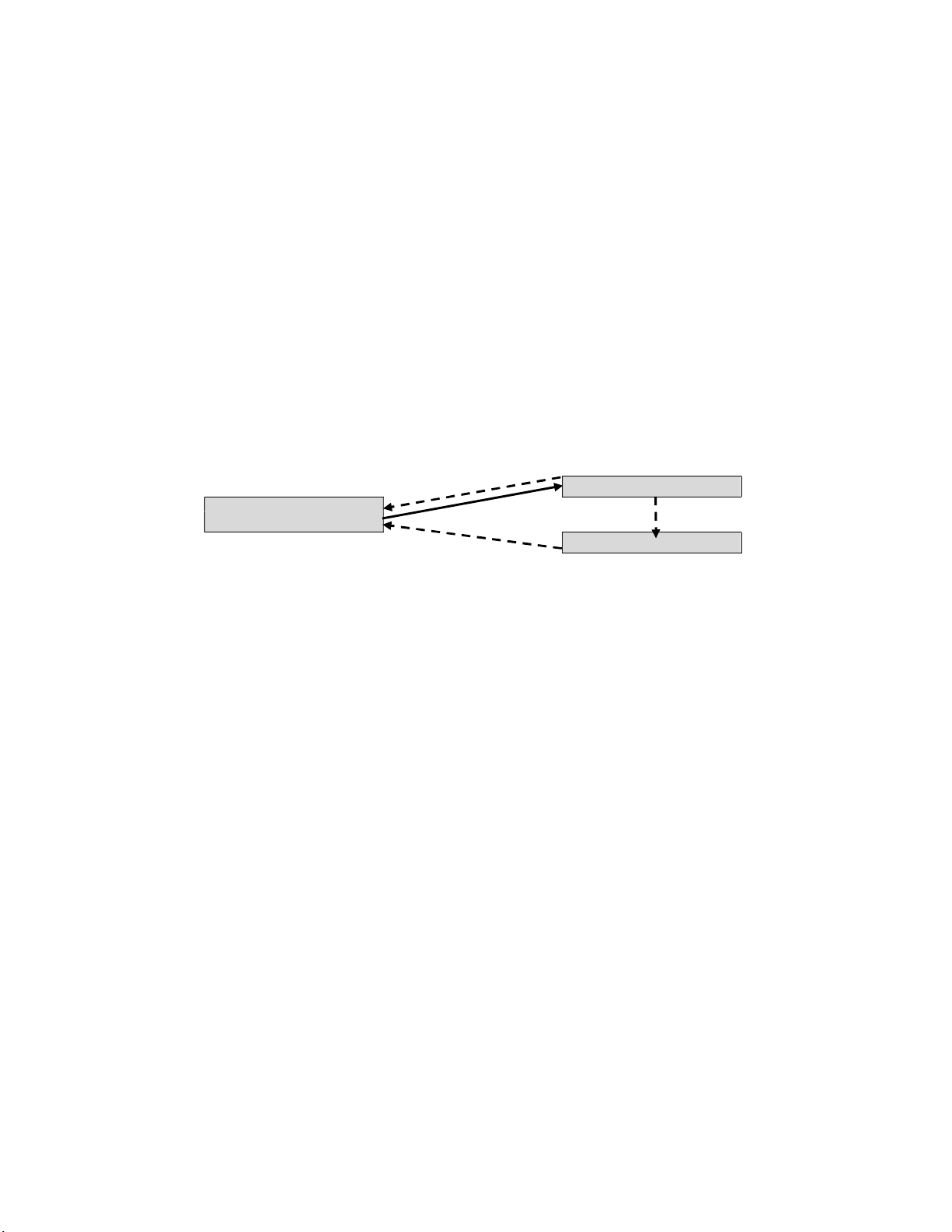
As illustrated in Fig. 1, in a forward logistics network, the products (e.g. beverages in a Returnable
Glass Bottle, abbreviated as RGB) are distributed to satisfy demand at day 𝑥 from a set of DCs. Notation
𝑥 refers to the day where the distribution and retrieval are optimized. The order responsiveness for
forward logistics refer to the total number of products distributed per total demand at day 𝑥. In the
reverse logistics network, the retrieved items (e.g. empty Returnable Glass Bottle) are transported from
a set of DCs to manufacturer in order to satisfy the forecast of production requirements at day 𝑦.
Notation 𝑦 refers to the day where the retrieved items are needed for production. The order
responsiveness for reverse logistic refers to the total amount of item retrieved per total production
requirement at day 𝑦. Order responsiveness is useful to understand how well a freight schedule reacts
to the change in products demand or retrieved items requirement.
retreival
DC
Factory
distribution
retreival
retreival
DC
Fig. 1 Illustration of distribution and retrieval in IRLP.
The problem in this research only allowed a DC to be visited exactly once for the same vehicle.
However, the DC also allowed to visit by multiple vehicles a day. This means that if vehicle-1 visits
DC-A, then it can visit the other DCs except DC-A on the same day. On the other hand, DC-A might
still be visited by the other vehicles. The time constraint for this problem is in the form of single time
windows and only applicable for the forward logistics. The reason is because from the preliminary
study of the real-world case (used as the case study later), it was known that the time constraint for the
reverse logistics was very lax. Thus, it was nearly impossible for the delivery in the reverse logistics to
be tardy.
3.2 Mathematical model and optimization approach
3.2.1 Proposed notations and mathematical model
A mathematical equations as the problem representation and the solutions similarity were formulated.
The model was consisted of two objectives and nine constraints. The optimization approach (NSGA-
II) would produce multiple solutions where each solution has a set of variables. Hence, it is best to
include the solution and variable’s indices in the model. For each solution, the list of indices, decision
variables, and parameters of the proposed model is presented as in Table 1. Furthermore, the goals and
constraints of the proposed model is presented as in the equations below this table. The formulation of
solution’s similarity was also presented to be used in the section 5 on this paper.

T. Djatna and G. A. M. Amien/ Decision Science Letters 9 (2020)
95
Table 1
List of notations
No. Notation Description Range
Indices
1.
𝑣
𝑉𝑒
ℎ
𝑖𝑐𝑙
𝑒
𝑠
𝑖𝑛𝑑𝑖𝑐𝑒𝑠
{
1
,
…
,
𝑣
}
2.
𝑝
𝑃𝑟𝑜𝑑𝑢𝑐
𝑡
𝑠
𝑖𝑛𝑑𝑖𝑐𝑒𝑠
{
1
,
…
,
𝑝
}
3.
𝑟
𝑅𝑒𝑡𝑟𝑖𝑒𝑣𝑒𝑑
𝑖𝑡𝑒
𝑚
𝑠
𝑖𝑛𝑑𝑖𝑐𝑒𝑠
{
1
,
…
,
𝑟
}
4.
𝑖
𝐹𝑎𝑐𝑡𝑜𝑟𝑦
𝑎𝑠
𝑎
𝑛𝑜𝑑
𝑒
𝑠
𝑖𝑛𝑑𝑖𝑐𝑒𝑠
{
1
,
…
,
𝑖
}
5.
𝑗
𝐷𝐶
𝑎𝑠
𝑎
𝑛𝑜𝑑
𝑒
𝑠
𝑖𝑛𝑑𝑖𝑐𝑒𝑠
{
1
,
…
,
𝑗
}
6.
𝑥
𝐷𝑎
𝑦
𝑠
𝑖𝑛𝑑𝑖𝑐𝑒𝑠
{
1
,
…
,
𝑥
}
7.
𝑐
𝑉𝑒
ℎ
𝑖𝑐𝑙𝑒
𝑐𝑎𝑝𝑎𝑐𝑖𝑡
𝑦
𝑠
𝑖𝑛𝑑𝑖𝑐𝑒𝑠
{
1
,
…
,
𝑐
}
8.
𝑠
𝐿𝑜𝑎𝑑𝑖𝑛𝑔
𝑠𝑒𝑟𝑣𝑒𝑟
′
𝑠
𝑖𝑛𝑑𝑖𝑐𝑒𝑠
{
1
,
…
,
𝑠
}
9.
𝑦
𝑜𝑟𝑑𝑒𝑟
𝑜𝑓
𝑑𝑒𝑝𝑎𝑟𝑡𝑢𝑟𝑒
′
𝑠
𝑖𝑛𝑑𝑖𝑐𝑒𝑠
{
1
,
…
,
𝑦
}
10.
𝑜
𝑆𝑜𝑙𝑢𝑡𝑖𝑜
𝑛
𝑠
𝑖𝑛𝑑𝑖𝑐𝑒𝑠
{
1
,
…
,
𝑜
}
11.
𝑎
𝑉𝑎𝑟𝑖𝑎𝑏𝑙
𝑒
𝑠
𝑖𝑛𝑑𝑖𝑐𝑒𝑠
{
1
,
…
,
𝑎
}
Where all index are integer
Decision variables
1.
𝑑
𝐴𝑚𝑜𝑢𝑛𝑡
𝑜𝑓
𝑝𝑟𝑜𝑑𝑢𝑐𝑡
𝑝
𝑑𝑖𝑠𝑡𝑟𝑖𝑏𝑢𝑡𝑒𝑑
𝑓𝑟𝑜𝑚
𝑛𝑜𝑑𝑒
𝑖
𝑡𝑜
𝑛𝑜𝑑𝑒
𝑗
𝑏𝑦
𝑣𝑒
ℎ
𝑖𝑐𝑙𝑒
𝑣
𝑎𝑡
𝑑𝑎𝑦
𝑥
2.
𝑒
𝐴𝑚𝑜𝑢𝑛𝑡
𝑜𝑓
𝑟𝑒𝑡𝑟𝑖𝑒𝑣𝑒𝑑
𝑖𝑡𝑒𝑚
𝑝
𝑡𝑟𝑎𝑛𝑠𝑝𝑜𝑟𝑡𝑒𝑑
𝑓𝑟𝑜𝑚
𝑛𝑜𝑑𝑒
𝑗
𝑡𝑜
𝑛𝑜𝑑𝑒
𝑖
𝑏𝑦
𝑣𝑒
ℎ
𝑖𝑐𝑙𝑒
𝑣
𝑎𝑡
𝑑𝑎𝑦
𝑥
Parameters
1.
𝑆𝑃
𝑆𝑡𝑜𝑐𝑘
𝑜𝑓
𝑝𝑟𝑜𝑑𝑢𝑐𝑡
𝑝
𝑜𝑛
𝑛𝑜𝑑𝑒
𝑖
𝑎𝑡
𝑑𝑎𝑦
𝑥
2.
𝑆𝑅
𝑆𝑡𝑜𝑐𝑘
𝑜𝑓
𝑟𝑒𝑡𝑟𝑖𝑒𝑣𝑒𝑑
𝑖𝑡𝑒𝑚
𝑝
𝑜𝑛
𝑛𝑜𝑑𝑒
𝑗
𝑎𝑡
𝑑𝑎𝑦
𝑥
3.
𝐷𝐼𝐷
𝐷𝑒𝑚𝑎𝑛𝑑
𝑓𝑜𝑟
𝑝𝑟𝑜𝑑𝑢𝑐𝑡
𝑝
𝑎𝑡
𝑑𝑎𝑦
𝑥
𝑓𝑟𝑜𝑚
𝑛𝑜𝑑𝑒
𝑗
𝑡𝑜
𝑛𝑜𝑑𝑒
𝑖
4.
𝐶𝑎𝑝
𝐶𝑜𝑛𝑠𝑡𝑎𝑛𝑡
𝑣𝑎𝑙𝑢𝑒
𝑜𝑓
𝑣𝑒
ℎ
𝑖𝑐𝑙
𝑒
𝑠
𝑐𝑎𝑝𝑎𝑐𝑖𝑡𝑦
𝑐
5.
𝑘
𝐶𝑜𝑛𝑠𝑡𝑎𝑛𝑡
𝑣𝑎𝑙𝑢𝑒
𝑜𝑓
𝑓𝑙𝑒𝑒𝑡
𝑠𝑖𝑧𝑒
𝑓𝑜𝑟
𝑣𝑒
ℎ
𝑖𝑐𝑙
𝑒
𝑠
𝑐𝑎𝑝𝑎𝑐𝑖𝑡𝑦
𝑐
6.
𝐷𝑒𝑝
𝑁𝑢𝑚𝑏𝑒𝑟
𝑜𝑓
𝑣𝑒
ℎ
𝑖𝑐𝑙𝑒𝑠
𝑑𝑒𝑝𝑙𝑜𝑦𝑒𝑑
𝑓𝑜𝑟
𝑐𝑎𝑝𝑎𝑐𝑖𝑡𝑦
𝑐
7.
𝐶𝐷
𝐶𝑜𝑠𝑡
𝑜𝑓
𝑑𝑖𝑠𝑡𝑟𝑖𝑏𝑢𝑡𝑖𝑜𝑛
𝑓𝑟𝑜𝑚
𝑛𝑜𝑑𝑒
𝑖
𝑡𝑜
𝑛𝑜𝑑𝑒
𝑗
8.
𝐶𝑅
𝐶𝑜𝑠𝑡
𝑜𝑓
𝑟𝑒𝑡𝑟𝑖𝑒𝑣𝑎𝑙
𝑓𝑟𝑜𝑚
𝑛𝑜𝑑𝑒
𝑗
𝑡𝑜
𝑛𝑜𝑑𝑒
𝑖
9.
𝐶𝐵
𝐵𝑎𝑠𝑒
𝑐𝑜𝑠𝑡
𝑜𝑓
𝑡𝑟𝑎𝑛𝑠𝑝𝑜𝑟𝑡𝑎𝑡𝑖𝑜𝑛
𝑏𝑒𝑡𝑤𝑒𝑒𝑛
𝑛𝑜𝑑𝑒
𝑖
𝑎𝑛𝑑
𝑛𝑜𝑑𝑒
𝑗
10.
𝐶𝐵𝐷
𝐵𝑎𝑠𝑒
𝑐𝑜𝑠𝑡
𝑜𝑓
𝑡𝑟𝑎𝑛𝑠𝑝𝑜𝑟𝑡𝑎𝑡𝑖𝑜𝑛
𝑏𝑒𝑡𝑤𝑒𝑒𝑛
𝑡𝑤𝑜
𝑛𝑜𝑑𝑒
𝑗
11.
𝜃
𝑊𝑒𝑖𝑔
ℎ
𝑡𝑖𝑛𝑔
𝑓𝑎𝑐𝑡𝑜𝑟
𝑓𝑜𝑟
𝑡
ℎ
𝑒
𝑜
𝑟𝑑𝑒𝑟
𝑟𝑒𝑠𝑝𝑜𝑛𝑠𝑖𝑣𝑒𝑛𝑒𝑠𝑠
𝑜𝑓
𝑓𝑜𝑟𝑤𝑎𝑟𝑑
𝑙𝑜𝑔𝑖𝑠𝑡𝑖𝑐
12.
(
1
−
𝜃
)
𝑊𝑒𝑖𝑔
ℎ
𝑡𝑖𝑛𝑔
𝑓𝑎𝑐𝑡𝑜𝑟
𝑓𝑜𝑟
𝑡
ℎ
𝑒
𝑜𝑟𝑑𝑒𝑟
𝑟𝑒𝑠𝑝𝑜𝑛𝑠𝑖𝑣𝑒𝑛𝑒𝑠𝑠
𝑜𝑓
𝑟𝑒𝑣𝑒𝑟𝑠𝑒
𝑙𝑜𝑔𝑖𝑠𝑡𝑖𝑐
13.
𝑑𝑇
𝐷𝑒𝑝𝑎𝑟𝑡𝑢𝑟𝑒
𝑡𝑖𝑚𝑒
𝑜𝑓
𝑜𝑟𝑑𝑒𝑟
𝑦
𝑎𝑡
𝑠𝑒𝑟𝑣𝑒𝑟
𝑠
14.
𝑙𝑇
𝐿𝑜𝑎𝑑𝑖𝑛𝑔
𝑡𝑖𝑚𝑒
15.
𝑡𝑇
𝑇𝑟𝑎𝑛𝑠𝑝𝑜𝑟𝑡𝑎𝑡𝑖𝑜𝑛
𝑡𝑖𝑚𝑒
𝑓𝑟𝑜𝑚
𝑛𝑜𝑑𝑒
𝑖
𝑡𝑜
𝑛𝑜𝑑𝑒
𝑗
16.
𝑍
𝑇𝑟𝑎𝑛𝑠𝑝𝑜𝑟𝑡𝑎𝑡𝑖𝑜𝑛
𝑐𝑜𝑠𝑡
17.
𝑍
𝑂𝑟𝑑𝑒𝑟
𝑟𝑒𝑠𝑝𝑜𝑛𝑠𝑖𝑣𝑒𝑛𝑒𝑠𝑠
18.
𝑛
𝑁𝑢𝑚𝑏𝑒𝑟
𝑜𝑓
𝑣𝑎𝑟𝑖𝑎𝑏𝑙𝑒
(
𝑠
)
𝑖𝑛
𝑎
𝑠𝑜𝑙𝑢𝑡𝑖𝑜𝑛
𝑡𝑜
𝑏𝑒
𝑐𝑎𝑙𝑐𝑢𝑙𝑎𝑡𝑒𝑑
𝑖𝑛
𝑠𝑜𝑙𝑢𝑡𝑖𝑜
𝑛
𝑠
𝑠𝑖𝑚𝑖𝑙𝑎𝑟𝑖𝑡𝑦
19.
𝑆𝑖𝑚
𝑆𝑖𝑚𝑖𝑙𝑎𝑟𝑖𝑡𝑦
𝑏𝑒𝑡𝑤𝑒𝑒𝑛
𝑠𝑜𝑙𝑢𝑡𝑖𝑜𝑛
𝑜
𝑎𝑛𝑑
𝑠𝑜𝑙𝑢𝑡𝑖𝑜𝑛
𝑟𝑒𝑓𝑒𝑟𝑒𝑛𝑐𝑒
𝑓𝑜𝑟
𝑛
𝑣𝑎𝑟𝑖𝑎𝑏𝑙𝑒
(
𝑠
)
Mathematical model:
𝑚𝑖𝑛
𝑍
=
𝐶𝐷
∗
𝑑
+
𝐶𝐵
+
𝐶𝑅
∗
𝑒
+
𝐶𝐵
+
𝐶𝐵𝐷
(1)
𝑚𝑎𝑥
𝑍
=
𝜃
∗
∑
∑
∑
𝑑
∑
∑
𝐷𝐼𝐷
+
(
1
−
𝜃
)
∗
∑
∑
∑
𝑒
∑
∑
𝐷𝐼𝐷
(2)

![Định mức kinh tế - kỹ thuật nghề Cơ khí hàn [chuẩn nhất]](https://cdn.tailieu.vn/images/document/thumbnail/2025/20251225/tangtuy08/135x160/695_dinh-muc-kinh-te-ky-thuat-nghe-co-khi-han.jpg)
![Tài liệu huấn luyện An toàn lao động ngành Hàn điện, Hàn hơi [chuẩn nhất]](https://cdn.tailieu.vn/images/document/thumbnail/2025/20250925/kimphuong1001/135x160/93631758785751.jpg)



![Giáo trình Cấu trúc dữ liệu và giải thuật - Trường CĐ Cơ điện Hà Nội [Mới nhất]](https://cdn.tailieu.vn/images/document/thumbnail/2026/20260323/lionelmessi01/135x160/58171774381670.jpg)


![Giáo trình Tiện nâng cao (Nghề Cắt gọt kim loại, Trình độ Cao đẳng) - Trường Cao đẳng Cơ điện Hà Nội [Mới nhất]](https://cdn.tailieu.vn/images/document/thumbnail/2026/20260323/lionelmessi01/135x160/48101774403543.jpg)


