

REVIEW ARTICLE
Innovative and safe supply of fuels for reactors
Stéphane Valance
1,*
, Bruno Baumeister
2
, Winfried Petry
2
, and Jan Höglund
3
1
CEA, DEN, DEC, Cadarache, 13108 Saint-Paul-lez-Durance, France
2
Forschungs-Neutronenquelle Heinz Maier-Leibnitz (FRM II), Technische Universität München, Lichtenbergstrass, 1,
85747 Garching, Germany
3
Westinghouse Electric Sweden AB., 72163 Västerås, Sweden
Received: 12 March 2019 / Accepted: 4 June 2019
Abstract. Within the Euratom research and training program 2014–2018, three projects aiming at securing the
fuel supply for European power and research reactors have been funded. Those three projects address the
potential weaknesses –supplier diversity, provision of enriched fissile material –associated with the furbishing of
nuclear fuels. First, the ESSANUF project, now terminated, resulted in the design and licensing of a fuel element
for VVER-440 nuclear power plant manufactured by Westinghouse. The HERACLES-CP project aimed at
preparing the conversion of high performance research reactor to low enriched uranium fuels by exploring fuels
based on uranium-molybdenium. Finally, the LEU-FOREvER pursues the work initiated in HERACLES-CP,
completing it by an exploration of the high-density silicide fuels, and including the diversification of fuel supplier
for soviet designed European medium power research reactor. This paper describes the projects goals, structure
and their achievements.
1 Introduction
At the core of reactor operation, nuclear fuel is a
consumable which necessitates a secure supply chain. In
EU, that entails a diversity of suppliers with licensed fuel
design and the availability of enriched uranium. Particu-
larly, reactors with an original soviet design present a
weakness in their supply chain as they depend on a single
manufacturer. In Europe, this is the case for VVER-440
power plants and medium power research reactors. High
Power Research Reactors (HPRRs), with more standard-
ized fuel designs, are, on their side, vulnerable to the supply
of high enriched uranium necessary to ensure their
performance.
Diversification of fuel element supply requires the
adaptation of non-historic fuel manufacturers to the
specificities of the reactor. The first step of this diversifica-
tion is thus reverse engineering to tackle all the technical
functions of the element for any type of operating
conditions. Then, a design has to be set-up which fulfils
the identified functions and is adapted to the producing
means of the new manufacturer. Finally, the new fuel
element should be licensed within one or several countries.
This last step might involve an irradiation depending on
the reactor specific needs.
With respect to enriched uranium supply, global
efforts are made to minimize the use of highly enriched
uranium in research reactors. In the EU, this conversion
from highly to lower enriched uranium has already begun
and is currently ongoing towards the qualification phase.
This concerns both medium and high power research
reactors. To reach this goal, the adopted path is the
development of fuels core which presents a higher fissile
uranium content without overcoming the 19.75% non-
proliferant enrichment limit. Three ways have been
identified to reach this goal: high density dispersed
silicide fuels, dispersed uranium-molybdenum fuels and
monolithic uranium-molybdenum fuels.
In this paper, a presentation of each of the projects is
done. Then the achievements for innovative and safe
supply of the fuel permitted thanks to the EU funding are
presented. Finally, a global picture of the challenges solved
and remaining questions is drawn.
2 H2020 projects enabling innovative
and safe supply of fuels
2.1 ESSANUF
Several countries in Eastern Europe rely heavily on
electricity generated from Russian-design VVER-440 pres-
surized water reactors. Currently, the Russian company
TVEL is the sole supplier of nuclear fuel to these facilities.
*e-mail: stephane.valance@cea.fr
EPJ Nuclear Sci. Technol. 6, 40 (2020)
©S. Valance et al., published by EDP Sciences, 2020
https://doi.org/10.1051/epjn/2019013
Nuclear
Sciences
& Technologies
Available online at:
https://www.epj-n.org
This is an Open Access article distributed under the terms of the Creative Commons Attribution License (http://creativecommons.org/licenses/by/4.0),
which permits unrestricted use, distribution, and reproduction in any medium, provided the original work is properly cited.

The EU-funded ESSANUF project was launched with the
goal to design a state-of-the-art fuel for VVER-440 reactors
in full compliance with nuclear safety standards.
ESSANUF (European Supply of Safe NUclear Fuel) [1]
is the Euratom funded project from 2016 to 2017 with the
overall objective to create greater security of fuel supply to
countries operating VVER-440 nuclear power plants in
Czech Republic, Finland, Hungary, Slovakia and Ukraine.
The project enables the re-entry of Westinghouse as
nuclear fuel supplier to VVER-440 offering diversification
and greater security of fuel supply.
The project is led by Westinghouse Sweden and
includes eight consortium partners: VUJE,
UJV Řež
(NRI), Lappeenranta University of Technology (LUT),
National Nuclear Laboratory (NNL), NucleoCon, National
Science Center Kharkov Institute of Physics and Technol-
ogy (NSC KIPT), Institute for Transuranium Elements of
the Joint Research Centre of the European Commission
(JRC-ITU) and Enusa Industrias Avanzadas (ENUSA).
The consortium covers by their geographical distribution
the targeted countries operating VVER-440 nuclear power
plants.
Within the project, an improved VVER-440 fuel design
has been developed and the manufacturing capabilities
assessed [2]. Furthermore, the project contributed to the
generation of a generic licensing methodology for VVER-
440 fuel and the set-up of tools enabling to perform the
required analyses and investigations for licensing [3,4].
The ESSANUF team selected the most suitable
materials for all the fuel assembly components and
identified necessary modifications to the earlier supplied
VVER-440 assembly design to fulfil utility needs and
regulatory requirements of each country. A development
programme was established to test and verify the modified
design and its manufacturability was assessed to identify
any changes needed to the manufacturing processes and
equipment.
Thereafter, the project partners developed and validated
methods andmethodologies necessary to qualify operation of
the modified fuel design in the participating countries. In
particular, the models to simulate the fuel rod thermo-
mechanical behaviour, corrosion and hydrogen uptake
were improved enabling significant advances in the design
of the fuel rods.
In addition to the VVER-440 nuclear fuel design, the
ESSANUF project partners established the methods and
methodologies required to qualify the fuel design for
operation in Finland, Hungary, Slovakia, Czech Republic
and Ukraine.
Also, significant progress was made to verify and
validate the methods and methodologies to simulate the
neutronic and thermal hydraulic behaviour of the fuel
design. Researchers developed a nuclear criticality safety
methodology for the EU and Ukraine based on Interna-
tional Atomic Energy Agency guidelines and regulations,
taking into account national requirements.
2.2 HERACLES-CP
HERACLES-CP [5], a Euratom project, funded from 2015
to 2019, is a central pillar of the overall fuel development
program of the HERACLES, a pan-European group which
gathers the high power research reactor operators ILL,
SCK-CEN, CEA and TUM as well as the fuel manufacturer
Framatome-CERCA. “CP”stands for “Comprehension
Phase”.
The general objective of this project is the provision
of the technical and scientific foundations for the
successful qualification of UMo, a new research reactor
fuel based on uranium-molybdenum (UMo) alloys, which
is developed in the framework of the joint international
efforts to reduce the risk of proliferation by minimising
the use of highly enriched uranium. UMo based nuclear
fuels, monolithic and dispersed, are promising candidates
to carry out the conversion of HPRRs (High Performance
Research Reactors). In such a fuel system, the addition of
molybdenum to uranium stabilises the body-centred
cubic crystal structure of the high-temperature g-phase
of uranium under irradiation. Hence, the transition to
the low-temperature orthorhombic a-phase with its
strongly anisotropic thermal expansion is prevented
with an addition of 7 to 10 wt.% Mo. This stoichiometry
has been proven to be the best compromise between
achievable uranium density and stabilisation of the
phase behaviour.
Despite being the most promising candidate, signifi-
cant obstacles were encountered on the way to qualifica-
tion of UMo fuels in the challenging environment of the
HPRRs, particularly with respect to density of dispersion
fuel, power and burnup. The very first in-pile tests (IRIS2,
FUTURE, IRIS3 0.3%Si) of nuclear fuels with a UMo/Al
composition showed an unacceptable swelling under
irradiation, in some cases even leading to plate break-
away, even though these tests were only performed with
limited surface power (350 W.cm
2
)[6–8]. The failure
has been traced back to a UMo/Al Inter-Diffusion Layer
(IDL) growing during in-pile irradiation at UMo-Al
interfaces and to its unsatisfactory properties under
irradiation [9].
The developments performed worldwide over the last
fifteen years have successfully limited the IDL growth [10].
The beneficial effect of Si additions to the dispersion UMo
fuel, and more recently the coating of UMo particles with a
diffusion barrier can be observed in the gradual, controlled
swelling up to higher burnups. A dispersion of UMo
particles coated by Physical Vapour Deposition (PVD)
with a 1 mm thick ZrN layer, dispersed in an Al matrix, is
currently the baseline solution for the conversion of most
European HPRRs.
The main objectives of the program are (see Fig. 1):
–for dispersed fuel:
*to fill the knowledge gaps identified by performing the
necessary experiments and measurements,
*to conclude on the most promising fuel design based on
the results of these,
*to develop the necessary production techniques
and,
*to prepare a SEMPER FIDELIS irradiation test to
verify the theory and to fill the gaps that require new
irradiation data;
2 S. Valance et al.: EPJ Nuclear Sci. Technol. 6, 40 (2020)
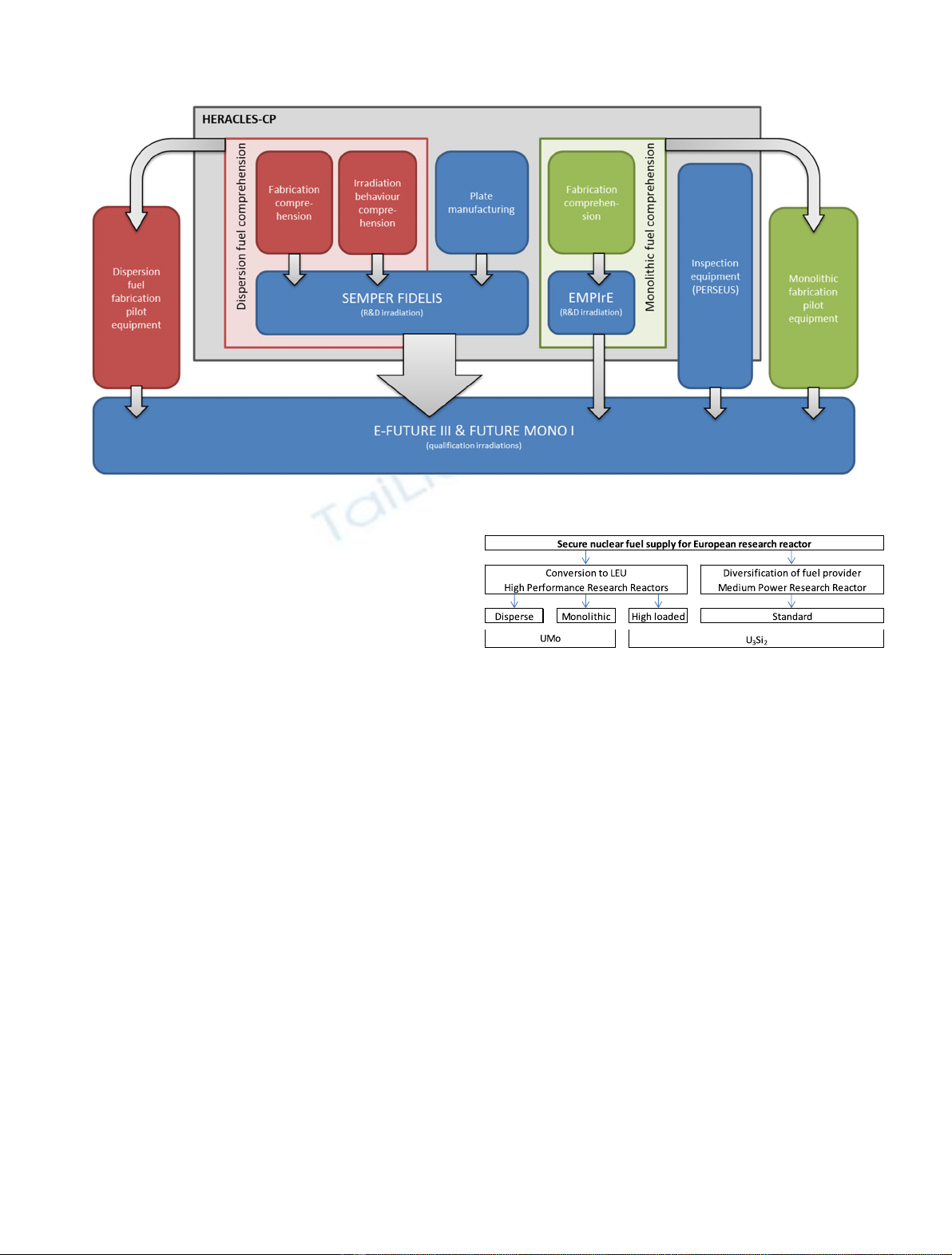
–for monolithic fuel:
*to develop the technology and knowledge necessary for
fabrication and,
*to prepare test samples for the EMPIrE irradiation test;
–for both:
*to develop the technology necessary for the irradiation
test as well as the tools for analysis,
*to launch and conduct the irradiation test and finally,
*to perform the Post-Irradiation Examinations (PIE) of
SEMPER FIDELIS.
Through the first results of this project, it is already
asserted that the UMo fuel is a thinkable way for the
replacement of high enriched uranium in HPRRs.
2.3 LEU-FOREvER
Following the still on-going HERACLES-CP Euratom
funded project, a second Euratom funded project, LEU-
FOREvER [11,12], has been launched for the period 2017–
2021 with the following identified goals to secure nuclear
fuel supply for European research reactors:
–the ongoing conversion of High Performance Research
Reactors (HPRRs) from high to low enriched nuclear
fuels (LEU), and;
–the difficult market situation for obtaining fuel elements
for Medium Power Research Reactors (MPRRs) with an
original Soviet design.
A multi-disciplinary consortium –composed of fuel and
core designers, nuclear research centers operating research
reactors and fuel manufacturers –has been set up to tackle
both issues in the framework of the H2020 European
Project LEU-FOREvER (2017–2021). Key issues and
operative solutions for this topic are underlined in the
schematic drawing of Figure 2. This project is carried-out
together by CEA, CVR, Framatome, ILL, NCBJ,
SCK•CEN, TechnicAtome and TUM. These actors are
supplemented by an End-User Group (EUG), an advisory
body consisting of representatives from potential end-users
of the Project results.
As presented before, the HERACLES group has been
developing UMo based solutions, both dispersed and
monolithic. Within LEU-FOREvER, optimisation of
the manufacturing process up to the construction of
pilot equipment, modelling of the in-pile behaviour
and post-irradiation examinations of European fuels
irradiated in the EMPIrE test at the Advanced Test
Reactor (ATR) of the Idaho National Lab (INL) are
addressed.
For the dispersed uranium-molybdenum fuel case, the
key tasks of the comprehension phase are undoubtedly the
tests carried-out in the SEMPER FIDELIS irradiation
facility (BR2, Mol –Belgium) and in its sister experiment
EMPIrE (ATR, Idaho –USA). These tests, carried out in
the framework of the HERACLES group, are aimed at
filling the data gaps in the understanding of UMo fuel
irradiation behavior and assessing a number of fabrication
options for the dispersion UMo fuel. Identified additional
knowledge and comprehension gaps will now be addressed
in the LEU-FOREvER project.
Fig. 2. Key issues and related nuclear fuel development to secure
fuel supply for European research reactors.
Fig. 1. Flow chart of the HERACLES-CP project.
S. Valance et al.: EPJ Nuclear Sci. Technol. 6, 40 (2020) 3

Regarding the monolithic UMo fuel type, the develop-
ments and assessments performed in the HERACLES-CP
project have made it possible to successfully demonstrate
that the fabrication of monolithic UMo plates with the
appropriate quality is entirely possible with the processes
developed in Europe.
As backup strategy to UMo based fuels, high loaded
U
3
Si
2
is considered as a viable solution for the conversion of
HPRRs. Within LEU-FOREvER, design and manufactur-
ing of such fuel plates will be optimised and tested in an
irradiation experiment under representative high power
and burnup conditions.
Lowering enrichment at constant
235
U content implies a
significant raise of the uranium surface density of the plate.
A correlate of this uranium density increase is an increased
parasitic absorption due to the higher amount of
238
U in the
core. This absorption needs to be overcome in order to
maintain cycle length and neutron flux. Within a given
dispersion fuel system, two options are available to increase
the fissile phase content:
–increase the volume fraction of fissile compound in the
meat for a dispersion fuel;
–modify the geometry of the fuel assembly and/or fuel
plates to accommodate more fuel meat volume, e.g.
using thicker plates, larger plates or more plates per
assembly.
In an optimized geometry, it would then be possible to
increase the quantity of fissile material in the fuel assembly
while maintaining the volume fraction of fuel at an
acceptable level. One of these options or a combination
of both is necessary to create a viable fallback option.
Within the LEU-FOREvER project, manufacturing
developments and an irradiation for this high loaded U
3
Si
2
are planned. The manufacturing developments will permit
to ascertain the manufacturability of such geometry
modified fuels, and to set the boundary for the use of high
loaded U
3
Si
2
fuels. The High Performance research
Reactors Optimized Silicide Irradiation Test (HiPROSIT)
experiment will then evaluate the behaviour under
irradiation of such modified fuels.
MPRRs (Medium Power Research Reactors) with an
original Soviet design currently have only one fuel provider.
An alternative to the fuel currently employed will be
developed in LEU-FOREvER. Due to some differences
between the manufacturing design, the detailed shape and
characteristics of the new fuel assemblies, compliant with all
the interfaces of the fuel assembly (geometry, performances,
safety), will be different. The design of such a fuel therefore
implies an in-depth analysis of the reactor and core from
neutronics, thermo-hydraulics and overall design point of
view. In addition to these technical aspects, special care
shall be taken to develop a solution which is above all
economically efficient. Thanks to the choice of a proven
technology for the fuel element, the potential complementary
qualification will only be at fuel assembly level.
For the design of a new fuel assembly, the LVR-15
research reactor will be the most detailed case study.
Nevertheless, a first assessment of the BRR core, with a
very different current fuel assembly will also be carrying
out.
Currently, the reactor uses Russian IRT-4M sandwich-
type fuel assemblies mainly composed of concentric square
tubes [13], manufactured by NZCHK in Novosibirsk. The
meat is composed of a dispersion of UO
2
and aluminium
powders. The assemblies have the form of six or eight
concentric square tubes. The development of a fuel
alternative for MPRRs by the LEU-FOREvER project
will bring several enhancements for the operators of these
reactors:
–much larger ease of use, on a routine basis, of European
origin fuel in reactors of Soviet origin;
–ease transition from historical fuel to new fuel, with
respect to both technical and regulatory aspects;
–potential improvement of life cycle cost coupled with
extended operating cycles.
As most HPRRs will also have to operate with a mixed
core configuration during conversion and both HPRRs and
MPRR are considering or even already using U
3
Si
2
/Al fuel
plates, strong synergies are found between the two
subprojects.
A fuel element design usable for MPRR has been
proposed and is now being manufactured for testing. For
HPRR a first batch of high density silicide fuel plates has
been manufactured with depleted uranium. The UMo fuel
solution is preparing the arrival of samples from the
EMPIrE and SEMPER-FIDELIS test irradiations.
3 Achievements
ESSANUF generated new knowledge, identifying improve-
ments in the fields of mechanical design, thermo-mechani-
cal fuel rod design, and safety analysis for VVER fuel. This
helped to fulfil Europe’s need for advanced and reliable
nuclear fuel, thereby safeguarding the EU’s energy supply
by speeding up the diversification of the fuel supply for
VVER-440 reactors in the EU and Ukraine.
Furthermore, the project enhanced the communication
and relationship between the utilities and regulators of the
different countries by encouraging open discussions and the
exchange of information between the different parties. The
initiative was an important step toward the diversification
of the nuclear fuel market in the countries involved,
providing long-term benefits to the utilities, industries and
citizens that rely on secure electricity supply.
During the project, several workshop were organised to
raise interest and share knowledge among the participants
and with other bodies, such as potential users or regulations
authorities. The project was presented during a meeting of
the Expert Group on Multi-Physics Experimental Data
Benchmark and Validation of the OECD/NEA. Last but not
least, the results were presented during the Finnish Fuel
Days in August 2017.
The governing objective of HERACLES-CP is to lay
the technical and scientific foundations for the successful
qualification of UMo fuel. In this regard, the following
progress has already been made.
Within HERACLES-CP, the SEMPER FIDELIS
irradiation experiment has been defined and carried out
[14]. The first non-destructive examinations show that the
4 S. Valance et al.: EPJ Nuclear Sci. Technol. 6, 40 (2020)

results are promising at least for one plate. Together with
EMPIrE, the experiment will close most of the remaining
knowledge gaps. Ion experiments showed no accelerated
growth of the interdiffusion layer between UMo and Al in
the first days of an irradiation.
For the design of the SEMPER FIDELIS irradiation
matrix, dozens of experts from the EU and the US have
(re-)measured, collected and evaluated data from more
than one dozen prior irradiation experiments to ensure that
SEMPER FIDELIS will deliver the maximum relevant
information for the further development of UMo.
The technique of UMo powder atomization is now
understood to an extent that enables the consortium to
build the next stage of manufacturing equipment on the
pilot level. The construction of the pilot induction furnace
has already begun.
Monolithic UMo foils can now be coated with PVD and
turned into plates with a very high yield. The technology
for this is fully available in Europe.
The HERACLES-CP has been presented at its
beginning during an event held at the Bavarian represen-
tation in Brussels [15]. The results and findings have been
shared and discussed outside the group both in open
literature [15–18] and in meetings with US counter sides
which are also involved in an intensive conversion program.
In the LEU-FOREvER project, both the actions
targeting European HPRR and MPRR have been on track
with the laid out plans.
For high density silicide fuels, the test matrix, finite
element computations, and depleted uranium fabrica-
tions have been done. On the uranium-molybdenum fuels
side, the research reactor fuel simulation finite element
code MAIA is being updated with latest open literature
models for the simulation of the SEMPER FIDELIS
experiment. With respect to monolithic uranium-molyb-
denum fuels, test for the realisation of graded geometries,
on surrogate materials have been carried, a fresh sample
of monolithic fuel has been received at CEA Cadarache
for microscopic examinations, and the retrieval of
irradiated samples from the EMPIrE test irradiation
has been secured.
The samples issued from the EMPIrE irradiation will
be examined in CEA and SCK.CEN. The HiPROSIT
irradiation will give key findings on the sustainability of the
high-density silicide solution, particularly precising the
manufacture possibilities and setting the basis for the
effective qualification of fuel for reactors.
To carry the design of a replacement element for the
LVR-15 reactor, a multidisciplinary team involving
representatives of all involved entities:
–reactor operators, i.e. CVR;
–fuel designers, to optimise both fuel “meat”and fuel
“assemblies”i.e. TechnicAtome and Framatome;
–research reactor designers with all the relevant core
design experience and calculation codes i.e. Technic
Atome.
A preliminary dimensioning has already been devel-
oped for a LVR-15 fuel alternative based on assemblies
with a European design, i.e. with parallel flat plates and
U
3
Si
2
/Al meat. Significant manufacturing and operating
experience already exists for this kind of fuel assembly in
Europe, as the OSIRIS material testing reactor has been
fuelled with assemblies of the same geometry and almost
the same fuel composition.
Indeed, preliminary drawings have been made for
both standard and control fuel elements, making it
possible to verify the feasibility of moving from one type
to the other. Even if it is still possible to optimize the
235
U
density, moderator volume, plate shapes, etc. Further-
more, it will be verified that the envisaged U
3
Si
2
/Al fuel
plate usage in LVR-15 is covered by NUREG 1313 [19]
regarding the fuel operational parameters. This will
make the qualification phase considerably shorter and
cheaper.
By implementing an innovative methodology for
fuel assembly design such as the design-to-cost method-
ology and by involving all relevant parties from
designer to manufacturer and to reactor operator,
LEU-FOREvER aims to design and produce an econom-
ically attractive alternative fuel assembly based on
proven European technology, produced by a European
manufacturer.
The design of a new element suitable for every
European medium power research reactor has given rise
to three workshops with the objective to share knowledge
on operation and functions of original elements. The
organization of a summer school on the research reactor
fuels issues is on-going, with a summer school foreseen to
take place in October 2020 in Belgium. Several commu-
nications on technical achievement have already been done
[20–23].
In the coming years, the designed fuel element will be
tested for the thermo-hydraulic characteristics and for
qualification in the LVR-15 reactor.
4 Conclusions
Although different in their targeted scope, all the three
Euratom funded project presented in this paper have the
goal to secure the supply chain of nuclear fuels, being for
nuclear power plant or research reactors. Through their
achievement (ESSANUF) or their current findings (HER-
ACLES-CP, LEU-FOREvER), they pave the way for a
greater security of supply for nuclear fuel in Europe. The
output of these projects will benefit the entire society by
ensuring the production of electricity, medical isotopes and
cutting edge science.
The ESSANUF project leaded to a renewed, up-to-
date replacement design for VVER-440 fuel element. Is
also fostered collaboration between user and regulatory
authorities in the countries using this type of reactor.
The HERACLES-CP project has been the key in
understanding innovative fuel systems for high perfor-
mance research reactors, therefore permitting a selection of
the most promising solution to alleviate technological
locks.
Finally, the on-going LEU-FOREvER project is both
pursuing the goal of converting European high perfor-
mance reactors and securing the fuel element supply of
S. Valance et al.: EPJ Nuclear Sci. Technol. 6, 40 (2020) 5






![Đề ôn tập cuối kỳ môn Kỹ thuật nhiệt - Nhiệt động học [mới nhất]](https://cdn.tailieu.vn/images/document/thumbnail/2026/20260310/hoaphuong0906/135x160/60681773197823.jpg)

![Bài giảng thang máy và thang cuốn: Tổng hợp kiến thức [chuẩn nhất]](https://cdn.tailieu.vn/images/document/thumbnail/2026/20260310/hoaphuong0906/135x160/41471773283876.jpg)
