

* Corresponding author.
E-mail addresses: msassu@unica.it (M. Sassu)
© 2018 Growing Science Ltd. All rights reserved.
doi: 10.5267/j.esm.2018.3.004
Engineering Solid Mechanics (2018) 89-104
Contents lists available at GrowingScience
Engineering Solid Mechanics
homepage: www.GrowingScience.com/esm
Production procedures and mechanical behaviour of interlocking stabilized compressed earth blocks
(ISCEBs) manufactured using float ram 1.0 press
Mauro Sassua*, Antonio Romanazzib, Linda Giresinic, Walter Francod, Carlo Ferraresid,
Giuseppe Quagliad and Elisa Oreficee
aDepartment of Civil, Environmental Engineering and Architecture, Università di Cagliari, Italy
bDepartment of Civil Engineering, Universidade do Minho, Portugal
cDepartment of Energy, Systems, Territory and Constructions Engineering, Università di Pisa, Italy
dDepartment of Mechanical and Aerospace Engineering, Politecnico di Torino, Italy
eTechnical Engineer, Comune di Montescudaio, Italy
A R T I C L EI N F O A B S T R A C T
Article history:
Received 22 September, 2017
Accepted 10 January 2018
Available online
18 March 2018
This paper illustrates an innovative manufacturing procedure for producing handcrafted
interlocking stabilized compressed earth blocks (ISCEBs). A comparison of the mechanical
properties of ISCEBs is conducted to assess the influence of varying components. The ISCEBs
are manufactured by employing different block densities with three distinct mixtures (earth,
earth and lime, earth and straw) and by using a human-powered machine named Float RAM
1.0 Press. The manual press was conceived for regions with limited access to technology and
allows the production of interlocking blocks via two modes of compaction: mono-directional
and bi-directional. A production average of approximately 30 blocks/hour corresponding to the
work of three people is achieved. Three-point bending tests and uniaxial compression tests are
carried out to investigate the ISCEB mechanical behaviour. The improvements obtained by
incorporating additives into the subset of ISCEBs made from a pure earth mixture are tested.
The aim of this work is to identify, for this specific technology, the relationship between
production parameters and the consequent behaviour of different stabilization methods. A
correlation is found between the compaction force and the compression strength of ISCEBs.
The addition of lime increases strength and causes the blocks to exhibit a brittle behaviour.
Moreover, the incorporation of straw fibres improves the tensile strength and ductility without
significantly affecting the compression strength of the blocks. Energy-based parameters are
obtained for all the tests, allowing the assessment of the ISCEB mechanical and dissipation
properties.
© 2018 Growin
g
Science Ltd. All ri
g
hts reserved.
Keywords:
Earth blocks
Human power
Mechanical test
Production test
Floating RAM press
1. Introduction
In the field of sustainable development, there is an increasing interest in constructive procedures
characterized by appropriate technologies and low-cost materials (Niroumand et al., 2013; Maskell et
al., 2016; Franco et al., 2016, 2017; Sassu et al., 2016 a,b). In particular, the focus on raw earth as a
material for civil constructions is promoted by its recyclability, local availability, environmental
sustainability, low cost and ease of use. Raw earth structures also permit self-construction approaches,
especially in developing countries (Pacheco-Torgal & Jalali, 2012; Arumala & Gondal, 2007; Mukerji,
1988; Houben & Guillaud, 1989; Oppong & Badu 2012). Furthermore, the thermal mass of raw earth,
due to the capacity of earth constructions to regulate the interior temperature and humidity, is attractive

90
as a means to reduce the building energy demand (Delgado & Guerrero 2006). These aspects are
emphasized by the growing demand for housing in underdeveloped countries. Local resources cannot
ensure the extensive applicability of modern construction techniques; thus, raw earth construction
techniques can represent sustainable and reasonable solutions from an economic point of view.
The resistance of earth blocks is usually low; in fact, in most cases, the compression strength is
lower than 1 MPa. However, these values can be sufficient for many practical cases, particularly for
the low-rise buildings found throughout rural areas or cities in developing countries (Guillaud &
Houben, 1994; Milke, 2006). The compressed earth blocks (CEBs), which originated in the mid-
twentieth century, represent a technological innovation among the raw earth techniques (e.g., rammed
earth, adobe, and cob). In the CEB technique, the earth mixture is compacted using motor-powered or
manual presses (Reddy 2015). The mentioned tools ensure an improvement in production quality
control due to the possibility to regulate the pressure during the production of blocks. Quality control
during or after production is a crucial issue especially for the manual production undertaken in
developing countries. Consequently, the idea of promoting human-powered machines, which are easy
to provide and to use, is of remarkable interest. The mixture compaction mode can be differentiated as
mono- or bi-directional, with a unique or opposing coupled movable mould, respectively (Ferraresi et
al., 2011).
A large number of experimental studies that evaluate the mechanical and thermal properties of earth
blocks are available in the literature (Bui et al., 2009; Bouhicha et al., 2005; Kouakou & Morel, 2009).
Traditional tests, such as three-point bending or compression tests, are illustrated in (Morel et al., 2007
Morel & Pkla, 2002), where new testing methods are also proposed. In this manner, a proper
classification of blocks after production and curing is possible depending on their mechanical
properties.
To improve the durability and mechanical performances of earth blocks, stabilization via the
addition of sand, lime, fibres or other components plays a delicate role during the production phase.
The efficiency of stabilization also depends on the type and amount of compaction force (Walker, 1995;
Billong et al., 2009; Anifowose, 2000; Venkatarama Reddy et al., 2016).
Several studies have focused on evaluating the effects of the addition of fibres, which was generally
carried out to enhance the tensile strength and ductility of the blocks (Delgado & Guerrero, 2006; Bati,
2001; Parisi et al., 2015; Lenci et al., 2011). The positive role of fibres has also been confirmed by
analyses of the use of recycled waste materials, e.g., plastic fibres or cellulose-based binders (Gomes
Battistelle & Borges Faria, 2005; Varadarajan & Govindan, 2013). Furthermore, it has been shown that
stabilization using sand influences not only the mechanical but also physical properties of blocks and
their ageing time (Pekmezci et al., 2012; Binici et al., 2005, 2007). Other authors have analysed the use
of stabilized CEBs for affordable high-quality dwellings (Matta et al., 2015) or the addition of granitic
soils to improve the mechanical properties of the units (Oliveira et al., 2016; Silva et al., 2015). Recent
investigations on the behaviour of walls made using interlocking stabilized compressed earth blocks
(ISCEBs) (Laursen et al., 2015; Qu et al., 2015 a,b) and the role of the compaction force (Bruno et al.,
2017) have been carried out; in particular, the adoption of interlocking dry-stack blocks (Sturm et al.,
2015) can simplify the execution phases. When this type of building exhibits box-type behaviour, the
role of the out-of-plane behaviour must be evaluated in the seismic context (Qu et al., 2015 a,b;
Andreini et al., 2013) or with regard to rocking phenomena in masonry walls (Giresini & Sassu, 2017;
Giresini et al., 2016). Indeed, earth block walls behave as rigid blocks that can rotate in the case of
dynamic actions. However, few research works on the mechanical performances of individual ISCEBs
are available; therefore, the present study attempts to contribute to this field. The innovative aspects of
this paper include the use of human power to operate a float ram press machine with bilateral actions
to produce ISCEBs. Another aspect is the proposal of a suitable method for producing an efficient earth
block in terms of self-construction in low technology areas via a manual press. In fact, this research is
conducted in collaboration with a self-construction pilot project in the village of Kouini (Burkina Faso).
A third contribution regards the comparison of experimental results for blocks with several additives

M. Sassu et al. / Engineering Solid Mechanics 6 (2018)
91
(lime, straw fibres, only soil), with several masses (6.4, 6.6, 6.8 kg/block) and that undergo several
actions during production (bi- and mono-lateral actions).
First, a geotechnical analysis of the soil used is illustrated in Section 2. Then, the production process
of twelve series of six blocks is described. The production makes use of the Float RAM 1.0 manual
press. The results of three-point bending (Section 3) and compression (Section 4) tests are then
presented. Finally, specific energy parameters are proposed to possibly use the results in energy-based
approaches for the dynamic analysis of masonry structures (Giresini, 2015). These parameters are
designed to highlight the characteristics of earth blocks in terms of inelastic behaviour and dissipated
energy.
2. Production of ISCEBs
2.1. Selection of soil and production process
To identify suitable soil for the production of earth blocks, the particle sizes and Atterberg’s indices
of three samples of soil taken from a cave in Rosignano Marittimo (Leghorn, Italy) were determined
by following the ASTM D4318 and ASTM D422 rules. By considering the geotechnical results, sample
n° 792 was selected (Table 1) to produce the set of ISCEBs. First, the soil was dried in an oven at 70°C
for 24 hours; since the available soil was mainly clayey, the addition of a sand fraction with a diameter
between 125 μm and 250 μm was done preliminarily. The amount of sand needed was determined after
several different attempts with some pilot samples by following the indications given in (Lenci et al.,
2011). Thus, the granulometric mix proportions are given in volumetric units, as displayed in Table 2.
Table 1. Geotechnical properties of tested soils
Kouini N° 792 N° 793 N° 794
Gravel % 8.8 0.2 0.0 0.1
Sand % 36.2 13.0 10.0 8.4
Silt % 37.9 52.6 50.0 52.7
Clay % 17.1 34.2 40.0 38.8
Liquid Limit 28 52 59 63
Plastic Limit 19 28 32 32
Plasticity Index 9 24 27 31
Table 2 . Granulometric mix design
N°792 Add Final
kg % kg kg %
Sand 1.51 13.0 14.50 16.01 61.4
Silt 6.10 52.6 - 6.10 23.4
Clay 3.98 34.2 - 3.98 15.2
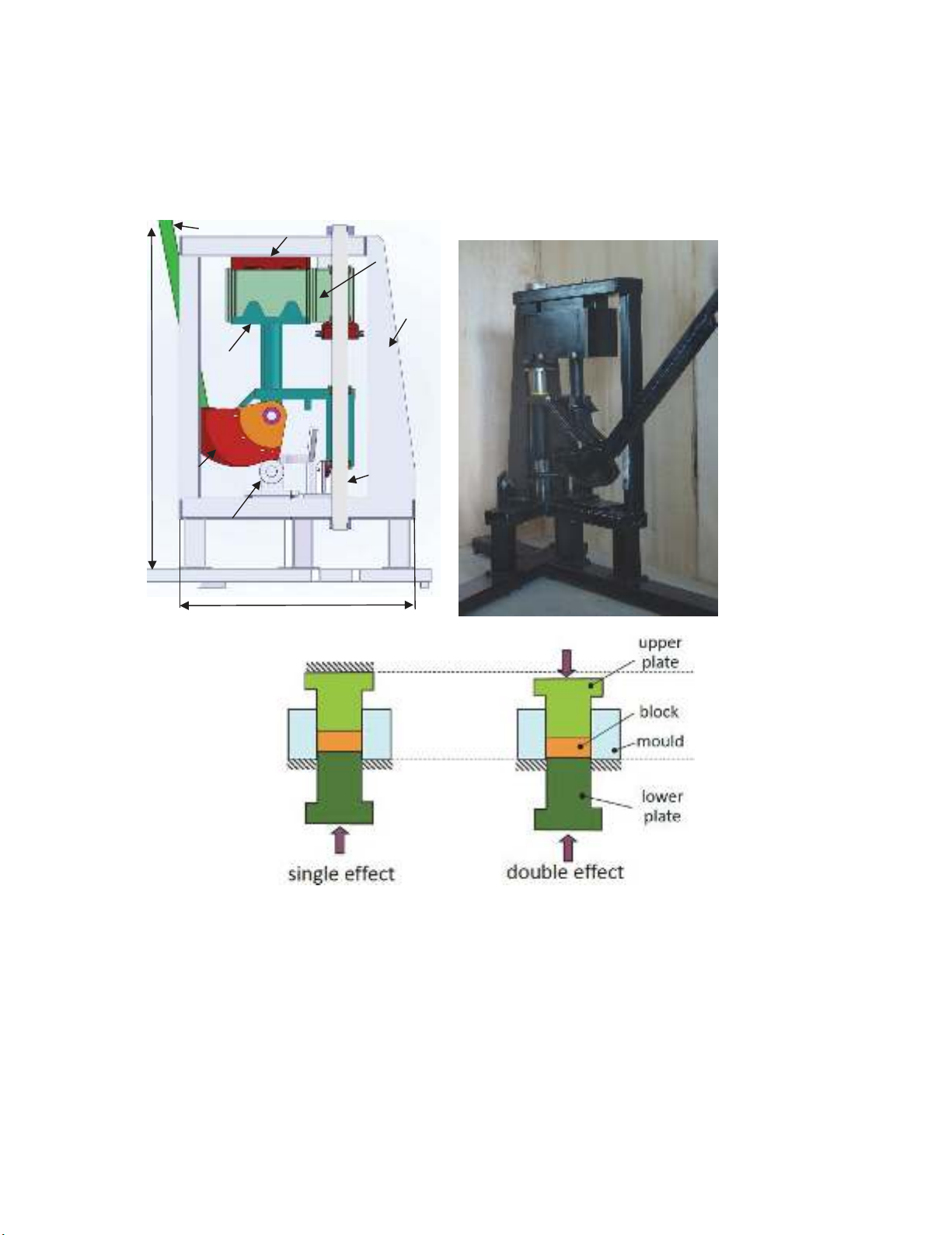
Compaction of the mixture was performed by using the Float RAM 1.0 manual press designed by
the team at the Department of Mechanical and Aerospace Engineering, Politecnico di Torino (Ferraresi
et al., 2014). The press is manually actuated by a lever integrated with a cam matched to a roller hinged
to the framework. Rotation of the cam, which is hinged to the strut of a lower plate connected to the
framework integral shaft, causes vertical movement of the lower plate, while the upper one is fixed
(Fig. 1). The mould of this press is of floating type. Due to the friction between the mixture and the
mould, the latter can translate vertically along the same shaft of the framework. This device allows a
bi-directional translation of both the upper and lower plates (double effect in Fig. 1), achieving a better
distribution of pressure within the height of the block during the compaction phase: the pressure acting
from both sides reduces the compaction path along the vertical direction. Moreover, a mono-directional
translation can be implemented to lock the movement of the mould (single effect in Fig. 1). The first
92
innovative aspect of the utilized CEB manual press is the employment of a floating mould. It can
translate freely along the pressing direction, automatically balancing the pressure on the upper and
lower surfaces of the block and moving only one plate. Unlike the human-powered press available on
the market, in the present Float RAM, the bi-directional compression is generated by moving only the
lower plate. Since the mould is free to translate, during compression, it moves upwards to equalize the
compression force on the top and bottom brick surfaces in the case of null friction between the mould
and the frame. The actuation mechanism of the compression plate is then considerably simplified.
Fig. 1. Float Ram Press 1.0
In addition, the Float RAM is able to maintain a constant worker operating force during the block
pressing phase. This is possible because a cam-follower mechanism that can generate the appropriate
output function, once the mechanical properties of the earth are known, is used. Finally, to simplify the
entire press mechanical architecture, the movements of the members of the press are concentrated in a
single node. A single shaft drives the displacement of the lower compression plate during the block
forming/block extraction operation and the floating of the mould during the block pressing phase and
allows the press configuration to be changed via rotation of the group comprising the lower plate and
the floating mould.
cam
frame
roller
shaft
floating
mould
operating
lever
lower
plate
Upper
plate
880 mm
1290
mm

M. Sassu et al. / Engineering Solid Mechanics 6 (2018)
93
This press produces the typical “blocco Mattone” unit, which consists of a 280x140x95 mm3 block
with two cylindrical holes 80 mm in diameter and 55 mm in height. The specific interlocking geometry
simplifies the construction procedures of masonry panels, reducing the use of lime and allowing the
production of robust walls even when employing thin mortar joints (Mattone, 2001; Melo et al., 2011).
For the investigation, the ISCEB series was produced via two compaction modalities: mono-directional
(NF series) and bi-directional (F series) compression. Several mix designs were prepared: only soil (T
series); soil with the addition of 0.5% straw fibres (weight of the fibre is with respect to the dry weight
of soil) with a length of 5-20 mm (P series), following the indications in Millogo et al. (2015) for the
Burkina Faso experiments and in Parisi et al. (2015) for the Italian tests; and soil with the addition of
10% lime (weight of lime with respect to the dry weight of soil) (C series), based on indications by
Pekmezci et al. (2012). This last mixture is preferred for soils with a plastic index above 15 (Guettala
et al., 2002; Osula, 1996).
To achieve suitable compaction, different soils, sands, water ratios and mixture masses were tested,
with two optimal ISCEB masses identified: 6.6 kg for the W series and 6.8 kg for the X series.
Meanwhile, the mortar workability was determined, with a water amount of approximately 33% of the
dry soil mass. A further series of samples with a mass of 6.4 kg (S series) was manufactured due to
difficulty in compacting the mixture with fibres. In total, twelve series of samples were produced by
combining different compaction modalities (N-NF series), mixture types (T-C-P series) and mixture
amounts (W-X-S series) (Table 3). Each series included six units; therefore, a total of 72 specimens
were tested.
Table 3 . Summary of the produced series
CEB n. Series Mixture Weight Compaction mode
1-6 TWF Only soil 6.6 kg Floating mode
7-12 TWNF Only soil 6.6 kg Non-Floating mode
13-18 TXF Only soil 6.8 kg Floating mode
19-24 TXNF Only soil 6.8 kg Non-Floating mode
25-30 CWF Soil and lime 6.6 kg Floating mode
31-36 CWNF Soil and lime 6.6 kg
N
on-Floating mode
37-42 CXF Soil and lime 6.8 kg Floating mode
43-48 CXNF Soil and lime 6.8 kg Non-Floating mode
49-54 PWF Soil and straw fibers 6.6 kg Floating mode
55-60 PWNF Soil and straw fibers 6.6 kg
N
on-Floating mode
61-66 PSF Soil and straw fibers 6.4 kg Floating mode
67-72 PSNF Soil and straw fibers 6.4 kg Non-Floating mode
T= only soil; P = with straw fibers; C = with lime
S = reduced mass (6.4 kg); W = normal mass (6.6 kg); X = superior mass (6.8 kg)
F = bi-direct. compaction; NF = mono-direct. compaction
The press is equipped with a load cell (capacity: 105 N, non-linearity < 0.15% of the rated output,
repeatability < 0.10% of the rated output) and a linear potentiometer (capacity: 100 mm, independent
linearity < 0.10% of the rated output) that yield the compression force related to the displacement of
the lower plate. The data were recorded using an LMS-Scadas Mobile recorder with a 100 Hz sampling
rate and the LMS-TestLab Rev.8.a software and later elaborated using the Scilab-5.5.2 numerical
computation software. Making use of the data, the progress of the compaction pressure on the upper
plate related to the density of the ISCEB and the mechanical work for the compression have been
outlined. The average and standard deviations of all production parameters are listed in Table 4.





![Giáo trình Vật liệu cơ khí [mới nhất]](https://cdn.tailieu.vn/images/document/thumbnail/2025/20250909/oursky06/135x160/39741768921429.jpg)


