

* Corresponding author. Tel: +98-21-61112273, Fax: +98-21-66403808
E-mail addresses: mpalas@ut.ac.ir (M. Palassi)
© 2018 by the authors; licensee Growing Science, Canada.
doi: 10.5267/j.esm.2017.11.002
Engineering Solid Mechanics (2018) 27-38
Contents lists available at GrowingScience
Engineering Solid Mechanics
homepage: www.GrowingScience.com/esm
Rheology investigation of waste LDPE and crumb rubber modified bitumen
Hosein Zanjirani Farahania, Massoud Palassia* and Saeed Sadeghpour Galooyakb
aSchool of Civil Engineering, College of Engineering, University of Tehran, Enghelab Ave., Tehran, Iran
bRefining Technology Development Division, Research Institute of Petroleum Industry, Tehran, Iran
A R T I C L EI N F O A B S T R A C T
Article history:
Received 26 June, 2017
Accepted 8 November 2017
Available online
8 November 2017
In this article, waste plastics (low-density polyethylene, LDPE) and crumb rubber have been
utilized to solve one of the most important environmental issues and to improve bitumen
performance properties by these low cost materials. At first, modified bitumen samples were
made using high shear mixer, then classic and performance tests were performed on them. It
has been observed that adding low-density polyethylene and crumb rubber to the bitumen leads
to improvement of classical characteristics. Then, after conducting dynamic shear rheometer
test on modified bitumen samples, it was found that the sample containing 3% LDPE and 3%
crumb rubber has the best performance. Conducting short-term and long-term aging
experiments on samples containing 3% LDPE showed improved performance at high
temperature services. After BBR test, more appropriate performance grade is observed for the
sample containing 3% LDPE 3% crumb rubber.
© 2018 b
y
the authors; licensee Growin
g
Science, Canada.
Keywords:
Bitumen
Waste material
LDPE
Aging
BBR
1. Introduction
Polymer modification of bitumen is the incorporation of polymers in bitumen by mechanical mixing
or chemical reaction. The chemical behavior and reactivity of polymers, however, are also supposed to
affect their compatibility with bitumen, which may have a direct effect on the result of modified
bitumen characteristics (Al-Hadidy et al., 2011; Navarro et al., 2009; Martin et al., 2006; González et
al., 2008). In the case of enhancing properties, the cost will increase. So allowing the degree of
enhancing characteristics to be high enough to cover the additional cost will result in more cost
effectiveness of modified bitumen. For reducing cost, some inexpensive polymeric materials, especially
wastes and by-products e.g. waste rubber, waste plastics, could have potential applications with greater
success in the future (Brovelia et al., 2015; Cuadri et al., 2013; Fuentes- Audén et al., 2008; Fang et al.,
2012; González et al., 2016).
28
The various investigated polymers are plastomers (e.g. polyethylene (PE), polypropylene (PP),
ethylene– vinyl acetate (EVA), ethylene–butyl acrylate (EBA)) and thermoplastic elastomers (Sengoz
et al., 2009; Garcia et al., 2007; Naskar et al., 2012); but none of them were initially designed for
bitumen modification. These polymers have been suggested for improving the properties of bitumen,
such as higher stiffness at high temperatures, higher cracking resistance at low temperatures, better
moisture resistance or longer fatigue life (Alatas et al., 2007; Gorkem & Sengoz, 2009; Tayfur et al.,
2013; Fang et al., 2013; Naskar et al., 2010, Aliha et al., 2015). These additives improved on one hand
the characteristics of bitumen and on the other hand the mechanical performances of the asphalt mix
(Moreno-Navarro et al., 2015; Brovellia et al., 2015; Navarro et al., 2007). Nevertheless, the cost of
modified bitumen represents between 60% and 150% of pure bitumen price (Aguiar-Moya et al., 2013).
Thus, the use of recycled materials can be a significant economical alternative (Fang et al., 2008; Li et
al., 2013; Mazzoni et al., 2017; Fang et al., 2013). Hınıslıoğlu, & Ağar (2004) reported that 4% high-
density PE (HDPE),1650C of mixing temperature and 30 min of mixing time were optimum conditions
for Marshall stability. Kofteci et al. (2014) studied three types of waste plastics such as window, blinds
and cable wastes based polyvinyl chloride. The results showed that the modification of bitumen with
PVC window and blinds wastes in the amount of 1-3% improved properties of bitumen at high
temperatures. Despite the advantages of window waste and blinds waste additives at high temperatures,
low temperatures properties of modified bitumen were not affected by these additives. Only 5% cable
wastes improved properties of bitumen at low temperatures.
The goal of the present research is to study the effect of the waste LDPE and CR on the bitumen
performance. For this purpose, blends of bitumen and several waste polymers were prepared, and
further classical and rheological characterizations were carried out.
2. Materials and Method
2.1. Materials
The 85/100 penetration grade bitumen with softening point of 45oC, penetration of 90 dmm, more
than 100 cm ductility, 0.75 Pa.s viscosity, less than 1% weight loss in RTFO and with performance
grade PG 64-16 obtained from Isfahan Refinery has been used to mix with waste materials. Crumb
rubber was prepared from Qom Rubber Industries Company with the characteristics shown in Table 1.
Table 1. Characteristics of crumb rubber
Weight (%) Substance
53
Hydrocarbons (natural and synthetic rubber)
32
Carbon black
11
THF extractable (C4H8O)
4
Ash
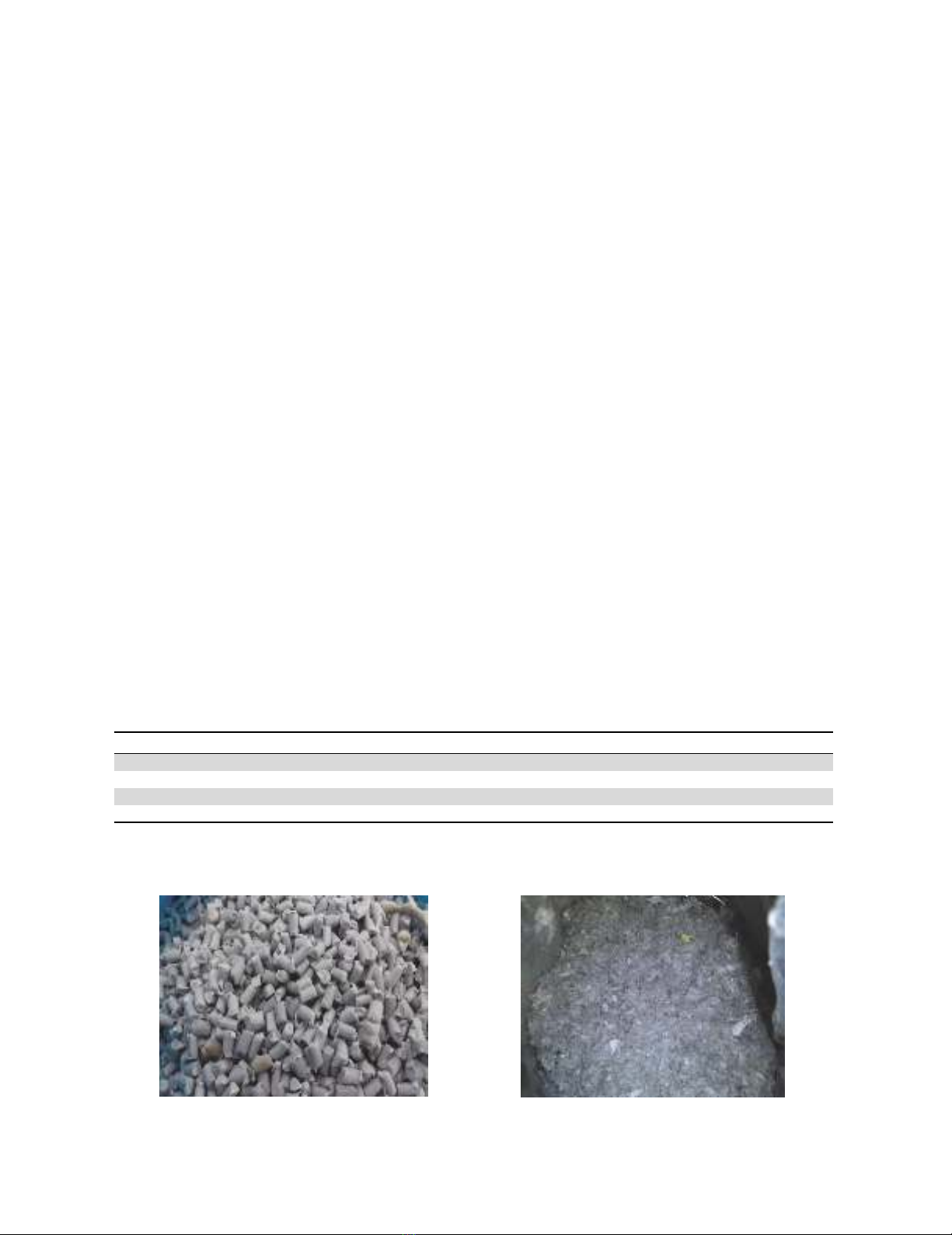
Waste plastics (Fig. 1) with the properties given in Table 2 were supplied from Isfahan Municipality
waste recycling factory.
Fig. 1. Waste Plastic PE1 & PE2

H. Zanjirani Farahani et al. / Engineering Solid Mechanics 6 (2018)
29
Table 2. Specifications of recycled plastics
Specifications Unit Amount Standard
MFI (1900C/2.16 kg) gr/10 min. 0.75 ASTM D 1238
Density gr/ml 0.9210 TSTM 209B
Softening point 0C 94 ASTM D 1525
Temperature thermal cracking 0C 33 ASTM D 648
Elongation at break %300 min. ASTM D 882
Force elongation at break kg/cm2 170 min. ASTM D 882
Paykan effect on sample gr 120 min. ASTM D 1709
2.2. Preparation of Modified Binders
To study the impact of waste polymers and crumb rubber on bitumen, first it is necessary to study
the compounds level, mixture situation and substances impressibility on bitumen. The percentages of
each of the substances are chosen by considering the classical tests which are performed on each of
waste plastics and crumb rubber.
where, PE1= Polyethylene (waste LDPE) type 1 as shown in Fig. 1 and PE2= Polyethylene (waste
LDPE) type 2 as shown in Fig. 1. The contents of PE1, PE2 and crumb rubber in prepared samples
have been specified in Table 3 and Table 4.
Table 3. List of samples prepared with different Table 4. List of samples prepared with different
percentage of PE1 and crumb rubber percentage of PE2 and crumb rubber
Sam
p
le PE1
(
%
)
CR
(
%
)
Sam
p
le PE2
(
%
)
CR
(
%
)
A1 3 1B1 3 1
A2 3 3B2 3 3
A3 3 5B3 3 5
A4 5 1B4 5 1
A5 5 3B5 5 3
A6 5 5B6 5 5
A7 7 1B7 7 1
A8 7 3B8 7 3
A9 7 5B9 7 5
2.3. Experimental program
After preparation of samples using a high shear mixer, classical and rheological tests were
performed on the samples. In conventional tests, softening point (according to ASTM D36 standard
test method) and needle penetration (according to ASTM D5 standard test method) were conducted on
the prepared sample. Then, fresh binders were characterized by dynamic shear rheometer (DSR). DSR
is the important test for the simulation of bitumen in high temperature services and could estimate
temperature susceptibility of bitumen in asphalt paving. Furthermore, modified samples were aged in
a rolling thin film oven (RTFO), and then aged binders in RTFO were aged again using a pressure
aging vessel (PAV). The PAV simulate the long term aging of bitumen in life service. After PAV,
rheological properties of samples were examined by a dynamic shear rheometer to investigate the
rheological characteristics of modified samples. Finally, stiffness of samples at low temperature service
was tested using a bending beam rheometer (BBR). In all of the procedures, to increase the precision,
samples were selected randomly for testing and all of the tests were repeated at least two times.
2.4. Testing method
Softening point according to ASTM D36 standard test method and needle penetration at 25 oC
according to ASTM D5 standard test method were conducted on the prepared samples. Viscoelastic
properties were determined by using dynamics shear rheometer (DSR) equipped with parallel plates at
frequency of 10 rad/s and temperatures from 30 oC to 80 oC according to ASTM D7175. In this study
RTFO (ASTM D2872) and PAV (ASTM D6521) were used to age bitumen samples. Standardized
30
conditions, i.e. 163 0C and 5 h for RTFO, 100 0C and 20 h for PAV, were used. The aged samples were
evaluated by measuring their rheological properties. Finally, BBR (ASTM D6648) was performed on
the samples. The BBR device measures beam deflection under a constant load at low temperatures.
During testing, the bitumen beams (125 mm long, 12.5 mm wide and 6.25 mm thick) were submerged
in a constant temperature bath and keep at test temperature for 60 min. A constant weight of 100 gr.
was then applied to the bitumen beam, which was supported at both ends, and the deflection of center
point was measured. Depending on the value of this deflection, creep stiffness and creep rate were
measured at several loading times.
3. Analysis of Results
3.1. Physical Properties
Penetration test is carried out according to ASTM-D5 standard for all bituminous samples. This test
is one of the physical tests to determine stiffness of bitumen under specific load conditions. According
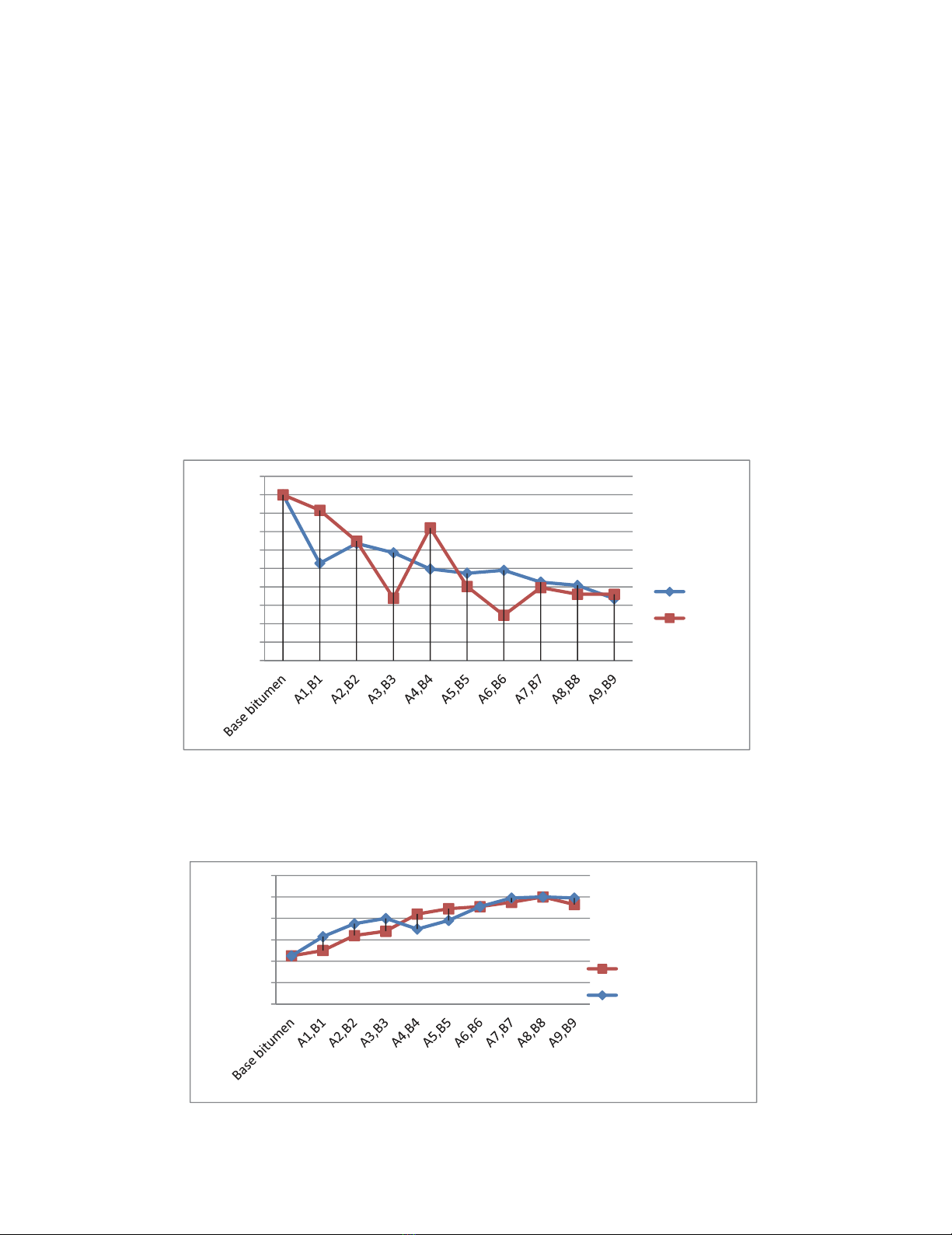
to Fig. 2, it can be observed that by increasing polymer percent, bitumen penetration is decreased.
Decreasing penetration degree means fluidity is decreased and the consistency of bitumen at high
temperatures is increased. Samples A1 to A6 have better penetration degree for using in road
construction. By increasing LDPE contents in samples A7 to A9, penetration level is decreased
continually. Similar results are observed for samples including LDPE Type 2 (Fig. 2).
Fig. 2. Penetration result for PE1 and PE2
Softening point for base and modified bitumen is measured according to ASTM-D 36 standard test
method. Higher softening point causes less thermal sensitivity. As it can be observed in Fig. 3, by
adding PE and crumb rubber to bitumen, softening point would be increased.
Fig. 3. Softening point result for PE1 and PE2
0
20
40
60
80
100
120
Softening Point (0C)
SofteningPoint(PE1)
SofteningPoint(PE2)
0
10
20
30
40
50
60
70
80
90
100
Penetration (dmm)
PenPE1
PenPE2
H. Zanjirani Farahani et al. / Engineering Solid Mechanics 6 (2018)
31
3.2. Performance experiments of bitumen
Since the performance of bitumen is related to loading time and temperature, the best test to evaluate
bitumen behavior is dynamic shear rheometer test; therefore, this test is performed on all samples. This
test measures bitumen rheology properties in middle to high temperatures (complex shear modulus and
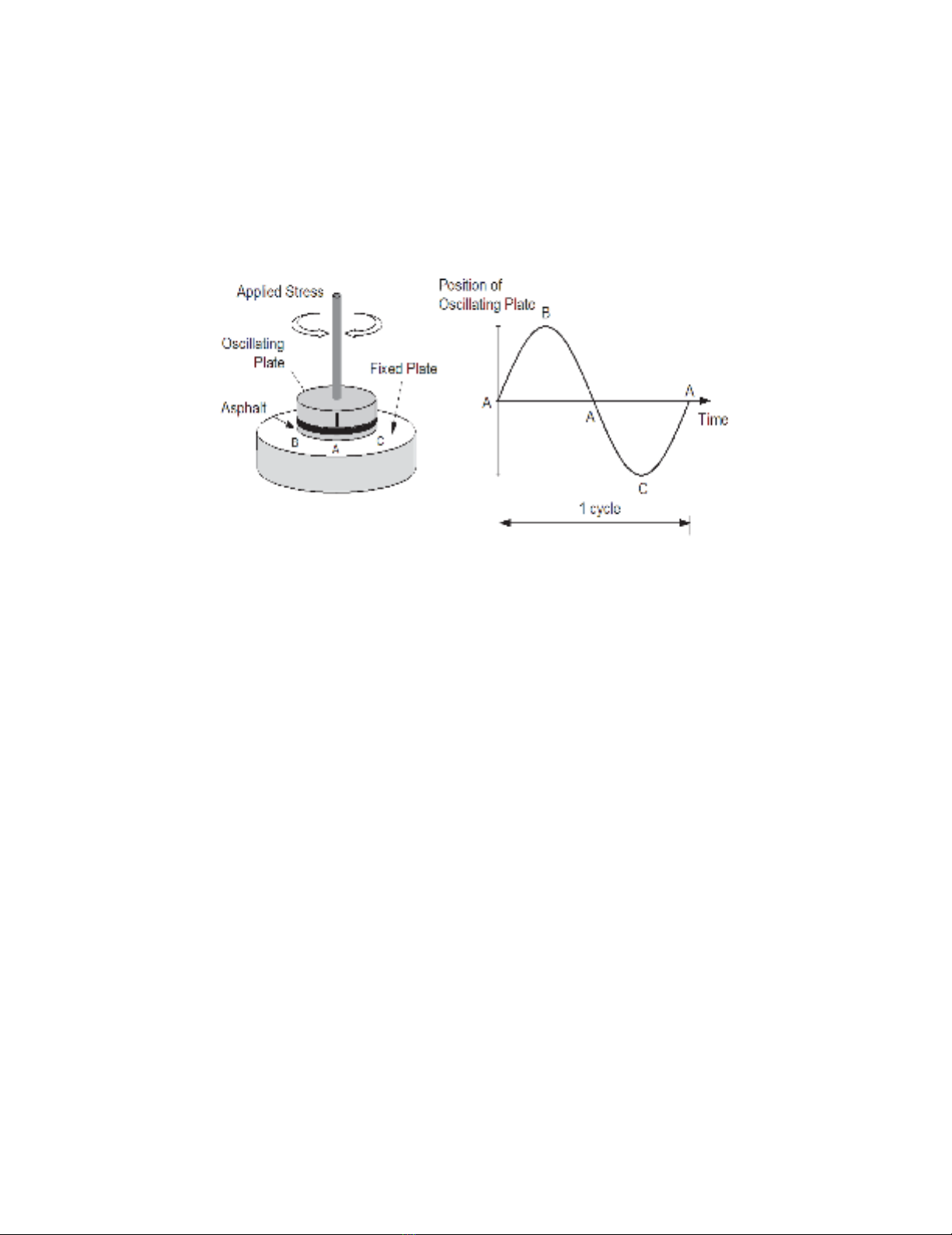
phase angle). In DSR apparatus, bitumen is placed as a disk between two parallel plates which one of
them is fixed and another one oscillates. Mobile plate moves from point A to B and then returns to
point A and from there moves to point C and returns to point A (Fig. 4). This oscillation is computed
as a cycle and DSR repeats this process regularly. The oscillation frequency would be equal to10 rad/s
(1.59Hz cycle per second).
Fig. 4. Dynamic shear rheometer (Ghile, 2006)
DSR apparatus identify bitumen’s mid and high temperature rheological behavior by measuring
complex shear modulus (G*) and phase angle (δ). G* is an index of resistance of a substance toward
deformation under repeated pulses in shear tension. It includes two parts: elastic modulus (recoverable)
and viscous modulus (irrecoverable). In this research, DSR is performed in the range of 30-85 °C. To
compare samples performance, 3 wt.% of crumb rubber and different percentages of PE1 and PE2 were
blended and results were compared. It can be observed that in all results, polymer Type 1 is mixed
better with bitumen because of its regular dimension and equal size and is distributed better in bitumen,
therefore it shows better results; however, these differences are not considerable.
Rheological curves are designed for 1%, 3%, 5% crumb percentage. By comparing these graphs, it
can be observed that samples with 3% crumb rubber have better performance; since samples containing
1% crumb rubber cannot improve performance of bitumen at low service temperatures. Moreover,
bitumen which has 5% crumb rubber is not recommended for regions with cold climate conditions,
because it returns high levels of performance (more than 82°C) and is suitable only for very hot
climates. So, the samples containing 3% crumb rubber are discussed in this paper.
As it can be observed in Fig. 5, complex modulus results are provided for samples which contain
polymers type 1 and 2 with 3% crumb rubber. All samples have larger complex modulus in comparison
to base bitumen. By increasing polymer percentage, this parameter is increased since waste
polyethylene and crumb rubber establish more adhesiveness in combination to bitumen which causes
increase in hardness and viscosity of bitumen. Therefore, complex modulus and high performance
grade is increased.





![Giáo trình Cấu trúc dữ liệu và giải thuật - Trường CĐ Cơ điện Hà Nội [Mới nhất]](https://cdn.tailieu.vn/images/document/thumbnail/2026/20260323/lionelmessi01/135x160/58171774381670.jpg)


![Giáo trình Tiện nâng cao (Nghề Cắt gọt kim loại, Trình độ Cao đẳng) - Trường Cao đẳng Cơ điện Hà Nội [Mới nhất]](https://cdn.tailieu.vn/images/document/thumbnail/2026/20260323/lionelmessi01/135x160/48101774403543.jpg)


