

REVIEW ARTICLE
JRC in Euratom Research and Training Programme 2014–2020
Said Abousahl
*
, Andrea Bucalossi, Victor Esteban Gran, and Manuel Martin Ramos
European Commission (EC), DG Joint Research Centre, Euratom Coordination, Brussels, Belgium
Received: 6 September 2019 / Accepted: 30 September 2019
Abstract. The Euratom Research and Training Programme 2014–2018 and its extension 2019–2020 (the
Euratom Programme) is implemented through direct actions in fission i.e. research performed by the
Commission’s Joint Research Centre (JRC), and through indirect actions in fission–i.e. via competitive calls for
proposals, and in fusion i.e. through a comprehensive named-beneficiary co-fund action managed by the
Commission’s Directorate-General for Research & Innovation (RTD). The general objective of the Programme
is “to pursue nuclear research and training activities with an emphasis on the continuous improvement of nuclear
safety, security and radiation protection, in particular to potentially contribute to the long-term decarbon-
isation of the energy system in a safe, efficient and secure way.”The Programme is an integral part of Horizon
2020, the EU Framework Programme for Research and Innovation. The direct actions implemented by the JRC
constitute an important part of the Euratom Programme and pursue specific objectives covering: nuclear safety,
radioactive waste management, decommissioning, emergency preparedness; nuclear security, safeguards and
non-proliferation; standardisation; knowledge management; education and training; and support to the policy of
the Union on these fields. The JRC multi-annual work programme for nuclear activities fully reflects the
aforementioned objectives. It is structured in about 20 projects, and allocates 48% of its resources to nuclear
safety, waste management, decommissioning and emergency preparedness, 33% to nuclear security, safeguards
and non-proliferation, 12% to reference standards, nuclear science and non-energy applications and 7% to
education, training and knowledge management. To ensure that direct actions are in line with and complement
the research and training needs of Member States, JRC is continuously interacting with the main research and
scientific institutions in the EU, and actively participating in several technological platforms and associations.
JRC also participates as part of the consortia in indirect actions, which allows JRC scientist to engage in top
level scientific research, and yields maintaining and further developing JRC’s scientific excellence. At the same
time, the members of the consortia can have access to unique research infrastructure. The participation of JRC
in indirect actions can be improved by exploiting synergies inside the Euratom Programme, and also with the
future Horizon Europe Framework Programme. In preparation of the next Euratom Programme 2021–2025, two
pilot projects on knowledge management and on open access to JRC research infrastructure will explore and test
this improved involvement of JRC in indirect actions. The paper highlights some of the achievements of recent
JRC direct actions with a focus on the interaction with EU MS research organisations, as well as some of the most
important elements of the Commission Proposal for the next (2021–2025) Euratom Programme, with a focus on
the new positioning of the JRC as regards its participation in indirect actions.
1 Introduction
Currently, fourteen Member States operate around 130
nuclear power reactors to generate over 25% of all
electricity consumed in the EU, contributing to competi-
tiveness, security of energy supply and limitation of CO
2
emissions as part of the European Union energy and
climate policy objectives. Regardless of the individual
decisions on continuing, phasing out or embarking in new
built nuclear power plants, nuclear energy will continue to
be part of the energy mix in the European Union for the
next decades. Indeed, in recent Communications on the
Energy Union and on the European long-term vision for a
prosperous, modern competitive and climate neutral
economy, the European Commission recognises nuclear
energy as an important player to achieve, together with
renewable sources, a carbon-free European energy system.
Worldwide, about 450 nuclear power plants are in
operation and around 50 more are under construction;
several of them in EU neighbouring countries.
To ensure the highest levels of nuclear safety and
security, the European Union needs to be at the forefront
not only in the development and implementation of the
*e-mail: Said.ABOUSAHL@ec.europa.eu
EPJ Nuclear Sci. Technol. 6, 45 (2020)
©S. Abousahl et al., published by EDP Sciences, 2020
https://doi.org/10.1051/epjn/2019036
Nuclear
Sciences
& Technologies
Available online at:
https://www.epj-n.org
This is an Open Access article distributed under the terms of the Creative Commons Attribution License (https://creativecommons.org/licenses/by/4.0),
which permits unrestricted use, distribution, and reproduction in any medium, provided the original work is properly cited.

most advance legislation at regional level, with the
Euratom Directives on Nuclear Safety (2009 [1], amended
in 2014 [2]), Safe and Responsible Management of
Radioactive Waste and Spent Fuel [3] (2011), and the
Basic Safety Standards [4] (2013), but also promoting
nuclear research and training. Indeed, nuclear research and
training is a key factor to help the European Union
maintain the scientific and technological leadership in
nuclear technologies, also in non-power applications.
The Euratom Treaty [5] establishes that the Commis-
sion is responsible for promoting and facilitating nuclear
research in the Member States and for complementing it by
carrying out a Community research and training pro-
gramme. These programmes are proposed by the European
Commission, and are discussed and adopted by unanimity
in the Council. The programmes are funded by the budget
of the Community.
2 The Euratom Research and Training
Programme
The Euratom Research and Training Programme 2014–
2018 [6] and its extension 2019–2020 [7](theEuratom
Programme) is implemented through so called indirect
and direct actions. Indirect actions are research activi-
ties carried out by consortia of research institutions from
EU Member States and associated countries partially
funded by the research budget of the European Union.
Research focuses in nuclear fission (via competitive calls
for proposals), and in nuclear fusion (through a
comprehensive named-beneficiary co-fund actions). Di-
rect actions are research activities in nuclear fission
carried out by the European Commission’sJoint
Research Centre (JRC).
The overall objective of the Programme currently in
force is “to pursue nuclear research and training activities
with an emphasis on the continuous improvement of
nuclear safety, security and radiation protection, in
particular to potentially contribute to the long-term
decarbonisation of the energy system in a safe, efficient
and secure way.”
The Programme also sets specific objectives for both
indirect and direct actions. Specific objectives of the
indirect actions encompass:
–supporting the safety of nuclear systems;
–contributing to the development of safe, longer-term
solutions for the management of ultimate nuclear waste,
including final geological disposal as well as partitioning
and transmutation;
–supporting the development and sustainability of nuclear
expertise and excellence in the Union;
–supporting radiation protection and the development of
medical applications of radiation, including, inter alia,
the secure and safe supply and use of radioisotopes;
–moving towards demonstrating the feasibility of fusion as
a power source by exploiting existing and future fusion
facilities;
–laying the foundations for future fusion power plants
by developing materials, technologies and conceptual
design; and
–promoting innovation and industrial competitiveness;
–ensuring the availability and use of research infra-
structures of pan-European relevance.
The direct actions implemented by the JRC constitute
an important part of the Euratom Programme and pursue
specific objectives covering:
–improving nuclear safety, including: nuclear reactor and
fuel safety, waste management, including final geological
disposal as well as partitioning and transmutation;
decommissioning, and emergency preparedness;
–improving nuclear security, including: nuclear safe-
guards, non-proliferation, combating illicit trafficking,
and nuclear forensics;
–increasing excellence in the nuclear science base for
standardisation;
–fostering knowledge management, education and train-
ing; and
–supporting the policy of the Union on nuclear safety and
security.
The Programme is an integral part of Horizon 2020, the
EU Framework Programme for Research and Innovation.
The extension of the Euratom Research and Training
Programme for 2019–2020 was adopted on 15 October, 2019.
The adopted extension carry over the activities of the 2014–
2018Programme, keeping the same strategy,scope and mode
of implementation, introducing as well the recommendations
of the interim evaluation of the 2014–2018 Programme issued
by a team of reputed international experts.
The recommendations for the JRC were to reinforce its
education and training activities; improve communication
and reach-out; introduce project management culture in
the work programme; ensure a more efficient management
or resources; proof that JRC is cost effective; integrate a
coherent direct/indirect actions programme; and pursue
synergies between the nuclear and the non-nuclear
activities.
The implementation of the programme will therefore
continue the activities in education and training, reinforce
knowledge management, increase the synergies between
nuclear and non-nuclear research in the field of nuclear
science applications, and improve open access to scientists
to JRC research infrastructure.
The budget for the extension rises up to €770.2 million,
with €268.8 million for direct actions to be carried out by
JRC.
It is clear that most of the challenges and research
needs of the current programme will remain for the EU
from 2021 onwards. Thus, the Commission proposal for
the next framework programme, the Euratom Research
and Training Programme 2021–2025 [8] complementing
Horizon Europe will need to focus in nuclear safety,
security, radioactive waste and spent fuel management,
radiation protection and fusion. The programme will
expand research into non-power applications of ionising
radiation, and make further improvements in the
areas of education, training and access to research
infrastructure.
Horizon Europe is the most ambitious framework
programme for research and innovation ever. The proposed
budget for 2021 to 2027 is €100 billion including €2.4 billion
2 S. Abousahl et al.: EPJ Nuclear Sci. Technol. 6, 45 (2020)

for the Euratom Research and Training Programme. For
2021 to 2025, 619 M€(out of the 1.6 b€for Euratom) are for
Direct Actions undertaken by JRC.
The proposal of the Commission establishes a common
set of objectives for the Direct and Indirect Actions, in
order to better streamline the research activities, and allow
the combination of instruments and assets, such as JRC’s
research infrastructure and knowledge base.
The proposal has two general objectives:
–to pursue nuclear research and training activities to
support continuous improvement of nuclear safety,
security and radiation protection;
–to potentially contribute to the long-term decarbon-
isation of the energy system in a safe, efficient and secure
way.
As well as four specific objectives:
–improve the safe and secure use of nuclear energy and
non-power applications of ionizing radiation, including
nuclear safety, security, safeguards, radiation protection,
safe spent fuel and radioactive waste management and
decommissioning;
–maintain and further develop expertise and competence
in the Community;
–foster the development of fusion energy and contribute to
the implementation of the fusion roadmap; and
–support the policy of the Community on nuclear safety,
safeguards and security.
The proposal also includes a focus on non-power
applications for medical and industrial use which are
clear synergies with Horizon Europe and opens Marie
Skłodowska-Curie Actions to nuclear researchers
(Fig. 1).
3 European Commission’s Joint Research
Centre
The Joint Research Centre is the European Commission’s
science and knowledge service. It employs scientists to
carry out research in order to provide independent
scientific advice and support to EU policy in areas such
as agriculture, food security, environment, climate change,
innovation, growth, as well as in nuclear safety and
security.
The JRC creates, manages and makes sense of
knowledge and anticipates emerging issues that need
to be addressed at EU level. It develops innovative
tools and makes them available to policy-makers. It
explores new and emerging areas of science and hosts
specialist laboratories and unique research facilities. Its
Fig. 1. European Commission’s Joint Research Centre sites.
S. Abousahl et al.: EPJ Nuclear Sci. Technol. 6, 45 (2020) 3

scientific results are highly ranked by international peer
systems.
Established as a Joint Nuclear Research Centre by
Article 8 of the Euratom Treaty [9], the JRC draws on
60 years of scientific experience and continually builds its
expertise, sharing know-how with EU countries, the
scientific community and international partners. With
time, the JRC broadened its field of research to non-nuclear
disciplines, which now cover around 75% of its entire
activities. It works together with over a thousand
organisations worldwide in more than 150 networks whose
scientists have access to JRC facilities through various
collaboration agreements.
The JRC is organised in Directorates, one with
corporate responsibilities for strategy, work programme
coordination and resources; and one support services. Six
scientific directorates dealing with growth and innovation;
energy, transport and climate; sustainable resources;
space, security and migration; health, consumers and
reference materials; and nuclear safety and security. And
two cross-JRC directorates dealing with knowledge
management and competences. The JRC directorates are
spread across six sites in five European Union Member
States: Brussels and Geel in Belgium, Petten in The
Netherlands, Karlsruhe in Germany, Ispra in Italy, and
Sevilla in Spain.
3.1 JRC research and training in nuclear safety
and security
The Directorate for Nuclear Safety and Security employs
around 500 scientists, technicians and administrative staff
in in Petten, Karlsruhe, Geel and Ispra.
The JRC multi-annual work programme for nuclear
activities fully reflects the objectives of the Euratom
Research and Training Programme. It is structured in about
20 projects, and allocates approximately 48% of its resources
to nuclear safety, waste management, decommissioning and
emergency preparedness, 33% to nuclear security, safe-
guards and non-proliferation, 12% to reference standards,
nuclear science and non-energy applications and 7% to
education, training and knowledge management.
To ensure that direct actions are in line with and
complement the research and training needs of Member
States, JRC is continuously interacting with the main
research and scientific institutions in the EU, and actively
participating in several technological platforms and
associations. In a few cases, JRC also participates as part
of the consortia in indirect actions, which allows JRC
scientist to engage in top level scientific research,
maintaining and further developing JRC’s scientific
excellence. At the same time, the members of the consortia
can have access to unique research infrastructure.
Without being exhaustive, the JRC’s most relevant
activities in the nuclear domain encompass, in nuclear
safety, research in advanced mechanical tests methods to
address creep fatigue or stress corrosion cracking at high
temperatures in corrosive environments, such as super-
critical water and liquid metals; research in severe
accident modelling and analysis with computer codes
such as the European software system ASTEC and others.
The JRC operates the EU Clearinghouse on Operating
Experience Feedback, a regional network constituted by
the JRC, nuclear safety regulatory authorities, technical
support organisations, and international organisations
that aim at enhancing nuclear safety through further use
of lessons learned from Operating Experience. Another
key activity is the development, operation and mainte-
nance of EURDEP, EU system for almost real-time
monitoring of radioactivity in the environment, and
support to ECURIE, which is the technical interface of the
EU early notification and information exchange system for
radiological emergencies.
JRC also carries out research in safety of the nuclear
fuel cycle, at in-core, storage and disposal, and under
normal, abnormal and accidental conditions. JRC devel-
oped and further improves and maintains the TRANS-
URANUS computer code, which is a widely used
independent computer code for fuel performance analysis.
JRC research is not limited to current nuclear fuels, but
also to advanced and innovative designs. Complementing
its European partners, JRC carries out research on safety
and safeguards aspects of Generation IV reactors [10].
In the area of radioactive waste management, JRC
focuses in non-destructive analyses techniques for the
characterisation of waste packages; standardisation of free
release measurements, development of novel techniques for
mapping contamination, and for decontamination in high
activity environments, methods for hard to measure
nuclides, etc.
JRC activities in the field of nuclear security and
safeguards focuses in four main areas: effective and efficient
safeguards (through research in, e.g. nuclear material
measurements, containment and surveillance, process
monitoring and on-site laboratories), verification of
absence of undeclared activities (through e.g. trace and
particle analysis, and development of in-field tools),
nuclear non-proliferation (through e.g. export control,
trade analysis, and studies) and combating illicit traffick-
ing (through, e.g. equipment development, testing, and
validation, nuclear forensics, preparedness plans).
In standardisation, the JRC is very active, and is a
reference entity in reference measurements and data; basic
and pre-normative research; and inter-laboratory com-
parisons. The JRC develops materials standards, and
manufactures reference materials. JRC is a major
European provider of nuclear data and standards for
nuclear energy applications, due to its experienced and
competent staff and unique scientific infrastructure. The
main repositories for these data are the databases of
Nuclear Data bank of the NEA-OECD and the IAEA,
which provide open access to the data to scientificand
engineers.
JRC has relevant research activities in the field of
nuclear science applications, such as accelerator-based
nuclear measurements, basic properties of radionuclides
and associated applications, including supporting the
authentication and preservation of cultural heritage and
archaeological studies, use of tracers for climate modelling,
nuclear medicine, such as targeted alpha-immunotherapy,
food fraud detection, and space applications.
4 S. Abousahl et al.: EPJ Nuclear Sci. Technol. 6, 45 (2020)
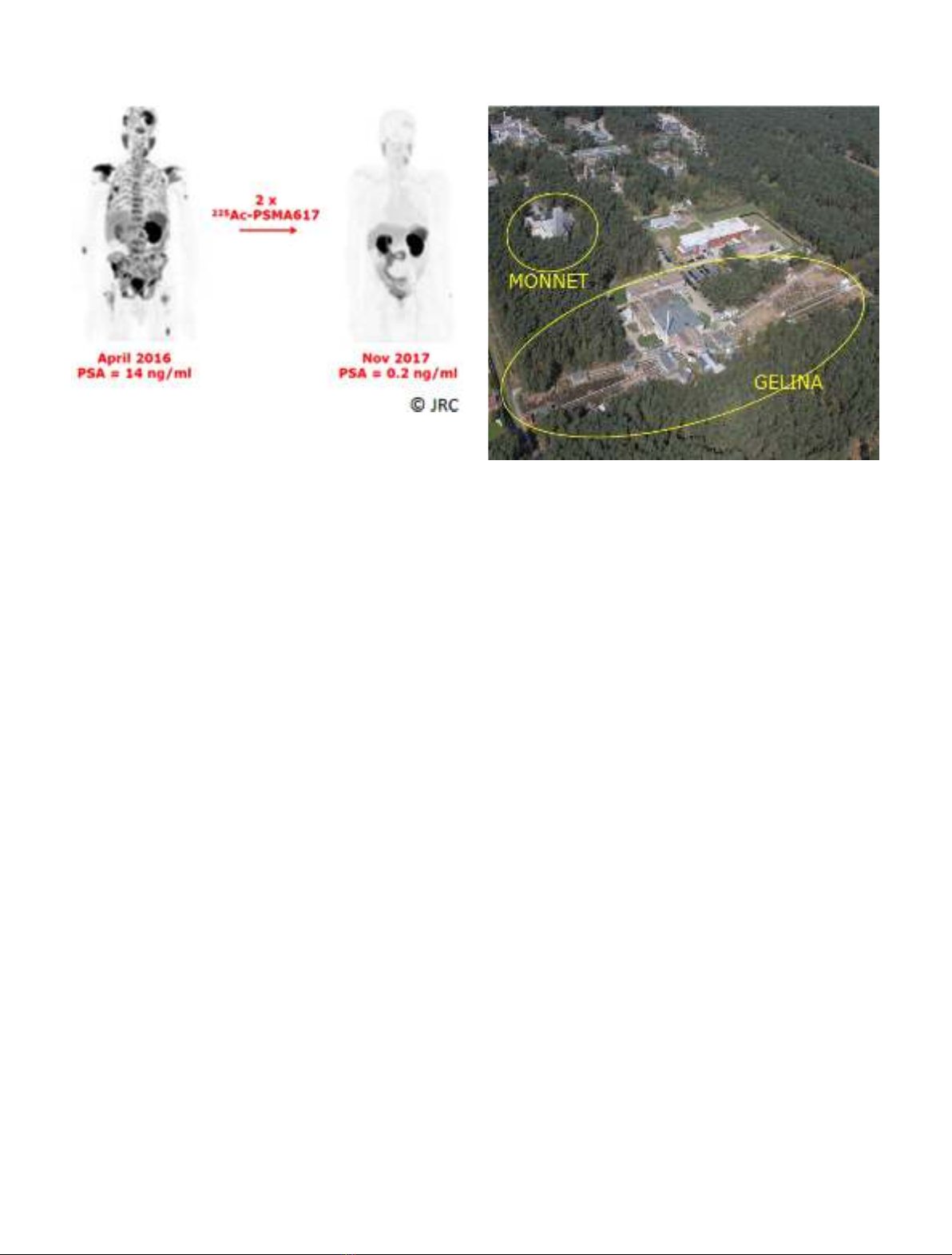
JRC activities in knowledge management, education
and training include organisation and active participation
in expert and scientific conferences, and the participation,
preparation and implementation of education and training
initiatives such as the European Nuclear Security Training
Centre (EUSECTRA), European Safeguards Research and
Development Association (ESARDA), education and
training of Euratom and IAEA nuclear inspectors,
European Learning Initiatives in Nuclear Decommission-
ing and Environmental Remediation (ELINDER), inter-
national summer schools in radioactive waste management
and decommissioning, nuclear resonance analysis, radio-
nuclides, as well as a number of other education and
training courses in nuclear safety, security, nuclear data,
etc (Fig. 2).
3.2 JRC nuclear research infrastructure
The nuclear research experimental facilities of the
JRC are distributed in the sites of Geel (Belgium),
Petten (the Netherlands), Karlsruhe (Germany) and
Ispra (Italy).
JRC-Geel research infrastructure mainly focuses in
nuclear data, radioactivity metrology, and nuclear refer-
ence materials:
–The neutron time-of-flight linear accelerator (GELINA)
is a pulse white spectrum neutron source with the best
time resolution in the world. It is a multi-user facility
serving up to 12 different experiments simultaneously.
GELINA combines four specially designed and distinct
units: a high-power pulsed linear electron accelerator, a
post-accelerating beam compression magnet system, a
mercury-cooled uranium target, and very long (up to
400 m) flight paths.
–The tandem accelerator based fast neutron source
(MONNET) is a 3.5 MV electrostatic accelerator for
the production of continuous and pulsed proton-,
deuteron- and helium ion beams. The combination of
both facilities GELINA and MONNET makes JRC-Geel
one of the few laboratories in the world which is capable
of producing the required accuracy for neutron data
needed for the safety assessments of present-day and
innovative nuclear energy systems.
–Radionuclide metrology laboratories: a cluster of instru-
ments for high precision radioactivity measurements
(RADMET laboratories) and the high activity disposal
experimental site (HADES): Laboratory for ultra-
sensitive radioactivity measurements 225 m deep under-
ground at the premises of the Belgian nuclear institute
SCK.CEN.
Nuclear reference materials laboratories for the prepa-
ration and provision of certified nuclear reference materials
and reference measurements (METRO) and well-defined
and well-characterised samples for nuclear data measure-
ments (TARGET). The nuclear reference materials
laboratories encompass mass spectrometry equipment,
chemical sample preparation equipment in glove boxes,
substitution weighing equipment in glove boxes, robot
systems for dispensing of radioactive solutions, equipment
for production of reference particles and UF6 reference
measurements (Fig. 3).
JRC-Petten hosts and operates laboratories for the
assessment of materials and components performance
under thermo-mechanical loading, corrosion, and neutron
irradiation:
–The high flux reactor (HFR, owned by JRC but operated
by the Dutch company NRG) is one of the most powerful
multi-purpose materials testing research reactors in the
world. The HFR is a tank in pool type light water-cooled
and moderated and operated at 45 MW. The reactor
provides a variety of irradiation facilities and possibilities
in the reactor core, in the reflector region and in the
poolside facility, as well as neutron beams.
–The laboratory for the ageing of materials in light water
reactor (LWR) environments (AMALIA) is a laboratory
Fig. 2. Targeted alpha-immunotherapy.
Fig. 3. Accelerators for nuclear data measurements in JRC-
Geel.
S. Abousahl et al.: EPJ Nuclear Sci. Technol. 6, 45 (2020) 5



![Đề ôn tập cuối kỳ môn Kỹ thuật nhiệt - Nhiệt động học [mới nhất]](https://cdn.tailieu.vn/images/document/thumbnail/2026/20260310/hoaphuong0906/135x160/60681773197823.jpg)

![Bài giảng thang máy và thang cuốn: Tổng hợp kiến thức [chuẩn nhất]](https://cdn.tailieu.vn/images/document/thumbnail/2026/20260310/hoaphuong0906/135x160/41471773283876.jpg)
