http://www.iaeme.com/IJM/index.asp 82 editor@iaeme.com
International Journal of Management (IJM)
Volume 7, Issue 7, November–December 2016, pp.82–89, Article ID: IJM_07_07_008
Available online at
http://www.iaeme.com/ijm/issues.asp?JType=IJM&VType=7&IType=7
Journal Impact Factor (2016): 8.1920 (Calculated by GISI) www.jifactor.com
ISSN Print: 0976-6502 and ISSN Online: 0976-6510
© IAEME Publication
JUST IN TIME APPROACH – IT’S APPLICATION IN
INDIAN INDUSTRIES
V. Vijaya Lakshmi
Research Scholar, Department of Commerce & Business Administration, ANU, Guntur, India
Prof. G. V. Chalam
Professor, Department of Commerce & Business Administration, ANU, Guntur, India
ABSTRACT
In today’s competitive global business environment, the goal of the manufacturing system is
long-term survival. In recent years, Inventory management is continuous challenge for all
organizations not only due to heavy cost associated with inventory holding, but also it has a great
deal to do with the organizations production process. JIT system has been defined and identified
worldwide by many researchers and practitioners for world class manufacturing. This system has
potential to compete in the present scenario of rapid development and growth of industrialization.
JIT production methods are now widely practiced in many industries. This paper presents the
background, benefits, implementation and reviews literature on JIT in developing countries like
India.
At the end it is suggested that by implementing the JIT in Indian industries, an enormous saving
can be generated and a new productivity ethics can be created that may be helpful to strengthen the
Indian economy. Further, Indian labor is usually uneducated, lacking in motivation and more
concerned with monetary benefits and job security than carrier progress and development of their
potential. Labor unions and their reluctances are also unfavorable for implementing the JIT.
Therefore, specific cultural changes are required for successfully implementing the JIT. On this
issue some researchers opined that Japanese training models are not very successful in India.
Therefore, some specific designed training programs should be organized for Indian workforce
after studying their behavior pattern, personal traits, attitudes and social values.
Key words: JIT, Total Quality Management, JIT Implementation, Enterprise Resource Planning.
Cite this Article: V. Vijaya Lakshmi and Prof. G. V. Chalam, Just in Time Approach – It’s
Application in Indian Industries. International Journal of Management, 7(7), 2016, pp. 82–89.
http://www.iaeme.com/IJM/issues.asp?JType=IJM&VType=7&IType=7
1. INTRODUCTION
The principle of JIT is to eliminate sources of manufacturing waste by getting right quantity of raw
material, processing the right quantity in the right place and at the right time.JIT production is a
manufacturer philosophy which eliminates waste associated with time, labor, and storage space. Basics of

Just in Time Approach – It’s Application in Indian Industries
http://www.iaeme.com/IJM/index.asp 83 editor@iaeme.com
the concept are that the company produces only what is needed, when it is needed and in the quantity that
is needed.
JIT is a system whether company starts manufacturing/purchasing once the customer orders the good
effectively making zero inventories. In other words, in a JIT environment, materials are purchased and
produced as and when it is needed. The whole idea is based on the phrase provide the goods just in time as
promised when the order is placed by the customer. The opposite of the JIT production is known as JIC
(Just in case) system where it produces goods for inventory with the intention of having goods just in case
a customer places an immediate order. JIT production system identifies the hidden problems in the value
chain and reduces the production waste of the system while increasing the throughout (Sales-Raw Material
Cost). Even though the JIT system seems to be interesting and less complicated it requires lot of
coordination with supply chain to avoid delays in the production schedule.
The whole concept of the JIT is differentiated from traditional productions systems using push vs. pull
systems of production. The push system of production pushes materials to the next stage of the production
irrespective of whether time and resources are needed at the next level of production creating lot of
inventories at each level of the production flow. The traditional manufacturing organizations adopt push
system where they produce for inventory and work in progress. The pull system of production is where the
materials are pulled by next level of the production only when is signaled or required by the next stage of
production. This drastically reduces the inventory held as it does not keep any work in progress. JIT
concept is built based on the concept of pull production which eliminates the total inventory.
2. BACKGROUND
JIT is a Japanese management philosophy which has been applied in practice since the early 1970s in
many Japanese manufacturing organizations. It was first developed and perfected within the Toyota
manufacturing plants by Taiichi Ohno as a means of meeting consumer demands with minimum delays.
Taiichi Ohno is frequently referred to as the father of JIT. Toyota was able to meet the increasing
challenges for survival through an approach that focused on people, plants and systems. Toyota realized
that JIT would only be successful if every individual within the organization was involved and committed
to it, if the plant and processes were arranged for maximum output and efficiency, and if quality and
production programs were scheduled to meet demands exactly.
The Toyota production plants were the first to introduction JIT. It gained extended support during the
1973 oil embargo and was later adopted by many other organizations. The oil embargo and the increasing
shortage of other natural resources were seen as a major impetus for the widespread adoption of JIT.
Toyota was able to meet the increasing challenges for survival through an approach to management
different from what was characteristic of the time. This approach focused on people, plants and system.
Toyota realized that JIT would only be successful if every individual within the organization was involved
and committed to it, if the plant and processes were arranged for maximum output and efficiency, and if
quality and production programs were scheduled to meet demands exactly.
JIT had its beginnings as a method of reducing inventory levels within Japanese shipyards. Today, JIT
has evolved into a management philosophy containing a body of knowledge and encompassing a
comprehensive set of manufacturing principles and techniques. JIT manufacturing has the capacity, when
properly adapted to the organization, to strengthen the organization’s competitiveness in the marketplace
substantially by reducing wastes and improving product quality and efficiency of production.
There is strong culture aspects associated with the emergence of JIT in Japan. The development of JIT
within the Toyota production plants did not occur independently of these strong cultural influences. The
Japanese work ethic is one of these factors. The work ethic emerged shortly after World War II and was
seen as an integral part of the Japanese economic success. It is the prime motivating factor behind the
development of superior management techniques that are becoming the best in the world. The Japanese
work ethic involves the following concepts:

V. Vijaya Lakshmi and Prof. G. V. Chalam
http://www.iaeme.com/IJM/index.asp 84 editor@iaeme.com
• Workers are highly motivated to seek constant improvement upon that which already exists. Although high
standards are currently being met, there exist even higher standards to achieve.
• Companies focus on group effort which involves the combining of talents and sharing knowledge, problem
solving skills, ideas and the achievement of a common goal.
• Work itself takes precedence over leisure. It is not unusual for a Japanese employee to work 14-hour days.
This contrasts greatly when compared to the Western emphasis on time available for leisure activities.
• Employees tend to remain one company throughout the course of their career span. This allows the
opportunity for them to hone their skills and abilities at a constant rate while offering numerous benefits to
the company. These benefits manifest themselves in employee loyalty, low turnover costs and fulfillment of
company goals.
• There exists a high degree of group consciousness and sense of quality among the Japanese. The Japanese
are a homogeneous race where individual differences are not exploited or celebrated.
In addition, JIT also emerged as a means of obtaining the highest levels of usage out of limited
resources available. Faced with constraints, the Japanese worked toward attainment of the optimal
cost/quality relationship in their manufacturing processes. This involves reducing waste and using
materials and resources in the most efficient manner possible. The input of sustained effort over a long
period of time within the framework of continuous improvement is key. This is achieved by a focus on a
continuous stream of small improvements known in Japan as ‘kaizen’ and has been recognized as one of
the most significant elements of the JIT philosophy.
Furthermore, Japanese firms tend to focus on enhancing the long-run competitiveness rather than
emphasizing the realization of short-term profits. They are willing to experience opportunity costs by
introducing and implementing innovative ideas within their firms. Stockholders and owners of Japanese
companies also encourage the maximization of-term benefits. This enables them to experience the
rewarding long-term profits as a result of their efforts.
3. OBJECTIVES OF JIT
JIT manufacturing tries to smooth the flow of materials from the suppliers to the customers, thereby
increasing the speed of the manufacturing process. The objectives of JIT are to change the manufacturing
system gradually rather than drastically.
• To focus on continuous improvement with less scrap
• To achieve ‘zero defects’ goal in manufacturing with quality
• To Increase productivity and worker efficiency with less idle time
• To achieve flexibility and administrative efficiency
• To reduce product cost by reducing space requirement
• To eliminate wastage in transportation, process, inventory, production, etc.,
• To be more responsive to customers with increased competitive position
• To improve profit margin with shorter lead time
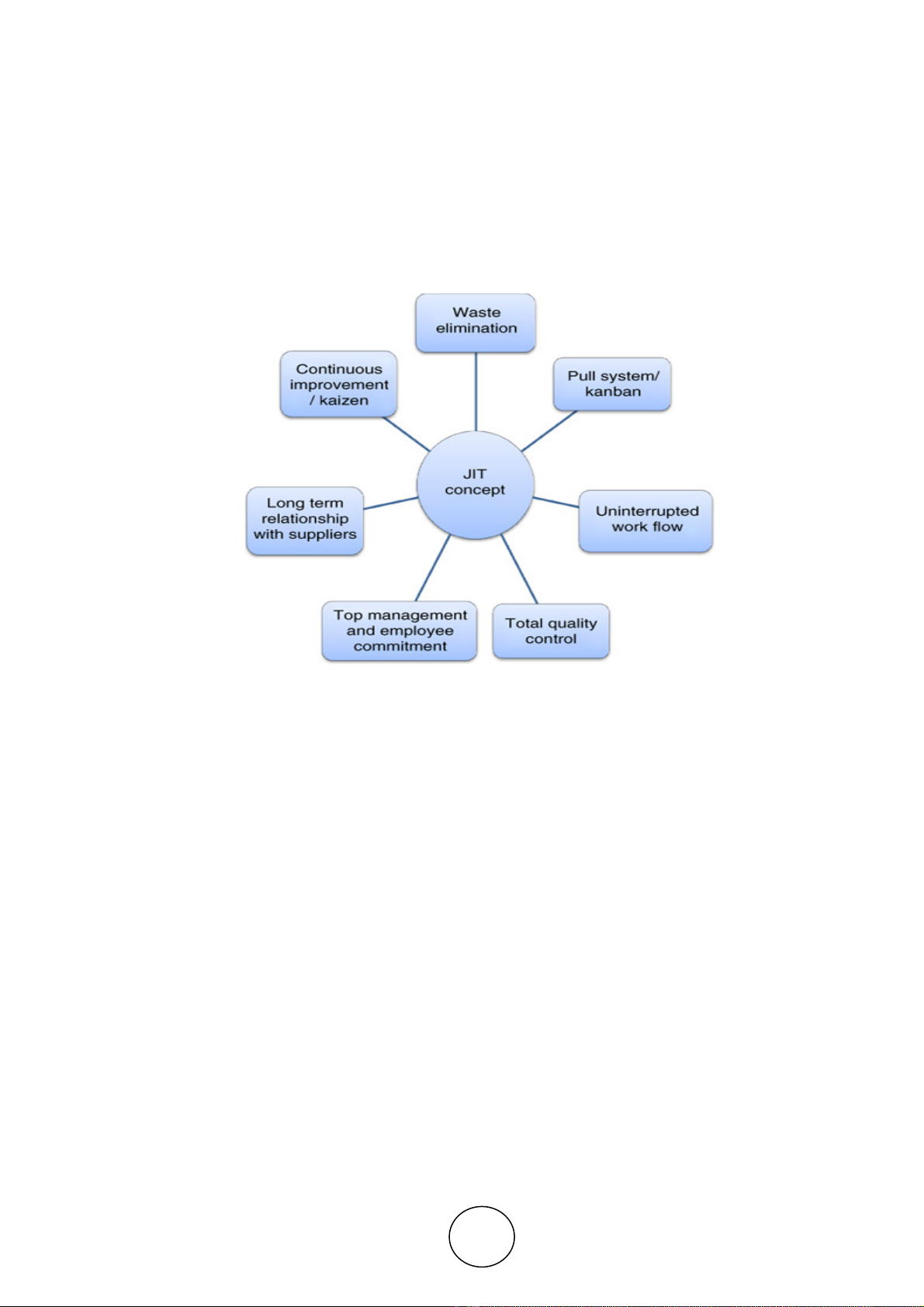
4. ELEMENTS OF JIT MANUFACTURING
• Top management commitment
• Eliminating waste/reducing inventories
• Enforce problem solving and continuous improvement
• People make JIT work- Employee Empowerment
Just in Time Approach – It’s Application in Indian Industries
http://www.iaeme.com/IJM/index.asp 85 editor@iaeme.com
• Total Quality Management (TQM)
• Parallel processing
• Kanban production control
• JIT purchasing
• Working toward repetitive manufacturing
• Cellular Layouts
5. LIMITATIONS OF JIT
Although the benefits of using JIT are numerous and cited more frequently than any potential limitations,
several shortcomings have been identified as follows:
• Cultural differences have been cited as a possible limitation of JIT. There exist many cultural differences
which may be intrinsically tied to JIT success. These will be problems that may be difficult to overcome or
work around without changes in attitudes and worker philosophy. The magnitude of their impact may be
difficult to measure because of their nature.
• The traditional approach to manufacturing involves the use of large inventories with safety stocks. Safety
stocks can act as a buffer for companies to fall back on to offset inaccurate demand forecasts. This has the
potential to cause problems for the organization which relies heavily on safety stocks to absorb any increases
in demand.
• The benefits associated with increased employee involvement and participation resulting from the use of
quality circles may be evident in Japanese organizations. However, Western ideas of participation involve
largely ‘empowering’ the workforce with respect to decision making. This suggests that the level of
involvement established within Japanese organizations using JIT is not compatible with the degree of
employee participation required to satisfy western workers. The benefits associated with JIT may be
culturally bound and somewhat limited to the Japanese environment.
• Loss of individual autonomy has been suggested as another possible short-coming of JIT. Loss of autonomy
has largely been attributed to limited cycle times or the ‘time between recurring activities’. Buffers such as
slack or idle time are significantly reduced resulting in greater amounts of stress and pressure placed upon
the worker to perform. The time which would otherwise be present would allow the worker more freedom to
perform ‘vertical tasks’ which constitute administrative tasks or team meeting.

V. Vijaya Lakshmi and Prof. G. V. Chalam
http://www.iaeme.com/IJM/index.asp 86 editor@iaeme.com
• Loss of team autonomy is a possible result of reducing or eliminating buffer inventories. This serves to
reduce the flexibility of workers to discuss possible solutions to problems. This is a function of quality
circles, which are an important part of JIT. Reduced buffer inventories and workers flexibility contradict the
other aspects of JIT concerning quality circles.
• Loss of autonomy over methods involves the idea that, under JIT, employees must adhere to strict methods
of production in order to maintain the system. This idea diminishes the ‘entrepreneurial spirit’ which many
workers may have previously enjoyed prior to JIT implementation.
• JIT success may be ‘industry specific’, i.e. craft-oriented businesses are considered to be better candidates
for a JIT program than organizations producing commodity-type products.
• Resistance to change may be experienced since JIT involves an organizational level of change, which will
affect almost every member of the organization. Employees may resist the change based on two different
levels: emotional and rational resistance. Rational resistance occurs when an individual is deficient of the
necessary information and facts pertaining to the degree to which the change will affect them. Emotional
resistance refers to the psychological processes of fear, anxiety and suspicion which arise which arise from
inducing change and cause resistance.
6. LITERATURE REVIEW
Singhvi (1992) has presented the experience of implementing the JIT in an Indian automobile company.
The study has found the ‘employee involvement’ as a critical element for implementing the JIT, while
large investments are not found essential. At last, it is concluded that implementation of JIT is not so
difficult in India. Its implementation could be a great opportunity for Indian industries due to its wide range
of benefits.
Padukone and Subba Rao (1993) have stated that India might provide an excellent case study to
determine, if JIT practices implemented in Indian industries. But JIT implementation without
understanding the conceptual framework cannot result in long lasting improvements. In addition, this study
suggested that JIT should be implemented in two stages. First stage of JIT implementation includes setup
reduction, lot size reduction, small machines, quality, layout, buffer stock reduction and flexible
workforce. These techniques are essential for full JIT to work because these focus on four main elements
of JIT that can be achieved in short term. These are: simplicity, flow quality, and fast setup and lays the
foundation for moving on the more difficult techniques like Kanban, JIT purchasing, Buffer stock removal,
multifunctional worker, pull scheduling, enforced improvement and visibility.
Vrat and Mittal (1993) have conducted a Delphi study to assess the applicability or difficulty of
implementing JIT elements in Indian context. The results have shown that quality circles and good
communication are not very difficult to implement having a rating of 30andabove on a 40 point scale. Top
management attitude, multifunctional workers, long-term relation- ship with vendor and support from
labour union have high rating ,which indicates that JIT implementation in India is not an impossible task.
.The study has also stressed on focusing more on poke-yoke, reduced set up time, Kanban system, and
quality of incoming material.
Garg, Vrat and Kanda (1994) have explored the specific cultural changes required in JIT environment
and also reported their presence in Indian industries. They have stated that trust, locality, responsibility,
development, motivation, authority, long-term relationship and respect for human beings mark work
culture required in JIT environment. It is critical for industries to make conscious and deliberate efforts to
change the work culture for successful implementation of JIT. These changes require top management
commitment and worker participation in decision making, and massive education and training to the
people concerned.
Deshmukh (1996) has attempted review on the state of the art of JIT and its possible ramifications in
the purchasing and manufacturing system. It has been pointed out that JIT from a systems perspective
requires that suppliers and manufacturing functions must be in concert with design, planning, and