

37. “The great rule of conduct for us in regard to
foreign nations is, in extending our commercial
relations to have with them as little political con-
nection as possible. So far as we have already
formed engagements let them be fulfilled with
perfect good faith.”
—President George Washington, Farewell Address,
1796
a. isolationism
b. nationalism
c. jingoism
d. pacifism
e. regionalism
38. “The free States alone, if we must go on alone,
will make a glorious nation. Twenty millions in
the temperate zone, stretching from the Atlantic
to the Pacific, full of vigor, industry, inventive
genius, educated, and moral; increasing by
immigration rapidly, and, above all, free—all
free—will form a confederacy of twenty States
scarcely inferior in real power to the unfortunate
Union of thirty-three States which we had on the
first of November.”
—Rutherford Birchard Hayes, January 4, 1861
a. isolationism
b. nationalism
c. jingoism
d. pacifism
e. regionalism
Questions 39 and 40 are based on the following passage.
Like so many other exploration stories, the
Lewis and Clark journey was shaped by the
search for navigable rivers, inspired by the quest
for Edens, and driven by competition for
empire. Thomas Jefferson was motivated by
these aspirations when he drafted instructions
for his explorers, sending them up the Missouri
River in search of a passage to the Pacific. Writ-
ing to William Dunbar just a month after Lewis
and Clark left Fort Mandan, Jefferson empha-
sized the importance of rivers in his plan for
western exploration and national expansion.
“We shall delineate with correctness the great
arteries of this great country.” River highways
could take Americans into an Eden, Jefferson’s
vision of the West as the “Garden of the World.”
And those same rivers might be nature’s out-
lines and borders for empire. “Future genera-
tions would,” so the president told his friend,
“fill up the canvas we begin.”
Source: Library of Congress, Exhibits, “Rivers, Edens,
Empires: Lewis & Clark and the Revealing of America.”
39. Which of the following was NOT one of Jeffer-
son’s goals in sponsoring the Lewis and Clark
expedition?
a. finding a waterway to the Pacific Ocean
b. mapping uncharted territory
c. setting aside vast tracts of land for Native
people
d. discovery of unspoiled plant and animal life
e. creation of an empire
40. Which historical idea best summarizes Jefferson’s
attitude toward the West?
a. Separation of Powers
b. Manifest Destiny
c. Pursuit of Happiness
d. Good Neighbor Policy
e. Separate but Equal
–GED SOCIAL STUDIES PRACTICE QUESTIONS–
185

Questions 41 and 42 refer to the following passage.
About the time of World War I, sharp-eyed
entrepreneurs began ...to see ways to profit
from the motorist’s freedom . . . Shops could be
set up almost anywhere the law allowed, and a
wide variety of products and services could be
counted on to sell briskly in the roadside mar-
ketplace. A certain number of cars passing by
would always be in need of gas. Travelers even-
tually grew hungry, tired, and restless for diver-
sions. Soon gas stations, produce booths, hot
dog stands, and tourist camps sprouted up
along the nation’s roadsides to capitalize on
these needs. As competition increased, mer-
chants looked for new ways to snag the new
market awheel. Each sign and building had to
visually shout: “Slow down, pull in, and buy.”
Still more businesses moved to the highway—
supermarkets, motor courts, restaurants, minia-
ture golf courses, drive-in theaters. By the early
1950s, almost anything could be bought along
the roadside.
Source: Excerpt from Chester H. Liebs, Main Street to
Miracle Mile. Little, Brown and Company, 1985.
41. What is the main idea of the passage?
a. Miniature golf was a very popular sport in the
1950s.
b. Travelers were looking for sources of
entertainment.
c. Some highway businesses were more success-
ful than others.
d. Flashy commercial enterprises sprouted along
highways, eager to profit from travelers.
e. The first businesses to flourish along the high-
ways were gas stations and hot dog stands.
42. Given the information in this passage, what
appeared to be an important post-World War II
trend in the United States?
a. train travel
b. car culture
c. historic preservation
d. downtown renewal
e. environmentalism
Questions 43 through 45 refer to the following passage.
In January 1863 during the Civil War, President
Abraham Lincoln’s Emancipation Proclamation
freed more than three million slaves who lived
in the Confederate states. Lincoln stated:
“And by virtue of the power and for the pur-
pose aforesaid, I do order and declare that all
person held as slaves within said designated
states and parts of states are, and henceforward
shall be, free; and that the Executive Govern-
ment of the United States, including the military
and naval authorities thereof, will recognize and
maintain the freedom of said persons.
And I hereby enjoin upon the people so
declared to be free and abstain from all violence,
unless in necessary self-defense; and I recom-
mend to them that, in all cases when allowed,
they labor faithfully for reasonable wages.
And I further declare and make known that
such persons, of suitable condition, will be
received into the armed service of the United
States to garrison forts, positions, stations, and
other places, and to man vessels of all sorts in
said service.”
Source: HistoryCentral.com.
43. According to the passage, which of the following
was NOT one of Lincoln’s expectations for the
former slaves?
a. to fight for the Union army
b. to become free citizens
c. to join the paid workforce
d. to defend themselves if necessary
e. to incite a rebellion among slaves in states that
were loyal to the Union
44. Based on the values expressed in the Emancipa-
tion Proclamation, which of the following
groups would have disapproved it?
a. nations like Great Britain and France where
there was strong antislavery sentiment
b. Confederate leaders
c. abolitionists
d. Union armed forces
e. humanitarians
–GED SOCIAL STUDIES PRACTICE QUESTIONS–
186

45. Which of the following is the most likely reason
that Lincoln did not emancipate all slaves?
a. Lincoln did not want to appease radical aboli-
tionist groups.
b. He believed slavery was an economic
necessity.
c. He did not want to upset the slaveholding
states that were loyal to the Union—Delaware,
Maryland, Kentucky, and Missouri.
d. Lincoln did not believe that the complete abo-
lition of slavery was possible.
e. He wanted to uphold the Supreme Court
decision in the Dred Scott case, which said that
Congress could not regulate slavery in new
territories.
World History
Questions 46 and 47 are based on the following passage.
The Cuban Missile Crisis began in 1962 when
U.S. spy planes spotted Soviet missile installa-
tions under construction in Cuba. The missiles
were capable of carrying nuclear weapons and
were within range of major U.S. cities. A
thirteen-day standoff began, during which
President John F. Kennedy imposed a naval
blockade of Cuba and demanded that the Sovi-
ets remove the weapons. Kennedy stated that
any missile attack from Cuba would be regarded
as an attack from the Soviet Union and would
be responded to accordingly. Khrushchev later
conceded, agreeing to remove the weapons if, in
return, the United States pledged not to invade
the island. Details from U.S. and Soviet declassi-
fied files and participants in the crisis have sur-
faced since the incident. Unknown to the U.S.
government at the time, 40,000 Soviet soldiers
were stationed in Cuba and armed with nuclear
weapons. Although Khrushchev’s actions helped
avert nuclear war, they made him appear weak
to younger Soviet leaders who ousted him from
power. Historians regard the crisis as the world’s
closest brush with the threat of nuclear war.
46. According to the information given in this pas-
sage, it is most likely that President Kennedy
a. viewed this as a regional crisis solely between
the United States and Cuba.
b. trusted Soviet officials who said there weren’t
any missiles in Cuba.
c. believed that the conflict was principally
between the United States and the Soviet
Union.
d. viewed the situation as serious but felt it could
be managed with diplomacy.
e. felt confident about how Khrushchev would
respond.
47. Which of the conclusions can you make based
on the passage?
a. Kennedy’s first concern during the crisis was
the appeal of Communist ideas.
b. Nuclear war is the only way to win a cold war.
c. Kennedy knew that Khrushchev would back
down.
d. Khrushchev’s popularity increased at home.
e. The U.S. government did not know the full
extent of the Soviet threat at the time.
Question 48 is based on the following passage.
German printer Johannes Gutenberg is often
credited with the invention of the first printing
press to use movable type. He used handset type
to print the Gutenberg Bible in 1455. Although
his invention greatly influenced printing in
Europe, similar technologies were used earlier in
China and Korea. Chinese printers used mov-
able block prints and type made of clay as early
as 1040, and Korean printers invented movable
copper type about 1392.
48. What is the purpose of the paragraph?
a. to praise the advances of printing technology
b. to connect the early advances in printing with
today’s technological advances
c. to show that technological advances can
develop in different geographical areas over
periods of time
d. to give credit to Gutenberg for the first
movable-type printing press
e. to show how Gutenberg’s invention made
printed materials more widely available
–GED SOCIAL STUDIES PRACTICE QUESTIONS–
187
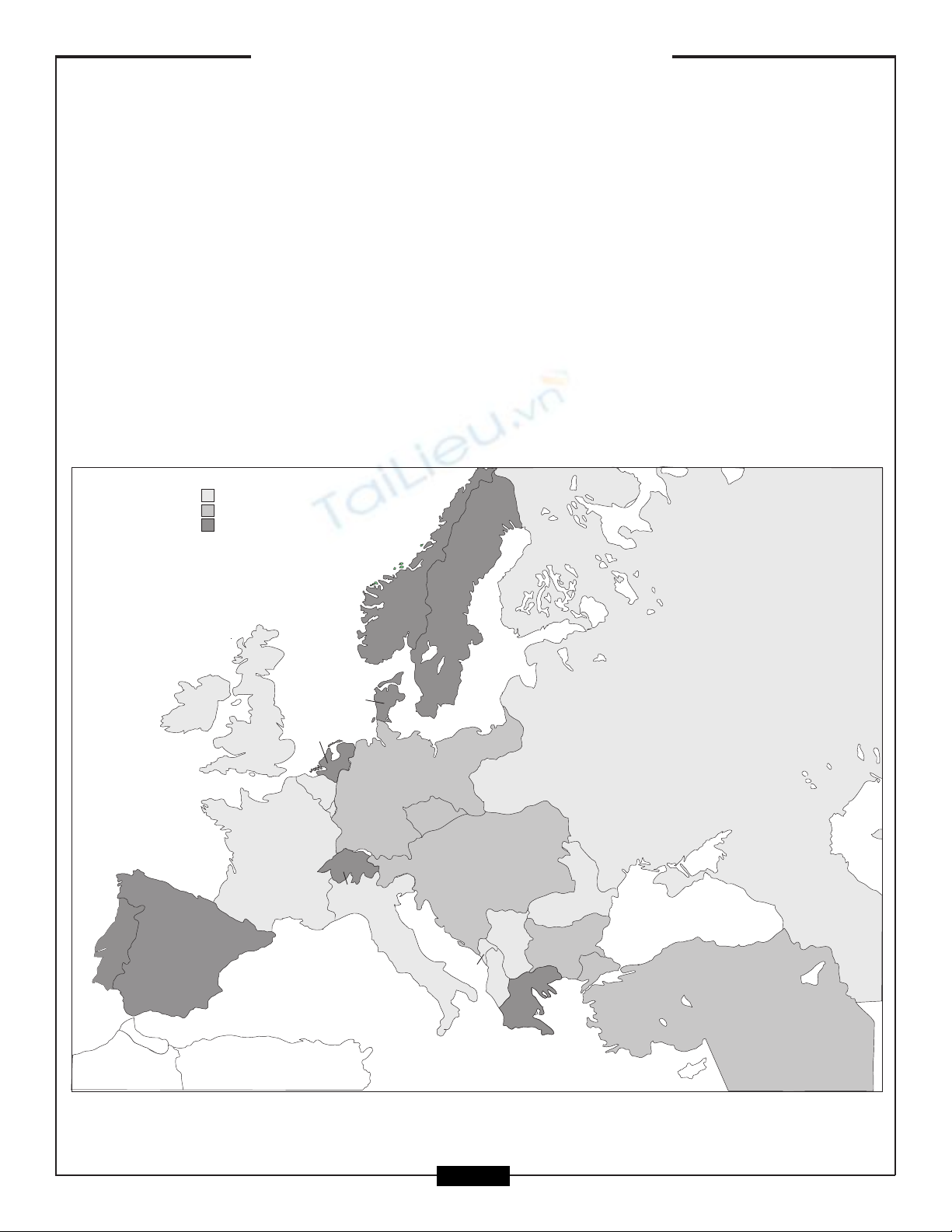
Questions 49 and 50 are based on the map below.
49. The United States maintained its neutrality in
the war until Germany announced its intention
to use unrestricted submarine warfare in the
seas. The U.S. Congress declared war on Ger-
many on April 6, 1917. By doing so, with what
other nations was it siding?
a. Bulgaria and Turkey
b. Albania and Andorra
c. Denmark and Sweden
d. Morocco and Algeria
e. Russia and Italy
50. U.S. President Woodrow Wilson called the war
one “to make the world safe for democracy.”
Based on the map and this quotation, what con-
clusion can be drawn?
a. Communist Russia was a threat to democracy
in 1917.
b. In 1917, Italy had become a fascist state that
threatened democracy.
c. Spain did not have a representative govern-
ment in 1917.
d. Germany and Austria-Hungary were not
democracies in 1917.
e. Great Britain was a constitutional monarchy
in 1917.
–GED SOCIAL STUDIES PRACTICE QUESTIONS–
188
Great
Britain
Allied Powers
Central Powers
Neutral Nations
The
Netherlands
Denmark
Norway
Sweden
Finland
France
Spain
Port-
ugal
Morocco
Algeria
Italy
Albania
Monte-
negro
Hungary
Austria
Germany
Switzer-
land
Russia
Belgium
Luxembourg
Romania
Bulgaria
Tur key
Cyprus
Baltic Sea
Mediterranean Sea
Black Sea
Serbia
Greece
World War I European Powers

Questions 51 and 52 are based on the following passage.
Mohandas Gandhi, also known as Mahatma
Gandhi, developed a policy of passive resistance
in his civil rights struggle for Indian immigrants
in South Africa, and later in the campaign for
Indian independence from British rule. The
writings of the Russian author Leo Tolstoy and
the essay, “Civil Disobedience,” by nineteenth-
century American Henry David Thoreau
inspired Gandhi. Gandhi called acts of nonvio-
lent resistance by the term satyagraha, Sanskrit
for “truth and firmness.” The Salt Satyagraha of
1930 exemplified his policy. In protest against
the British government’s salt tax, he led tens of
thousands of Indians on a 200-mile march to
the Arabian Sea, where they made salt from
evaporated sea water. Thousands, including
Gandhi, were arrested. When the British con-
ceded to his demands, Gandhi stopped the cam-
paign. He was released from prison in 1931, and
that same year, he traveled to London as a repre-
sentative of the Indian National Congress to
negotiate reform measures.
51. Which of the following would be the best title
for this passage?
a. “The Salt March of 1930”
b. “How to Lead an Effective Protest”
c. “Gandhi’s Acts of Nonviolent Resistance”
d. “Free India”
e. “Mahatma Gandhi and Henry David
Thoreau”
52. Which of the following conclusions can be
drawn from the passage?
a. Gandhi’s nonviolent protests were effective
political tools.
b. The British did not respond to the Salt
Satyagraha.
c. Satyagraha means “truth and firmness” in
Sanskrit.
d. Gandhi refused to support the British govern-
ment in World War II until it granted India its
independence.
e. India could not win its independence without
resorting to violent revolution.
Questions 53 and 54 refer to the following paragraph.
From 2000 B.C. until the twentieth century, a
succession of dynasties ruled China. The word
China comes from the Ch’in Dynasty (221–206
B.C.), which first unified the country by con-
quering warring land-owning feudal lords. King
Cheng named himself Shih Huang-ti, or first
emperor, and consolidated his empire by abol-
ishing feudal rule, creating a centralized monar-
chy, establishing a system of laws and a common
written language, and building roads and canals
to the capital. Scholars speculate that construc-
tion of the Great Wall or chang cheng, meaning
“long wall,” began during the Ch’in Dynasty in
order to protect China’s northern border from
invaders. Shih Huang-ti ruled with absolute
power, imposing strict laws and heavy taxes and
doling out harsh punishments. He also is
reputed to have burned books on topics that he
did not consider useful like agriculture or medi-
cine. Shih Huang-ti died in 210 B.C. His son suc-
ceeded him, but soon peasants and former
nobles revolted and overthrew the dynasty.
The Han Dynasty replaced it, ruling China until
220 A.D.
53. Which of the following is NOT a contribution of
the Ch’in Dynasty?
a. unification of territory
b. feudal aristocracy
c. road construction
d. standardized written script
e. regulations and penalties
54. Which of the following conclusions can you
make based on the passage?
a. The Ch’in Dynasty enjoyed a stable and long-
lasting rule.
b. By abolishing feudalism, Ch’in Shih Huang-ti
promoted democracy in China.
c. The Ch’in Dynasty was popular among peas-
ants and displaced nobles.
d. Disunity and disorder marked the Ch’in
Dynasty.
e. The Ch’in Dynasty had long-lasting influence.
–GED SOCIAL STUDIES PRACTICE QUESTIONS–
189

![Bộ tài liệu học vỡ lòng Tiếng Anh [mới nhất]](https://cdn.tailieu.vn/images/document/thumbnail/2020/20200504/lanxichen/135x160/1651588587086.jpg)
![Đề cương Tiếng Anh phổ thông [năm học]: Tổng hợp đầy đủ nhất](https://cdn.tailieu.vn/images/document/thumbnail/2019/20190717/thukhuyen1257/135x160/7691563342337.jpg)
![10 modals là gì? [Năm hiện tại]](https://cdn.tailieu.vn/images/document/thumbnail/2018/20181029/hongduc7981/135x160/3551540823056.jpg)


![509 mẫu câu tiếng Anh giao tiếp thông dụng nhất: Kho mẫu câu [năm hiện tại]](https://cdn.tailieu.vn/images/document/thumbnail/2026/20260515/baobinh_011/135x160/121778822152.jpg)


%20--%3e%3cdefs%3e%3cstyle%3e%20.st0%20{%20fill:%20%23fff;%20}%20.st1%20{%20fill:%20%237800fa;%20}%20%3c/style%3e%3c/defs%3e%3cpath%20class='st1'%20d='M117.78,12.18H43.11c2.9,3.47,4.65,7.94,4.65,12.82,0,5.6-2.3,10.66-6.01,14.29h76.02l7.22-13.56-7.22-13.56Z'/%3e%3cg%3e%3cpath%20class='st0'%20d='M53.58,26.17h-.59v-1.46h.59v-4.96h2.83c1.78,0,2.67.94,2.67,2.82v5.76c0,1.87-.89,2.81-2.67,2.81h-2.83v-4.96ZM55.36,21.37v3.34h1.1v1.46h-1.1v3.34h1.01c.61,0,.91-.37.91-1.1v-5.93c0-.74-.3-1.1-.91-1.1h-1.01Z'/%3e%3cpath%20class='st0'%20d='M65.99,31.14h-1.8l-.31-2.07h-2.19l-.31,2.07h-1.64l1.82-11.39h2.62l1.82,11.39ZM65.28,18.04c-.25.46-.51.77-.75.94-.21.15-.47.22-.79.22-.26,0-.57-.07-.92-.22l-.38-.15c-.14-.05-.26-.07-.37-.07-.3,0-.53.18-.71.54l-.91-.68c.25-.46.51-.77.75-.94.21-.14.48-.21.79-.21.26,0,.57.07.92.21l.38.15c.14.05.26.07.37.07.3,0,.53-.18.71-.54l.91.68ZM61.91,27.52h1.73l-.87-5.76-.87,5.76Z'/%3e%3cpath%20class='st0'%20d='M74.53,26.89v1.52c0,1.91-.89,2.86-2.67,2.86s-2.67-.95-2.67-2.86v-5.93c0-1.91.89-2.86,2.67-2.86s2.67.95,2.67,2.86v1.11h-1.69v-1.22c0-.75-.31-1.12-.93-1.12s-.93.37-.93,1.12v6.15c0,.74.31,1.11.93,1.11s.93-.37.93-1.11v-1.63h1.69Z'/%3e%3cpath%20class='st0'%20d='M81.4,31.14h-1.8l-.31-2.07h-2.19l-.31,2.07h-1.64l1.82-11.39h2.62l1.82,11.39ZM75.9,19.2l1.52-1.91h1.71l1.51,1.91h-1.61l-.76-.95-.75.95h-1.61ZM77.32,27.52h1.73l-.87-5.76-.87,5.76ZM83.1,15.99l-1.76,1.91h-1.26l1.17-1.91h1.86Z'/%3e%3cpath%20class='st0'%20d='M84.86,19.75c1.78,0,2.67.94,2.67,2.82v1.48c0,1.87-.89,2.81-2.67,2.81h-.85v4.28h-1.79v-11.39h2.64ZM84.01,21.37v3.86h.85c.58,0,.87-.36.87-1.08v-1.71c0-.71-.29-1.07-.87-1.07h-.85Z'/%3e%3cpath%20class='st0'%20d='M93.51,19.75c1.78,0,2.67.94,2.67,2.82v1.48c0,1.87-.89,2.81-2.67,2.81h-.85v4.28h-1.79v-11.39h2.64ZM92.66,21.37v3.86h.85c.58,0,.87-.36.87-1.08v-1.71c0-.71-.29-1.07-.87-1.07h-.85Z'/%3e%3cpath%20class='st0'%20d='M98.8,31.14h-1.79v-11.39h1.79v4.88h2.03v-4.88h1.83v11.39h-1.83v-4.88h-2.03v4.88Z'/%3e%3cpath%20class='st0'%20d='M105.36,24.55h2.46v1.62h-2.46v3.34h3.09v1.63h-4.88v-11.39h4.88v1.63h-3.09v3.18ZM108.17,17.29l-1.76,1.91h-1.26l1.17-1.91h1.86Z'/%3e%3cpath%20class='st0'%20d='M112.2,19.75c1.78,0,2.67.94,2.67,2.82v1.48c0,1.87-.89,2.81-2.67,2.81h-.85v4.28h-1.79v-11.39h2.64ZM111.35,21.37v3.86h.85c.58,0,.87-.36.87-1.08v-1.71c0-.71-.29-1.07-.87-1.07h-.85Z'/%3e%3c/g%3e%3ccircle%20class='st1'%20cx='25'%20cy='25'%20r='20'/%3e%3cpath%20class='st0'%20d='M32.78,19.27c2.92,0,4.43,2.55,5.28,5.33l.71,2.17c.14.38-.33.75-.71.75h-5.61c.19-.33.24-.71.09-1.08l-.75-2.45c-.43-1.32-.99-2.64-1.79-3.77.75-.57,1.65-.94,2.78-.94h0ZM25,18.38c3.25,0,4.9,2.78,5.89,5.89l.76,2.45c.14.42-.33.8-.8.8h-11.69c-.42,0-.94-.38-.8-.8l.75-2.45c.99-3.11,2.64-5.89,5.89-5.89h0ZM25,11.35c1.74,0,3.11,1.37,3.11,3.11s-1.37,3.11-3.11,3.11-3.11-1.41-3.11-3.11,1.41-3.11,3.11-3.11h0ZM17.27,19.27c1.08,0,1.98.38,2.73.94-.8,1.13-1.37,2.45-1.74,3.77l-.8,2.45c-.14.38-.05.75.09,1.08h-5.56c-.42,0-.9-.38-.75-.75l.71-2.17c.9-2.78,2.41-5.33,5.33-5.33h0ZM17.27,12.91c1.51,0,2.78,1.27,2.78,2.83s-1.27,2.83-2.78,2.83-2.83-1.27-2.83-2.83,1.27-2.83,2.83-2.83h0ZM32.78,12.91c1.56,0,2.78,1.27,2.78,2.83s-1.23,2.83-2.78,2.83-2.83-1.27-2.83-2.83,1.27-2.83,2.83-2.83h0ZM27.07,28.56v.09c0,.57-.24,1.08-.61,1.46h0v.05c-.38.33-.9.57-1.46.57s-1.08-.24-1.46-.61h0c-.38-.38-.61-.9-.61-1.46v-.09h1.41v.09c0,.19.05.38.19.47v.05c.09.09.28.19.47.19s.38-.09.47-.19v-.05c.14-.09.24-.28.24-.47t-.05-.09h1.41ZM30.99,28.56v.09c0,1.65-.66,3.16-1.74,4.24-1.08,1.08-2.59,1.79-4.24,1.79s-3.16-.71-4.24-1.79l-.05-.05c-1.04-1.08-1.7-2.55-1.7-4.2v-.09h1.41v.09c0,1.27.47,2.4,1.27,3.25h.05c.85.85,1.98,1.37,3.25,1.37s2.4-.52,3.25-1.37c.85-.8,1.37-1.98,1.37-3.25v-.09h1.37ZM34.99,28.56v.09c0,2.78-1.13,5.28-2.92,7.07-1.79,1.79-4.29,2.92-7.07,2.92s-5.23-1.13-7.07-2.92c-1.79-1.79-2.92-4.29-2.92-7.07v-.09h1.41v.09c0,2.4.94,4.53,2.5,6.08,1.56,1.56,3.72,2.5,6.08,2.5s4.52-.94,6.08-2.5c1.56-1.56,2.5-3.68,2.5-6.08v-.09h1.41Z'/%3e%3c/svg%3e)