

http://www.iaeme.com/IJM/index.asp 36 editor@iaeme.com
International Journal of Management (IJM)
Volume 8, Issue 2, March – April 2017, pp.36–52, Article ID: IJM_08_02_005
Available online at
http://www.iaeme.com/ijm/issues.asp?JType=IJM&VType=8&IType=2
Journal Impact Factor (2016): 8.1920 (Calculated by GISI) www.jifactor.com
ISSN Print: 0976-6502 and ISSN Online: 0976-6510
© IAEME Publication
VARIED DIMENSIONS IMPACTING
STRATEGIC DECISION MAKING PROCESS IN
OIL AND GAS INDUSTRIES OF UAE-A STUDY
Regilal Gopalan
Research Scholar, Jaipur National University, Jagatpura, Jaipur, India
Prof. Dr. Rajesh Mehrotra
Director, School of Business Management, Jaipur National University,
Jagatpura, Jaipur, India
ABSTRACT
Nowadays, businesses have shifted their focus from product orientation to
strategic orientation as they understood to recognize the importance of strategic
approach and management in order to penetrate international markets. This is
because entering foreign markets require strategic planning and proactive market
analysis of both internal and external business environments for successful
penetration and long-term sustainability. This becomes more apparent in the case of
Oil and Gas companies as the industry is highly volatile with fewer products and more
areas to gain a competitive edge. Thus, the focus of this study is to identify the varied
Dimensions which Impacts Strategic Decision making process in Oil and Gas
Industries of UAE
In order to understand and examine the research problem of the study, both
primary and secondary data collections were undertaken. The primary data for the
study was collected from 85 senior managers of 15 major Oil/Gas companies
operating in UAE, (EPCs, FEED Contractors and End users) . The samples had been
analysed with the ANOVA to test the hypothesis of the study. The ANOVA analysis
between the responses of participants were calculated to understand the varied
Dimensions Impacting Strategic Decision making process in Oil and Gas industries of
UAE.
Globalization and Technological advancement have made imperative the need for
a strategic approach in businesses, in order to remain competitive and sustainable in
the long run. Thus, organisations need to pay attention to the importance of
evaluation, implementation, and advancement of strategies while implementing
decisions for business profitability and sustainability. International business poses
new challenges everytime especially in the verticals of Oil/Gas industires, which in
turn initiated managers and necessitated them to analyse, evaluate, implement their
strategies in a proactive manner to gain a competitive edge over rival firms
Key words: UAE, OIL, GAS, STRATEGY, ANOVA

Varied Dimensions Impacting Strategic Decision Making Process in Oil and Gas Industries of
UAE-A Study
http://www.iaeme.com/IJM/index.asp 37 editor@iaeme.com
Cite this Article: Regilal Gopalan and Prof. Dr. Rajesh Mehrotra, Varied Dimensions
Impacting Strategic Decision Making Process in Oil and Gas Industries of UAE-A
Study. International Journal of Management, 8 (2), 2017, pp. 36–52.
http://www.iaeme.com/IJM/issues.asp?JType=IJM&VType=8&IType=2
1. INTRODUCTION
Decision-making is the most intricate, important and fundamental aspects of an organisation.
It refers to choose a strategy for the achievement of goals or designing an alternative or
appropriate plan according to the demands of the situations being faced. The decision-making
plays a very efficient role in every company, industry, and organisation. The managers face a
lot of pressure from the organisation in terms of formulating the optimum strategies
considering the internal and external pressures, obligations and trends.
According to Bell (2014), the decision-making is carried out by constructing a clear
picture of the decision to be taken, compiling and jotting the requirements which must be met,
collecting the information about the alternatives that will be able to meet the requirements,
comparing the alternatives with the currently existing system about finding out their ability of
meeting the requirements and considering all sorts of ifs and buts relevant to the alternative
plan or strategy. The strategic decision-making can be carried out by the organisation top
management alone ot it can seek for the help, guidance, and opinion of other members,
colleagues and delegates as well. The strategic decisions play a very vital and prominent role
in the business sector.
Pettigrew (2014) stated that the factors affecting the strategic decision-making process are
mainly clustered into internal and external factors . The internal factors refer to the factors
within an organisation that have an effect on the decision-making power of the managers.
However, the external factors refer to the factors relevant to the matters of the governmental
and legislature level. Strategic decision-making plays as one of the key roles in an
organisation to solve and manage all the issues and situations that are necessary to compete in
the market at a national and an international level in the era of such extensive competitive
market.
Bromber, Karawiets, and Maguire (2013) mentioned in their study the United Arab
Emirates has now been renowned as a hub for business and jobs. The country holds its state of
being the point of attention of every second person is due to its financial and political
stability. The major role has been played by the oil and gas industry. Today, the UAE is
ranked among the top most oil and gas producing region of the world. The country generates a
huge amount of revenue from the industry.
1.1. Aims and Objectives of the Study
The aims of the study are to highlight the factors that have been influencing the managers of
the UAE Oil/Gas industry for their strategic decision-making process which are formulated in
the favour of the industry. The research objectives are
To study the impact of the internal factors on the strategic decision-making process in the oil
and gas industries of the United Arab Emirates
To study the impact of the external factors on the strategic decision-making process in the oil
and gas industries of the United Arab Emirates
The significance of strategic decision-making on the Oil/Gas Industreis of UAE

Regilal Gopalan and Prof. Dr. Rajesh Mehrotra
http://www.iaeme.com/IJM/index.asp 38 editor@iaeme.com
2. DISCUSSION
2.1. Strategic Decision-Making
Traditionally, the research on the strategy has mainly focused on the perspectives of the firm
or the macro setups which included the structure, diversification, the institutional theory and
the resource-based view. In the recent era, a new perspective has been evolved within the field
of strategy which has brought the micro-level activities to the centre of consideration of the
strategy practitioners (Johnson et al., 2003). The field focuses on strategy as practice (S-as-P)
and has the aim of understanding the detailed processes and practices which formulates the
day-to-day activities of organisational life and which relate to strategic outcomes (Johnson et
al., 2003, p. 14). The effectiveness of a firm's strategic decisions is critically depended on the
well-developed internal decision-making capabilities of an organisation (Elbanna & Child,
2007). It has been evident that the higher quality decisions are the resultant of the
incorporation of a broad range of information into the decision-making process (Dalton et al.,
1998 and Miller et al., 1998). The firms which are operating in complex competitive
environments, it is recommended to opt for the decision processes which are based on a
diversity of frames of reference for the identification of the important factors such as
customer needs, availability of new market opportunities, operational best practices and
competitive interactions. The competitive advantage can be created and sustained by knowing
the knowledge diversity and by understanding the key role which knowledge-based resources
can play. (Anand et al., 2002 and Hambrick, 2007).
Figure 1 Strategic Decision Making Process Representation
In accordance with the study of Nishimura (2016), strategic decision-making is the
fundamental basis of any organisation. It is considered the utmost responsibility of the
manager to carry out strategic decision-making whenever such situation arises. Strategic
decision-making is about knowing and understanding the problems, thinking of the possible
alternatives, then implementing it and then finally waiting for the outcomes it renders. It is
quite necessary that a company should have an alternative decision that is designed
strategically. It has been said that among the many decisions that a manager have to make for
Decision Framing
Gathering Intelligence
Coming to Conclusions Decision
Implementation
Learning and Process
Improvement
Varied Dimensions Impacting Strategic Decision Making Process in Oil and Gas Industries of
UAE-A Study
http://www.iaeme.com/IJM/index.asp 39 editor@iaeme.com
the benefit of an organisation, strategic decision-making receives the top most importance.
Lund (2014) emphasised that a manager should have the alternatives for fighting and facing
against any of the odd or unusual situation. Many models are designed for the strategic
decision-making policies. However, depending on the situations, circumstances also the type
of organisation and the type of work an organisation does prove to be the major factors in
deciding the appropriate strategic decision-making plan.
2.2. Oil and Gas Industries in the United Arab Emirates
The oil and gas industry is considered distinctive in a way that it has been associated with the
financial community. Further, it has its impact on the economy of the country as in the case of
United Arab Emirates, the oil and gas industry is considered the topmost source of earning
foreign exchange. Concerning the importance that it holds, there needs to be a strict and
regular scrutiny of the working and processing of the industry. There is an immense source of
literature discussing the factors influencing the strategic decision-making in this regards. All
sorts of factors that can influence the strategic decision-making should be considered with a
keen vision (Shahbaz et al, 2014).
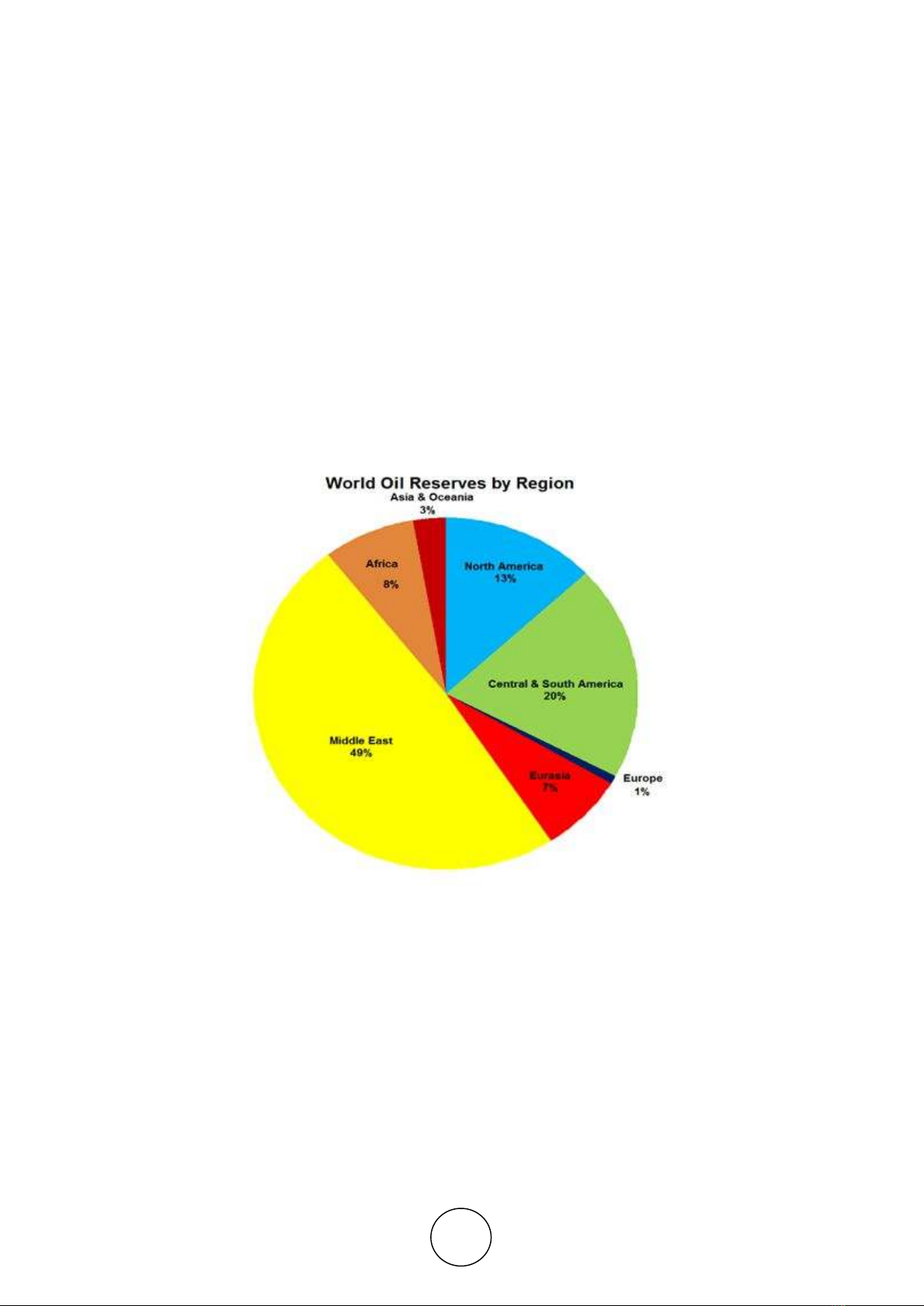
Figure 2 World Oil Revenues by Region
The UAE has been a ground of political stability and is one of the most reliable producers
and exporters of crude oil in the world. The oil and gas industry significantly impact on the
gross domestic product of the UAE. The production shale oil has been observed in the US and
other parts of the world but the UAE and the Middle East will maintain its position of being
the centre of the global oil supply. It is because of the expertise of UAE in offering low cost
of the productions in the region and its expansion to the Asian economies.
Among the oil and natural gas reserves of the world, the UAE stands world’s seventh
largest proved reserves which are estimated as 215 trillion cubic feet which make up 97.8
million barrels. This makes 3.5 percent of the proven gas reserves and 4 percent of the
world’s oil reserves. There is a huge investment programme in Abu Dhabi which amounts
more than 70 billion US dollars is continued as emirate’s Supreme Petroleum Council (SPC).

Regilal Gopalan and Prof. Dr. Rajesh Mehrotra
http://www.iaeme.com/IJM/index.asp 40 editor@iaeme.com
By 2017, the target of 3.5 million barrels per day would be achieved by the Abu Dhabi
National Oil Company (ADNOC).The largest estimated reserves of 50 billion barrels are
operated by ADNOC and ExxonMobil and Jadco in partnership. It has been planned that the
14 billion US$ will be invested for the increment of the production from the current
production of 585,000 bpd to 750,000 bpd. After that, the investment will be made to increase
the production to 1 million bpd by 2024. To meet the production target of 1.8 million bpd till
the end of 2017, the Abu Dhabi Company for Onshore Oil Operations (ADCO) has planned to
invest 5 billion US$ more. For the ADCO onshore fields, ADNOC and Total have signed a 40
years concession agreement. The future of the Abu Dhabi major onshore can be determined
by the SPC’s decisions on the ADCO concession. It will also set the path for the
reconstruction and the renewal of the offshore concession which is held by ADNOC’s Adma-
Opco operating subsidiary. Adma-Opco is, however, a joint venture signed between the
ADNOC, Total, BP, and Jadco. A number of new entrants are also exploring the new fields
for he oil and gas production like the Korean company KNOC. In 2012, the Abu Dhabi Crude
Oil Pipeline was inaugurated which has the capacity of 1.5 million bpd. It was expected that
this would be later expanded to 1.8 bpd. However, this is the first time that the crude is
exported from a terminal which is outside the gulf. The gas production of Abu Dhabi has
increased remarkably in recent years because of the major onshore and offshore projects.
2.3. Environmental Issues
A substantial challenge to the global oil and gas industry is faced because of the
environmental mitigation over the global warming. The industries are under pressure to find
the solutions for cutting down the carbon emissions. The UAE is currently progressing for the
solution by taking a number of initiatives. ADNOC is a partner of the UAE in a long-term
plan which is based on developing a storage network and carbon capture in the UAE. It is
based on the capturing of carbon dioxide emission from the industrial installations. It also
includes the piping of gas to oil fields for its use in projects for the enhancement of the oil
recovery. As a result, the carbon dioxide can be stored underground in the reservoirs. Carbon
capture, usage and storage (CCUS) is a joint venture by ADNOC and MASDAR whose focus
is on the exploration and the development of the commercial scale project for carbon capture.
For the first CCUS project of the joint venture, the carbon dioxide will be captured onsite at
the Emirates steel. It will then be compressed, following the transportation and injection into
the fields which are operated by ADNOC. 800,000 tonnes of carbon dioxide is expected to be
sequestered annually.
2.4. Downstream
IPIC and ADNOC’s oil refining company called as Takreer had been working for several
years in the downstream petroleum sector. In the existing refinery, Takreer has been able to
add 417,000 bpd of new processing capacity. It has been estimated that the chemical products
of worth 11 billion US$ chemical products which include the fertilisers and plastic. As a
result of the Shah project, Abu Dhabi will be among the leading regional exporter of Sulphur.
The sulphur would be transported by a major federal infrastructure railway project which is
under development. The sulphur holds its importance in the making of fertilisers, sulphuric
acid, and sulphur.
2.5. Dubai
Dubai Supreme Council of Energy is the body which holds the position of being the highest
planning authority and energy policy. It deals with the effective planning for the stability of
the energy sector of Dubai whose primary focus has been the sustainability of the energy. The
oil reserves of Dubai are 4 billion barrels which have dramatically fallen in the recent years.



![Báo cáo tác động xăng dầu quý I/2018 [Mới nhất]](https://cdn.tailieu.vn/images/document/thumbnail/2019/20191001/johnluong1998/135x160/8611569904340.jpg)


