
TM 5-815-1/AFR 19-6
13-2
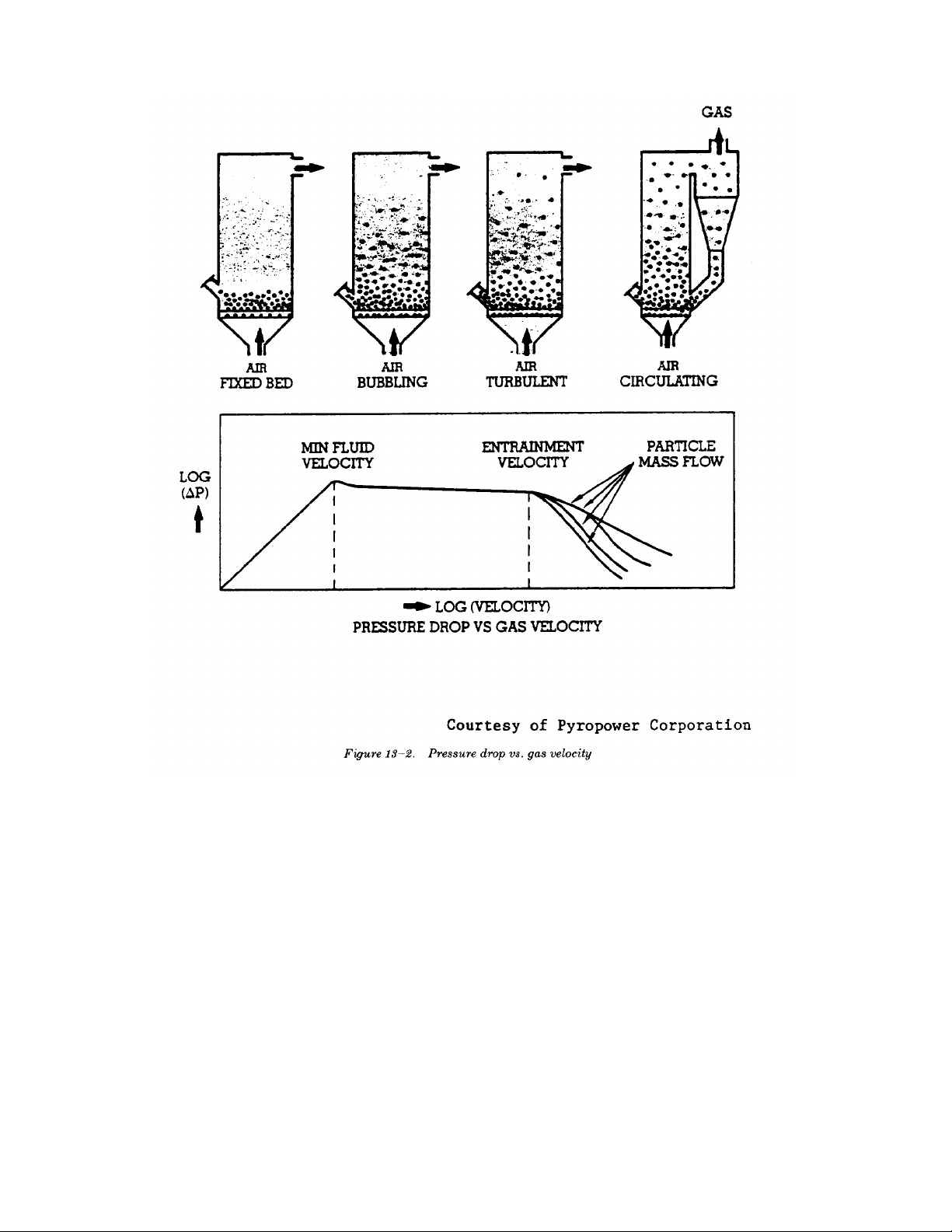
particles leave the combustion chamber with the flueDesulfurization efficiency of a shallow bed is poor,
gases so that solids recirculation is necessary to main- with only about 60 to 80 percent removal, because SO
does not have adequate time to react with the limestone
circulating fluidized bed. before moving out of the shallow bed. The shallow bed
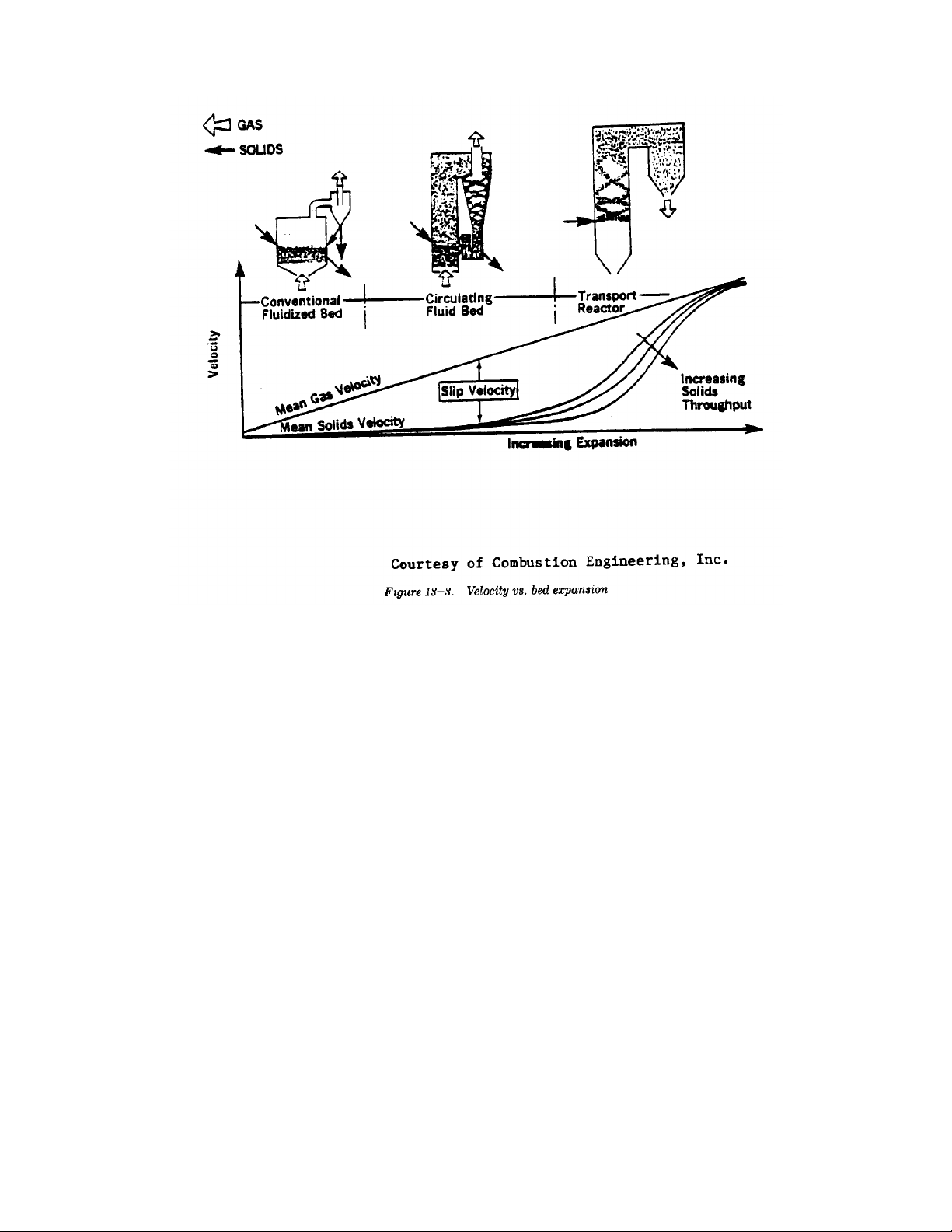
e. The mean solids velocity increases at a slower rate fluidized boiler is of the bubbling bed design. The shal-
than does the gas velocity, as illustrated in figure 13-3. low bed will be of very limited use because of its poor
Therefore, a maximum slip velocity between the solids sulfur dioxide removal.
and the gas can be achieved resulting in good heatg. A deep fluidized bed boiler is a bubbling bed
transfer and contact time with the limestone, for sulfur design.
dioxide removal. When gas velocity is further(1) The bed depth is usually 3 feet to 5 feet deep
increased, the mean slip velocity decreases again.and the pressure drop averages about one
These are the operating conditions for transport reactor inch of water per inch of bed depth. The bulk
or pulverized coal boiler. The design of the fluidizedof the bed consists of limestone, sand, ash, or
bed falls between the stoker fired boiler and the pul-other material and a small amount of fuel.
verized coal boiler using the bed expansion. The rate at which air is blown through the bed
f.The shallow fluidized bed boiler operates with a determines the amount of fuel that can be
single bed at a low gas velocity. A shallow bed mini-reacted. There are limits to the amount of air
mizes fan horsepower and limits the free-board space. that can be blown through before the bed
The bed depth is usually about 6 inches to 9 inches and material and fuel are entrained and blown out
the free-board heights are only four to five feet.
2
tain the bed solids. This type of fluidization is called
Simpo PDF Merge and Split Unregistered Version - http://www.simpopdf.com
TM 5-815-1/AFR 19-6
13-3
of the furnace. Conversely, when air flow iscontinuous stopping of sections is required to
reduced below the minimum fluidizingcontrol load for extended periods, the
velocity, the bed slumps and fluidizationfluidized bed boiler may become a big user of
stops. auxiliary fuel to maintain bed temperature.
(2) The fuel feed systems available are either(4) Major limitations of the bubbling bed design
under-bed feed system or over-the-bed feedare high calcium/sulfur ratios, low
system. The under-bed feed system is quitecombustion efficiency, limited turndown
complex. It requires coal at less than 8without sectionalization of the furnace bottom
percent surface moisture and crushed toand complexity of the under bed feed system
about 6 MM top size to minimize pluggingrequired to minimize elutriation of unburned
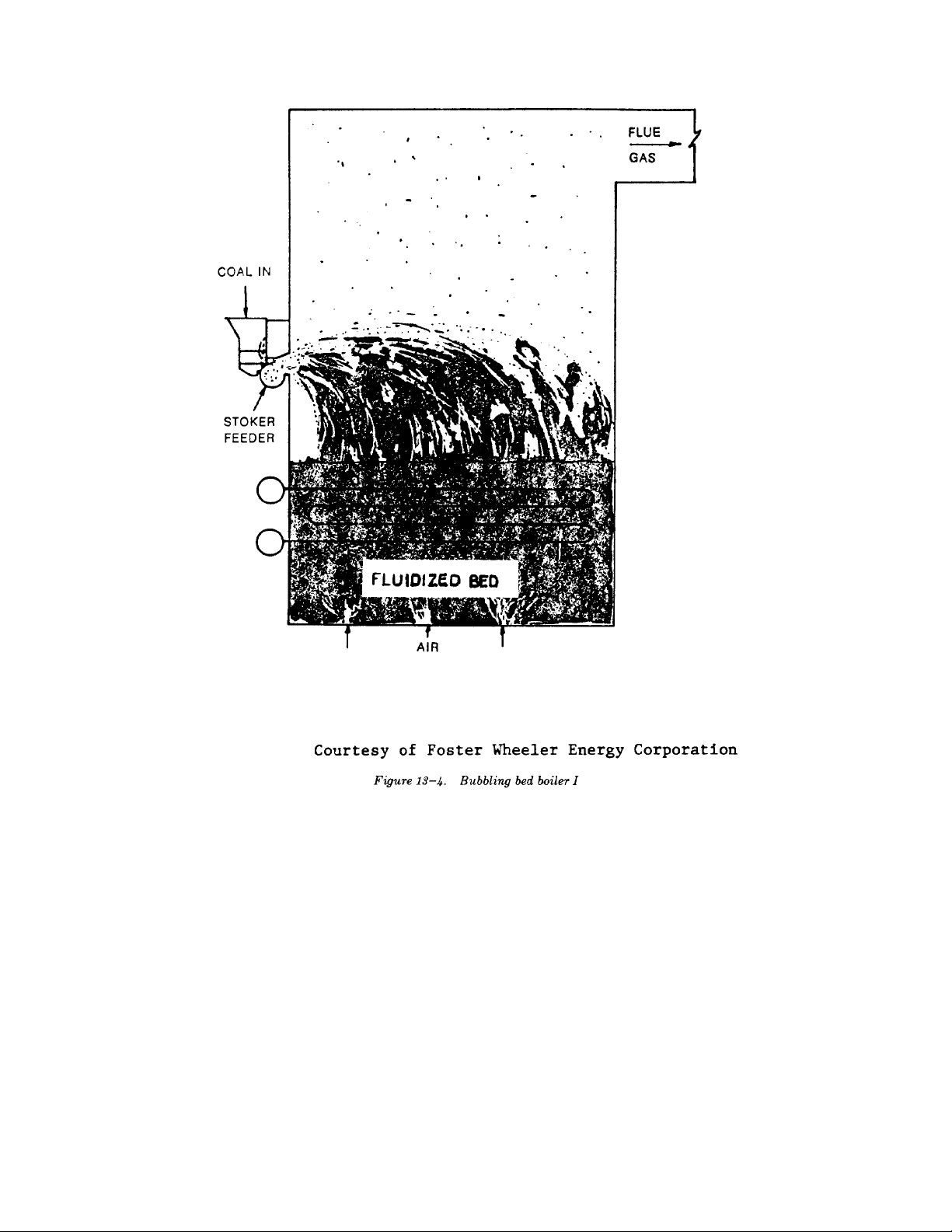
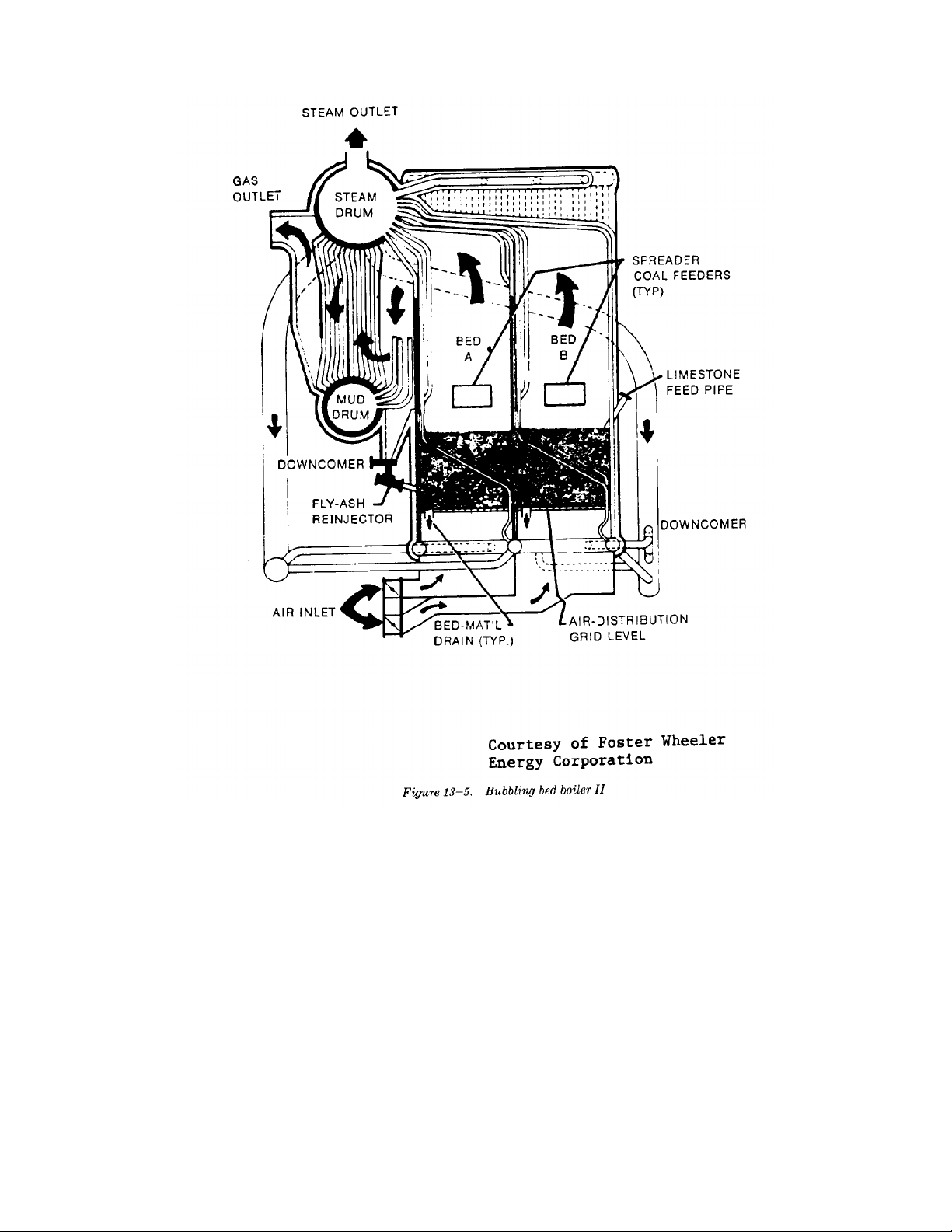
the coal pipes. Operating and maintenancefines. Typical fluidized bed combustors of
costs are usually high for the under-bed feed this type are shown in figures 13-4 and 13-5.
system. The major advantage of the under-h. In the circulating fluidized bed boiler, the fuel is
bed feed system is that with use of recyclefed into the lower combustion chamber and primary air
combustion efficiency approaches 99 percent. is introduced under the bed.
The over-bed feed system is an adaptation of (1) Because of the turbulence and velocity in the
the spreader stoker system for conventionalcirculating bed, the fuel mixes with the bed
boilers. This system has a potential problemmaterial quickly and uniformly. Since there is
of effective carbon utilization. Carbonnot a definite bed depth when operating, the
elutriation can be as high as 10 percent. density of the bed varies throughout the sys-
(3) Some bubbling bed units have sectionalizedtem, with the highest density at the level
or modular design for turndown or loadwhere the fuel is introduced. Secondary air is
response. This allows a section to be cut in or introduced at various levels to ensure solids
out as required. Some are actually dividedcirculation, provide stage combustion for NO
with water cooled or refractory walls. Thisreduction, and supply air for continuous fines
type unit should be matched to the facilitycombustion in the upper part of the combus-
demand pro-file to avoid continual bedtion chamber.
slumping and operator attention. When(2) Combustion takes place at about 1600
x
Simpo PDF Merge and Split Unregistered Version - http://www.simpopdf.com
TM 5-815-1/AFR 19-6
13-4
degrees Fahrenheit for maximum sulfurthroughout the process because of the
retention. The hot gases are separated fromhigh turbulence and circulation of solids.
the dust particles in a cyclone collector. TheThe low combustion temperature also
materials collected are returned to theresults in minimal NO formation.
combustion chamber through a(c) Sulfur present in the fuel is retained in the
nonmechanical seal, and ashes are removed at circulating solids in the form of calcium
the bottom. The hot gases from the cyclonesulphate soit is removed in solid form.
are discharged into the convection section of The use of limestone or dolomite
a boiler where most of the heat is absorbed to sorbents allows a higher sulfur retention
generate steam. Typical fluidized bed boilers rate, and limestone requirements have
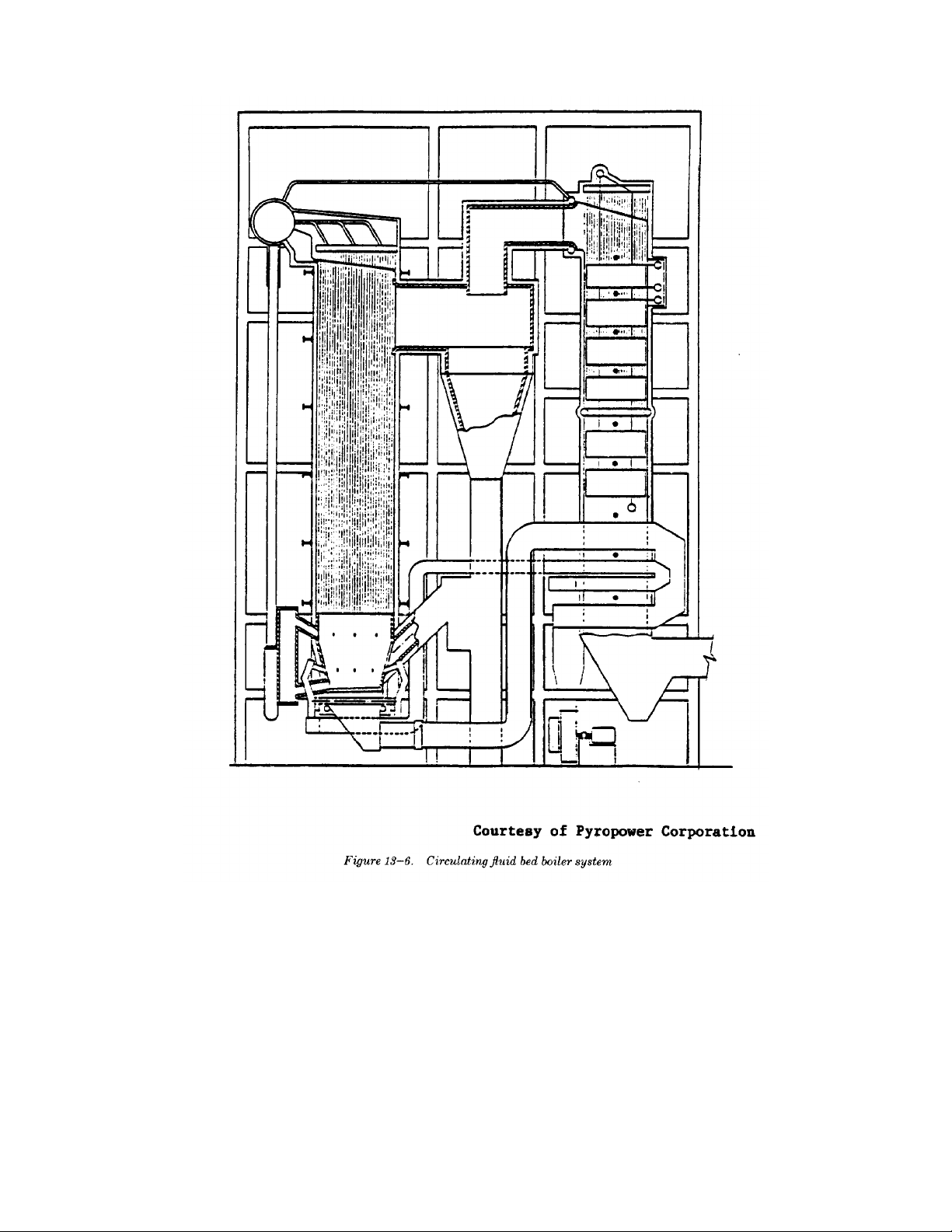
of this type are as shown in figure 13-6. been demonstrated to be substantially less
(3) Major performance features of the circulating than with bubbling bed combustor.
bed system are as follows: (d) The combustion air is supplied at 1.5 to 2
(a) It has a high processing capacity because psig rather than 3-5 psig as required by
of the high gas velocity through thebubbling bed combustors.
system. (e) It has a high combustion efficiency.
(b) The temperature of about 1600 degrees(f) It has a better turndown ratio than bub-
Fahrenheit is reasonably constantbling bed systems.
x
Simpo PDF Merge and Split Unregistered Version - http://www.simpopdf.com
TM 5-815-1/AFR 19-6
13-5
(g) Erosion of the heat transfer surface in the desulfurization takes place. The dual bed
combustion chamber is reduced, since the design allows coals to be burned at about
surface is parallel to the flow. In a1750 degrees Fahrenheit while
bubbling bed system, the surfacedesulfurization takes place at about 1550
generally is perpendicular to the flow. degrees Fahrenheit. The upper bed also
i.In the dual bed fluidized combustor, combustion serves to catch unburned coal particles that
and desulfurization take place in two separate beds,may have escaped to complete combustion of
allowing each different reaction to occur under optimal any unburned carbon.
conditions. (3) A dual bed can be utilized on capacities up to
(1) The lower bed burns coal in a bed of sand,200,000 pounds per hour of steam. The
fluidized from below by the combustion airmajor advantages are: shop fabrication; can
and gases, and maintained at a steadybe retrofitted to some existing oil and gas
equilibrium temperature by the extraction of fired boilers; enhanced combustion efficiency
energy through in-bed steam generator tubes. by allowing the lower bed to operate at 1750
The bed depth is more shallow than the con- degrees Fahrenheit; lower free-board heights
ventional bubbling bed design. required; and better load following. A typical
(2) The flue gas then travels through an upperdual bed fluidized combustor is shown in
bed of finely ground limestone wherefigure 13-7.
Simpo PDF Merge and Split Unregistered Version - http://www.simpopdf.com
TM 5-815-1/AFR 19-6
13-6
13-3. Applications (2) A complete evaluation of fuels to be burned
a. Fuel Application.
(1) A wide range of high grade and low grade
fuels of solid, liquid or gaseous type can be fired. The
primary applications are fuels with low heating value,
high sulfur, waste materials, usually the least
expensive. Fuel can be lignite, coal washing waste
(culm), high sulfur coal, delayed petroleum coke, or
waste material that would not burn satisfactorily in a
conventional boiler. The fluidized bed boiler has the
ability to burn most any residual fuel and reduce
emissions by removal of sulfur compounds in the
limestone bed.
should be given consideration in selection of
the equipment. Many factors including
heating value, moisture, ash fusion
temperature, sulfur content, and ash content
will affect the system configuration.
(3) Fuel sizing is important. For coal it is recom-
mended that it not be run-of-mine. It should
be crushed to avoid large rocks and pieces of
coal causing problems in the bed. Coal sizing
is important and will vary with each fluidized
bed manufacturer. Typically, sizing will vary
from 0 — ¼ inch x 0 for overfeed systems to
¼ inch x 0 for underfeed systems.
Simpo PDF Merge and Split Unregistered Version - http://www.simpopdf.com



![Đề cương tuabin lò hơi [mới nhất]](https://cdn.tailieu.vn/images/document/thumbnail/2015/20150723/vinadnh/135x160/1764936_356.jpg)




%20--%3e%3cdefs%3e%3cstyle%3e%20.st0%20{%20fill:%20%23fff;%20}%20.st1%20{%20fill:%20%237800fa;%20}%20%3c/style%3e%3c/defs%3e%3cpath%20class='st1'%20d='M117.78,12.18H43.11c2.9,3.47,4.65,7.94,4.65,12.82,0,5.6-2.3,10.66-6.01,14.29h76.02l7.22-13.56-7.22-13.56Z'/%3e%3cg%3e%3cpath%20class='st0'%20d='M53.58,26.17h-.59v-1.46h.59v-4.96h2.83c1.78,0,2.67.94,2.67,2.82v5.76c0,1.87-.89,2.81-2.67,2.81h-2.83v-4.96ZM55.36,21.37v3.34h1.1v1.46h-1.1v3.34h1.01c.61,0,.91-.37.91-1.1v-5.93c0-.74-.3-1.1-.91-1.1h-1.01Z'/%3e%3cpath%20class='st0'%20d='M65.99,31.14h-1.8l-.31-2.07h-2.19l-.31,2.07h-1.64l1.82-11.39h2.62l1.82,11.39ZM65.28,18.04c-.25.46-.51.77-.75.94-.21.15-.47.22-.79.22-.26,0-.57-.07-.92-.22l-.38-.15c-.14-.05-.26-.07-.37-.07-.3,0-.53.18-.71.54l-.91-.68c.25-.46.51-.77.75-.94.21-.14.48-.21.79-.21.26,0,.57.07.92.21l.38.15c.14.05.26.07.37.07.3,0,.53-.18.71-.54l.91.68ZM61.91,27.52h1.73l-.87-5.76-.87,5.76Z'/%3e%3cpath%20class='st0'%20d='M74.53,26.89v1.52c0,1.91-.89,2.86-2.67,2.86s-2.67-.95-2.67-2.86v-5.93c0-1.91.89-2.86,2.67-2.86s2.67.95,2.67,2.86v1.11h-1.69v-1.22c0-.75-.31-1.12-.93-1.12s-.93.37-.93,1.12v6.15c0,.74.31,1.11.93,1.11s.93-.37.93-1.11v-1.63h1.69Z'/%3e%3cpath%20class='st0'%20d='M81.4,31.14h-1.8l-.31-2.07h-2.19l-.31,2.07h-1.64l1.82-11.39h2.62l1.82,11.39ZM75.9,19.2l1.52-1.91h1.71l1.51,1.91h-1.61l-.76-.95-.75.95h-1.61ZM77.32,27.52h1.73l-.87-5.76-.87,5.76ZM83.1,15.99l-1.76,1.91h-1.26l1.17-1.91h1.86Z'/%3e%3cpath%20class='st0'%20d='M84.86,19.75c1.78,0,2.67.94,2.67,2.82v1.48c0,1.87-.89,2.81-2.67,2.81h-.85v4.28h-1.79v-11.39h2.64ZM84.01,21.37v3.86h.85c.58,0,.87-.36.87-1.08v-1.71c0-.71-.29-1.07-.87-1.07h-.85Z'/%3e%3cpath%20class='st0'%20d='M93.51,19.75c1.78,0,2.67.94,2.67,2.82v1.48c0,1.87-.89,2.81-2.67,2.81h-.85v4.28h-1.79v-11.39h2.64ZM92.66,21.37v3.86h.85c.58,0,.87-.36.87-1.08v-1.71c0-.71-.29-1.07-.87-1.07h-.85Z'/%3e%3cpath%20class='st0'%20d='M98.8,31.14h-1.79v-11.39h1.79v4.88h2.03v-4.88h1.83v11.39h-1.83v-4.88h-2.03v4.88Z'/%3e%3cpath%20class='st0'%20d='M105.36,24.55h2.46v1.62h-2.46v3.34h3.09v1.63h-4.88v-11.39h4.88v1.63h-3.09v3.18ZM108.17,17.29l-1.76,1.91h-1.26l1.17-1.91h1.86Z'/%3e%3cpath%20class='st0'%20d='M112.2,19.75c1.78,0,2.67.94,2.67,2.82v1.48c0,1.87-.89,2.81-2.67,2.81h-.85v4.28h-1.79v-11.39h2.64ZM111.35,21.37v3.86h.85c.58,0,.87-.36.87-1.08v-1.71c0-.71-.29-1.07-.87-1.07h-.85Z'/%3e%3c/g%3e%3ccircle%20class='st1'%20cx='25'%20cy='25'%20r='20'/%3e%3cpath%20class='st0'%20d='M32.78,19.27c2.92,0,4.43,2.55,5.28,5.33l.71,2.17c.14.38-.33.75-.71.75h-5.61c.19-.33.24-.71.09-1.08l-.75-2.45c-.43-1.32-.99-2.64-1.79-3.77.75-.57,1.65-.94,2.78-.94h0ZM25,18.38c3.25,0,4.9,2.78,5.89,5.89l.76,2.45c.14.42-.33.8-.8.8h-11.69c-.42,0-.94-.38-.8-.8l.75-2.45c.99-3.11,2.64-5.89,5.89-5.89h0ZM25,11.35c1.74,0,3.11,1.37,3.11,3.11s-1.37,3.11-3.11,3.11-3.11-1.41-3.11-3.11,1.41-3.11,3.11-3.11h0ZM17.27,19.27c1.08,0,1.98.38,2.73.94-.8,1.13-1.37,2.45-1.74,3.77l-.8,2.45c-.14.38-.05.75.09,1.08h-5.56c-.42,0-.9-.38-.75-.75l.71-2.17c.9-2.78,2.41-5.33,5.33-5.33h0ZM17.27,12.91c1.51,0,2.78,1.27,2.78,2.83s-1.27,2.83-2.78,2.83-2.83-1.27-2.83-2.83,1.27-2.83,2.83-2.83h0ZM32.78,12.91c1.56,0,2.78,1.27,2.78,2.83s-1.23,2.83-2.78,2.83-2.83-1.27-2.83-2.83,1.27-2.83,2.83-2.83h0ZM27.07,28.56v.09c0,.57-.24,1.08-.61,1.46h0v.05c-.38.33-.9.57-1.46.57s-1.08-.24-1.46-.61h0c-.38-.38-.61-.9-.61-1.46v-.09h1.41v.09c0,.19.05.38.19.47v.05c.09.09.28.19.47.19s.38-.09.47-.19v-.05c.14-.09.24-.28.24-.47t-.05-.09h1.41ZM30.99,28.56v.09c0,1.65-.66,3.16-1.74,4.24-1.08,1.08-2.59,1.79-4.24,1.79s-3.16-.71-4.24-1.79l-.05-.05c-1.04-1.08-1.7-2.55-1.7-4.2v-.09h1.41v.09c0,1.27.47,2.4,1.27,3.25h.05c.85.85,1.98,1.37,3.25,1.37s2.4-.52,3.25-1.37c.85-.8,1.37-1.98,1.37-3.25v-.09h1.37ZM34.99,28.56v.09c0,2.78-1.13,5.28-2.92,7.07-1.79,1.79-4.29,2.92-7.07,2.92s-5.23-1.13-7.07-2.92c-1.79-1.79-2.92-4.29-2.92-7.07v-.09h1.41v.09c0,2.4.94,4.53,2.5,6.08,1.56,1.56,3.72,2.5,6.08,2.5s4.52-.94,6.08-2.5c1.56-1.56,2.5-3.68,2.5-6.08v-.09h1.41Z'/%3e%3c/svg%3e)