

Implementation
Science
Trafton et al. Implementation Science 2010, 5:26
http://www.implementationscience.com/content/5/1/26
Open Access
RESEARCH ARTICLE
BioMed Central
© 2010 Trafton et al; licensee BioMed Central Ltd. This is an Open Access article distributed under the terms of the Creative Commons
Attribution License (http://creativecommons.org/licenses/by/2.0), which permits unrestricted use, distribution, and reproduction in
any medium, provided the original work is properly cited.
Research article
Designing an automated clinical decision support
system to match clinical practice guidelines for
opioid therapy for chronic pain
Jodie A Trafton*
†1
, Susana B Martins
†1,2
, Martha C Michel
†1
, Dan Wang
1
, Samson W Tu
3
, David J Clark
4
, Jan Elliott
4
,
Brigit Vucic
1
, Steve Balt
1
, Michael E Clark
5
, Charles D Sintek
6,7
, Jack Rosenberg
8
, Denise Daniels
8
and
Mary K Goldstein
2,1,9
Abstract
Background: Opioid prescribing for chronic pain is common and controversial, but recommended clinical practices
are followed inconsistently in many clinical settings. Strategies for increasing adherence to clinical practice guideline
recommendations are needed to increase effectiveness and reduce negative consequences of opioid prescribing in
chronic pain patients.
Methods: Here we describe the process and outcomes of a project to operationalize the 2003 VA/DOD Clinical Practice
Guideline for Opioid Therapy for Chronic Non-Cancer Pain into a computerized decision support system (DSS) to
encourage good opioid prescribing practices during primary care visits. We based the DSS on the existing ATHENA-
DSS. We used an iterative process of design, testing, and revision of the DSS by a diverse team including guideline
authors, medical informatics experts, clinical content experts, and end-users to convert the written clinical practice
guideline into a computable algorithm to generate patient-specific recommendations for care based upon existing
information in the electronic medical record (EMR), and a set of clinical tools.
Results: The iterative revision process identified numerous and varied problems with the initially designed system
despite diverse expert participation in the design process. The process of operationalizing the guideline identified
areas in which the guideline was vague, left decisions to clinical judgment, or required clarification of detail to insure
safe clinical implementation. The revisions led to workable solutions to problems, defined the limits of the DSS and its
utility in clinical practice, improved integration into clinical workflow, and improved the clarity and accuracy of system
recommendations and tools.
Conclusions: Use of this iterative process led to development of a multifunctional DSS that met the approval of the
clinical practice guideline authors, content experts, and clinicians involved in testing. The process and experiences
described provide a model for development of other DSSs that translate written guidelines into actionable, real-time
clinical recommendations.
Background
Promoting use of good care practices is necessary for safe
and effective use of opioid therapy for chronic non-can-
cer pain, but achieving provider adherence to clinical
practice guideline (CPG) recommended care practices
has proven difficult in most primary health care settings
[1-3]. Increased attention to the importance of pain man-
agement has led to increased prescribing of analgesic
medications [4]. Opioid analgesics are among the most
prescribed medications in the US today [5,6] and, as of
2008, hydrocodone was the top prescribed medication in
the country [4]. However, increased use of these powerful
and potentially addictive medications has had negative
consequences. Rates of opioid overdose, prescription opi-
oid misuse and addiction, diversion of prescribed medi-
* Correspondence: jodie.trafton@va.gov
1 Center for Health Care Evaluation (CHCE), VA Palo Alto Health Care System
and Stanford University Medical School, 795 Willow Road (152-MPD), Menlo
Park, CA 94025, USA
† Contributed equally
Full list of author information is available at the end of the article

Trafton et al. Implementation Science 2010, 5:26
http://www.implementationscience.com/content/5/1/26
Page 2 of 11
cations toward illicit use, and opioid-related legal suits
against physicians have all increased to a disturbing
extent [4,5]. Use of recommended care practices is con-
sidered essential for minimizing these negative conse-
quences without reversing gains made in improving pain
management in clinical settings.
In 2003, the Veterans Administration (VA)/Department
of Defense (DOD) published a CPG for use of opioid
therapy for the treatment of chronic non-cancer pain [7].
The goals included using evidence-based recommenda-
tions to improve analgesia, promote uniformity of care,
and decrease related morbidity of patients with non-can-
cer chronic pain in the primary care setting. This guide-
line provides detailed information about appropriate
dosing, including protocols for initiation, titration, and
cessation of the most commonly used opioid medica-
tions. It provides information on potential contraindica-
tions for opioid therapy for chronic pain and suggestions
for opioid management in patients at higher risk of mis-
use, diversion, adverse effects, overdose, and/or lack of
efficacy. A substantial portion of the guideline focuses on
processes of care. For example, the guideline encourages
clinicians to: regularly conduct assessments of pain and
functioning; use urine drug screening protocols to dis-
courage and detect medication misuse and diversion;
obtain written agreement on the parameters and respon-
sibilities of the patient regarding the opioid prescription;
provide clear education on both the risks and realistic
level of benefit from opioid analgesics; and carefully doc-
ument and follow treatment plans. This framework can
increase clinician's confidence in appropriately prescrib-
ing opioid therapy.
Despite expert consensus on the importance of adher-
ence to these care guidelines, there is little evidence that
they are consistently followed in actual clinical practice
[8]. Numerous barriers to providing guideline-adherent
care exist [9]. Clinicians report lack of training in both
pain management and addiction medicine and are
uncomfortable assessing and treating these conditions.
Moreover, patient-provider communication about opi-
oids is complicated by: the subjective nature of pain expe-
rience, which prevents physicians from objectively
verifying the severity of the pain condition; the reinforc-
ing effects of opioid drugs, which may lead to either
deliberate or unknowing attempts by the patient to obtain
opioid medications; provider and patient fears about the
consequences of either prescribing a potentially addictive
medication or under-managing pain; and stigma associ-
ated with substance use disorders [10-12]. Because of
these communication difficulties, providers may be hesi-
tant to prescribe opioid medications initially, to discon-
tinue medication when there is no clear sign of benefit,
and to address the addictive nature of opioid analgesics
and the possibility of misuse. In all cases, these behaviors
lead to suboptimal care. Additionally, poor care coordina-
tion within the health care system contributes to poor
opioid management [13]. Lack of clear documentation of
pain management plans and opioid use agreements and
lack of communication between providers can lead to
inconsistent treatment and poor prescribing decisions
that contribute to misuse and poor pain management.
Lastly, good care practices take time, and time limitations
and competing demands during outpatient visits in pri-
mary care may limit clinician adherence to guidelines.
Developing health services interventions that address
these barriers is essential for improving opioid manage-
ment in chronic pain. A computerized decision support
system (DSS) may provide such an intervention [14,15],
and some DSSs have been shown to increase adherence
to guideline recommended care [16]. Hunt and colleagues
systematically reviewed randomized controlled trials of
DSSs, defined as 'any electronic or non-electronic system
designed to aid directly in clinical decision making, in
which characteristics of individual patients are used to
generate patient-specific assessments or recommenda-
tions that are then presented to clinicians for consider-
ation' [17]. Kawamoto and colleagues identified features
that were independently associated with improved clini-
cal practice in a multiple regression analysis. These
included: automatic delivery, presentation of the DSS
when and where clinical decision making occurs, provi-
sion of concrete recommendations of how to proceed,
and computer-based generation of decision support [18].
A model computerized DSS (ATHENA-DSS) that links
with the electronic medical record (EMR) system used by
the VA Health Care System (VistA) was designed to pro-
vide these key features [19-22]. ATHENA-DSS, devel-
oped using the EON guideline decision-support
technology [23,24], accesses patient information in the
EMR, evaluates this information in terms of a knowledge
base consisting of encoded CPG recommendations, gen-
erates patient-specific recommendations, and presents a
graphical user interface with these recommendations
along with tools and information support to clinicians
when they open the EMR of a relevant patient at the time
of the clinic visit.
We used an iterative development process involving
authors of the CPG, local content experts, end-users (i.e.,
opioid prescribers), knowledge modelers, graphic design-
ers, and systems software engineers to modify the initial
ATHENA-DSS, ATHENA-Hypertension (HTN), to guide
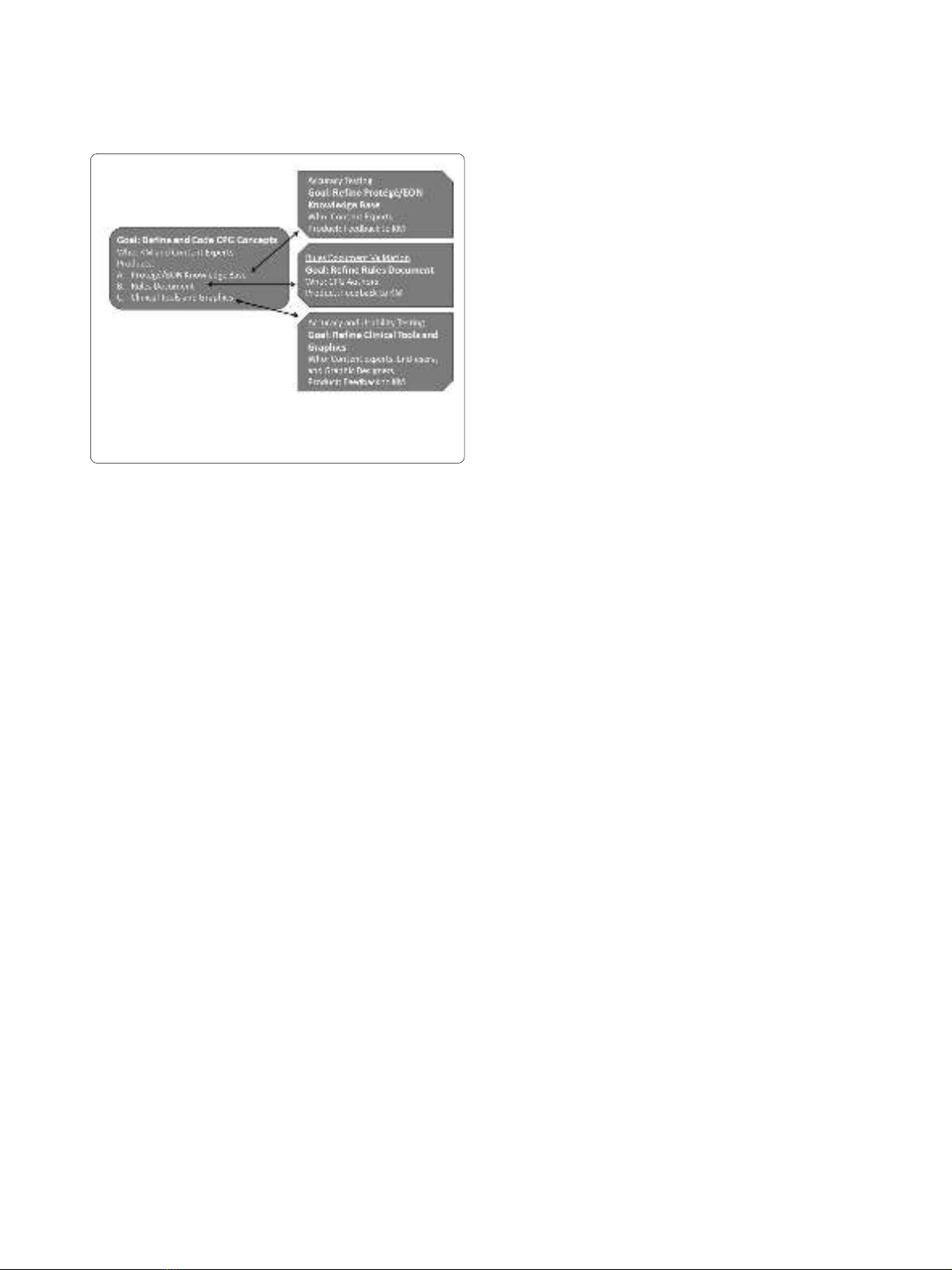
evidence-based opioid prescribing (Figure 1). We named
this newly developed system ATHENA-Opioid Therapy
(ATHENA-OT) [25]. Here, we describe the process and
outcome of this iterative development via which we oper-
ationalized CPG information into a computer-interpreta-
ble knowledge base to provide patient-specific
recommendations for care, and clinical tools to encour-
Trafton et al. Implementation Science 2010, 5:26
http://www.implementationscience.com/content/5/1/26
Page 3 of 11
age good care practices in opioid prescribing. Iterative
usability testing was also a crucial component of ATH-
ENA-OT development, but these processes will be
described elsewhere [26]. A valuable part of our process
is collaboration of the DSS developers directly with the
CPG authors. The process described provides a model for
translating guidelines into DSSs, including methods to
ensure that the DSS retains the intent of the CPG authors
and encourages use of good care practices through inclu-
sion of patient-specific recommendations and clinical
tools.
Methods
The patient safety features and a thorough description of
the ATHENA-OT graphical user interface have been
described previously [25]. This study was approved and
overseen by the Stanford University Human Research
Protection Program and the VA Palo Alto Health Care
System Research and Development Committee.
In the process described, the team started with the
CPG and translated it into three primary products: an
operationalized algorithm in Protégé/EON, a matching
written Rules Document, plus a set of clinical tools (Fig-
ure 1). We based our guideline translation process on
experience gained in development of ATHENA-Hyper-
tension as well as general principles from medical infor-
matics literature encouraging iterative design based on
interim evaluation and testing (for example, the ADDIE
(Analysis, Design, Development, Implementation and
Evaluation) process [27]. The accuracy testing procedures
for both the Protégé/EON algorithm and the clinical tools
were adapted from those initially designed and success-
fully used by the ATHENA-Hypertension development
team [28]. The Rules Document validation process was
designed for ATHENA-OT and has not been previously
described, and thus we report this process and findings in
greater detail.
A knowledge management team (KM) consisting of the
study managers, knowledge modelers (SBM and MM,
medical informaticists with expertise in translation of
clinical knowledge into encoded computer-interpretable
formats using a knowledge acquisition program called
Protégé [29]), and system software experts drafted,
revised, and managed the review of these 3 products.
Each of these three products were reviewed and revised
through separate procedures and distinct, but overlap-
ping teams. Revisions to the Protégé/EON algorithm and
the Rules Document were made in tandem to maintain
consistency, based on feedback from the accuracy and
rules validation testing. These processes occurred itera-
tively during ATHENA-OT development. Each of the
processes, as well as major revisions, are described below.
Drafting a Rules Document and operationalized algorithm
in Protégé/EON
To create an encoded guideline, one must specify details
that are not explicitly included in the CPG [30]. For
example, the CPG for opioid therapy states: 'long-acting
agents are effective for continuous, chronic pain'. This
statement fails to specify which medications should be
considered 'long-acting agents' and the definition of con-
tinuous, chronic pain. In order for the computer to be
able to use this information, the definitions of 'long-act-
ing agents' and 'continuous, chronic pain' must be explic-
itly defined or operationalized.
To operationalize the 2003 VA/DOD 'Clinical Practice
Guideline for Opioid Therapy for Chronic Non-Cancer
Pain', the KM, the medical director, and clinical nurse
specialist who direct the VA Palo Alto Health Care Sys-
tem Pain Management Clinic worked collaboratively to
create a draft of the guideline knowledge to be encoded in
Protégé and specify concepts that were not clearly
defined. The process involved the KM reviewing the CPG
and attempting to translate the contained recommenda-
tions into well-defined concepts that could be encoded in
terms of a computer-interpretable model of CPGs [23].
The KM referred questions to clinical experts to itera-
tively refine the encoded guideline. In addition to encod-
ing the knowledge in Protégé/EON, a 'Rules Document'
was created that provided a written description in simple
but highly-specified English of the included concepts and
rules that the developers intended to encode. The Rules
Document serves as a format for review by clinicians and
CPG authors [28].
Review processes
Accuracy testing of the Protégé/EON algorithm
Experts in opioid therapy for chronic pain, including the
clinical nurse specialist at the VA Palo Alto Pain Manage-
ment Clinic, a Ph.D. researcher specializing in opioid
pharmacology and behavior, a primary-care physician,
Figure 1 Model of CPG translation and revision. This figure de-
scribes the products, review processes and reviewers for the three
main products of the ATHENA-OT CPG translation project.

Trafton et al. Implementation Science 2010, 5:26
http://www.implementationscience.com/content/5/1/26
Page 4 of 11
and a psychiatrist, pilot tested the encoded guideline iter-
atively during the development and refinement of the
operationalized algorithm. Accuracy testing involved
examination of ATHENA-OT recommendations for real
patient cases with recent primary care visits selected
from the VA Palo Alto's EMR. ATHENA-OT generated
definitions and recommendations that were compared to
information in the EMR and to expert assessment of the
patient case in the EMR using the CPG recommenda-
tions. Straightforward errors in the generated recommen-
dations were noted and sent to the KM for immediate
correction (e.g., miscoding of a diagnosis or minor word-
ing changes). Concerns involving clinical recommenda-
tions were first discussed by the expert reviewers, and
final suggestions for changes to the encoded guideline
were sent to the KM. When suggestions were outside the
boundaries of the DSS, the KM met again with the expert
reviewers to discuss options and insure that the boundar-
ies were made clear to clinical users to avoid false expec-
tations on the part of the user about the system's
capabilities.
Validation of the draft Rules Document by authors of the CPG
Once the encoded guideline had been pilot tested for
accuracy and the Rules Document updated to match the
current content of the encoded guideline, the Rules Doc-
ument was sent to three authors of the 2003 VA/DOD
Opioid Therapy for Chronic Non-Cancer Pain CPG (MC,
JR, CS). For each clinical rule, the authors were asked to
consider the CPG and indicate first whether the clinical
rule agreed with the intent of the CPG as written or was
incorrect based upon the intent of the CPG. Second, they
were asked to comment when the Rules Document was
not clear and further clarification of intent of the encoded
guideline was required. The guideline-authors' comments
included details regarding clinical rules with which they
disagreed or that they thought needed refinement. This
feedback was used to revise the Rules Document and Pro-
tégé/EON algorithm to address the guideline authors'
concerns.
Clinical tool design
The CPG contained many recommendations to support
good clinical care practices that were best shared with
primary care clinicians through easily accessible tools
(links within the DSS). In discussion with VA Palo Alto
clinicians in the Pain Management and Primary Care
Clinics, the KM developed information sheets and other
clinical tools within ATHENA-OT to facilitate adherence
to the CPG recommendations. These tools were vetted
and, where appropriate, pilot tested for accuracy by the
clinical staff at the pain management clinic and opioid
experts on the project team.
User interface design
A final step in translating the CPG into ATHENA-OT
was determining how to present patient-specific recom-
mendations and clinical tools to the clinicians most effec-
tively. Accordingly, in consultation with a graphic design
firm, we used an iterative design and evaluation process
to optimize the graphical user interface. This process is
described elsewhere [26]. While it is difficult to com-
pletely dissociate the development of the user interface
from the process of translating the guideline, here we
focus only on development of clinical tools and patient-
specific recommendations suggested in the CPG.
Revision of the Rules Document and Protégé/EON algorithm
Based upon feedback from the review processes, a sub-
stantial redesign of the algorithm was conducted. Follow-
ing system redesign, in depth re-testing of the accuracy
the Protégé/EON algorithm was conducted, and the
revised Rules Document was again sent out to the three
CPG authors for a second round of validation. The CPG
authors indicated additional areas of disagreement or
requirements for clarification. In this round, the exact
wording of DSS recommendations was provided for
review. Final consensus on the Rules Document was
obtained by conducting follow-up phone calls and emails
with the CPG authors where remaining changes were
planned, specified, and approved.
Results
Drafting of a Rules Document and operational algorithm in
Protégé/EON
The KM and clinical experts met approximately 30 times
over the course of nine months, and had extensive email
communication. The encoded guideline in Protégé/EON
included: operationalized definitions of all the concepts
included in the guideline (e.g., the ICD-9 codes corre-
sponding to a named diagnosis, or the pharmacy codes
for medications of a specified class); an algorithm that
operationalized guideline recommendations in terms of
the relevant patient scenarios, management decisions,
and alternative actions; a collection of situations that
warrant warning messages; and declarative specification
of the indications, contraindications, and dose ranges of
classes of opioids.
Because it is not possible to encode all medical knowl-
edge, clinical DSSs must attend to specifying boundaries
and planning system performance at the boundaries
[31,32]. Some of the guideline knowledge relies on clini-
cal concepts that are difficult to operationalize and/or call
for data not available in computable formats from the
patients' EMR. We set these as boundaries of ATHENA-
OT and specified plans for system behavior at the bound-
ary (see Table 1 for examples).
Round one review
Accuracy testing of the Protégé/EON algorithm
Accuracy testing of the Protégé/EON algorithm identi-
fied numerous errors in CPG coding that were subse-

Trafton et al. Implementation Science 2010, 5:26
http://www.implementationscience.com/content/5/1/26
Page 5 of 11
quently corrected. Commonly identified technical errors
included omissions of important medical record data in
the ATHENA-OT data extract and miscoding of concepts
such that recommendations were not produced as
planned. Less commonly, clinical cases that had not been
anticipated previously by the KM and clinical experts
were identified that required refinement of recommenda-
tions to align with the assumed intent of the CPG.
In round one assessment the CPG authors agreed with
many but not all the clinical rules specified in the Rules
Document (table 2). However, they also identified some
broad conceptual problems with the design of the DSS.
CPG authors often objected to strict recommendations
based on patient diagnoses. For example, the initial DSS
eligibility criteria excluded all patients with a cancer diag-
nosis because the guideline indicated that the recommen-
dations for opioid therapy were specifically for non-
cancer pain. CPG authors highlighted their disagreement
with this decision because it would prevent the system
from providing recommendations to those patients with
non-cancer-related chronic pain who also happened to
have cancer. There was also some disagreement among
CPG authors about the broad issue of whether ATHENA-
OT should provide firm discontinuation recommenda-
tions based on the presence of substance abuse and psy-
chiatric diagnosis. Moreover, comments from CPG
authors made it clear that accurate decisions about
whether medication should be increased, decreased, or
discontinued could not be made using only information
available in the EMR. These comments helped clarify sit-
uations where clinicians might appropriately either
ignore or decide against guideline recommended actions
based on information not in the EMR, allowing alteration
of the DSS to encourage less rigid use of recommenda-
tions in these circumstances.
Thus, CPG authors' comments in round one Rules
Document assessment suggested problems with an over-
all decision support strategy of providing clinicians with a
single actionable recommendation for opioid prescribing
(e.g., 'increase dose of medication [X] by [Y] mg'). Guide-
line author comments made it clear that clinician judg-
ment, patient preferences, and information not available
in the EMR were crucial to providing CPG-adherent opi-
oid therapy, and that a decision support strategy provid-
ing greater clinical flexibility would be more appropriate.
Revision of the Rules Document and Protégé/EON algorithm
A substantial redesign was conducted. This redesign
addressed several concerns that had not previously been
solved because of lack of consensus or detail in the CPG
or lack of information in the EMR. Instead of displaying
our best 'guess' about the recommended course for opioid
prescribing, we decided to display all possible therapeutic
options for the provider to select from based on clinical
judgment. Specifically, we switched from presenting cli-
nicians with detailed procedural or dosing recommenda-
tions for the system's one best guess regarding the
appropriate strategy for dosing change (i.e., start medica-
tion, increase dose, decrease dose, switch to a different
medication, or stop medication) to providing detailed
procedural or dosing recommendations for all possible
options with presentation of indications and contraindi-
cations for each choice. This modification emphasized
the fact that clinical decisions about overall strategy for
opioid therapy require assessment of physical and social
functioning and the patients' goals and preferences for
treatment as well as clinical judgement. Thus, this clinical
Table 1: Examples of Boundaries of ATHENA-Opioid
Therapy
Issue Solution
Lack of expert consensus on
specific criteria for judging an
opioid trial as failed and thus
appropriate to discontinue.
The determination of
whether to discontinue an
opioid medication was left to
clinical judgment and always
presented as an option.
Detailed instructions on how
but not when to discontinue
the opioid medication were
provided.
CPG was written to guide
prescribing for non-cancer
pain. Some patients have
cancer plus pain from non-
cancer-related causes,
making it unclear whether
the CPG was appropriate to
apply.
ATHENA-OT issued a warning
when the patient had cancer
and indicated that system
recommendations may not
be appropriate if the
patient's pain was caused by
the cancer.
Determination of the severity
of illness requires clinical
assessment during the
current visit.
ATHENA-OT issued a warning
about potentially concerning
diagnoses and
recommended that the
clinician assess the patient's
current status to clarify if
opioid dose adjustments
were necessary.
In the electronic medical
record (VistA), allergies are
not distinguished from
adverse events.
As a conservative measure,
any record of an allergy/
adverse event was
considered an allergy, and
recommendations were
generated based on this
assumption. This definition
was clarified in clinician
training sessions.
The table above provides examples of portions of the guideline
that were not encoded. For each example, we describe how this
boundary of the DSS was indicated in ATHENA-OT.


![Báo cáo seminar chuyên ngành Công nghệ hóa học và thực phẩm [Mới nhất]](https://cdn.tailieu.vn/images/document/thumbnail/2025/20250711/hienkelvinzoi@gmail.com/135x160/47051752458701.jpg)




%20--%3e%3cdefs%3e%3cstyle%3e%20.st0%20{%20fill:%20%23fff;%20}%20.st1%20{%20fill:%20%237800fa;%20}%20%3c/style%3e%3c/defs%3e%3cpath%20class='st1'%20d='M117.78,12.18H43.11c2.9,3.47,4.65,7.94,4.65,12.82,0,5.6-2.3,10.66-6.01,14.29h76.02l7.22-13.56-7.22-13.56Z'/%3e%3cg%3e%3cpath%20class='st0'%20d='M53.58,26.17h-.59v-1.46h.59v-4.96h2.83c1.78,0,2.67.94,2.67,2.82v5.76c0,1.87-.89,2.81-2.67,2.81h-2.83v-4.96ZM55.36,21.37v3.34h1.1v1.46h-1.1v3.34h1.01c.61,0,.91-.37.91-1.1v-5.93c0-.74-.3-1.1-.91-1.1h-1.01Z'/%3e%3cpath%20class='st0'%20d='M65.99,31.14h-1.8l-.31-2.07h-2.19l-.31,2.07h-1.64l1.82-11.39h2.62l1.82,11.39ZM65.28,18.04c-.25.46-.51.77-.75.94-.21.15-.47.22-.79.22-.26,0-.57-.07-.92-.22l-.38-.15c-.14-.05-.26-.07-.37-.07-.3,0-.53.18-.71.54l-.91-.68c.25-.46.51-.77.75-.94.21-.14.48-.21.79-.21.26,0,.57.07.92.21l.38.15c.14.05.26.07.37.07.3,0,.53-.18.71-.54l.91.68ZM61.91,27.52h1.73l-.87-5.76-.87,5.76Z'/%3e%3cpath%20class='st0'%20d='M74.53,26.89v1.52c0,1.91-.89,2.86-2.67,2.86s-2.67-.95-2.67-2.86v-5.93c0-1.91.89-2.86,2.67-2.86s2.67.95,2.67,2.86v1.11h-1.69v-1.22c0-.75-.31-1.12-.93-1.12s-.93.37-.93,1.12v6.15c0,.74.31,1.11.93,1.11s.93-.37.93-1.11v-1.63h1.69Z'/%3e%3cpath%20class='st0'%20d='M81.4,31.14h-1.8l-.31-2.07h-2.19l-.31,2.07h-1.64l1.82-11.39h2.62l1.82,11.39ZM75.9,19.2l1.52-1.91h1.71l1.51,1.91h-1.61l-.76-.95-.75.95h-1.61ZM77.32,27.52h1.73l-.87-5.76-.87,5.76ZM83.1,15.99l-1.76,1.91h-1.26l1.17-1.91h1.86Z'/%3e%3cpath%20class='st0'%20d='M84.86,19.75c1.78,0,2.67.94,2.67,2.82v1.48c0,1.87-.89,2.81-2.67,2.81h-.85v4.28h-1.79v-11.39h2.64ZM84.01,21.37v3.86h.85c.58,0,.87-.36.87-1.08v-1.71c0-.71-.29-1.07-.87-1.07h-.85Z'/%3e%3cpath%20class='st0'%20d='M93.51,19.75c1.78,0,2.67.94,2.67,2.82v1.48c0,1.87-.89,2.81-2.67,2.81h-.85v4.28h-1.79v-11.39h2.64ZM92.66,21.37v3.86h.85c.58,0,.87-.36.87-1.08v-1.71c0-.71-.29-1.07-.87-1.07h-.85Z'/%3e%3cpath%20class='st0'%20d='M98.8,31.14h-1.79v-11.39h1.79v4.88h2.03v-4.88h1.83v11.39h-1.83v-4.88h-2.03v4.88Z'/%3e%3cpath%20class='st0'%20d='M105.36,24.55h2.46v1.62h-2.46v3.34h3.09v1.63h-4.88v-11.39h4.88v1.63h-3.09v3.18ZM108.17,17.29l-1.76,1.91h-1.26l1.17-1.91h1.86Z'/%3e%3cpath%20class='st0'%20d='M112.2,19.75c1.78,0,2.67.94,2.67,2.82v1.48c0,1.87-.89,2.81-2.67,2.81h-.85v4.28h-1.79v-11.39h2.64ZM111.35,21.37v3.86h.85c.58,0,.87-.36.87-1.08v-1.71c0-.71-.29-1.07-.87-1.07h-.85Z'/%3e%3c/g%3e%3ccircle%20class='st1'%20cx='25'%20cy='25'%20r='20'/%3e%3cpath%20class='st0'%20d='M32.78,19.27c2.92,0,4.43,2.55,5.28,5.33l.71,2.17c.14.38-.33.75-.71.75h-5.61c.19-.33.24-.71.09-1.08l-.75-2.45c-.43-1.32-.99-2.64-1.79-3.77.75-.57,1.65-.94,2.78-.94h0ZM25,18.38c3.25,0,4.9,2.78,5.89,5.89l.76,2.45c.14.42-.33.8-.8.8h-11.69c-.42,0-.94-.38-.8-.8l.75-2.45c.99-3.11,2.64-5.89,5.89-5.89h0ZM25,11.35c1.74,0,3.11,1.37,3.11,3.11s-1.37,3.11-3.11,3.11-3.11-1.41-3.11-3.11,1.41-3.11,3.11-3.11h0ZM17.27,19.27c1.08,0,1.98.38,2.73.94-.8,1.13-1.37,2.45-1.74,3.77l-.8,2.45c-.14.38-.05.75.09,1.08h-5.56c-.42,0-.9-.38-.75-.75l.71-2.17c.9-2.78,2.41-5.33,5.33-5.33h0ZM17.27,12.91c1.51,0,2.78,1.27,2.78,2.83s-1.27,2.83-2.78,2.83-2.83-1.27-2.83-2.83,1.27-2.83,2.83-2.83h0ZM32.78,12.91c1.56,0,2.78,1.27,2.78,2.83s-1.23,2.83-2.78,2.83-2.83-1.27-2.83-2.83,1.27-2.83,2.83-2.83h0ZM27.07,28.56v.09c0,.57-.24,1.08-.61,1.46h0v.05c-.38.33-.9.57-1.46.57s-1.08-.24-1.46-.61h0c-.38-.38-.61-.9-.61-1.46v-.09h1.41v.09c0,.19.05.38.19.47v.05c.09.09.28.19.47.19s.38-.09.47-.19v-.05c.14-.09.24-.28.24-.47t-.05-.09h1.41ZM30.99,28.56v.09c0,1.65-.66,3.16-1.74,4.24-1.08,1.08-2.59,1.79-4.24,1.79s-3.16-.71-4.24-1.79l-.05-.05c-1.04-1.08-1.7-2.55-1.7-4.2v-.09h1.41v.09c0,1.27.47,2.4,1.27,3.25h.05c.85.85,1.98,1.37,3.25,1.37s2.4-.52,3.25-1.37c.85-.8,1.37-1.98,1.37-3.25v-.09h1.37ZM34.99,28.56v.09c0,2.78-1.13,5.28-2.92,7.07-1.79,1.79-4.29,2.92-7.07,2.92s-5.23-1.13-7.07-2.92c-1.79-1.79-2.92-4.29-2.92-7.07v-.09h1.41v.09c0,2.4.94,4.53,2.5,6.08,1.56,1.56,3.72,2.5,6.08,2.5s4.52-.94,6.08-2.5c1.56-1.56,2.5-3.68,2.5-6.08v-.09h1.41Z'/%3e%3c/svg%3e)