

TRƯỜNG ĐẠI HỌC ĐIỆN LỰC
KHOA QUẢN LÝ CÔNG NGHIỆP VÀ NĂNG LƯỢNG
---------***---------
BÁO CÁO
ĐỀ TÀI
Các giải pháp tiết kiệm năng lượng theo công nghệ mới cho
toà nhà
……………………………………………………………
Giáo viên hướng dẫn: Nguyễn Đình Tuấn Phong
Sinh viên thực hiện: Nguyễn Trung Kiên
Lớp: D17QLNL1
Hà Nội .07./.09./.2025.
Hà Nội … - ….

1.Introduction: The Energy Context and the Need for
Digitization
1.1. Global Energy Challenges from the Construction Secto
The construction sector and its buildings are playing a central role in the global energy
consumption and emission landscape. Specifically, buildings in the European Union consume
nearly 40% of the total energy consumption, and the sector is responsible for approximately
36% of total global emissions. To achieve the ambitious energy and environmental targets for
2030 and 2050, mitigating energy consumption in buildings is an urgent necessity.
The core issue lies with the existing building stock. Over 97% of the building stock consists of
older buildings. For instance, more than 220 million units of housing in the EU, with 85% built
before 2001, remain inefficient. These buildings often rely on fossil fuels for heating and cooling
and utilize outdated and inefficient technologies.
1.2. The Opportunity Lies in the Operational Stage
The majority of construction assets are currently in their operational life cycle stage. Intervening
at this stage, through the installation of digital technologies, can contribute significantly to
reducing energy demand and enhancing occupant comfort. The digitalization of building data
is a crucial catalyst, allowing buildings to adapt to changes in the power grid and user behavior,
while also supporting strategic maintenance activities.
1.3. Digital Twin (DT) as the Solution
The Digital Twin emerges as a key technology to realize this potential. Unlike traditional
Building Information Modeling (BIM), which provides only a static analysis during the design
and construction phases, DT integrates real-time sensor data and a two-way data exchange
between the digital model and the physical asset. This combination of the BIM model (providing
detailed component-level description) and IoT data (providing near real-time operational data)
forms the foundation for a comprehensive Digital Twin.
However, DT implementation in the built environment still faces major challenges, particularly
with older buildings that lack digital records or BIM models. This article aims to systematically
evaluate the applications, benefits, and challenges of DT in optimizing energy efficiency during
the operational stage of buildings.
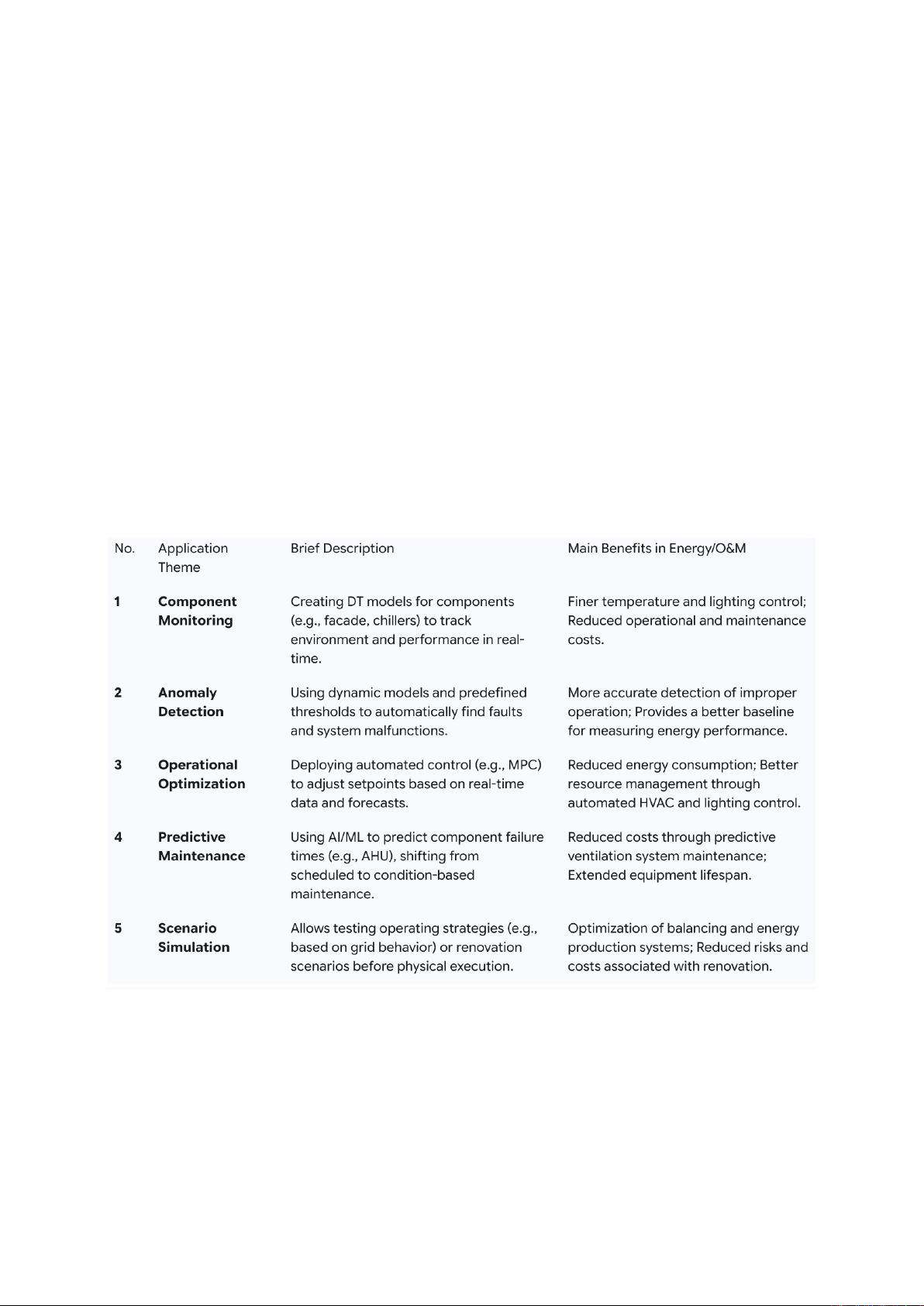
2.3. Main Thematic Classification
Through the analysis of 21 case studies, recurring themes were identified based on the specific
benefits achieved from DT implementation. Five primary applications were found, all related to
improvements in the building's operational phase:
1. Component Monitoring: Focuses on creating a detailed model of a specific component
to monitor its status and collect data about the surrounding environment.
2. Anomaly Detection: Uses the DT to identify operational faults or improper procedure
execution (e.g., cooling coil not working correctly).
3. Operational Optimization: Applies advanced control algorithms (such as Model
Predictive Control - MPC) to adjust system settings to reduce energy consumption.
4. Predictive Maintenance: Uses DT and Machine Learning (ML) to forecast the time of
equipment failure or need for maintenance, extending lifespan and reducing costs.
5. Simulation of Alternative Scenarios: The ability to simulate changes (e.g., renovation
strategies or renewable energy integration) before physical implementation.
Table 1: Summary of the Main Application Classification of Digital Twin in Building Operations

3. In-depth Analysis of DT Applications and
Quantitative Results
3.1. Component Monitoring and Optimization: The 40% COP Story
Initial DT studies often focused on creating detailed component-level models. For example, one
study described the creation of a limited DT for a specific office building facade element,
collecting over 25,000 sensor readings to monitor light, temperature, and humidity. The goal was
to enable more subtle control over temperature and lighting, thereby reducing facility
management and operational costs.
A typical case illustrating quantitative benefits in component optimization is the study on the
chiller DT. By creating a DT model integrating static information, physical models, and
interactive mapping, the system manipulated the chiller setpoints more intelligently. When the
optimization feature was activated, the chiller's Coefficient of Performance (COP) increased by
approximately 40%. This is an impressive figure, demonstrating the immense potential of DT in
optimizing energy-intensive Mechanical, Electrical, and Plumbing (MEP) systems.

3.2. Fault Detection and Diagnostics (FDD) and Optimal Operation
Fault Detection and Diagnostics (FDD) is another crucial application. DT provides real-time
diagnostic capability by comparing actual performance against its modeled standard.
One study introduced a systematic retro-commissioning method, using a dynamic model to
identify operational problems in a hospital in Denmark. This technique successfully detected
issues such as malfunctioning cooling coils, providing a better baseline for future energy
efficiency measurement and warning of inadequate operation.
In the area of Operational Optimization, DT often serves as the backbone for advanced control
systems, such as Model Predictive Control (MPC). MPC uses the DT model to forecast energy
loads and building behavior, allowing the system to automatically adjust HVAC and lighting
settings to minimize energy consumption without compromising user comfort. For example, a
centralized energy operations center (EOC), utilizing a BIM-based DT, was reported to achieve a
17% energy reduction in a South Korean building.
3.3. Predictive Maintenance (PdM) and Retrofitting Simulation
Predictive Maintenance leverages DT's data analysis and machine learning capabilities. Instead
of performing maintenance based on a fixed schedule (whether needed or not) or after a failure,
DT helps pinpoint the exact time components are at risk of failure.
AI Application for AHUs: Various machine learning techniques, such as Artificial
Neural Networks (ANN) and Support Vector Machines (SVM), are employed to
predict the state of components in Air Handling Units (AHUs), extending their lifespan
and significantly reducing maintenance costs.
Simulation of Alternative Scenarios is a unique DT application for decision-making support.
This capability allows stakeholders to evaluate the potential impact of renovation strategies or the
integration of renewable energy sources (RES) before physical investment. This function is
especially critical for the existing building stock in the EU. DT assists in forecasting
electrical/thermal loads, optimizing energy production systems, and minimizing risks and costs
associated with the trial-and-error process.


%20--%3e%3cdefs%3e%3cstyle%3e%20.st0%20{%20fill:%20%23fff;%20}%20.st1%20{%20fill:%20%237800fa;%20}%20%3c/style%3e%3c/defs%3e%3cpath%20class='st1'%20d='M117.78,12.18H43.11c2.9,3.47,4.65,7.94,4.65,12.82,0,5.6-2.3,10.66-6.01,14.29h76.02l7.22-13.56-7.22-13.56Z'/%3e%3cg%3e%3cpath%20class='st0'%20d='M53.58,26.17h-.59v-1.46h.59v-4.96h2.83c1.78,0,2.67.94,2.67,2.82v5.76c0,1.87-.89,2.81-2.67,2.81h-2.83v-4.96ZM55.36,21.37v3.34h1.1v1.46h-1.1v3.34h1.01c.61,0,.91-.37.91-1.1v-5.93c0-.74-.3-1.1-.91-1.1h-1.01Z'/%3e%3cpath%20class='st0'%20d='M65.99,31.14h-1.8l-.31-2.07h-2.19l-.31,2.07h-1.64l1.82-11.39h2.62l1.82,11.39ZM65.28,18.04c-.25.46-.51.77-.75.94-.21.15-.47.22-.79.22-.26,0-.57-.07-.92-.22l-.38-.15c-.14-.05-.26-.07-.37-.07-.3,0-.53.18-.71.54l-.91-.68c.25-.46.51-.77.75-.94.21-.14.48-.21.79-.21.26,0,.57.07.92.21l.38.15c.14.05.26.07.37.07.3,0,.53-.18.71-.54l.91.68ZM61.91,27.52h1.73l-.87-5.76-.87,5.76Z'/%3e%3cpath%20class='st0'%20d='M74.53,26.89v1.52c0,1.91-.89,2.86-2.67,2.86s-2.67-.95-2.67-2.86v-5.93c0-1.91.89-2.86,2.67-2.86s2.67.95,2.67,2.86v1.11h-1.69v-1.22c0-.75-.31-1.12-.93-1.12s-.93.37-.93,1.12v6.15c0,.74.31,1.11.93,1.11s.93-.37.93-1.11v-1.63h1.69Z'/%3e%3cpath%20class='st0'%20d='M81.4,31.14h-1.8l-.31-2.07h-2.19l-.31,2.07h-1.64l1.82-11.39h2.62l1.82,11.39ZM75.9,19.2l1.52-1.91h1.71l1.51,1.91h-1.61l-.76-.95-.75.95h-1.61ZM77.32,27.52h1.73l-.87-5.76-.87,5.76ZM83.1,15.99l-1.76,1.91h-1.26l1.17-1.91h1.86Z'/%3e%3cpath%20class='st0'%20d='M84.86,19.75c1.78,0,2.67.94,2.67,2.82v1.48c0,1.87-.89,2.81-2.67,2.81h-.85v4.28h-1.79v-11.39h2.64ZM84.01,21.37v3.86h.85c.58,0,.87-.36.87-1.08v-1.71c0-.71-.29-1.07-.87-1.07h-.85Z'/%3e%3cpath%20class='st0'%20d='M93.51,19.75c1.78,0,2.67.94,2.67,2.82v1.48c0,1.87-.89,2.81-2.67,2.81h-.85v4.28h-1.79v-11.39h2.64ZM92.66,21.37v3.86h.85c.58,0,.87-.36.87-1.08v-1.71c0-.71-.29-1.07-.87-1.07h-.85Z'/%3e%3cpath%20class='st0'%20d='M98.8,31.14h-1.79v-11.39h1.79v4.88h2.03v-4.88h1.83v11.39h-1.83v-4.88h-2.03v4.88Z'/%3e%3cpath%20class='st0'%20d='M105.36,24.55h2.46v1.62h-2.46v3.34h3.09v1.63h-4.88v-11.39h4.88v1.63h-3.09v3.18ZM108.17,17.29l-1.76,1.91h-1.26l1.17-1.91h1.86Z'/%3e%3cpath%20class='st0'%20d='M112.2,19.75c1.78,0,2.67.94,2.67,2.82v1.48c0,1.87-.89,2.81-2.67,2.81h-.85v4.28h-1.79v-11.39h2.64ZM111.35,21.37v3.86h.85c.58,0,.87-.36.87-1.08v-1.71c0-.71-.29-1.07-.87-1.07h-.85Z'/%3e%3c/g%3e%3ccircle%20class='st1'%20cx='25'%20cy='25'%20r='20'/%3e%3cpath%20class='st0'%20d='M32.78,19.27c2.92,0,4.43,2.55,5.28,5.33l.71,2.17c.14.38-.33.75-.71.75h-5.61c.19-.33.24-.71.09-1.08l-.75-2.45c-.43-1.32-.99-2.64-1.79-3.77.75-.57,1.65-.94,2.78-.94h0ZM25,18.38c3.25,0,4.9,2.78,5.89,5.89l.76,2.45c.14.42-.33.8-.8.8h-11.69c-.42,0-.94-.38-.8-.8l.75-2.45c.99-3.11,2.64-5.89,5.89-5.89h0ZM25,11.35c1.74,0,3.11,1.37,3.11,3.11s-1.37,3.11-3.11,3.11-3.11-1.41-3.11-3.11,1.41-3.11,3.11-3.11h0ZM17.27,19.27c1.08,0,1.98.38,2.73.94-.8,1.13-1.37,2.45-1.74,3.77l-.8,2.45c-.14.38-.05.75.09,1.08h-5.56c-.42,0-.9-.38-.75-.75l.71-2.17c.9-2.78,2.41-5.33,5.33-5.33h0ZM17.27,12.91c1.51,0,2.78,1.27,2.78,2.83s-1.27,2.83-2.78,2.83-2.83-1.27-2.83-2.83,1.27-2.83,2.83-2.83h0ZM32.78,12.91c1.56,0,2.78,1.27,2.78,2.83s-1.23,2.83-2.78,2.83-2.83-1.27-2.83-2.83,1.27-2.83,2.83-2.83h0ZM27.07,28.56v.09c0,.57-.24,1.08-.61,1.46h0v.05c-.38.33-.9.57-1.46.57s-1.08-.24-1.46-.61h0c-.38-.38-.61-.9-.61-1.46v-.09h1.41v.09c0,.19.05.38.19.47v.05c.09.09.28.19.47.19s.38-.09.47-.19v-.05c.14-.09.24-.28.24-.47t-.05-.09h1.41ZM30.99,28.56v.09c0,1.65-.66,3.16-1.74,4.24-1.08,1.08-2.59,1.79-4.24,1.79s-3.16-.71-4.24-1.79l-.05-.05c-1.04-1.08-1.7-2.55-1.7-4.2v-.09h1.41v.09c0,1.27.47,2.4,1.27,3.25h.05c.85.85,1.98,1.37,3.25,1.37s2.4-.52,3.25-1.37c.85-.8,1.37-1.98,1.37-3.25v-.09h1.37ZM34.99,28.56v.09c0,2.78-1.13,5.28-2.92,7.07-1.79,1.79-4.29,2.92-7.07,2.92s-5.23-1.13-7.07-2.92c-1.79-1.79-2.92-4.29-2.92-7.07v-.09h1.41v.09c0,2.4.94,4.53,2.5,6.08,1.56,1.56,3.72,2.5,6.08,2.5s4.52-.94,6.08-2.5c1.56-1.56,2.5-3.68,2.5-6.08v-.09h1.41Z'/%3e%3c/svg%3e)