

On certain integral Schreier graphs of the symmetric
group
Paul E. Gunnells ∗
Department of Mathematics and Statistics
University of Massachusetts
Amherst, Massachusetts, USA
gunnells@math.umass.edu
Richard A. Scott †
Department of Mathematics and Computer Science
Santa Clara University
Santa Clara, California, USA
rscott@math.scu.edu
Byron L. Walden
Department of Mathematics and Computer Science
Santa Clara University
Santa Clara, California, USA
bwalden@math.scu.edu
Submitted: Feb 17, 2006; Accepted: May 3, 2007; Published: May 31, 2007
Mathematics Subject Classification: 05C25, 05C50
Abstract
We compute the spectrum of the Schreier graph of the symmetric group Sn
corresponding to the Young subgroup S2×Sn−2and the generating set consisting
of initial reversals. In particular, we show that this spectrum is integral and for
n≥8 consists precisely of the integers {0,1,...,n}. A consequence is that the first
positive eigenvalue of the Laplacian is always 1 for this family of graphs.
∗Supported in part by NSF grant DMS 0401525.
†Supported in part by a Presidential Research Grant from Santa Clara University.
the electronic journal of combinatorics 14 (2007), #R43 1

1 Introduction
Given a group G, a subgroup H⊂G, and a generating set T⊂G, we let X(G/H, T )
denote the associated Schreier graph: the vertices of X(G/H, T ) are the cosets G/H and
two cosets aH and bH are connected by an edge whenever aH =tbH and t∈T. We
shall assume that Tsatisfies t∈T⇔t−1∈Tso that X(G/H, T ) can be regarded as an
undirected graph (with loops). The main result of this article is the following.
Theorem 1.1. Let Snbe the symmetric group on nletters, let Hnbe the Young subgroup
S2×Sn−2⊂Sn, and let Tn={w1, . . . , wn}where wkdenotes the involution that reverses
the initial interval 1,2, . . . , k and fixes k+ 1, . . . , n. Then for n≥8, the spectrum of the
Schreier graph X(Sn/Hn, Tn)consists precisely of the integers 0,1, . . . , n.
The full spectrum, complete with multiplicities, is given in Theorem 7.2 and seems
interesting in its own right. There are, however, some connections with results in the
literature that are worth mentioning. Given a graph X, let λ=λ(X) denote the difference
between the largest and second largest eigenvalue of the adjacency matrix. For a connected
graph, λcoincides with the first positive eigenvalue of the Laplacian and is closely related
to certain expansion coefficients for X. In particular, one way to verify that a given
family of graphs has good expansion properties is to show that λis uniformly bounded
away from zero (see, e.g., [Lu2]).
Given a group Gand generating set T⊂G, we denote by X(G, T ) the corre-
sponding Cayley graph. Several papers in the literature address spectral properties of
X(Sn, Tn) for certain classes of subsets Tn. In the case where Tnis the set of transposi-
tions {(1,2),(2,3), . . . , (n−1, n)}, i.e., the Coxeter generators for Sn, the entire spectrum
is computed by Bacher [Ba]. Here λ= 2 −2 cos(π/n), which approaches zero as n
gets large. On the other hand, in the case where Tnis the more symmetric generating
set {(1,2),(1,3), . . ., (1, n)}, the eigenvalue gap λis always 1 ([FOW, FH]). In [Fr], it is
shown that among Cayley graphs of Sngenerated by transpositions, this family is optimal
in the sense that λ≤1 for any set Tnconsisting of n−1 transpositions.
In applications, one typically wants an expanding family with bounded degree, meaning
there exists some kand some ǫ > 0 such that every graph in the family has λ≥ǫand
vertex degrees ≤k. In [Lu1] Lubotzky poses the question as to whether Cayley graphs
of the symmetric group can contain such a family. When restricting Tnto transpositions,
this is impossible, since one needs at least n−1 transpositions to generate Sn. In [Na]
the case where Tnis a set of “reversals” (permutations that reverse the order of an entire
subinterval of {1,2, . . . , n}1) is considered. Although any Sncan be generated by just
three reversals, it is shown in [Na] that if Tnis a set of reversals with |Tn|=o(n), then
λ→0 as n→ ∞. Hence, among Cayley graphs of Sngenerated by reversals, one obtains
a negative answer to Lubotzsky’s question.
The argument in [Na] proves the stronger result that certain Schreier graphs of the
symmetric group generated by reversals cannot form an expanding family. It is well-known
1In the context of Coxeter groups, reversals are the elements of longest length in the irreducible
parabolic subgroups of Sn.
the electronic journal of combinatorics 14 (2007), #R43 2

(and easy to see) that the spectrum of any Schreier graph X(G/H, T ) is a subset of the
spectrum of the Cayley graph X(G/T ), hence if a collection of Cayley graphs forms an
expanding family, so does any corresponding collection of Schreier graphs. In particular,
[Na] considers the Schreier graphs corresponding to Hn=S2×Sn−2⊂Sn, and shows that
if Tnis a set of reversals and |Tn|=o(n) then even for the Schreier graphs X(Sn/Hn, Tn),
one has λ→0 as n→ ∞.
The elements w1, . . . , wnin the theorem above are, in fact, reversals; wkflips the
initial interval 1,2, . . . , k and fixes k+ 1, . . . , n. Hence, in addition to providing another
example of a Schreier graph whose spectrum can be computed (with a nice explicit form),
our theorem shows that the Schreier graphs X(Sn/Hn, Tn) satisfy λ= 1 for all n. In
particular, the bound |Tn|=o(n) in [Na] is essentially sharp. Empirical evidence suggests
that the corresponding Cayley graphs X(Sn, Tn) with Tn={w1, . . . , wn}also have λ= 1
for all n, but our methods do not extend to prove this.
2 Preliminaries
Let Snbe the group of permutation of the set {1,2, . . . , n}and let Tn⊂Snbe the set of
reversals {w1, . . . , wn}given by
wk(i) = k+ 1 −iif 1 ≤i≤k
iif k < i ≤n
Let Vnbe the set consisting of 2-element subsets {i, j} ⊂ {1,2, . . . , n}(i6=j). We
define the graph Xnto be the graph with vertex set Vnand an edge joining {i, j}to
{wk(i), wk(j)}for each k∈ {1, . . . , n}. Since each wkis an involution, Xncan be regarded
as an undirected graph. Moreover, Xnhas loops: the vertex {i, j}has a loop for every
wkthat fixes or interchanges iand j. We adopt the standard convention that a loop
contributes one to the degree of a vertex. Thus, Xnis an n-regular graph with n
2
vertices. The first few graphs (with loops deleted) are shown in Figure 1.
Remark 2.1.The group Snacts transitively on the set Vnand the stabilizer of {1,2}is the
subgroup S2×Sn−2. It follows that Vncan be identified with the quotient Sn/S2×Sn−2,
and that the graph Xncoincides with the Schreier graph X(Sn/S2×Sn−2, Tn) described
in the introduction.
Let Wn=L2(Vn) be the real inner product space of functions on Vn. Given x∈Wn
we shall often write xij instead of x({i, j}), and use the following format to display x:
x=
x12
x23 x13
x34 x24 x14
.
.
....
xn−1,n · · · x1,n
(1)
the electronic journal of combinatorics 14 (2007), #R43 3
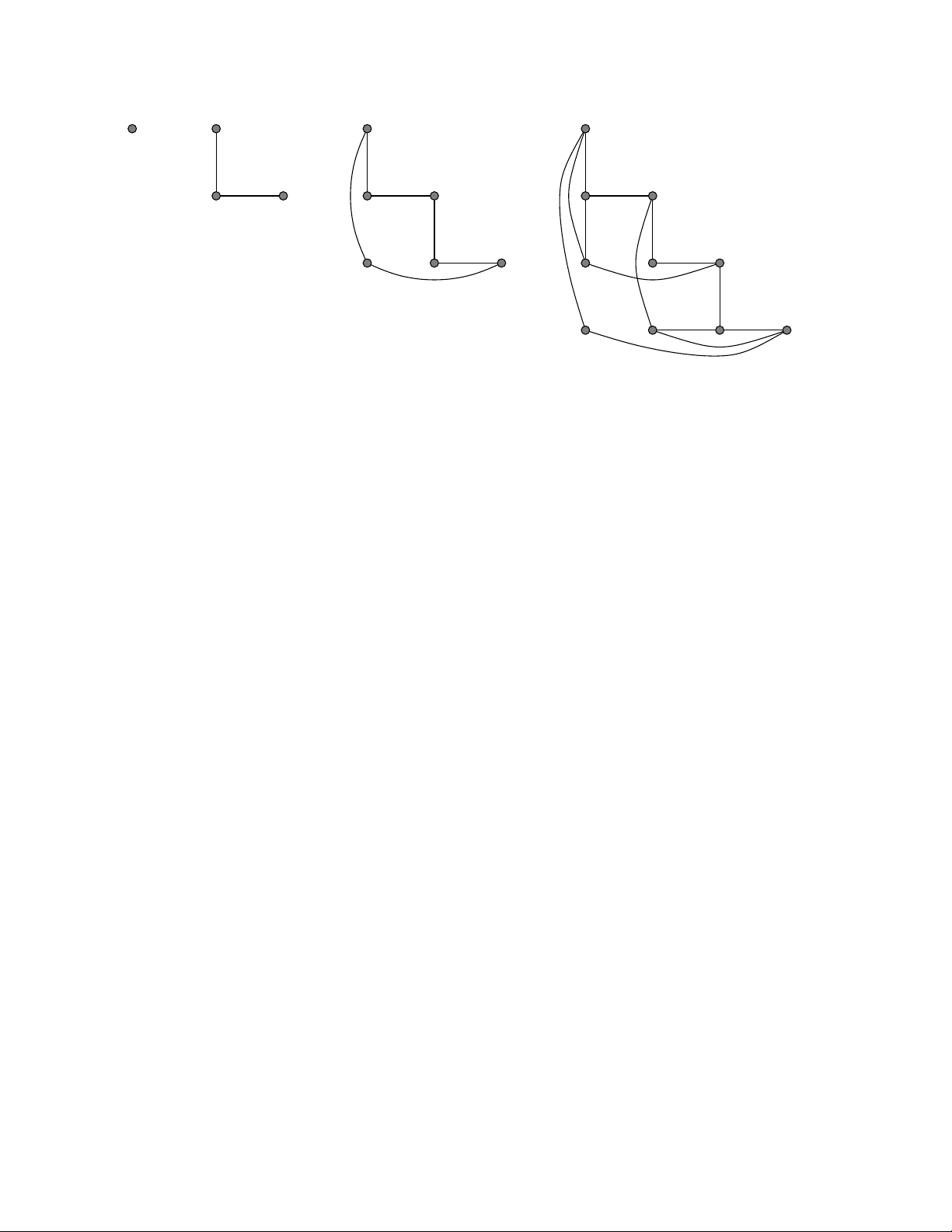
{1,2}{1,2} {1,2}{1,2}
{1,3}{1,3}{1,3} {2,3}{2,3}{2,3}
{1,4}{1,4}{2,4} {2,4}{3,4}{3,4}
{2,5} {1,5}{3,5}{4,5}
Figure 1:
Let A=A(Xn) : Wn→Wnbe the adjacency operator
(Ax)({i, j}) =
n
X
k=1
x({wk(i), wk(j)}).
Ais symmetric, hence diagonalizable.
3 The involution
A glance at the examples in Figure 1 suggests that the graphs Xnare symmetric about a
diagonal line (from the bottom left to the top right). To prove this is indeed the case, we
let ιbe the involution on the vertex set V=Vnobtained by reflecting across this diagonal
line, i.e.,
ι:{i, j} 7−→ {i, n +i−j+ 1}
for i < j.
It will be convenient to picture a vertex {i, j} ∈ Vas a row of nboxes with balls in
the boxes iand j. Assuming i < j, we call them the left and right balls, respectively.
There are i−1 boxes to the left of the left ball, j−i−1 boxes between the two balls,
and n−jboxes to the right of the right ball.
We shall say that a reversal wkmoves a ball in the ith box if iis contained in the
interval [1, k]. We say that wkfixes a ball in the ith box if i > k. (It may be helpful
to think of wkas lifting up the boxes in positions from 1 to k, reversing them, and then
putting them back down. Thus, wk“moves” balls in boxes 1 through k, even though
when kis odd, the ball in position (k+ 1)/2 does not change its position.) A vertex {i, j}
determines a partition of the set T={w1, w2, . . . , wn}into three types (Figure 2):
1. Those wkfixing both balls (type 1). There are i−1 of these.
the electronic journal of combinatorics 14 (2007), #R43 4
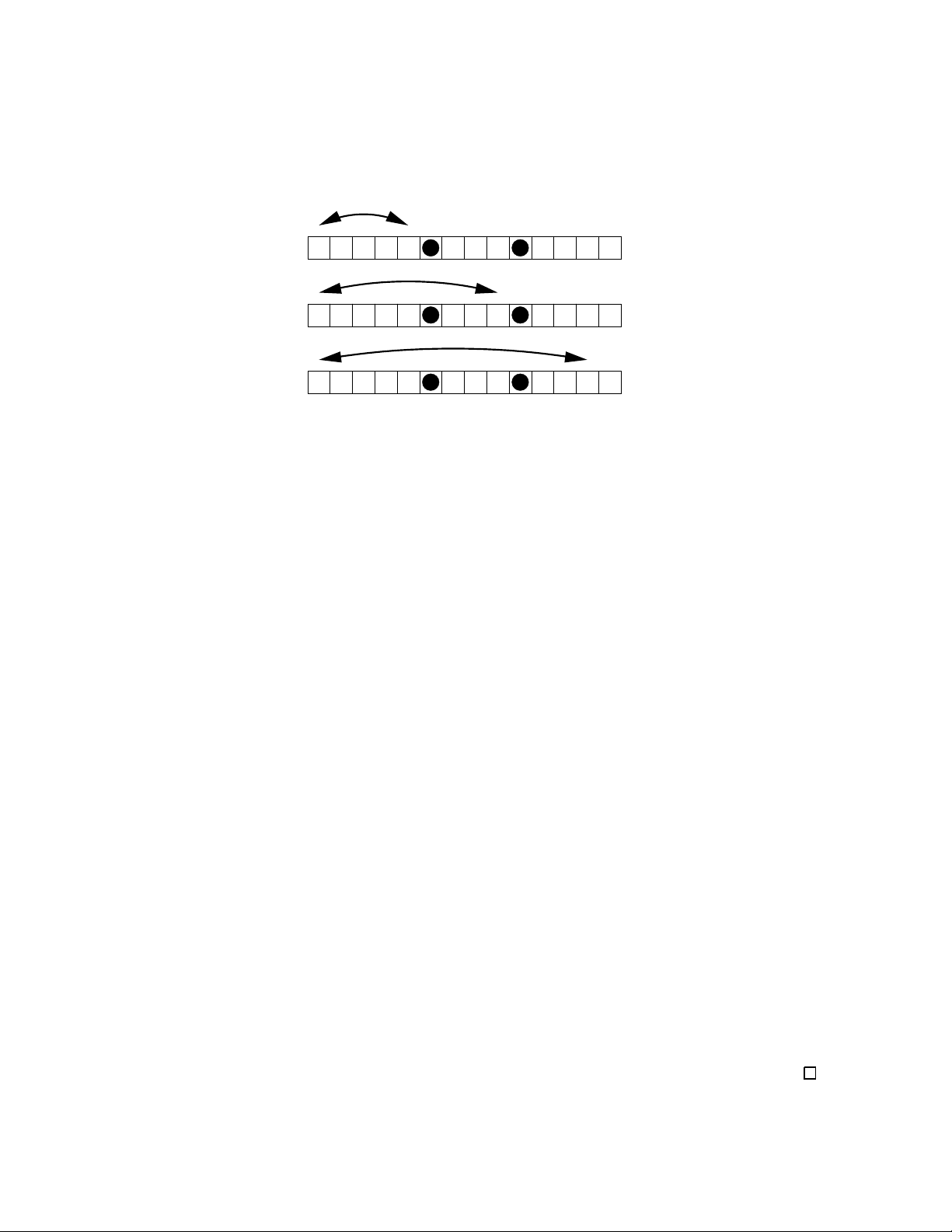
2. Those wkmoving the left ball and not the right (type 2). There are j−iof these.
3. Those wkmoving both balls (type 3). There are n−j+ 1 of these.
Figure 2: The three types of reversals
This also gives a partition of the set of neighbors of {i, j}into types. Namely, a
neighbor uof vhas type 1, 2, or 3 (respectively) if u=w·vand whas type 1, 2, or 3
(resp.). Given v∈V, write Np(v) for the multiset of neighbors of vof type p. (Thus for
example N1({i, j}) consists of i−1 copies of {i, j}. We need multisets to keep track of
multiple edges. Actually this only arises for neighbors of type 1; the other two neighbor
multisets are really sets.)
Proposition 3.1. Let ι:V→Vbe the map
ι:{i, j} 7−→ {i, n +i−j+ 1}.
Then ιmaps N1(v)bijectively onto N1(ι(v)), and N2(v)bijectively onto N3(ι(v)). Thus ι
is an involution of Xn.
Proof. We can describe the action of ιas follows: If there are aboxes between the left
and right balls of v, then the left balls of vand ι(v) are in the same positions, and there
are aboxes to the right of the right ball of ι(v). Hence N1(v) is in bijection with N1(ι(v)),
since ιkeeps the left ball fixed and moves the right ball to a new “right” position.
Consider the type 2 neighbors of v={i, j}. There are j−isuch neighbors. In all
of them the right ball is in the same position as that of v(so there are n−jboxes to
the right of the right ball). However the left balls of these neighbors occupy successively
boxes 1, . . . , j −i.
Applying ιto these vertices produces a set Sof vertices with left ball in boxes 1,...,j−
i, and with n−jboxes between the left and right balls. We claim that Sis exactly N3(ι(v)).
First observe that N3(ι(v)) has the same cardinality as S. Also, the vertices in N3(ι(v))
have their left balls in positions 1, . . . , j −i. Finally, there are always n−jboxes in
between the left and right balls of elements of N3(ι(v)), since that is the number of boxes
between the left and right balls of ι(v). This completes the proof.
the electronic journal of combinatorics 14 (2007), #R43 5


