Engineering Solid Mechanics 3 (2015) 235-244
Contents lists available at GrowingScience
Engineering Solid Mechanics
homepage: www.GrowingScience.com/esm
Numerical investigation of stress intensity factor for semi-circular bend specimen
with chevron notch
Eqlima Mahdavia,b*, Yuzo Obarab, Majid Reza Ayatollahia
aFatigue and Fracture laboratory, School of Mechanical Engineering, Iran University of Science and Technology, 16846-13114, Tehran, Iran
bGraduate School of Science and Technology, Kumamoto University, Kumamoto, Japan
A R T I C L E I N F O A B S T R A C T
Article history:
Received 6 April, 2015
Accepted 12 July 2015
Available online
15 July 2015
One of the specimens to investigate the mode-I fracture toughness of rock and geo-materials is
semi-circular bend (SCB) specimen. In general, initial cracks in rock test specimens are
produced in two shapes: straight-edge cracks and chevron notches. The ISRM suggested SCB
specimen has straight shaped notch. However, use of V-shaped (or chevron) notch in the SCB
specimen is preferred because of some technical difficulties associated with making a sharp
crack or creating pre-crack to conduct the experimental tests. In this paper, the minimum
dimensionless stress intensity factor of cracked chevron notched semi-
circular bend
(CCNSCB) specimen is determined using finite element analysis with ABAQUS software. An
analytical method, (i.e. Bluhm’s slice synthesis method) is used to verify the results. It is shown
that a good agreement exists between the numerical data and theoretical results.
© 2015 Growing Science Ltd. All rights reserved.
Keywords:
Semi-circular bend specimen
Chevron notch
Rock
Stress intensity factor
Finite element analysis
1. Introduction
Rocks are complex materials which contain natural joints, fractures or flaws. Since discontinuities
usually have some effects on the mechanical properties of rock, evaluation of cracks in rock mass is
very important. Fracture mechanics is employed as a useful tool to solve various rock engineering
problems such as rock cutting, hydraulic fracturing, tunneling, blasting, stability of rocks, etc. The
earliest work on fracture mechanics in brittle materials was performed by Griffith (1921). Since, there
were some limitations in Griffith theory, Irwin (1957) developed the extension of Griffith’s theory to
an arbitrary crack and proposed the criterion for the crack growth. In addition, Irwin explained that the
stress field around the crack tip is evaluated by an important parameter called stress intensity factor
(SIF).
Stress intensity factor, K as most important parameter in linear elastic fracture mechanics (LEFM),
defines the magnitude of the local stresses around the crack tip. This factor depends on loading
* Corresponding author.
E-mail addresses: eqlima.mahdavi@gmail.com (E. Mahdavi)
© 2015 Growing Science Ltd. All rights reserved.
doi: 10.5267/j.esm.2015.7.001

236
condition, crack size, crack shape, and geometric boundaries. Fracture toughness is termed as critical
value of stress intensity factor and denoted as Kc that describes the material resistance against
propagation of pre-existing cracks (Kanninen & Popelar, 1985). Generally this parameter depends on
temperature, environment, loading rate, the composition of the material and its microstructure as well
as geometric properties. Accurately measuring the rock fracture toughness is crucial in engineering
applications.
Several methods have been proposed in the literature to measure the fracture toughness of rocks.
International Society for Rock Mechanics (ISRM) suggested short rod (SR) and chevron bending (CB)
test methods in 1988 (Ouchterlony, 1988), cracked chevron notched Brazilian disc (CCNBD) in 1995
(Fowell, 1995), and semi-circular bend specimen (SCB) in 2014 (Kuruppu et al., 2014). All of the
specimens used in these methods are core-based, which facilitate the sample preparation from cores
obtained from natural rock masses. Accordingly, several researchers have used the mentioned
specimens for determining the mode I fracture toughness of different rocks (Ayatollahi & Aliha, 2008;
Cui et al., 2010; Aliha et al., 2012a,b; Erarslan & Williams, 2012; Kuruppu & Chong, 2012; Akbardoost
et al., 2014; Aliha & Ayatollahi, 2014; Dai et al., 2015).
The semi-circular bend (SCB) specimen proposed initially by Chong and Kuruppu (1987) has
recently received much attention by researchers. The SCB specimen have some advantages over other
specimens such as convenient sample preparation (directly prepared from rock cores), simple geometry
and loading configuration, the straightforward testing procedure and application of compressive load
which is more appropriate for rocks instead of tensile loads. Furthermore, surrounding environment
such as temperature, confining pressure, water vapor pressure and so on is known as important
parameters which affect the fracture toughness of rock materials. The SCB specimen is suitable to
measure the rock fracture toughness at elevated temperatures, high strain rates, high confining
pressures, and water vapor pressure (Obara et al., 2007; Kuruppu & Chong, 2012).
Artificial crack in rock test specimens can be created with either a straight or a chevron shape.
When a cracked chevron notched rock specimen is subjected to an externally applied load, there is a
stress concentration around the crack front. As this concentrated stress reaches a critical value, failure
occurs. The fracture toughness is then calculated in terms of the stress intensity factor (SIF) using the
failure load, notch size, and the other geometrical parameters of the specimen.
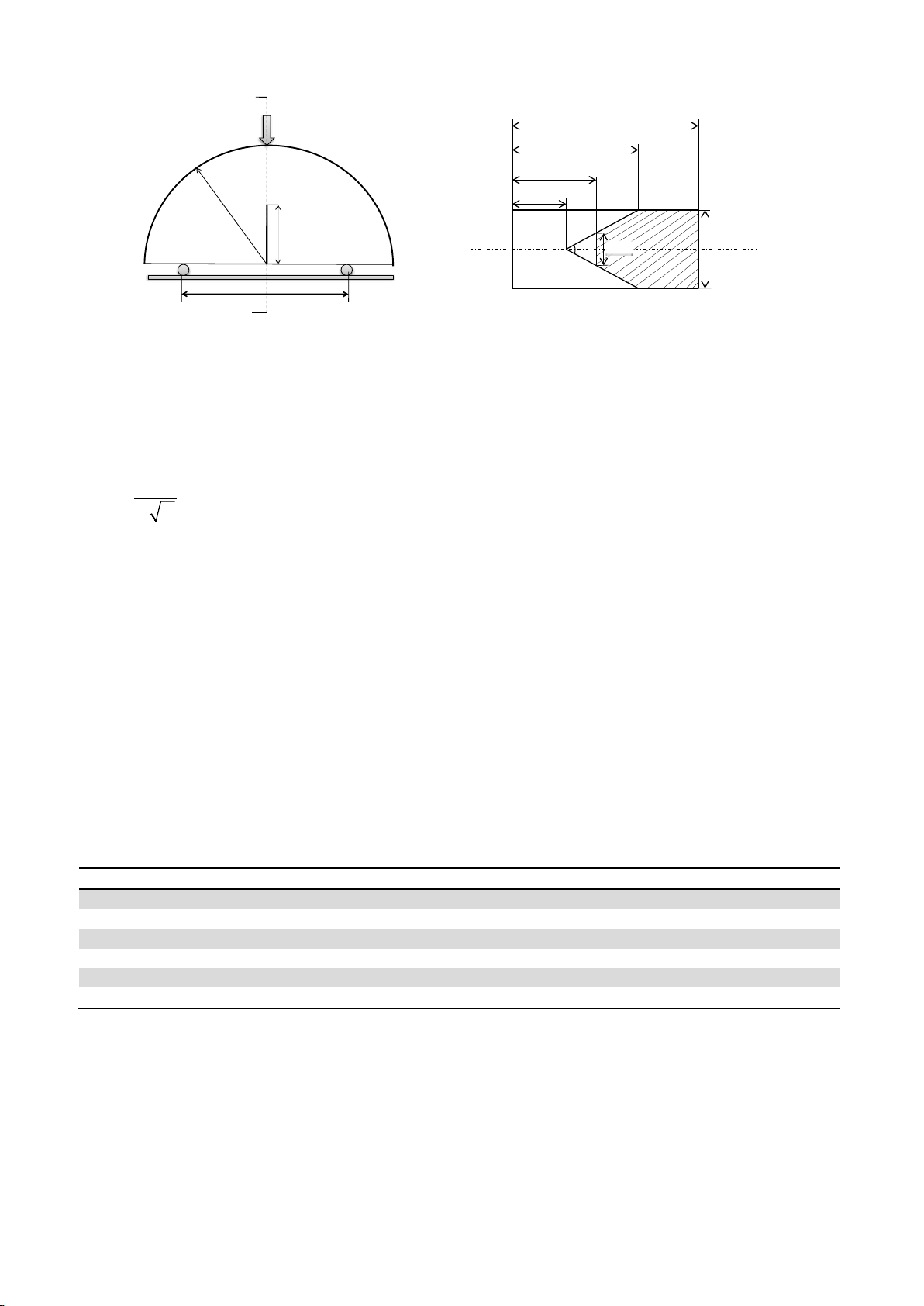
Cracked chevron notched semi-circular bending (CCNSCB) method was first proposed by Kuruppu
(1997) as shown in Fig. 1. Unlike the straight cracked samples, computation of the stress intensity
factor is not easy and straightforward for a chevron notch crack. In this paper, finite element analysis
is performed for obtaining the minimum dimensionless stress intensity factor in the chevron notched
semi-circular bend specimen. Then an analytical method (i.e. Bluhm’s slice synthesis method) is
applied to verify the results.
2. Semi-circular bend specimen
Geometric parameters in the CCNSCB specimen of radius
R
is shown in Fig. 1b in which a0, a1,
and am are the initial, final, and critical crack lengths, respectively. θ is the half of the chevron notch
angle, B is the thickness and S is the half-distance between the supports. However, the normalized
parameters are used as α0 (=a0/R), α1 (=a1/R), α(=a/R), αB(=aB/R), and αS(=S/R).
E. Mahdavi et al. / Engineering Solid Mechanics 3 (2015)
237
(a)
(b)
Fig. 1. (a) Semi-circular bend specimen geometry and loading configuration, and (b) chevron notch
Using the formulation proposed by ISRM to calculate the rock fracture toughness of CCNBD
specimen (Fowell, 1995), the following formulation could be written for the fracture toughness (KIc) of
the CCNSCB specimen:
min
*
max
=
Ic
P
KY
BR
(1)
Indeed, KIc is the critical stress intensity factor corresponding to the initiation of fracture. In Eq.
(1) Y*min is the minimum dimensionless stress intensity factor for mode-I loading, and Pmax is the
maximum peak load at the onset of fracture. Y*min can be determined using numerical techniques. In the
next section the variations of this non dimensional fracture parameter is obtained for different
geometries of notch in the CCNSCB specimen.
3. Finite element analysis of SCB specimen
In the following, the CCNSCB is analyzed by the commercial finite element software ABAQUS
and the stress intensity factor is determined using the J-integral method. 3D modeling of the CCNSCB
is used to calculate the distribution of stress intensity factor at the crack front. The mechanical
properties were selected as E = 2.94 GPa and ν = 0.3. Geometric properties of the specimen can be
found in Table 1.
Table 1. Geometric properties in mm
Geometric parameter
Value
Normalized value
Radius of specimen, R (mm)
37.5
-
Thickness of specimen, B (mm)
30
αB=0.8
Support distance, 2S (mm)
26.25
αs=0.7
Initial crack length, a0 (mm)
3.75
α0=0.1
Final crack length, a1 (mm)
22.5
α1=0.6
Chevron angle, 2θ
π/2
-
After geometric modeling and appropriate partitioning the model, the crack can be created. For
modeling the crack, there are two important points that must be considered. The first is that since around
the crack tip, the triangular elements can cover the model better than other elements, they should be
used at the first ring around the crack tip; But, for performing the J-integral method it is not allowed to
use of two types of elements in the model. To solve this problem, the collapsed element was introduced.
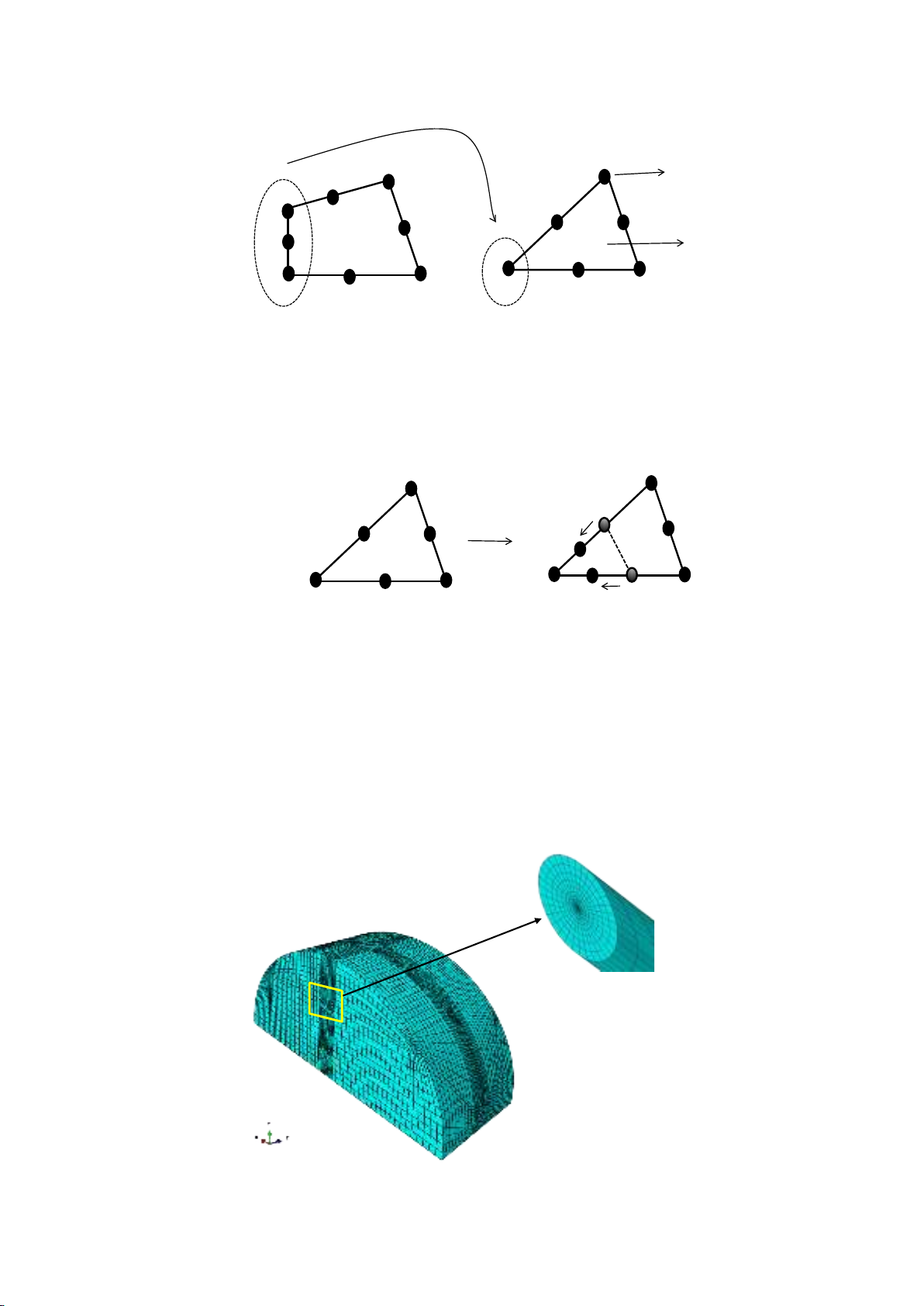
In collapsed elements, the nodes on one side around the crack front have the same geometric location
at the crack tip. In Fig. 2, the collapsed element is shown in 2D modeling.
R
a
2S
A
A
P
𝒂𝟎
𝒂𝒎
𝒂𝟏
𝑩
𝟐𝜽 𝒃
𝑹
238
Fig. 2. Collapsed element for modeling the crack tip region.
In addition, the other important issue must be considered is the singularity at the crack tip. Actually,
to obtain the mesh convergence in a small-strain analysis, the singularity at the crack tip should be
considered. In small-strain analysis, the strain singularity of linear elasticity is ε∝r-1/2 (r is the distance
from the crack tip). By moving the mid-side nodes on the sides connected to the crack tip to the ¼ point
nearest to the crack tip, singularity of linear elasticity can be satisfied (as shown in Fig. 3).
Fig. 3. Elastic singular element
If the part is two-dimensional, the crack front should be modeled with a ring of triangles and
quadrilateral elements are assigned to the rest of the contour integral region. In the case of three-
dimensional, a ring of wedges and hexahedral elements are used for the crack front and the remainder
of the contour integral region, respectively.
A typical 3D finite element modeling of the CCNSCB specimen can be seen in Fig. 4.
Approximately, 50000 20-node 3D elements were used to mesh this model. As mentioned above,
because of singularity at the crack tip, the elastic singular elements and finer mesh were used around
the crack tip as shown in Fig. 4
Fig. 4. A typical finite element mesh used for simulating the CCNSCB specimen.
11
22
33
4
4
5
5
6
7
8
6
78
node
element
The nodes are tied together
Crack front
1
2
3
4
5
6
78
1
2
3
4
5
6
8
7
Crack tip
E. Mahdavi et al. / Engineering Solid Mechanics 3 (2015)
239
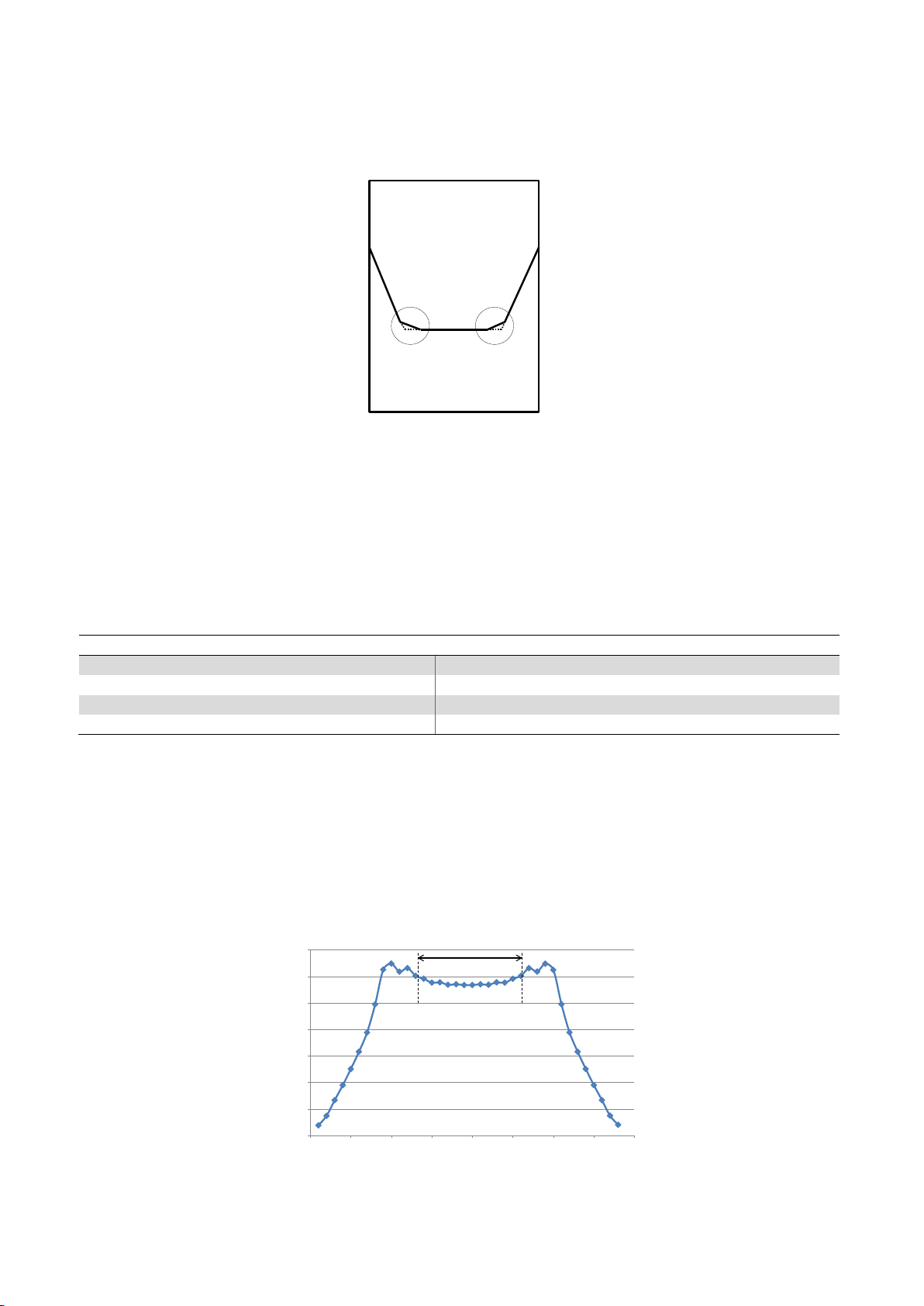
It should be noted that there were some problems in the modeling of chevron notch because of high
stress concentration at the two corners of notch. As shown in Fig. 5, the modified shape of sharp corners
was used to model the chevron notch in the ABAQUS software. Using this model, more uniform results
can be obtained.
Fig. 5. Modified shape of chevron notch modeling in the ABAQUS software
In fact, to compute the minimum stress intensity factor at critical crack length, the crack length was
increased step by step from initial crack length to the final crack length. After that, by plotting the
distribution of dimensionless stress intensity factor for different values of crack length and finding the
turning point in the diagram, the critical crack length and the corresponding minimum dimensionless
stress intensity factor can be obtained. For this purpose, eight different crack lengths were considered
to analyze the CCNSCB specimen as shown in Table 2.
Table 2. Different crack length in each case of FE modeling
α=a/R
α=a/R
Case-1
0.2
Case-5
0.4
Case-2
0.25
Case-6
0.45
Case-3
0.3
Case-7
0.5
Case-4
0.35
Case-8
0.55
4. Results and discussion
The distribution of the stress intensity factor along the crack front for case-3 was plotted in Fig. 6.
It can be seen that the diagram has a relatively uniform region at the middle part of the crack front and
two decreasing part at the two side notches. In fact, the two side notches are not true crack. In addition,
stress intensity factors are not identical along the middle part of the crack front. Thus, a suitable
averaging method should be used for the values of stress intensity factor at the uniform middle part of
the crack front.
Fig. 6. Dimensionless stress intensity factor along the crack front for case-1
0.00
0.50
1.00
1.50
2.00
2.50
3.00
3.50
0.00 5.00 10.00 15.00 20.00 25.00 30.00 35.00 40.00
Y*
Node number along crack front

![Bài tập tối ưu trong gia công cắt gọt [kèm lời giải chi tiết]](https://cdn.tailieu.vn/images/document/thumbnail/2025/20251129/dinhd8055/135x160/26351764558606.jpg)