Vietnam Journal
of Agricultural
Sciences
ISSN 2588-1299
VJAS 2024; 7(1): 2085-2097
https://doi.org/10.31817/vjas.2024.7.1.07
2085
Vietnam Journal of Agricultural Sciences
Received: October 10,
2023
Accepted: March 30, 2024
Correspondence to
ndhoc@vnua.edu.vn
Current Situation and Solutions for
Vocational Training in Extremely Isolated
Communes, Lowland and Coastal Areas,
and on Islands in Vietnam
Nguyen Dang Hoc*, Le Thi Minh Chau, Hoang Thi Mai Anh, Phi
Thi Diem Hong & Tran Quan Trung
Faculty of Accounting and Business Management, Vietnam National University of
Agriculture, Hanoi 131000, Vietnam
Abstract
This study aimed to analyze the current situation of vocational
training for farmers and farmers’ needs for vocational training in
the next years in extremely isolated communities. The primary data
were collected from 480 farmers in 16 communes. The selection of
the study sites was based on the list issued in Decision No. 353/QD-
TTg dated March 15, 2022 of the Prime Minister. The secondary
data on vocational training in the period of 2016-2022 were
collected from the Department of Labor, Invalids, and Social
Affairs in the study sites. The research results showed that
vocational training programs for farmers in the period of 2016-2022
had some achievements. The numbers of courses and trained
workers increased every year (except the period of 2020 to early
2022 because of Covid-19), and the contents of the training courses
were designed in accordance with the special requirements of local
conditions and production and business characteristics. However,
the vocational training program for farmers in extremely isolated
communes in the period 2016-2022 still had limitations in terms of
training contents, training methods, and training duration. It was
found that in the 2023-2025 period, 73.5% of surveyed farmers
desired to participate in vocational training. Based on the limitations
of the vocational training program in the past, some proper solutions
were proposed to improve the effectiveness of vocational training
and to meet the farmers’ expectations.
Keywords
Vocational training, farmers, extremely isolated communes
Introduction
Vocational training is essential to produce qualified human
resources not only nationally but also locally. Especially in poor areas
or extremely isolated communes, lowland areas, coastal areas, and

Current situation and solutions for vocational training in extremely isolated communes, lowland and coastal areas and on islands
2086
Vietnam Journal of Agricultural Sciences
on islands where there are "core poor" areas with
rugged terrain, low living standards, poor socio-
economic and infrastructure conditions, and a
high rate of poor households (Ho Huong, 2022).
In these regions, the goals of escaping poverty
and developing sustainable poverty reduction
systems are two of the primary concerns.
Escaping poverty or reducing poverty
sustainably, however, can only be achieved
successfully when there are sustainable
livelihoods for households, and farmers are
active in creating jobs as well as responding to
their difficult conditions effectively. According
to Liu (2013), an anti-poverty program may have
more immediate priorities in the short term to
reduce poverty but in the long run, poverty needs
to be tackled through education. With the same
this opinion, Oxfarm (2017) also agreed that
education is necessary to improve farmers’
(especially poor farmers) knowledge and should
be a priority long term solution. Addressing the
farmers’ needs through training allows each
farmer to improve their awareness of poverty
reduction. This is also the reason why the
Vietnam target program on sustainable poverty
reduction for the period 2021-2025 was
implemented nationwide, with a focus on poor
districts and communes, particularly in isolated
communes, lowland areas, coastal areas, and on
islands. In fact, the vocational training program
for rural workers related to agriculture, forestry,
fisheries, and other non-farm sectors (such as
handicrafts and services) has been conducted
since 2010 according to Decision No. 1956 of the
Prime Minister. After more than 10 years of
implementation, the program has received
positive results, thereby making important
contributions to creating jobs, shifting the labor
structure, and improving the quality of rural
workers (Trinh Xuan Viet, 2023). However, there
have been very few studies to evaluate these
programs from the perspective of learners and
farmers as existing studies and reports are mainly
statistical and from the approach of the organizers.
Unfortunately, the findings of Nguyen et al.
(2022) showed that most vocational training
institutions only focus on compiling information
and teaching by subject, accounting for 70% of
the framework program paying non-soft-skills or
spending far too little time on practice according
to state regulations, so when implemented for
students, the programs take up too much time
teaching theory and not enough time on teaching
practical skills and providing practice
opportunities for students. In their conclusion,
the authors stated that the vocational training
program in Vietnam has not yet established strict
output standards for vocational training levels,
and the curriculum only meets the needs of
society's employers. In the aspect of rural
vocational training, despite of the huge demand
for vocational training and job creation in rural
areas, the goal has not been met; the structure of
vocational training in the agricultural sector is
still not suitable for the needs of the agricultural
learners' needs (Trinh Xuan Viet, 2023). The
research of Pham Thi Kien (2023) also showed
that the rural labor source is huge but rural
vocational training in general and agricultural
vocational training specifically have been done
as spontaneous programs instead of following the
requests of the national development plan, and
thus, the achievements of vocational training as a
whole have not met expectations.
Moreover, according to the statistics data of
General Statistics Office (2020), the rate of
trained farmers (the main workforce in rural
areas) with elementary degrees, certificates, or
other qualifications in rural areas is 16%, much
lower than the rate in urban areas (39.3%) and
lower than the national average (24.6%). Up until
June 2022, many poor districts and extremely
isolated communes, coastal areas, and islands
had not escaped particularly difficult situations.
The majority of poor and near-poor households
were shown to lack livelihoods and jobs, have
low and unstable incomes, and lack professional
skills (Ho Huong, 2022). Therefore, to achieve
the goal of sustainable poverty reduction,
vocational training in general and agricultural
vocational training in particular need to promote
past advantages and overcome existing
shortcomings. This was the main reason for
conducting this study to analyze the status of
vocational training organized by public
organizations and the farmers’ needs of
vocational training in extremely isolated
communes, coastal areas, and on islands. Based

Nguyen Dang Hoc et al. (2024)
https://vjas.vnua.edu.vn/
2087
on the results, the researchers then proposed
some solutions for vocational training programs
to meet the farmers’ expectations.
Methodology
Analytical framework
Based on the key contents of training
activities, with two main participants: the
lecturer (or training organizations) and the
learner (farmers) (Nguyen et al., 2022), this
study approached and evaluated the current
situation of vocational training with a focus on
the learner's view. According to Maslow (1943),
the learners' needs or expectations can be
assessed on the basis of their desires and
intentions to learn. As such, the desires and
intentions of learners were measured according
to five indicators, namely (i) their awareness of
the necessity of vocational training; (ii) their
motivation for participating in the training
courses; (iii) the desired content/field of study;
(iv) training methods; and (v) training duration.
From the survey data on the training results
and farmers' expectations, statistical analyses and
comparisons were applied for determining the
level of the laborers’ assessment on vocational
training in order to identify the problems as well
as achievements of vocational training. From
these analyses, the study proposed solutions to
improve the effectiveness of vocational training
in extremely isolated communes, lowland and
coastal areas, and on islands (hereafter referred
to as extremely isolated communes). These
contents are summarized in Figure 1.
Data collection
To gather information and data for assessing
the current situation, the study conducted a
sample survey of farmers in extremely isolated
communes that were selected following the list
issued in Decision No. 353/QD-TTg dated
March 15, 2022 of the Prime Minister
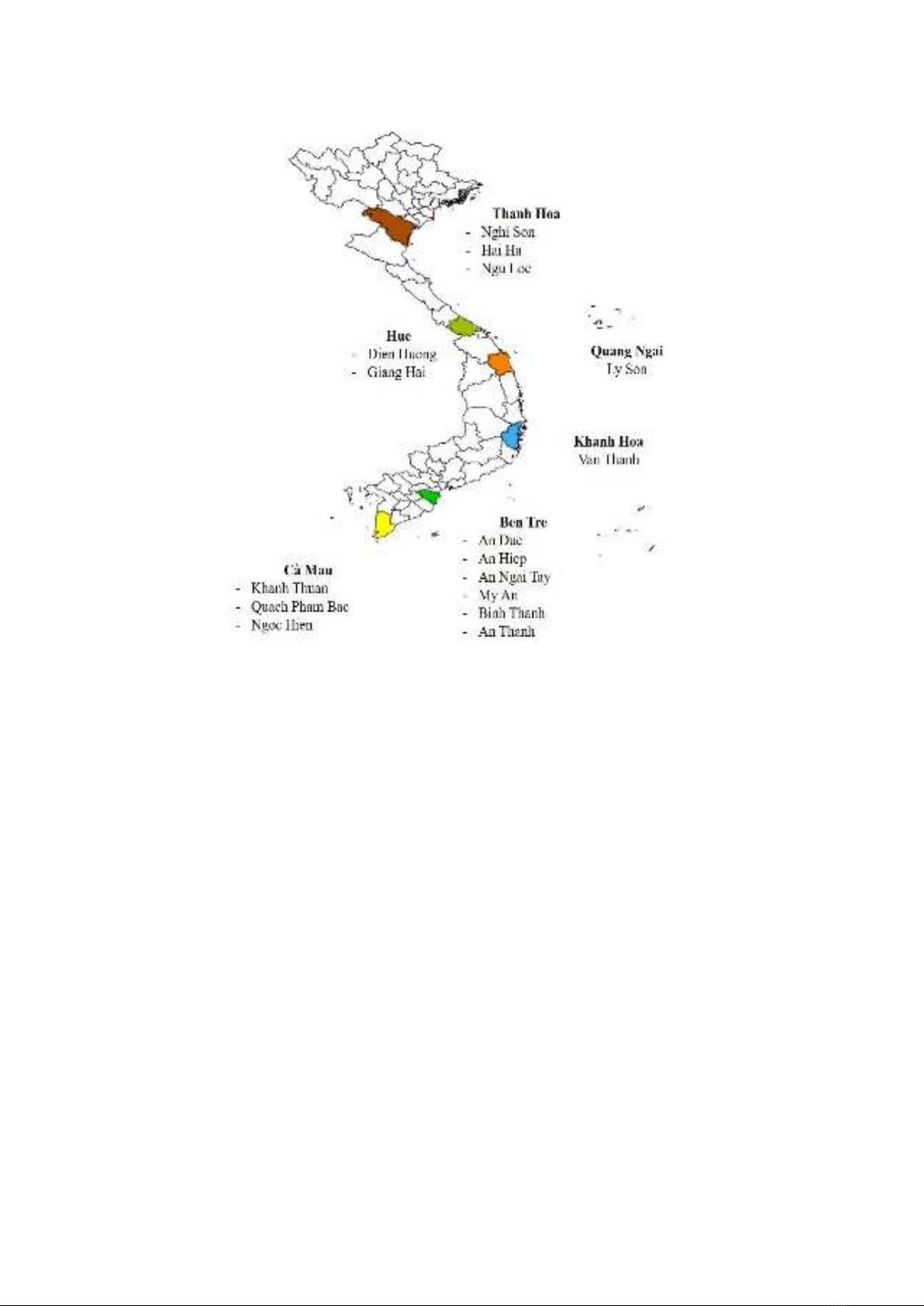
(containing 54 communes: 11 communes in the
North Central region, 10 communes in the South
Central region, and 33 communes in the Mekong
Delta region). The number of communes in the
geographical regions for surveying was
determined according to the proportion of
communes in each region in the total sample.
Consequently, the North Central region had three
communes, the South Central region had four,
and the Mekong Delta region had nine
communes (Figure 2). In each geographical
Figure 1. Analytical Framework
Status of vocational training in
extremely isolated communes,
lowland and coastal areas, and on
islands
THE FARMERS’
SURVEY
Proposed Solutions
Sample: 480 farmers
+ 03 area groups
+ 06 provinces
+ 16 communes
+ 30 farmers per commune
Interviewees:
+ Farmers
+ Ages: 15-60 years
Achievements
Problems
Criteria:
1. Achievement (2016-2022
+ Volume
+ Training content
+ Learner’s assessment
2. Learner’s expectations
+ Awareness
+ Motivation
+ Content
+ Training methods
+ Training duration
Sample survey:
By questionnaires
Statistical Analysis,
Comparison, 5-point Likert scale
Training Results
Learners’ Expectations
Current situation and solutions for vocational training in extremely isolated communes, lowland and coastal areas and on islands
2088
Vietnam Journal of Agricultural Sciences
Figure 2. Study sites
region, the provinces selected for the sample
survey were chosen based on the following
criteria: (1) having a large number of extremely
isolated communes and (2) representing various
terrains (mountainous, coastal areas, and
islands). In each commune, 30 farmers were
selected to be interviewed. The total number of
survey samples was 480. In addition,
secondary data on vocational training results
during the period of 2016-2022 were collected
from the Department of Labor, Invalids, and
Social Affairs in the study areas.
Methods
Descriptive statistics were used to describe
the achievements of vocational training during
the period of 2016-2022 in the extremely isolated
communes. The expectations of farmers in the
vocational training were expressed following the
five indicators presented in Figure 1. In addition,
this study also compared the number of leaners
and classes by the years, geographical regions
and training topics. On these bases, the study
aimed to propose solutions to improve the
effectiveness of vocational training for farmers in
extremely isolated communes in order to meet
the needs of the farmers.
Results and Discussion
Characteristics of the survey sample
The results in Table 1 show that the
respondents’ average age was quite high, 47.2
years, and varied between 16 and 77 years. This
reflects the reality of rural areas in Vietnam in
general and in extremely isolated communes in
particular, where most working-aged people
work away from home or study at educational
institutes. Most of the respondents were of an old
age and were women. The respondents’ average
ages in Ca Mau, Ben Tre, and Quang Ngai were
quite high. Workers in these provinces mostly
worked in industrial parks located in Binh
Duong, Dong Nai, and Tay Nguyen. This had a
significant effect on the farmers’ demand of

Nguyen Dang Hoc et al. (2024)
https://vjas.vnua.edu.vn/
2089
Table 1. Characteristics of the survey sample
Criteria
Unit
Min
Max
Mean
SD
Age
Years
16
77
47.2
12.40
Education level
Years
0
12
7.4
3.21
Gender (female)
%
65
Household size
Persons
1
10
5
1.33
Farmers of a working age
Persons
0
9
3
1.05
Farmers working at the local
Persons
0
8
2
1.18
Land area
m2
400
20,000
3,197.4
3,781.58
Vocational training status
%
53
vocational training as well as the effectiveness of
vocational training courses in these provinces.
In terms of the educational level, the average
number of years of schooling of the respondents
was 7.4 years (ranging from 0 to 12 years). The
proportion of people who had less than 3 years of
schooling and no schooling accounted,
respectively, for 11% and 5.6%. Ca Mau and Ben
Tre had the lowest averages of years of
schooling. This is one of the constraints of
implementing vocational training for farmers in
those provinces.
Concerning the demographic characteristics
of the survey sites, the average household size
was 5 persons (varying between 1 and 10
persons). The average number of people of
working age was 3 persons. Most people of
working age worked in rural areas and in the
agricultural sector.
On average, there were 2 people in one
household working in agriculture, forestry, or
fisheries. In regional comparisons, there were no
significant differences in the demographic
characteristics. It is worth noting that the number
of working aged people who worked in rural
areas and the agriculture sector was low, most of
them were women, and old people.
The statistics showed that the average
agricultural production land area was 3,197m2
(ranging from 400 to 20,000m2). Households in
the Mekong Delta (such as Ca Mau and Ben Tre)
had the largest areas of agricultural production
land. Table 1 also shows that 53% of the
interviewees had attended at least one vocational
training course.
Vocational training in extremely isolated
communes during 2016-2022
Figure 3 shows that during 2016-2022, the
number of courses organized in extremely
isolated communes was low, accounting for 1.8
courses per year (ranging from 0 to 5 courses).
Notably, the provinces in the Central region had
more vocational training courses than those in the
Mekong Delta. The number of vocational
training courses decreased during the 2019-2021
period but was followed by an increase in 2022.
Because of Covid-19, in 2020, 6 of the 16
communes did not organize vocational training
courses, while others organized only 1-2
vocational training courses.
The average number of farmers participating
in vocational training in the survey sites during
2016-2022 was 456 persons per year . The
average number of farmers participating in
vocational training reached a peak at 1,464
persons in 2018 with a decline after that because
of Covid-19 (Table 2). In regional comparisons,
the number of farmers enrolled in vocational
training in the Central region was higher than that
in the Mekong Delta. The reasons for these
differences were the fewer number of farmers
who wanted to enroll in vocational training
courses, a lack of funds for vocational training,
and the restructuring of the network of vocational
training institutes, which resulted in the
reduction of the number of vocational training
institutes. In addition, many farmers reported that
they only took part in vocational training to get
financial support from the government, instead
of applying to build their awareness of the
vocational training topics.


![Bài giảng Tiếng Anh chuyên ngành Bảo vệ thực vật [chuẩn nhất]](https://cdn.tailieu.vn/images/document/thumbnail/2025/20250506/vinarutobi/135x160/5631746530031.jpg)