

ISSN 2394-7349
International Journal of Novel Research in Engineering and Science
Vol. 2, Issue 2, pp: (67-74), Month: September 2015 - February 2016, Available at: www.noveltyjournals.com
Page | 67
Novelty Journals
Design and Comparison of PID & FUZZY
Controller for Water Level Control of Coupled
Tank System
1SURBHI SHARMA, 2MANISHA ARORA
1EEE. Department, JCDMCO. ENGG. SIRSA, India
2ASSISTANT. PROF., JCDMCO. ENGG. SIRSA, India
Abstract: This paper presents the approach to design and comparison of the Tuning PID & FUZZY controller for
interactive Water Level Process and to model a dynamic process which can be done easily, conveniently and very
efficiently. In this paper MATLAB software of Simulink modelling is used for modelling and testing of the control
system. The experimental results of the interacting water level process can be satisfyingly illustrated the transient
response and the steady state response. Simulation results confirm the effectiveness of the proposed control
methodology.
Keywords: Coupled-Tank, Interacting water level process, PID Controller & Fuzzy Controller.
1. INTRODUCTION
Chemical, Food, Milk brewage Plants are tightly integrated processes, which exhibit non-linear behaviour and complex
dynamic properties. Chemical manufacturing processes present many challenging control problems due to their non-linear
dynamic behaviour, uncertain and time-varying parameters, constraints on manipulated and state variables, multivariable
interactions between manipulated and controlled variables. In particular, it is well recognised that one of the most
important characteristics of chemical processes that present formidable control problem is the inherent nonlinearity of the
process.
Intelligent Process Control methods such as fuzzy logic control have shown some success, there is a significant need to
evaluate their real time performance relative to conventional control approaches, particularly in an experimental setting.
Such evaluations help to determine the performance of the new intelligent process control methods, and provide the
engineer with general guidelines on how to apply them to more complex real-world applications[4]. Despite a lot of
research and the large number of different solutions proposed, most industrial control systems are still based on
conventional PID regulators.
Fuzzy control and Conventional control strategies have been applied to implement level control in the process control unit
as shown in Fig.1. These strategies have been successfully implemented in cascade control configurations. In the cascade
control configuration, it has been observed that the fuzzy controller gives out perform than the conventional controller.
In practice, it is often being integrated into complex control structures in order to achieve a better control performance.
The advantages of easy implementation and potentially large control performance improvement have led to wide spread
applications of cascade control for several decades. It has become a standard application provided by industrial process
controllers [3, 5].
ISSN 2394-7349
International Journal of Novel Research in Engineering and Science
Vol. 2, Issue 2, pp: (67-74), Month: September 2015 - February 2016, Available at: www.noveltyjournals.com
Page | 68
Novelty Journals
However, conventional PID controllers cannot provide a general solution to all control problems. The processes involved
are in general complex and time-variant, with delays and non-linearity, and often with poorly defined dynamics. When the
process becomes too complex to be described by analytical models, it is unlikely to be efficiently controlled by
conventional approaches. To overcome these difficulties, various types of modified conventional PID controllers such as
autotuning and adaptive PID controllers were developed lately [6,7]. Also, a class of non-conventional type of PID
controller employing Fuzzy logic has been designed and simulated for this purpose [5,7,8].
Fuzzy Logic Controller (FLC) has emerged as one of the most active and useful research areas in the fuzzy control theory.
That is why fuzzy logic controllers have been successfully applied for control of various physical processes. Basically
there are two approaches to a fuzzy controller design: an expert approach and a control engineering approach. In the first,
the fuzzy controller structure and parameters choice are assumed to be the responsibility of the experts. Consequently,
design and performance of a fuzzy controller depend mainly on the knowledge and experience of the experts, or intuition
and professional feeling of a designer. This dependence, which is considered far from systematic and reliable, is the flaw
of this approach.
However, this approach could assist in constructing a fuzzy model or an initial version of a fuzzy controller. The second
approach supposes an application of the knowledge of control engineering and a design of a fuzzy controller in some
aspects similar to the conventional design with the parameter’s choice, depending on the information of their influence on
the controller performance [3-4].
On the other hand best known industrial process controller is Proportional- Integral-Derivative (PID) controller because of
its simple structure and robust performance in a wide range of operating conditions. The similarity of FLC and PID
Controllers and there improvement is still being investigated [1].
However, not many observations have been reported so far in the literature on the effect of use of fuzzy logic controller in
the cascade control strategy in real time.
2. COUPLED TANK SYSTEM
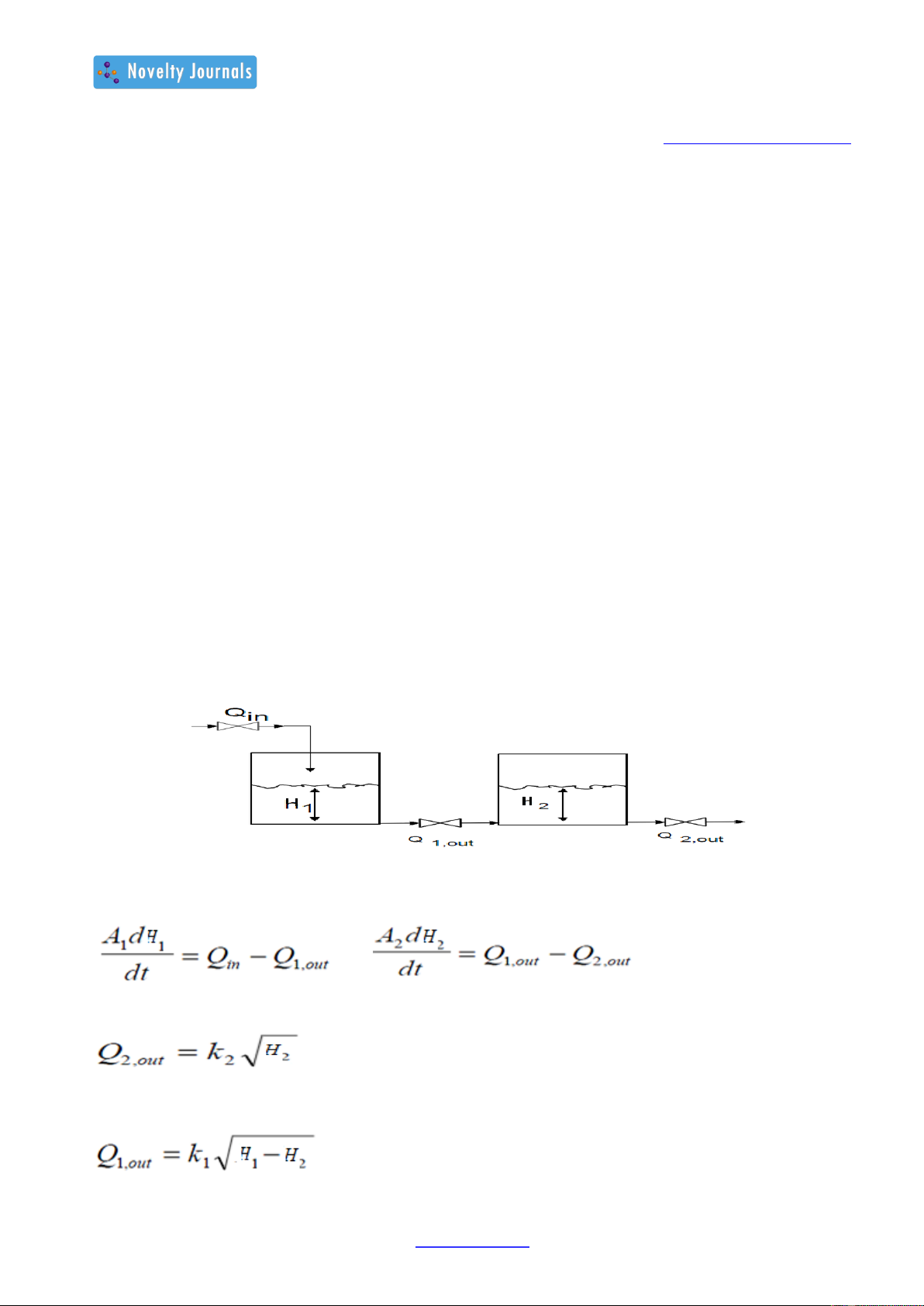
Figure 1: Coupled Tank System
From system can be obtained the non-linear system equations:
,
The flow out of the second tank is determined by the liquid head in that tank, i.e.
However, because of the coupling between the two tanks, the flow out of the first tank is determined by the difference in
levels of the two tanks, i.e.
Thus the final set of ODE’s that describe system behaviour is given by:
ISSN 2394-7349
International Journal of Novel Research in Engineering and Science
Vol. 2, Issue 2, pp: (67-74), Month: September 2015 - February 2016, Available at: www.noveltyjournals.com
Page | 69
Novelty Journals
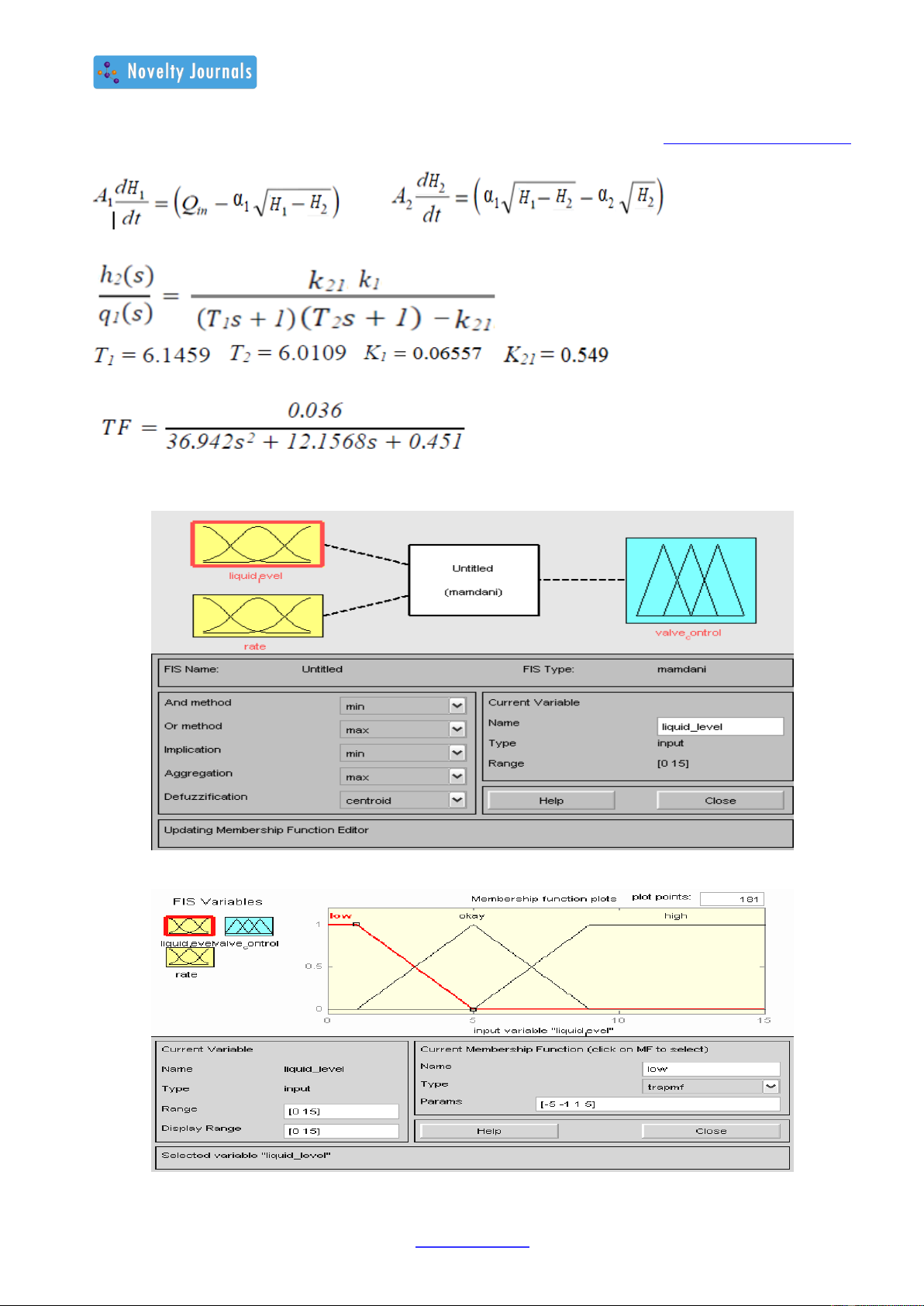
,
After Linearized the above non-linear equations and taking Laplace Transform, we get
, , ,
After taking values, the Transfer Function obtained is:
3. FUZZY CONTROLLER FOR COUPLED TANK SYSTEM
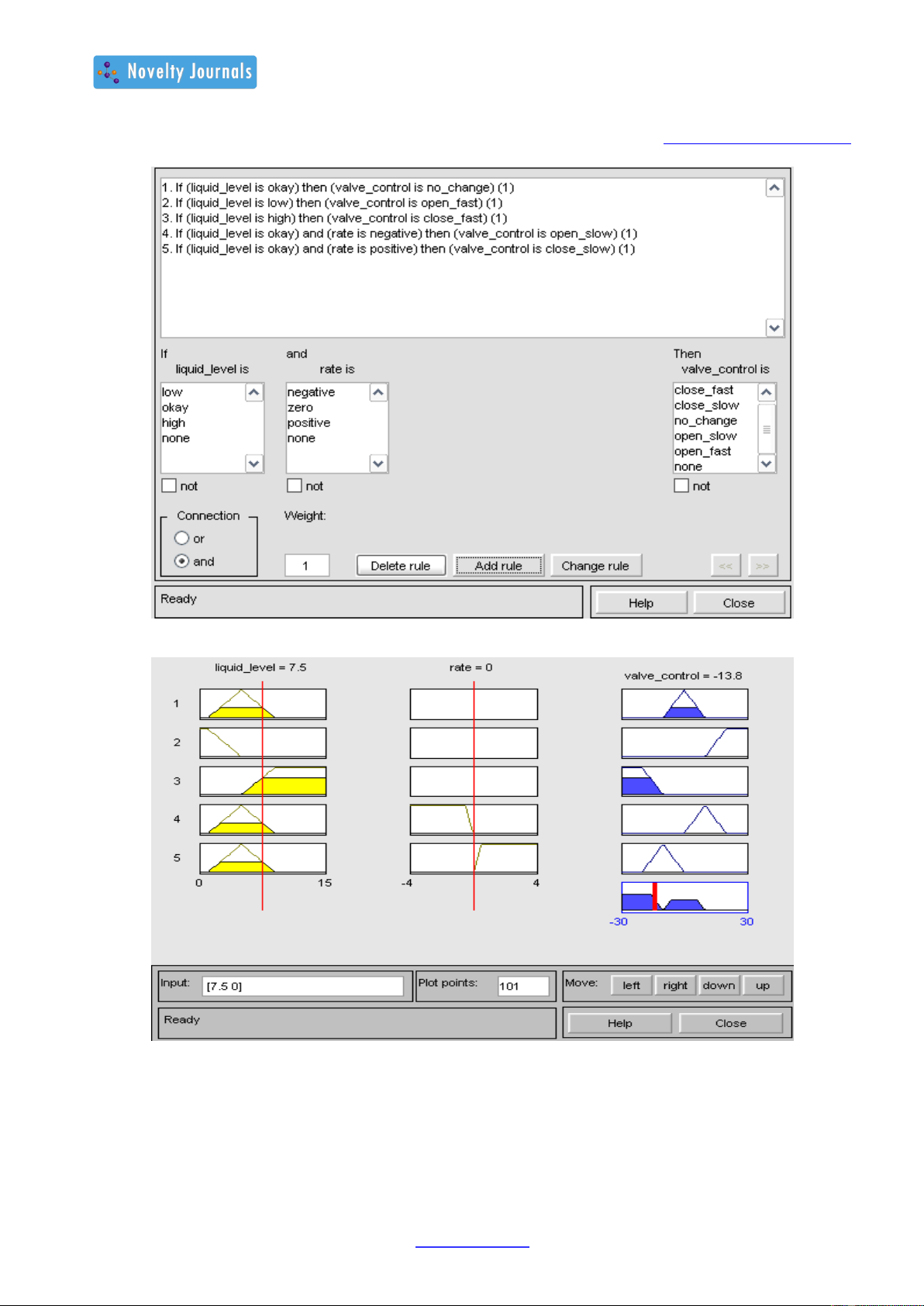
Figure 2: FIS window showing level, rate & valve control membership
Figure 3: Membership degree editor files window
ISSN 2394-7349
International Journal of Novel Research in Engineering and Science
Vol. 2, Issue 2, pp: (67-74), Month: September 2015 - February 2016, Available at: www.noveltyjournals.com
Page | 70
Novelty Journals
Figure 4: 5 Rule creator editor window file
Figure 5: Five Rule Viewer window file
Three rule tuning System:
(a) If Level is low then valve is open slowly.
(b) If Level is high then valve is close slowly.
(c) If Level is okay then no change in valve.
ISSN 2394-7349
International Journal of Novel Research in Engineering and Science
Vol. 2, Issue 2, pp: (67-74), Month: September 2015 - February 2016, Available at: www.noveltyjournals.com
Page | 71
Novelty Journals
4. SIMULATION AND RESULTS
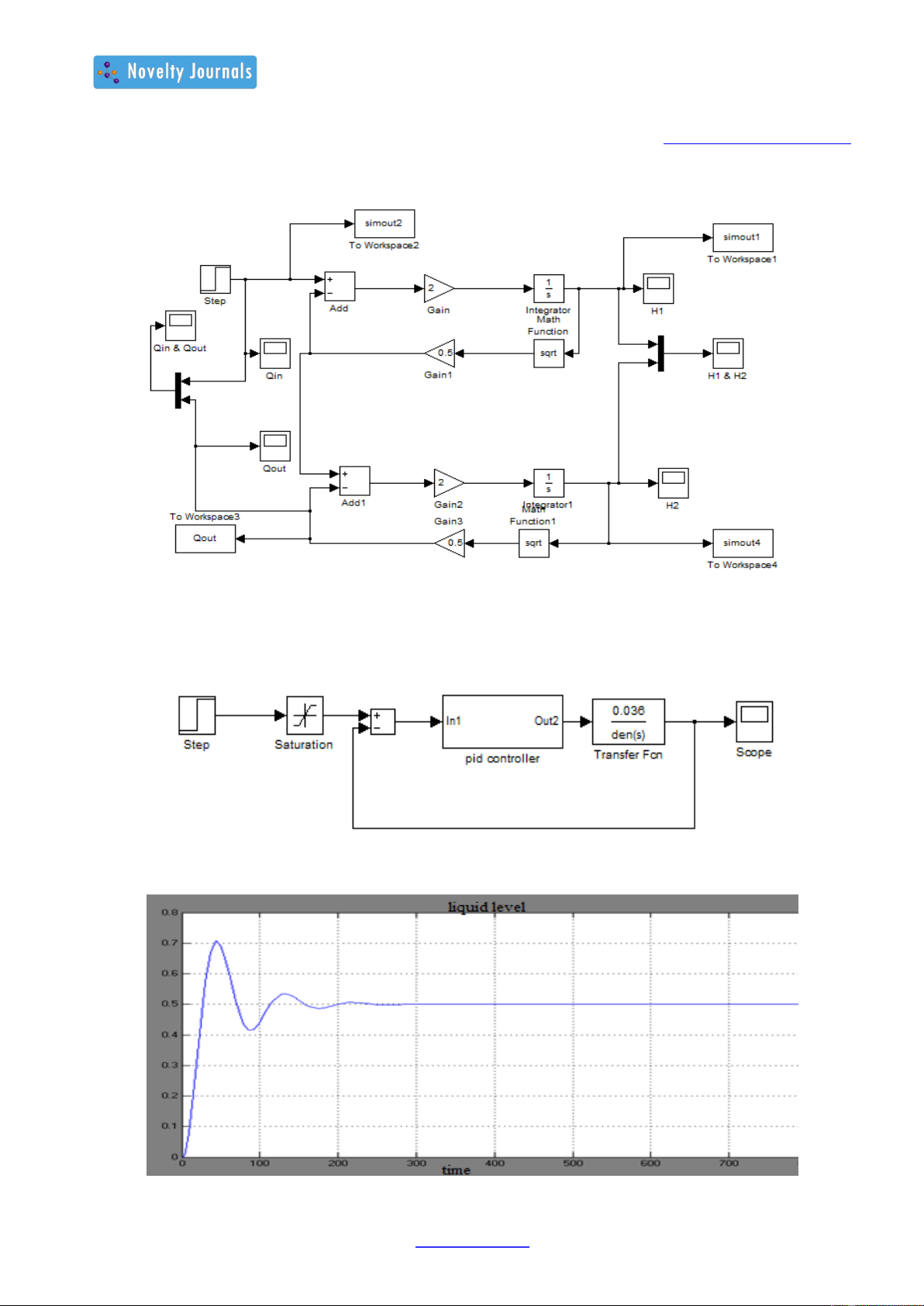
Figure 6: Coupled Tank System
4.1 For PID Controller:
Figure 7: PID Control System
Figure 8: Response for PID Controller









![Giáo trình Thực hành Truyền động điện Trường Đại học Bà Rịa - Vũng Tàu [Mới nhất]](https://cdn.tailieu.vn/images/document/thumbnail/2026/20260310/hoaphuong0906/135x160/11121773283865.jpg)
![Giáo trình Thực hành SCADA Trường Đại học Bà Rịa - Vũng Tàu [Mới nhất]](https://cdn.tailieu.vn/images/document/thumbnail/2026/20260310/hoaphuong0906/135x160/94061773283866.jpg)
![Tài liệu học tập La bàn từ [mô tả/định tính]](https://cdn.tailieu.vn/images/document/thumbnail/2026/20260310/hoaphuong0906/135x160/25191773287376.jpg)

![Tài liệu học tập Thiết kế hệ thống nhúng [mới nhất, đầy đủ]](https://cdn.tailieu.vn/images/document/thumbnail/2026/20260305/hoatulip2026/135x160/37051773135929.jpg)


![Giáo trình Điều khiển khí nén thuỷ lực Phần 2: [Mô tả/Chủ đề cụ thể của phần 2]](https://cdn.tailieu.vn/images/document/thumbnail/2026/20260302/camtucau2026/135x160/11911772768225.jpg)
![Giáo trình Điều khiển khí nén thuỷ lực Phần 1: [Mô tả/Định tính thêm nếu cần]](https://cdn.tailieu.vn/images/document/thumbnail/2026/20260302/camtucau2026/135x160/51511772768225.jpg)
![Giáo trình Điều khiển số Phần 2: [Thêm từ khóa mô tả nội dung chương trình]](https://cdn.tailieu.vn/images/document/thumbnail/2026/20260302/camtucau2026/135x160/37201772766913.jpg)
