

Liquid Level Control of Coupled-Tank System
Using Fuzzy-Pid Controller
Trinh Luong Mien
Falculty of Electrical and Electronic Engineering
University of Transport and Communications
No. 3 Cau Giay, Lang Thuong, Dong Da, Hanoi, Vietnam
Abstract: Liquid level control of coupled-tank is widely used
in the chemical industry - the environment is often affected by
noise. The article deals with the fuzzy-PID controller applied to
the nonlinear dynamic model of the liquid level of the coupled-
tank system, taking into account the effects of noise. Fuzzy-PID
controller is designed based on PID initial parameters
(determined based on the linear model) and fuzzy logic calculator
for tunning PID parameters (suitable for nonlinear models and
noise). The study results are caried out throught simulation model
on Matlab using the coupled-tank nonlinear model with noise,
applying the fuzzy-PID proposed controller, PID based on Ziegler
Nichols.
Keywords: PID, Fuzzy, Level control, Coupled-tank
I. INTRODUCTION
Liquid level control is always in great demand in the
chemical industry, petrochemical refining, water treatment,
power generation and construction material production. In
these technological processes, the fluid is pumped, stored in a
tank, and then pumped to another tank. Over the liquid is
processed by chemical reaction and/or agitation in the tank,
where the liquid level in the tank is controlled [1,2,14]. The
coupled tank systems are commonly used in industries and the
master of controlling the level of liquid in the tank, the flow
control between the tanks is an important of all technological
process control systems. Today's chemicals - the field has a
tremendous impact on our economy [1,13,14]. Improving the
quality of control and increasing the efficiency of the
processing/production process is always required in this field,
in order to reduce production/processing cost and lower
production cost.
Nonlinearity, associated kinetic and uncertainty are the
major challenges posed by controlling the liquid level in the
coupled-tank. Most of the coupled-tank object in published
studies use a linear mathematical model when designing the
controller, such as PID controlller [10,12], fuzzy controlller
[9], fuzzy-PID [8], LQR, state feedback controller, model
reference adaptive control [4,13].
A number of recent studies have also addressed the
nonlinear model of coupled tank using nonlinear control
strategies such as sliding mode control [5,7,11], backstepping
control [3], passivity based control [6], fuzzy logic controller
[1], neuro-fuzzy-sliding mode controller [2]. It can be seen
that the quality of the liquid level control system of the
coupled-tank in the recently published works is good, but the
implementation of these controllers is complex, the disturbance
factor is not really considered.
This article proposes a control approach: combining
between the fuzzy logic calculator and traditional PID
controller for a nonlinear model with noise of the liquid level
coupled-tank control system. Firstly, the article presents a
nonlinear model of the liquid level coupled-tank control
system. Then, the PID controller is designed based on a linear
model of the coupled-tank according to the method Ziegler-
Nichols; designing the fuzzy logic calculator for tunning PID
parameters applied in the nonlinear model with noise of the
coupled-tank system. Finally, the study results is caried out
throught simulation model on Matlab, showing the
efiectiveness of the proposed control strategy.
II. DYNAMIC MODEL OF COUPLED-TANK SYSTEM
This article deals with the coupled tanks with the two
separate vertical tanks (see Fig. 1). Both tanks are
interconnected by a flow channel where a rotary valve will be
used to vary the sectional area of the channel by changing the
discharge coefficient of the valve B. The liquid is fed into the
first tank through the DC-motor controlled electric valve. Then
the liquid flows to the second tank through the manual valve B,
the liquid flows out of the tanks through the manual valve A
or/and the manual valve C by adjusting the discharge
coefficient of the valve A, C. The liquid level in the second
tank is measured by the liquid level untrasonic sensor that
converts the real physical level in the second tank l2 [cm] to an
electrical voltage signal y [V].
2s
y k l
(1)
where ks [V/cm] is gain of level untrasonic sensor.
The control objective is to control the height of the liquid
level in the second tank by manipulating the flow rate of the
liquid into the first tank by means of the electric valve voltage.
Assume that the valve’s output volume flow rate fi [cm3/s] is
proportional to the manipulating voltage applied to electric
valve u [V] as below equation:
iv
f k u
(2)
where kv is gain of the electric valve [cm3/s/V].
International Journal of Engineering Research & Technology (IJERT)
ISSN: 2278-0181http://www.ijert.org
IJERTV6IS110213 (This work is licensed under a Creative Commons Attribution 4.0 International License.)
Published by :
www.ijert.org
Vol. 6 Issue 11, November - 2017
459

fb
l1
fc
Vc
l2
LT
101
LC
101
l2SP
Vb
Valve B
Valve A Valve C
MV,
volltage signal
l1l2
Tank 1 Tank 2
fib, Cb
a, Cac, Cc
fafc
fb
A1A2
r
uy
Inlet
liquid CV,
voltage signal
AC
motor
Pump
Vafa
LI
101
LAH
101
LAL
101
LR
101
fi
A1A2
12
(b). P&ID of the coupled-tank liquid level control system
(a). Schematic diagram of the coupled-tank apparatus
Ve
kv
Electric
valve
ksLevel
untrasonic
sensor
y
Electric
Valve
-
rLevel
controller
c). The block diagram of the coupled-tank control system
Coupled-
Tank
Level
Sensor
Voltage
u
Voltage
fi
Flow rate
l2
Level Voltage
Fig. 1. Description of the coupled tank liquid level control system
The liquid used in the coupled tank is assumed to be
steady, non-viscous, incompressible type of liquid. Applying
Bernoulli's principle for the liquid at point 1 (before valve B)
and point 2 (after valve B) with corresponding pressure p1 and
p2 (Fig. 1b), we have 2 cases:
Case 1: when the liquid level in tank 1 is higher or equal
the liquid level in tank 2, l1
l2, the liquid flows from tank 1
into tank 2, we obtain the balance equation:
2
2
1 2 2 1 2 12
() 2
22
bb
bb
f bC
p v p g l l f bC g l l
r
r r r
(3a)
where g=981[cm2/s] is acceleration of gravity; l1 [cm] is level
in the first tank;
r
[g/cm3] is liquid density; fb [cm3/s] is
volume flow rate through valve B, v2 [cm/s] is liquid velocity
at point 2; b [cm2] is section area of valve B, Cb [%] is
percentage of opening valve B
Case 2: when the height of the liquid level in tank 1 is
less than in tank 2, such as l1<l2, the liquid flows from tank 2
into tank 1, we obtain the balance equation:
21
2
bb
f bC g l l
(3b)
Combining the above equations, we have flow-rate
equation through the valve B as follows
1 2 1 2
( ) 2 | |
bb
f sign l l bC g l l
(3c)
Similarly, we obtain the volume flow-rate equations
through the valve A, C as:
1
2
aa
f aC g l
(4)
2
2
cc
f cC g l
(5)
where a, c [cm2] are respectively section area of valve A, C;
and Ca, Cc [%] are percentage of opening valve A, C
respectively.
The coupled tank dynamics are based on the principle of
mass balance which states that the rate of change of liquid
mass in each tank equals the net of liquid mass flows into the
tank. Here it assumes that the liquid density and cross area of
tanks are constant
1 1 1
11i a b i a b i a b
dw dl dl
w w w A f f f A f f f
dt dt dt
r r r r
(6)
2 2 2
22b c b c b c
dw dl dl
w w A f f A f f
dt dt dt
r r r
(7)
where wi, wa, wb, wc are mass flow-rate; A1, A2 [cm2] are
respectively section area of the first tank and second tank.
Using above equations (2), (3c), (4), (5), thus we obtain
11 1 2 1 2
1
1( 2 ( ) 2 | |)
b a b
dl k u aC g l sign l l bC g l l
dt A
(8)
21 2 1 2 2
2
1( ( ) 2 | | 2 )
bc
dl sign l l bC g l l cC g l
dt A
(9)
The equations (8) and (9) represent a non-linear dynamic
relationship of the liquid level (l1 and l2) in the two tanks with
the ideal equations for the valves. In general applications, the
square root law is only an approximation by solving directly
the no-linear equations (8) & (9). But if the operating point is
known and does not change quite often then it is convenient to
linearize the system obtained by first principles around the
desired operating point. This makes the process significantly
simpler and the model works well in a region around the
chosen operating point. This allows us to easily use linear
control theory to design linear controller for the linear model of
the coupled-tank, such as PID controller.
The linear model of the coupled-tank: At the desired
operating point of the fluid level in the second tank L2s, the
control system is at steady state, so on:
11 1 2 1 2
1
1
0 ( 2 ( ) 2 | |)
sb s a s s s b s s
dL k U aC g L sign L L bC g L L
dt A
(10)
21 2 1 2 2
2
1
0 ( ( ) 2 | |) 2 )
ss s b s s c s
dL sign L L bC g L L cC g L
dt A
(11)
where L1s is height at steady state, Us is pump voltage at
at steady state.
International Journal of Engineering Research & Technology (IJERT)
ISSN: 2278-0181http://www.ijert.org
IJERTV6IS110213 (This work is licensed under a Creative Commons Attribution 4.0 International License.)
Published by :
www.ijert.org
Vol. 6 Issue 11, November - 2017
460

Considering a small incremental change in the control
input,
u in Us, which subsequently cause an incremental
change in height in the two tanks,
l1 in L1s and
l2 in L2s.
Hence, equations (8) and (9), assuming that the fluid always
flows from tank 1 to tank 2, can be re-written as:
11 1 1 1 2 1 2
1
()
1[ ( ) 2 2 ]
sb s a s b s s
d l L k u U aC g l L bC g l l L L
dt A
(12)
22 1 2 1 2 2 2
2
()
1( 2 2 )
sb s s c s
d l L bC g l l L L cC g l L
dt A
(13)
Following Newton's binomial generalized theorem, if
x<<1 then we can approximate:
(1 ) 1xx
(14)
Applying the above approximation (14), we obtain the
below equations:
1 1 1
1 1 1 1 1
111
(1 ) (1 )
22
s s s s
ss
s
l l l
l L L L L
LLL
(15)
2 2 2
2 2 2 2 2
222
(1 ) (1 )
22
s s s s
ss
s
l l l
l L L L L
LLL
(16)
1 2 1 2
1 2 1 2 1 2 1 2
12 12
( )(1 ) 2
s s s s s s
ss ss
l l l l
l l L L L L L L
LL LL
(17)
Substitute these approximation equations (15-17) into
(12-13) and in combination with equations (10-11), we obtain:
11 2 1 2 2
1
() b
k
dl k k l k l u
dt A
(18)
23 1 3 4 2
()
dl k l k k l
dt
(19)
1
11
2
a
s
aC g
kAL
;
2
1 1 2
2( )
b
ss
bC g
kA L L
;
3
2 1 2
2( )
b
ss
bC g
kA L L
;
4
22
2
c
s
cC g
kAL
The equations (18) and (19) describe the linear model of
the coupled-tank system, where input is the incremetal pump
voltage
()ut
, and output is the incremetal fuild level in the
second tank
2()lt
. By taking the Laplace transform of
equations (18-19) the following transfer function is obtained:
31
2
221 2 3 4 1 3 1 4 2 4
/
()
() ( ) ( ) ( )
b
L
k k A
ls
Gs u s s k k k k s k k k k k k
(20)
In this paper, we design a fuzzy-PID controller applied
for coupled-tank system with following parameters [15].
Tab 1. Constants involved in coupled-tank system of Fig. 1
Parameter
Desctiption
Value
Unit
v
k
Gain of DC-motor electric valve
3.3
cm3/s/V
s
k
Gain of level untrasonic sensor
6.1
cm/s
a
C
Percentage of opening valve A
60
%
b
C
Percentage of opening valve B
80
%
c
C
Percentage of opening valve C
60
%
12
,DD
Inner diameter of tank 1, 2
6
cm
A
D
Inner diameter of valve A
0.5
cm
B
D
Inner diameter of valve B
0.7
cm
C
D
Inner diameter of valve C
0.5
cm
max
H
Max. height of liquid level in tank 1, 2
30
cm
Assume that the desired height of fluid level in the second
tank L2s=15[cm], from equations (10), (11) and (20), we obtain
the linear model of the liquid level process of the coupled-tank
system as below:
2
22
() 0.0176
() ( ) 0.362 0.007
L
ls
Gs u s s s
(21)
III. THE FUZZY-PID CONTROLLER DESIGN FOR
LIQUID LEVEL PROCESS OF THE COUPLED-
TANKS SYSTEM
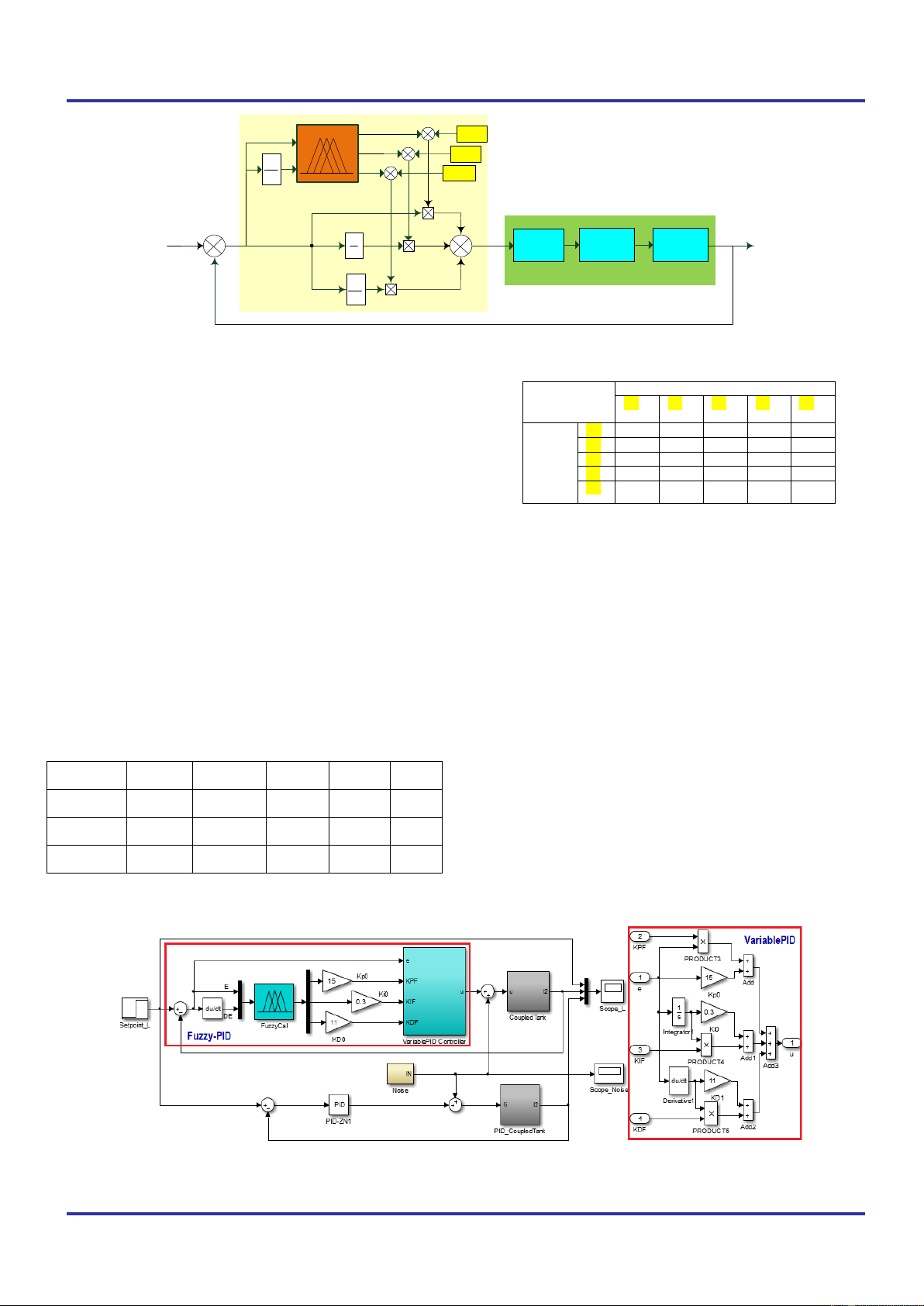
The structure of the fuzzy-PID controller for the liquid
level process of the coupled-tank system is proposed as in Fig.
2. The fuzzy-PID controller is a combination of the basic PID
and the fuzzy logic calculator. The initial parametters
0 0 0
,,
P I D
k k k
of the basic PID are definited based on the
common methods, such as Ziegler Nichols (PID-ZN), Chien-
Hrones- Reswick (PID-CHR). The
,,
PF IF DF
k k k
are seft-
tunning parametters of PID based on fuzzy logic calcutalor
(FuzzyCal block in Fig.2) for the nonlinear model of coupled-
tank with the noise.
3.1. Designing the basic PID controller
The basic PID is designed based on the linear model of the
liquid level process of the coupled-tank system. Using the
Ziegler Nichols method, we can determine the initial
paramaters
0 0 0
,,
P I D
k k k
.
The transfer function of the level control object as:
2212
0.1074
( ) ( ) 0.362 0.007 ( 1)( 1)
obj s L
K
G s k G s s s T s T s
(22)
where K=15.372, T1=2.93, T2=48.78
Arcoding to the Ziegler Nichols 1st method, the
parameters
0 0 0
,,
P I D
k k k
can be determined as follows:
0
00
I
C P D
k
G s k k s
s
(23)
where:
2
0
1
1.2 1.2*48.78 1.31
15.372*2.93
P
T
kKT
0
0
1
0.22
2P
I
k
kT
1
001.92
2
DP
T
kk
Howerver with the nonlinear model of the coupled-tank,
the acceptable pamameters are
0 0 0
15, 0.3, 11
P I D
k k k= = =
.
International Journal of Engineering Research & Technology (IJERT)
ISSN: 2278-0181http://www.ijert.org
IJERTV6IS110213 (This work is licensed under a Creative Commons Attribution 4.0 International License.)
Published by :
www.ijert.org
Vol. 6 Issue 11, November - 2017
461
r
Fuzzy-PID
controller
Fuzzy Cal
-
de
dt
e
kPF
kDF
kIF
y
kI0
kD0
kP0
1
s
de
dt
uElectric
Valve
Coupled-
Tank
Level
Sensor
Level process of coupled-tank
Fig. 2. Structure of fuzzy-PID for liquid level process of coupled-tank
3.2. Designing the fuzzy logic calculator
The fuzzy logic calculations block (FC) have: two
inputs - level error in the second tank (EL), derivative of
level error (DEL) corresponding to input voltage error signal
e=y-r (r- level setpoint, y- level in tank 2) and de/dt; three
output is PL, IL, DL corresponding to the output value kPF,
kIF, kDF.
Using membership functions are shaped triangular for
all variables, fuzzied for all input variables by 5 fuzzy sets
{NL (Negative Large), NS (Negative Small), ZE (ZEro), PS
(Positive Small), PL (Positive Large)}, fuzzied for all output
variables by 5 fuzzy sets {SM (SMall), ME (MEdium), LA
(LArge), QL (Quite Large), VL (Very Large)}. The physical
domain of the input & output variables are determined as:
EL[-20,20], DEL[-2,2], PL[0,20], IL[0,1],
DL[0,15].
Depending on the characteristics of the level control
proces of the coupled-tank and the PID control principle in
order to improve quality control for this system (see Tab.2),
we define the 25 basic fuzzy rules as Tab.3.
Tab.2. The effect of kP, kI, kD tunning
Closed-loop
respond
Rise time
Steady time
Over-
shoot
Steady
error
Stability
Increasing kP
Decrease
Small
change
Increase
Decrease
Degrade
Increasing kI
Small
decrease
Decrease
Increase
Eliminate
Degrade
Increasing kD
Small
decrease
Decrease
Small
decrease
Small
change
IIncrease
Tab.3. The basic fuzzy rule of kPL, kIL, kDL
PL
IL
DL
EL
NL
NS
ZE
PS
PL
DEL
NL
SM
SM
SM
SM
SM
NS
SM
ME
SM
SM
SM
ZE
SM
SM
LA
LA
QL
PS
SM
SM
LA
QL
VL
PL
SM
SM
QL
VL
VL
Using the Max-Min composition rule and the cetroid
defuzzification method, we can obtain the clear output value
of FC: kPF, kIF, kDF for level control loop. Thus, the fuzzy-
PID controller can be calculated by equations:
*0,
P P PF
k k k=+
*0,
I I IF
k k k=+
*0D D DF
k k k=+
(24)
IV. SIMULATION RESULT
The simulated diagram of the fluid level process of
coupled-tank system is described as Fig. 3. The fuzzy-PID
controller is a combination of the FuzzyCal block with the
VariablePID. The self-tunning parameters of fuzzy-PID is
determine on equation (24), here
0 0 0
,,
P I D
k k k
are initial
parmaters of PID and
,,
PF IF DF
k k k
are the clear output value
of the FuzzyCal block. The fluid level process of coupled-
tank is used as nonlinear model, using equations (8) and (9).
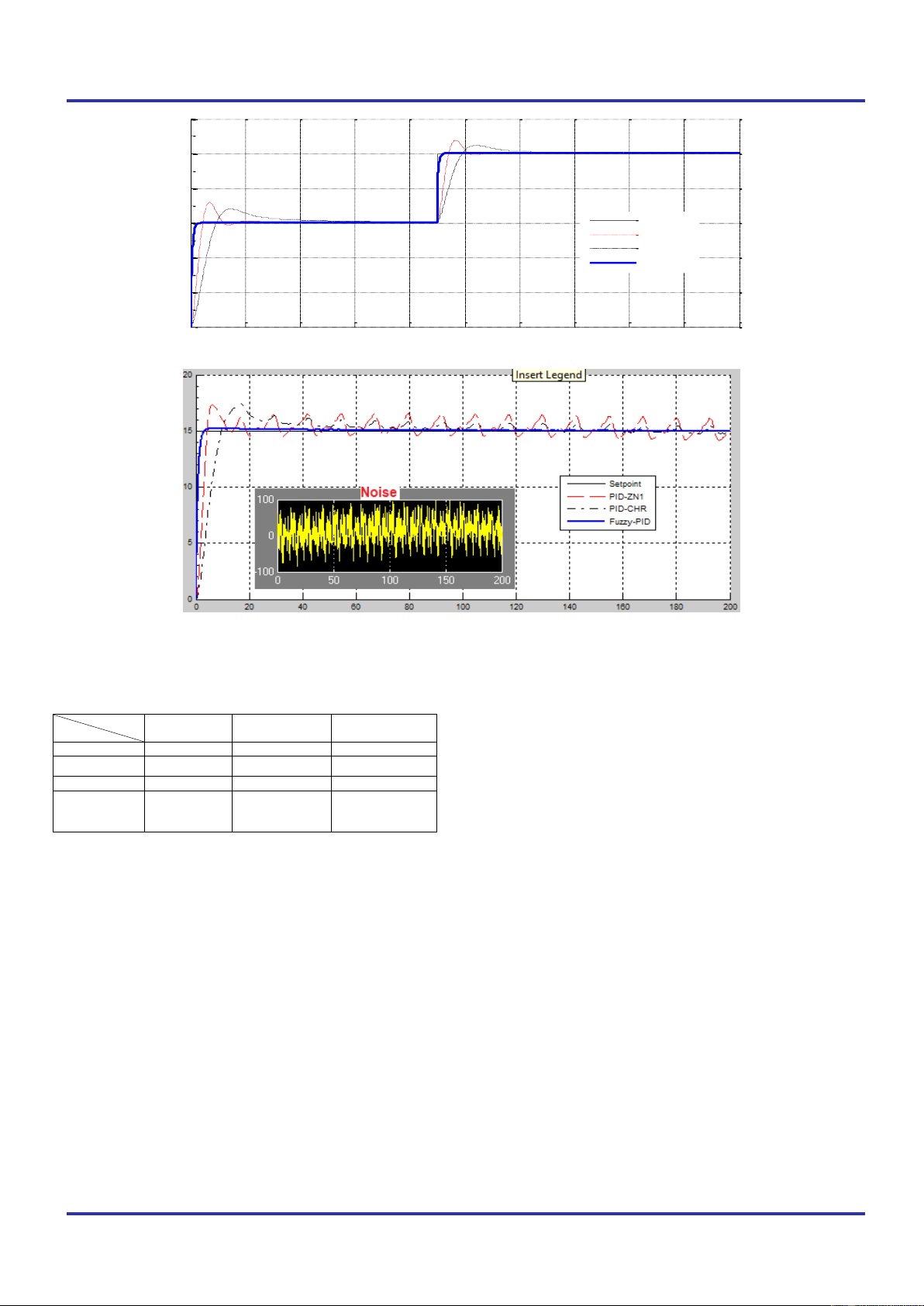
The simulation is carried out with three controllers:
Fuzzy-PID, PID-ZN1, PID-CHR. The quality control system
is evaluated through four indexes (overshoot, rise time,
steady time, steady error) in two circumstances: (a). varying
setpoint level; (b). as impacted by the bound noise with
small margin.
Fig. 3. Simulation of the fluid level coupled-tank control system using fuzzy-PID
International Journal of Engineering Research & Technology (IJERT)
ISSN: 2278-0181http://www.ijert.org
IJERTV6IS110213 (This work is licensed under a Creative Commons Attribution 4.0 International License.)
Published by :
www.ijert.org
Vol. 6 Issue 11, November - 2017
462
020 40 60 80 100 120 140 160 180 200
0
5
10
15
20
25
30 L2 [cm]
Setpoint
PID-ZN1
PID-CHR
Fuzzy-PID
Fig. 4. Response curves of the level controllers as varying setpoint level
Fig. 5. Response curves of the level controllers as having noise with small margin
The simulation results, as using PID-ZN1, PID-CHR
and Fuzzy-PID controller, is presented in Tab. 4.
Tab. 4. Performance of Fuzzy-PID controller & others
Controller
Index
Fuzzy-PID
PID-ZN1
PID-CHR
Rise time
Small, ~1.5s
Large, ~4.1s
Very large, ~8.4s
Steady time
Small, ~3.1s
Large, ~11.2s
Very large, ~8.4s
Overshoot
Not
Large, ~19.4%
Small, ~12.3%
Steady error
Eliminate, or
very small
with noise
Very small, but
large swing
with noise
Very small, but
swing with noise
The simulating results show that fuzzy-PID has the best
control quality: not overshoot, eliminating steady error, the
smallest steady time and eliminating neraly the effect of the
disturbaces, when it was compared to traditional PID
controllers.
V. CONCLUSION
This paper has presented a case study where the basic
PID controller is combined with the fuzzy logic calculator
for the nonlinear model of the liquid level of coupled-tank
system. The simulation results suggest that the fuzzy-PID
proposed controller can be applied to the liquid level control
process in the chemical industry, where noise is always
presented. The fuzzy-PID controller can improve quality of
the liquid level coupled-tank control system, increase the
process efficiency and bring economic benefit to end-user.
However, we need to study in more detail about dynamics of
actuator & sensor, according to the actual device to obtain a
more realistic control object model, which helps to control
the fluid level in coupled-tank better.
REFERENCES
[1]. Abdelelah Kidher Mahmood, Hussam Hamad Taha, Design Fuzzy
Logic Controller for Liquid Level Control, International Journal of
Emerging Science and Engineering (IJESE), Volume-1, Issue-11,
September 2013
[2]. Ahcene Boubakir, Fares Boudjema, Salim Labiod, A Neuro-fuzzy-
sliding Mode Controller Using Nonlinear Sliding Surface Applied to
the Coupled Tanks System, International Journal of Automation and
Computing, 06 (1), February 2009, 72-80.
[3]. Vasile CALOFIR, Valentin TANASA, Ioana FAGARASAN, A
backstepping control method for a nonlinear process - two coupled-
tanks, International conference on energy and environment (CIEM)
2013
[4]. MUHAMMAD NASIRUDDIN MAHYUDDIN, MOHD RIZAL
ARSHAD, Performance Evaluation of Direct Model Reference
Adaptive Control on a Coupled-tank Liquid Level System,
ELEKTRIKA, 10(2), 2008, 9-17
[5]. Parvat B. J., Jadhav V. K., Lokhande N. N., Design and
Implementation of Sliding Mode Controller for Level Control, Journal
of Electronics and Communication Engineering (IOSR-JECE)
[6]. N. Kottenstette, J. Porter, G. Karsai, and J. Sztipanovits. Discrete-time
ida-passivity based control of coupled tank processes subject to
actuator saturation. In Resilient Control Systems (ISRCS), The 3rd
International Symposium on, pages 115-120, aug. 2010.
[7]. N.B. Almutairi and M. Zribi, Sliding mode control of coupled tanks,
Mechatronics, 16(7):427 – 441, 2006.
[8]. Pawan Kumar Kushwaha and Vinod Kumar Giri, Control Strategies
for Water Level Control of Two Tank System, IJBSTR RESEARCH
PAPER VOL 1 [ISSUE 8] AUGUST 2013
[9]. Himanshu Gupta, Om Prakash Verma, Intelligent Controller for
Coupled Tank System, International Journal of Advanced Research in
Computer Science and Software Engineering, Volume 2, Issue 4,
April 2012.
[10]. Pawan Kumar Kushwaha and Vinod Kumar Giri, PID controllers for
water level control of two tank system, International Journal of
Electrical, Electronics & Communication Engineering, Vol. III Issue
VIII August 2013
International Journal of Engineering Research & Technology (IJERT)
ISSN: 2278-0181http://www.ijert.org
IJERTV6IS110213 (This work is licensed under a Creative Commons Attribution 4.0 International License.)
Published by :
www.ijert.org
Vol. 6 Issue 11, November - 2017
463









![Đề thi Kỹ thuật lập trình PLC: Tổng hợp [Năm]](https://cdn.tailieu.vn/images/document/thumbnail/2026/20260121/lionelmessi01/135x160/85491768986870.jpg)

![Đề thi cuối học kì 1 môn Máy và hệ thống điều khiển số năm 2025-2026 [Kèm đáp án chi tiết]](https://cdn.tailieu.vn/images/document/thumbnail/2025/20251117/dangnhuy09/135x160/4401768640586.jpg)


![Tự Động Hóa Thủy Khí: Nguyên Lý và Ứng Dụng [Chi Tiết]](https://cdn.tailieu.vn/images/document/thumbnail/2025/20250702/kexauxi10/135x160/27411767988161.jpg)


