

* Corresponding author. Tel/Fax: +98 (51) 47224994; Tel.: +98 (915) 6133767
E-mail address: ghasemian.abbas66@yahoo.com (A. Ghasemian Zeidanlu)
© 2017 Growing Science Ltd. All rights reserved.
doi: 10.5267/j.ccl.2017.3.003
Current Chemistry Letters 6 (2017) 117–124
Contents lists available at GrowingScience
Current Chemistry Letters
homepage: www.GrowingScience.com
Synthesis of ethyl-3-amino-1-aryl-1H-benzo[f]chromeme-2-carboxylate
derivatives promoted by DMAP
Abbas Ghasemian Zeidanlua*, Safoora Sheikhb, Jalil Laria and Hooshang Vahedia
aDepartment of Chemistry, Payame Noor University, Mashhad, 91735-433, Iran
bDepartment of Chemistry, Faculty of Science, University of Birjand, Birjand, 97179-414 Iran
C H R O N I C L E A B S T R A C T
Article history:
Received January 2, 2017
Received in revised form
March 1, 2017
Accepted March 21, 2017
Available online
March 21, 2017
An efficient route, convenient and environmentally friendly procedure for the synthesis
chromenes derivatives have been developed via a three-component coupling and one-pot
reactions of various aromatic aldehyde with malononitrile or ethyl cyanoacetate and phenols
in the presence N,N-dimethylpyridin-4-amine (DMAP) in reflux conditions. In simple reaction
conditions, the use of DMAP is explored as an easy workup and a green catalyst for the one-
pot three-component synthesis ethyl 3-amino-1-aryl-1H-benzo[f]chromene-2-carboxylate
derivatives.
© 2017 Growing Science Ltd. All rights reserved.
Keywords:
Benzochromenes
Three-component reaction
DMAP
1. Introduction
Chromenes derivatives are very important biologicals that occur widely in natural products.
Chromenes derivatives significant heterocycles that are known to have multiple biological activities1
for instance, antibacterial,2 antitumor,3 sex pheromonal,4 antimicrobial,5 TNF-a inhibitory,6 anticancer,
7antifungal,8 estrogenic,9 antiviral10 and anti-HIV.11 Such compounds have also been applied in
pigments, and insecticides12 and therefore, a number of methods and catalysts have been reported for
the synthesis of chromene derivatives such as, a [1-(n-butyl)-3-methylimidazolium hydroxide ([bmim]-
OH)]/H2O/reflux,13 Triton B/EtOH/rt,14 K
2CO3/H2O/MW irradiation,15 MCM-41-NH2/H2O/80oC,16
CTACl/ H2O/reflux,17 CTABr/us/H2O/rt,18 K
3PO4.3H2O/solvent free,19 piperazine/neat/ MW
irradiation,20 tetramethylguanidine/neat/rt,21 H
14[NaP5W30O110]/ H2O/reflux,22 CuSO4.5H2O/
H2O/reflux,23 methanesulfonic acid/CH3CN/reflux,24 KF-Al2O3/ EtOH/80oC,25potassium phthalimide-N-
oxyl/ H2O/reflux,26 the nanostructured diphosphate Na2CaP2O7/ H2O/reflux,27 nano polypropylenimine
dendrimer (DAB-PPI-G1) /solvent free/110˚C,28 DBU,29 KF/solvent free/110˚C,30 and
Ca(OH)2/MeOH/rt. 31Many of the above methods have their own advantages. However, several of these
methods suffer from certain drawbacks such asuse of expensive catalyst, prolonged reactions times,
use of volatile or hazardous organic solvents, tedious workup conditions, use of extra energy source,
118
employment of large amount of catalystand harsh reaction conditions. The present work represents a
new method for the synthesis of chromene derivatives using DMAP as catalyst and co-solvent
(additive), as a rapid convenient method with suitable yields. The point is which lead to higher purity
of the products in compare with conventional method.
2. Results and Discussion
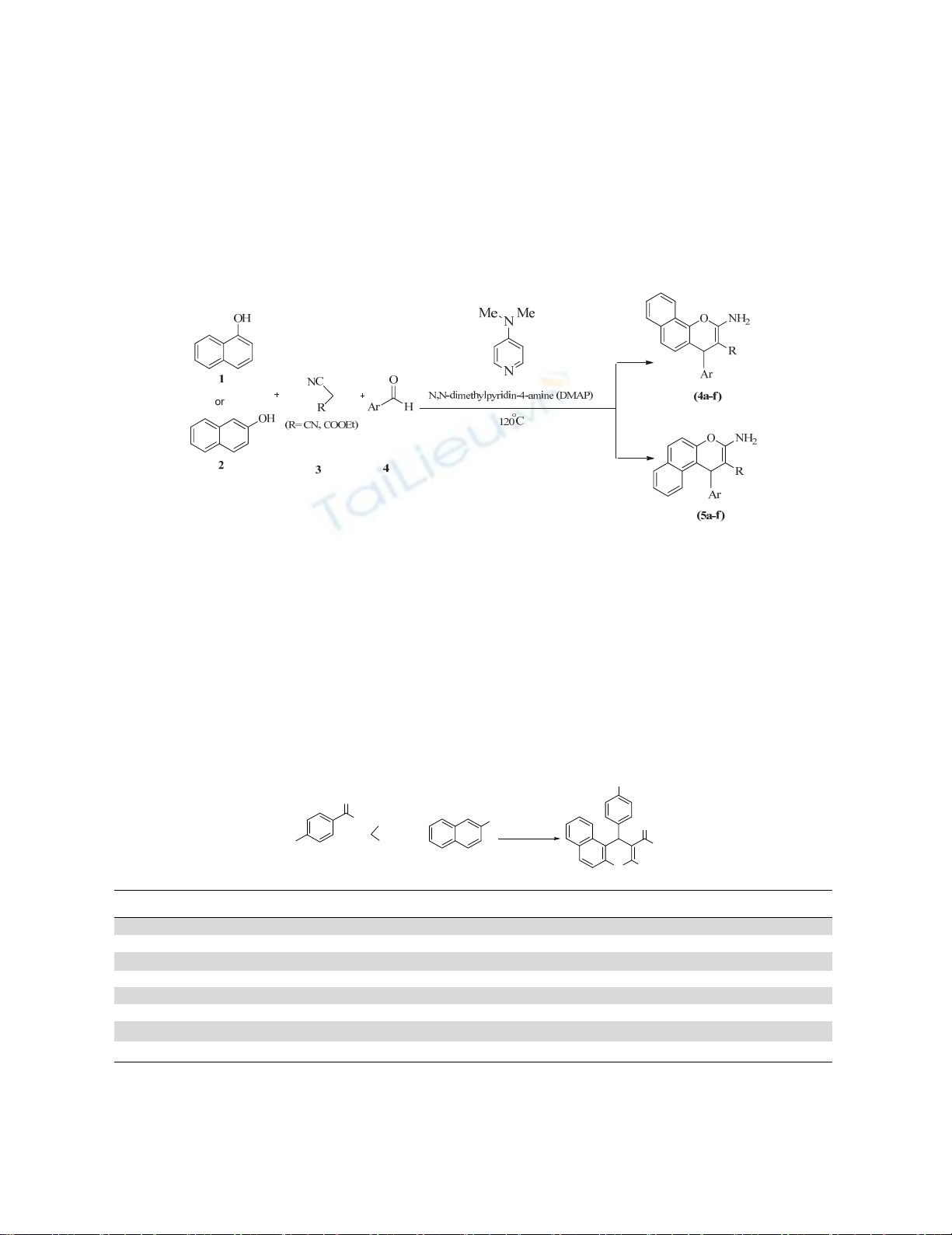
In continuation of our efforts toward the development of greener methodologies,32-38 we report here
in a simple, clean, and environmentally friendly process for the synthesis of ethyl-3-amino-1-aryl-1H-
benzo[f]chromene-2-carboxylate derivatives by reaction of various aromatic aldehydes with
malononitrile or ethyl cyanoacetate and phenols (α-naphthol or β-naphthol ) in the presence DMAP, as
catalyst and co-solvent (Scheme 1).
Fig. 1. One-pot synthesis of ethyl 3-amino-1-aryl-1H-benzo[f]chromene-2-carboxylate derivatives
promoted by DMAP.
In the beginning, we chose three-componentreaction via ethyl cyanoacetate (1 mmol), p-
nitrobenzaldehyde (1 mmol), and 2-naphthol (1 mmol) (5a) as a model to determine the optimal
reaction conditions. Reaction was performed in the presence of varying amounts of DMAP and at
different temperatures. The best result is achieved in 0.5 mmol of DMAP at 120°C (Table 1, Entry 3).
Also reaction was carried out in absence of the catalyst and was not observed product even after 5 h
(Table 1, Entry 3). A summary of the optimization experiments is provided in Table 1.
Table. 1. Screening of the Reaction Conditions for the Synthesis of (5a).
O
H
+
N
O
2
COOEt
CN
OH
+DMAP
O
OE
t
O
NH
2
NO
2
reflux
Entry DMAP (mol %) Temperature (˚C) Time (min) Yield1 (%)
1 10 100 20 76
2 10 110 20 80
3 10 120 20 91
4 10 130 20 85
5 15 120 20 90
6 5 120 20 81
7 10 rt 300 2
_
8 _ 120 300 2
_
1 Isolated yields; 2 No reaction.
A. Ghasemian Zeidanlu et al. / Current Chemistry Letters 6 (2017)
119
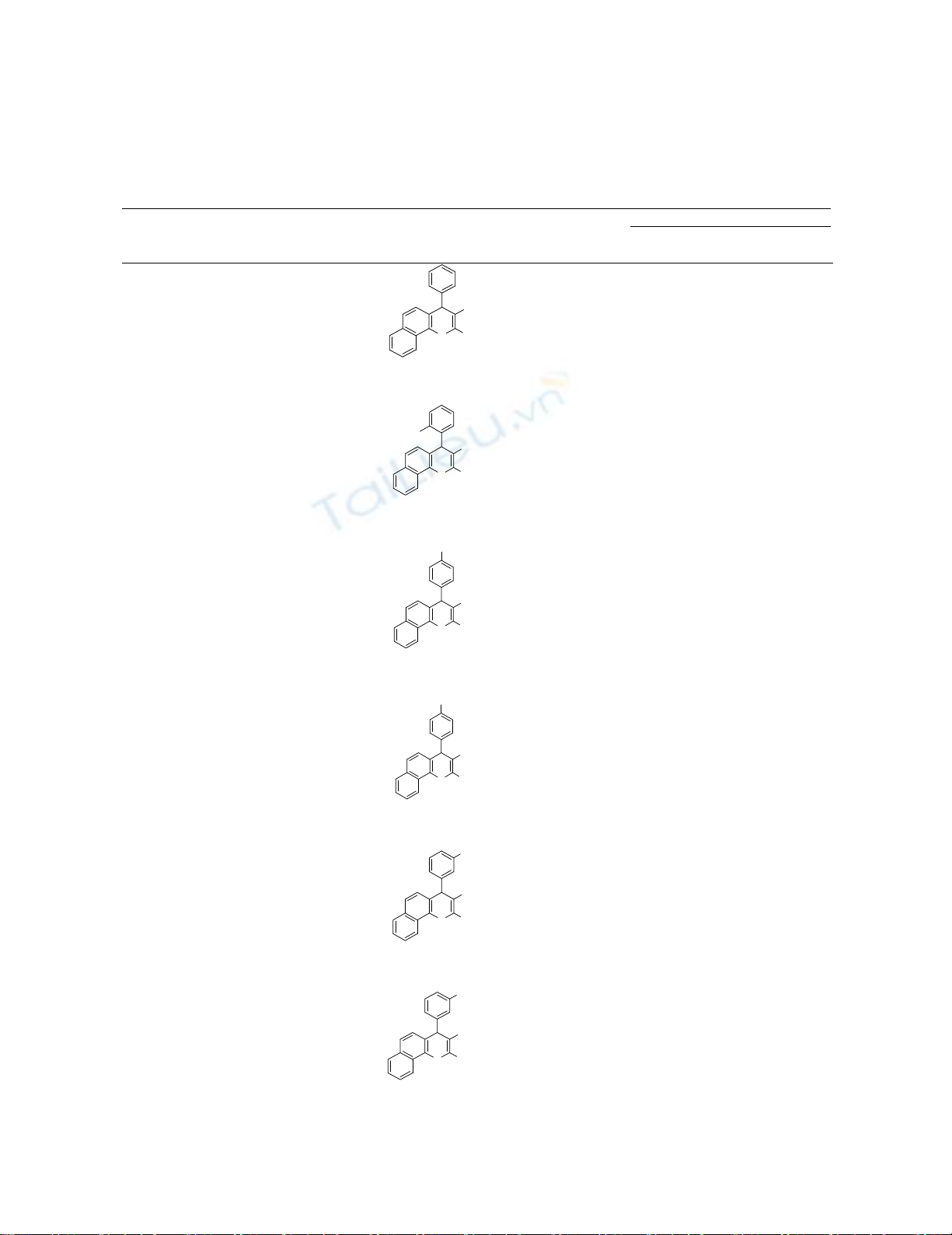
After optimization of the reaction conditions, we studied the generality of these conditions to other
substrates. By using this method, different kinds of various aromatic aldehydes compounds were
reacted with malononitrile or ethyl cyanoacetate and phenols to produce the corresponding chromenes
derivatives under reflux conditions (Table 2).
Table. 2. One-pot synthesis of ethyl-3-amino-1-aryl-1H-benzo[f]chromeme-2-carboxylate
derivatives under reflux conditions.
Entry Ar Phenol R Products Time
(min)
Yield(%)a Mp˚C
Found Reported
1
C6H5
1-naphthol
CN
ONH
2
CN
4a
80
89
213-212
212-21319
2
2-ClC6H5
1-naphthol
CN
ONH
2
CN
Cl
4b
45
93
233-234
234-23519
3
4-ClC6H5
1-naphthol
CN
ONH
2
CN
C
l
4c
30
91
233-234
231-23219
4
4-FC6H5
1-naphthol
CN
ONH
2
CN
F
4d
100
79
230-231
231-23219
5
3-
NO2C6H5
1-naphthol
CN
ONH
2
CN
N
O
2
4e
35
91
208-210
212-21319
6
3-
NO2C6H5
1-naphthol
CO2Et
ONH
2
CO
2
Et
NO
2
25
90
198-200
198-20014

120
4f
7
4-ClC6H5
2-naphthol
CN
ONH2
CN
C
l
50
93
206-207
207-20826
5a
8
4-ClC6H5
2-naphthol
CO2Et
ONH
2
CO
2
Et
C
l
5b
30
86
187-188
NEW
10
4-BrC6H5
2-naphthol
CO2Et
ONH
2
CO
2
Et
Br
5d
15
93
203-204
204-20628
11
4-OHC6H5
2-naphthol
CO2Et
ONH
2
CO
2
Et
OH
5e
180
53
130-131
129-13028
12
4-MeC6H5
2-naphthol
CO2Et
ONH
2
CO
2
Et
Me
5f
30
90
197-198
NEW
1 Isolated yields
Finally, to show the merit of the present work, we summarized the results for the synthesis of
chromenesderivatives obtained by other workers (Table 3). In contrast with other existing methods,
the present methodology offers several advantages such as higher yields, a simple procedure, easy
synthesis, simple work-up, does not require either hazardous acids or harsh reaction and greener
conditions using DMAP as an efficient catalyst (Table 3).
3. Conclusions
In summary,we have developed an efficient and environmentally friendly method for the
synthesis of 2-amino-2-chromenes in high yield, by use DMAP, as catalyst and co-solvent (additive).
In contrast to the existing methods using potentially hazardous catalysts/additives,these procedures
provide several advantages such as cleaner reactions, does not require either hazardous acids or harsh
reaction, easier work-up, and an eco-friendly and promising strategy.

A. Ghasemian Zeidanlu et al. / Current Chemistry Letters 6 (2017)
121
Table. 3. Comparison of methods for the synthesis of chromenes derivatives.
Entry Conditions Time
(min)
Yield
(%)
ONH
2
CN
C
l
4c
DMAP/120˚C (this work)
K3PO4.3H2O/100 oC /solvent-free19
potassium phthalimide-N-oxyl /water/reflux26
30
7
10
91
50
93
ONH
2
CN
N
O
2
4e
DMAP/120˚C (this work)
Methanesulfonic acid/CH3CN/reflux24
CTABr/H2O/ultrasonic/rt18
Na2CaP2O7/water/reflux27
KF/110˚C/ solvent-free30
35
240
40
300
5
91
90
93
85
89
ONH
2
CO
2
Et
NO
2
5c
DMAP/120˚C (this work)
KF-Al2O3/EtOH/80 oC 25
CTABr/H2O/ultrasonic/rt18
K3PO4.3H2O/100 oC /solvent-free19
Nano polypropylenimine dendrimer
(DAB-PPI-G1) /110 oC / Solvent-free28
45
300
150
6
4
93
86
80
78
5
Acknowledgements
The authors are thankful to research council of Payame Noor University of mashhad and Hakim
Sabzevari University for financial support.
4. Experimental
4.1. Generel
All the chemicals required for the synthesis of cheromene derivatives were purchased from Merck
Company. A Bruker (DRX-400 AVANCE) NMR instrument was used to record the 1H NMR and 13C
NMR spectra. All NMR spectra were determined in CDCl3 at ambient temperature; chemical shifts
have been expressed in ppm. The IR spectra were recorded on a Shimadzu 8400 instrument (the samples
as KBr disks for the range 400-4000 cm-1). Melting points were recorded with Electrothermal 9100
apparatus. Thin-layer chromatography was performed on Kieselgel 60 GF254 and visualization was
accomplished by UV Lamp or iodine flask. Elemental analysis was carried out on a Thermo Finnigan
Flash EA microanalyzer, and the results were found to match satisfactorily with the calculated and
observed values.
4.2. General procedure for the synthesis of cheromene derivatives (4a-f and 5a-f).
To a mixture of various aldehydes, 1-naphthol or 2-naphlhol (5 mmol), ethyl 2-cyanoacetate or
malononitril (5 mmol) and DMAP (0.5 mmol) in reflux conditions was stirred magnetically at 120 C



![Câu hỏi ôn tập Môi trường và phát triển [năm]](https://cdn.tailieu.vn/images/document/thumbnail/2025/20250710/kimphuong1001/135x160/2361752136158.jpg)
![Câu hỏi ôn tập Con người và môi trường: Tổng hợp [mới nhất/chuẩn nhất]](https://cdn.tailieu.vn/images/document/thumbnail/2025/20250704/kimphuong1001/135x160/8741751592841.jpg)
![Câu hỏi ôn tập môn Môi trường [chuẩn nhất]](https://cdn.tailieu.vn/images/document/thumbnail/2025/20250702/kimphuong555/135x160/62401751441591.jpg)
![Tài liệu tập huấn quản lý và bảo tồn đất ngập nước [mới nhất]](https://cdn.tailieu.vn/images/document/thumbnail/2025/20250627/vijiraiya/135x160/30351751010876.jpg)



![Giáo trình Tài nguyên năng lượng và bảo vệ môi trường - Trường CĐ Cơ điện Hà Nội [Mới nhất]](https://cdn.tailieu.vn/images/document/thumbnail/2026/20260323/lionelmessi01/135x160/8121774378783.jpg)
![Đề cương bài giảng Kỹ thuật xử lý môi trường - Trường Cao đẳng Cơ điện Hà Nội [Chuẩn nhất]](https://cdn.tailieu.vn/images/document/thumbnail/2026/20260323/lionelmessi01/135x160/75051774429892.jpg)


![Giáo trình Bảo vệ môi trường (Nghề Bảo vệ thực vật CĐ/TC) - Trường Cao đẳng Gia Lai [Mới Nhất]](https://cdn.tailieu.vn/images/document/thumbnail/2026/20260224/hoacattuong2026/135x160/61741772002861.jpg)
