http://www.iaeme.com/IJMET/index.asp 1447 editor@iaeme.com
International Journal of Mechanical Engineering and Technology (IJMET)
Volume 10, Issue 03, March 2019, pp. 1447-1455. Article ID: IJMET_10_03_146
Available online at http://www.iaeme.com/ijmet/issues.asp?JType=IJMET&VType=10&IType=3
ISSN Print: 0976-6340 and ISSN Online: 0976-6359
© IAEME Publication Scopus Indexed
THE ROLE OF HIGH THROUGHPUT
SATELLITE AS SKY HIGHWAY
INFRASTRUCTURE TO SUPPORT THE
ACCELERATION OF INTERNET
ENTRY INTO VILLAGES IN INDONESIA
Surya Hidayat, Tiswa Ramdani, Ibnu Fajar Alam, Sfenrianto Sfenrianto and Emil
Robert Kaburuan
Information Systems Management Department,
BINUS Graduate Program – Master of Information System Managements
Jakarta, Indonesia 11480
ABSTRACT
The use of the internet has become a very important need, and the development of
information technology continues to grow indefinitely. As an archipelagic country, the
connectivities of satellite infrastructure networks connect all corners of the country in
Indonesia, which cannot be reached through land networks. The existence of High
Throughput Satellite (HTS) technology that has been launched in Indonesia it is
expected to support government programs to be able to open access to the entire village.
It will be of great strategic value for economic acceleration and management of
development, as well as the internet and social media that can open up wider marketing
space for micro-entrepreneurs to develop their businesses in the region. This paper
presents that lately call the sky toll with High Throughput Satellite (HTS) technology
can be the best solution, especially in supporting government programs in accelerating
the internet into the village.
Key words: high throughput satellite, internet, connectivity, infrastructure.
Cite this Article Surya Hidayat, Tiswa Ramdani, Ibnu Fajar Alam, Sfenrianto
Sfenrianto and Emil Robert Kaburuan, the Role of High Throughput Satellite as Sky
Highway Infrastructure to Support the Acceleration of Internet Entry into Villages in
Indonesia, International Journal of Mechanical Engineering and Technology, 10(3),
2019, pp. 1447-1455.
http://www.iaeme.com/IJMET/issues.asp?JType=IJMET&VType=10&IType=3
1. INTRODUCTION
The development of information and communication technology that is stepping into high-tech
that continues to grow, which is predicted to provide many changes to people's lifestyles in

The Role of High Throughput Satellite as Sky Highway Infrastructure to Support the Acceleration
of Internet Entry into Villages in Indonesia
http://www.iaeme.com/IJMET/index.asp 1448 editor@iaeme.com
implementing industry 4.0 is also predicted to further develop Internet of Things (IoT)
technology to a higher level that also enters the smart city concept. It will create new values
that will further develop the economy. like the internet and social media that can open a wider
marketing space for micro-entrepreneurs to develop their business in the region and also the
village budget reporting system that must now be done online. An increase in regional internet
data usage in Indonesia which continues to grow and requires a large capacity of traffic and
data rates.
As an archipelagic country, Indonesia, with its wide spread area, the need for internet can
reach remote villages because some of its inhabitants are in areas that are still not affected by
land network infrastructure via cable or fiber optics. Thus, some residents find it difficult to
access internet facilities, and disparities in the digital world so the need for using infrastructure
networks using satellites is very important for their use in remote areas. In developing countries,
basic communication using satellite needs to be provided for large populations that do not live
in cities [9]. It can help if this happens, and it will change the world [10].
The next generation satellite system uses throughput technology can also reduce costs per
Mbps, in meeting higher capacity Satellite High Throughput (HTS) in its coverage area [1].
Reporting from the official website of the Indonesian government through the ministry of
communication and informatics has had an integrated broadband village program that promises
the development of Internet access in several districts and opens opportunities for developers
to provide digital applications that are relevant to village potential. The government prioritizes
applications that have content related to agriculture, fishermen and inland. The application can
be based on a website, or a mobile device such as a smart phone and tablet. In addition to
Internet access and its digital applications, Integrated Broadband Village also promises the
availability of consumer devices that are in accordance with the characteristics of local residents
to empower village potential, and will continue to be developed in the coming years.
By launching HTS satellites, high-speed internet, this device has the advantage of providing
internet services to remote areas. HTS has a performance to channel information far better than
conventional satellites. HTS can accelerate the target of broadband connections in Indonesia to
remote areas so that it can accelerate the target of broadband connections in Indonesia to remote
areas which will certainly increase the opportunity for Indonesia to take advantage of the
benefits of digital economy with high-speed satellite internet use for schools, health centers,
villages, police stations, universities, which are not served by the internet in remote areas.
2. STUDY LITERATURE
Satellite is an object that is placed and circulated in space and around the earth on its axis. Then
the signal is amplified, the frequency is changed and the signal is sent back through the
downlink frequency to the earth station area [3]. This is important and needed in networks in
wide area.
With the advancement of satellite communication technology in its development has led to
new technologies 'High Throughput Satellite' (HTS) systems. And there are already several
satellites (HTS) launched in recent years and also some will continue to orbit in the next few
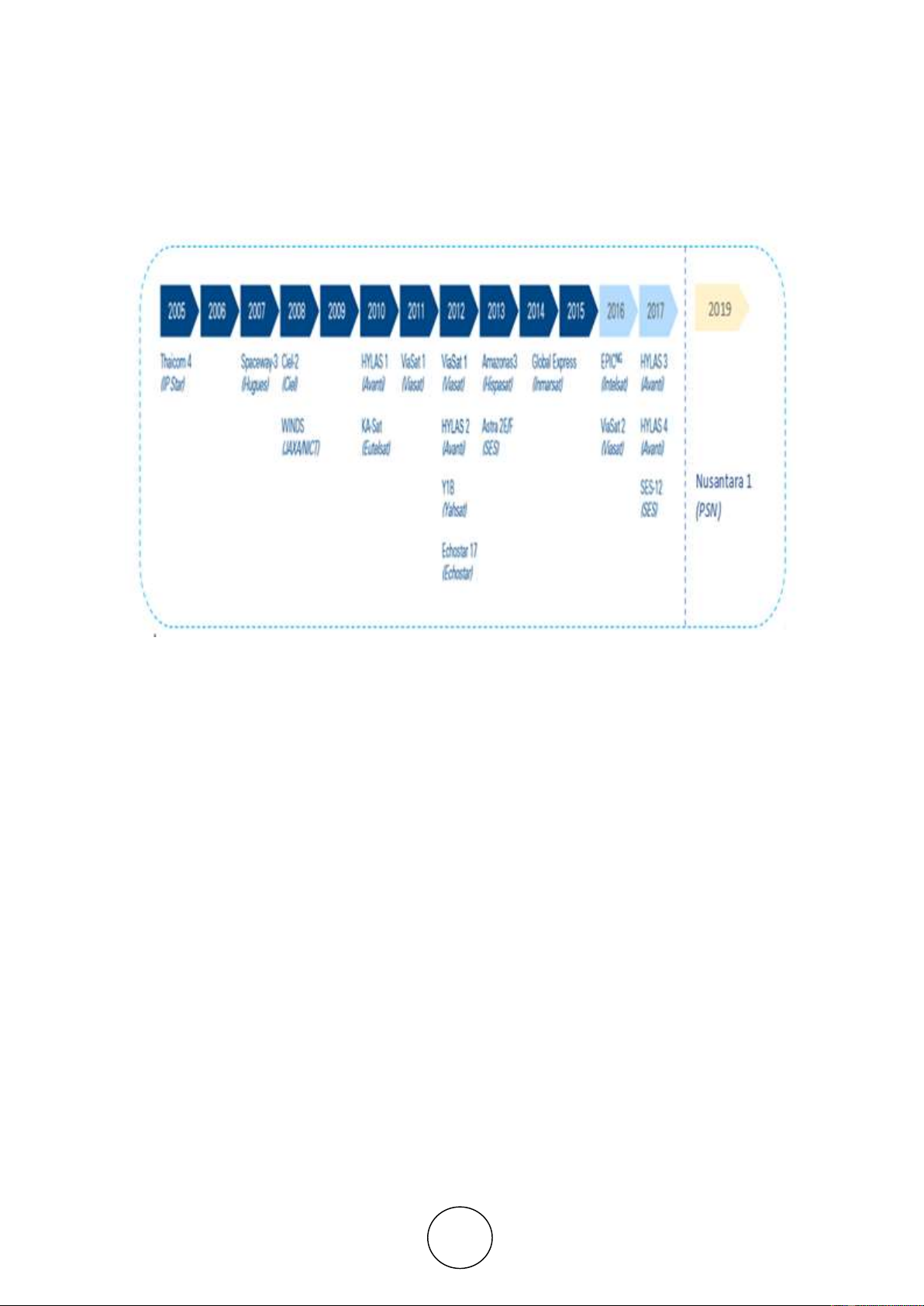
years including in Indonesia (see figure 1) [6]. This satellite supports the diverse needs of users
and the use of connecting unconnected to provide safe and robust communication for industry,
SMEs and all end users.
HTS is different from ordinary satellite communications or conventional ones in some
ways, one of which is the use of higher capacity blocks / transponders around 100 MHz even
more by using gateway stations on earth that support multiple beams (average with 5 Gbps
capacity usage) throughput for all remote stations and a technique that is quite capable of
Surya Hidayat, Tiswa Ramdani, Ibnu Fajar Alam, Sfenrianto Sfenrianto and Emil Robert
Kaburuan
http://www.iaeme.com/IJMET/index.asp 1449 editor@iaeme.com
overcoming rain attenuation, especially in band frequency [5]. It also offers more spectrum set
on bandwidth (higher than 1.1 GHz) [5]. requirement); high per-station throughput for all
remote stations; and sophisticated techniques to overcome rain attenuation, Particulary for ka-
band systems [5]. It is offer more bandwidth-assigned spectrum (higher than 1.1 GHz) [5].
Figure 1. Major High Throughput Commercial Satellites Launches, 6
3. RESEARCH METHODE
The Research methodology used in The Role Of High Throughput Satellites As Sky Highway
Infrastructure To Support The Acceleration Of Internet Entry Into Villages In Indonesia a tool
for the documentation process, and exploration of literature studies as a guide for obtaining a
process design covering several ways, descriptive qualitative method is used to interpret and
tell the data requested with what has happened, direct observations made to the location
(observation) and involved grounded theory in order to see first-hand the processes of work
design in satellite information systems that are related to the material needed in the preparation
of research such as studying documentation. Library search, namely research conducted by
exploring relevant libraries and related to the research topic under study.
4. DISCUSSION
4.1. The Indonesian Internet Connectivity
The rapid development of social media and e-commerce in Indonesia has also increased the use
of internet data and also spread out use of smartphones in recent years. The features of various
applications such as online shopping also make the need for communication and interaction
between buyers and sellers and sharing information easier. In addition, information technology
infrastructure is part of the production network, because some content is also operated through
cellular applications and websites and its geographical settings are also important for e-
commerce development [7].
The Role of High Throughput Satellite as Sky Highway Infrastructure to Support the Acceleration
of Internet Entry into Villages in Indonesia
http://www.iaeme.com/IJMET/index.asp 1450 editor@iaeme.com
Because the Internet continues to grow to become one of the needs, making it very important
to be able to ensure that infrastructure continues to function properly. The infrastructure is from
an internet connection and may experience physical disturbances or damage due to earthquakes,
hurricanes and natural disasters and other physical attacks [8]. To support government programs
in accelerating the internet to reach all corners of the village in Indonesia, of course, the
infrastructure network model is not only land-based, but satellite infrastructure networks are
now developing as technology advances with geographical networks originating from the
Internet backbone topology.
4.2. The Indonesian HTS Transponder Frequency Plan Analysis
Basically, Indonesia already has several communication satellites, each of which has been
regulated by its orbit slot and conventional satellites GSO (Geo Stationer Orbit) which are
above Indonesia using C-Band and Ku-Band frequency bands, both the Indonesian government
and private companies in Indonesia continues to procure HTS satellites, from the Indonesian
government is procuring Multifunctional satellites "Satria" (Greater Indonesia Satellite) which
are targeted for completion in 2020 and from the private sector to launch HTS technology
satellites in lieu of the Palapa D satellite named Nusantara 2 which is targeted to launch in May
2020, and what had already begun to be felt was PSN's HTS satellite, which was named satellite
Nusantara 1 launched on 22 February 2019.
Nusantara 1 satellite is one of the first broadband satellites in Indonesia equipped with High
Throughput Satellite (HTS) technology that can provide high speed internet services with a
much greater capacity, compared to conventional satellites in the country, from the PSN and
seconds sites. com. Nusantara 1 has a capacity of up to 15 Gbps or about 3 times the capacity
of conventional satellites total need for broadband satellite is currently 189 transponders.
However, only 57% of them, or 103 transponders, are capable of being served by national
operators. The remaining 86 transponders are served by foreign operators that have orbit slots
above the Indonesian territory or are close to Indonesia. The Nusantara1 satellite produced by
Space System Loral (SSL), a technology company from the United States, will be launched at
Cape Canaveral, the United States using Falcon-9 launch rockets from the Space-X company.
Nusantara Satu is also equipped with Next Generation Electric Propulsion technology that
makes satellites become cost effective and efficient because the weight of the satellite becomes
very light and of course makes investment costs more affordable. Around 25 million
Indonesians are targeted to get access to the internet by operating Nusantara1 Satellite.

Surya Hidayat, Tiswa Ramdani, Ibnu Fajar Alam, Sfenrianto Sfenrianto and Emil Robert
Kaburuan
http://www.iaeme.com/IJMET/index.asp 1451 editor@iaeme.com
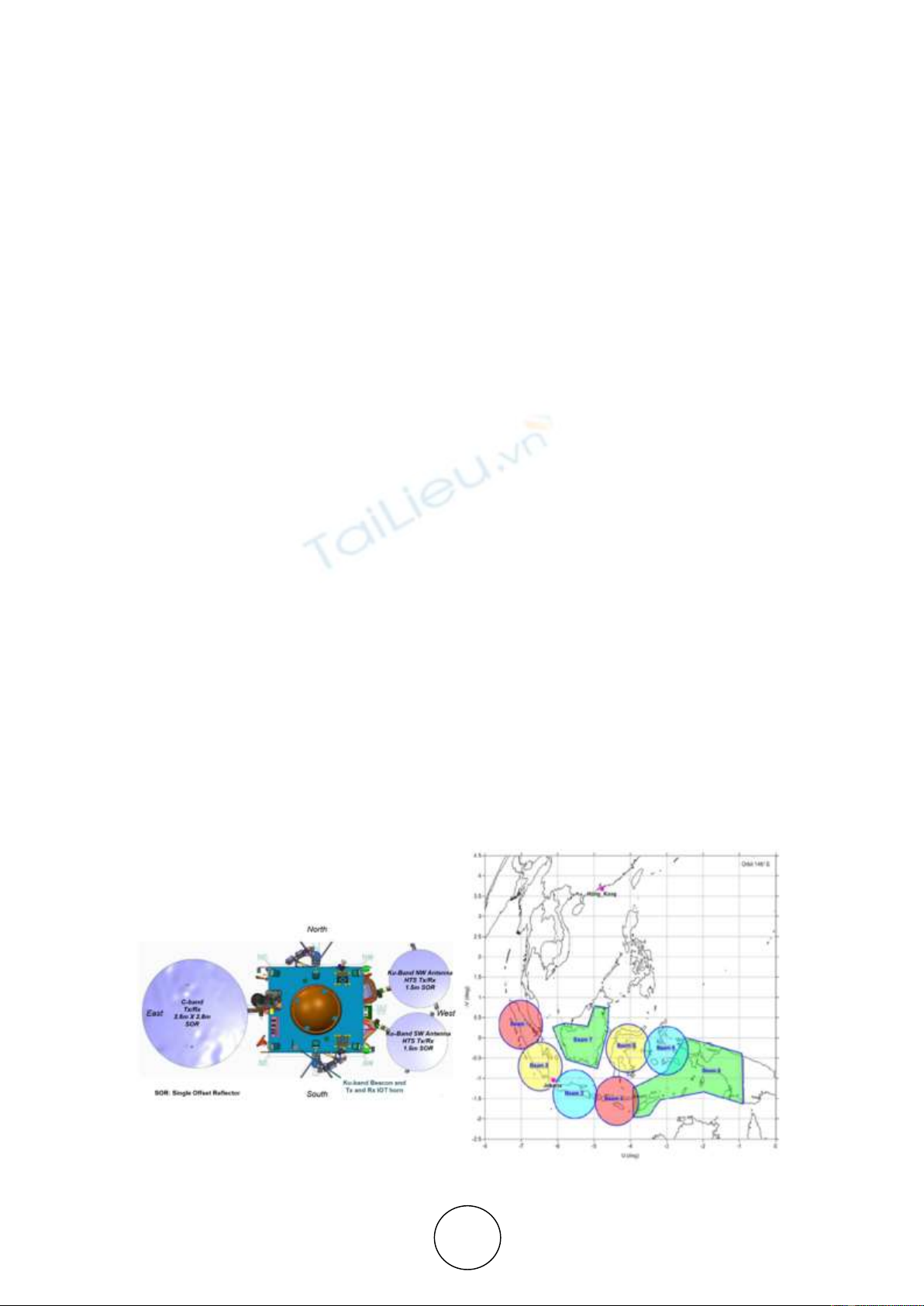
Figure 2. Nusantara 1 Ku Band HTS Area Coverage [20]
The coverage of Nusantara1 Satellite covers all regions of Indonesia to Southeast Asia.
After sliding, this satellite will be placed in the orbit slot 146 degrees east longitude, just above
Papua. High Throughput Satellite (HTS) technology, dividing the coverage area into several
spot beams, with more efficient frequency use (frequency re-use), making bandwidth capacity
far greater than conventional satellites for the same spectrum allocation. With the operation of
Nusantara One, it is considered to be very beneficial for the people in various parts of the region
by gaining access to information technology. Nusantara 1 satellite will be used for the purposes
of the Government which will disseminate the internet to various villages in Indonesia. In
addition, the satellite is also used to strengthen PSN's retail services through my Ubiqu and
Sinyalku products. Currently around 3,000 villages have been connected to Ubiqu. Expected at
the end of 2019.
Ku-Band frequencies Analysis:
Forward
Uplink: 13.750 to 14.800 GHz
Downlink: 12.250 to 12.678 GHz
Return
Uplink: 14.070 to 14.430 GHz
Downlink: 10.970 to 12.700 GHz
18 transponders providing coverage over Indonesia via 8 spot beams (beams 1-8)
Gateway 1 & 2 on the NW antenna
Gateway 1 in Jakarta supports all 8 beams (8 FWD& 2 RTN transponders)
Gateway 2 in Hong Kong supports beams 1-6 (6 FWD & 2 RTN transponders)
Spot beams 2, 4, 6 & 7 on NW antenna
Spot beams 1, 3, 5 & 8 on SW antenna
Ku-band Active Receive Equipment
Two 1.5 m Single Offset Reflector (SOR) Antennas for Indonesia coverage
8:8 NW LNAs for GW 1 & 2 and Beams 2, 4, 6 & 7
5:4 SW LNAs for Beams 1, 3, 5 & 8
Down converters:
FWD: 3:2 2.05 GHz, 3:2 1.3 GHz, 2:2 1.8 GHz, 2:2 2.025 GHz, 2:2 1.5 GHz
RTN: 3:2 3.30 GHz, 3:2 2.80 GHz, 2:2 1.70 GHz, 2:2 1.50 GHz
60, 130, 140, 144 & 150 MHz Channel Filters
Ku-band Active Transmit Equipment
FWD: 14:14 150-W Direct Radiation Cooled (DRC) LCTWTAs, 12 Dual and 2
Single EPC
RTN: 4:4 45-W Single EPC Conduction Cooled LCTWTAs
FWD: 4 x 1 channel, 4 x 2 channel & 1 x 3 channel OMUXs
RTN: 3 x 1 channel, & 1 x 3 channel OMUXs
4.3. Internet Connection with Indonesian Satellite