1
CODI3-03
THE TREND OF FOREIGN DIRECT OF FORREIGN DIRECT INVESTMENT
CAPITAL MOVEMENT AND VIETNAM’S POLICY RESPONSE
The fact that the global value chain is broken, difficult to recover due to the heavy impact of the
Covid-19 pandemic, along with the increasing conflicts and trade tensions between major countries,
has had a significant impact on the trend of investment movement around the world. With many
advantages such as a stable economy and politics, a large consumption market and an abundant labor
force with competitive costs compared to other countries in the region, the ability to respond to
epidemics well…, Vietnam is expected to have many opportunities to get foreign investment inflows
in the coming period. However, in the context of fierce competition between countries, in order to
receive this redirected capital flow, we need to be aware of the existing challenges and have a strategy
to effectively attract foreign direct investment (FDI) inflows. In the article, I analyze the trend of
investment capital’s movement in the world, advantages and difficulties when attracting redirected
FDI flows; and propose some solutions for Vietnam to receive this new FDI inflow in the context of
the Covid-19 pandemic.
Keywords: Trends, investment capital movement, policy, foreign direct investment, Vietnam.
XU HƯỚNG DỊCH CHUYỂN VỐN ĐẦU TƯ TRỰC TIẾP NƯỚC NGOÀI VÀ PHẢN
ỨNG CHÍNH SÁCH CỦA VIỆT NAM
Chuỗi giá trị toàn cầu bị đứt gãy, khó hồi phục bởi tác động nặng nề của đại dịch Covid-19,
cùng với những mâu thuẫn, căng thẳng thương mại ngày một gia tăng giữa các nước lớn đã tác động
không nhỏ đến xu hướng dịch chuyển vốn đầu tư trên toàn thế giới. Với nhiều lợi thế như nền kinh tế
và chính trị ổn định, thị trường tiêu thụ lớn và lực lượng lao động dồi dào với chi phí cạnh tranh so
với các nước trong khu vực, khả năng ứng phó với dịch bệnh tốt… Việt Nam được kỳ vọng là một
quốc gia có nhiều cơ hội để đón dòng vốn đầu tư nước ngoài trong giai đoạn tới. Tuy nhiên, trong bối
cảnh các quốc gia cạnh tranh khốc liệt, để đón nhận dòng vốn chuyển hướng này chúng ta cần nhận
thức được những thách thức hiện hữu và có chiến lược nhằm thu hút hiệu quả dòng vốn FDI. Bài viết
phân tích xu hướng dịch chuyển vốn đầu tư trên thế giới; những thuận lợi, khó khăn khi thu hút dòng
vốn FDI chuyển hướng và đề xuất một số giải pháp cho Việt Nam để tiếp nhận dòng vốn FDI mới này
trong bối cảnh đại dịch Covid-19.
Từ khóa: Chính sách, dịch chuyển vốn đầu tư, vốn đầu tư trực tiếp nước ngoài, Việt Nam, xu
hướng.
1. TRENDS IN THE MOVEMENT OF FOREIGN DIRECT INVESTMENT CAPITAL IN
THE WORLD

2
The wave of FDI capital’s movement appeared many years ago due to the tendency to
protect production and the impact of the economic crisis, which led many countries to encourage
enterprises to move capital to the domestic market to solve employment problems. The main changes
to the dynamics of locating production abroad (Offshoring) compared to moving production to nearby
countries (Nearshoring) are happening and will continue to happen in the future due to political
pressures, automation and economic considerations. This will change the way investors choose
investment locations from moving production from one location to another to finding ways to adapt.
Therefore, the global production network will shift from a country with a lot of unskilled labor and
resources to a country with many research centers, more skilled and highly specialized workers and
closer to the consumer market. New production methods are formed that do not require a lot of labor
resources and consume too much energy, resources, even freight...
There have been many signs of the movement of FDI out of the Chinese market in recent years.
According to investment consulting firm AT Kearney (2019), China has been relegated from 3rd (in
2017) to 7th (in 2019) among the world's best FDI investment locations (the lowest ever); reflects the
decline of China's attractiveness to investors. According to Nomura Group (2019), from the beginning
of 2018 to August 2019, there were 56 international enterprises leaving China to manufacture in other
countries; in which, 26 enterprises chose Vietnam, 11 went to Taiwan, 11 went to Thailand, 3 went to
India... A 2019 survey by the American Chamber of Commerce in China in May 2019 also showed
that about 40 % of companies surveyed have moved production facilities outside of China or are
considering moving. Among 40% of companies that have or intend to move, Southeast Asia is selected
as the top alternative location, with nearly 25% of surveyed companies choosing this region (See Table
1.1).
Table 1.1. Survey results of the American Chamber of Commerce and Industry in
Shanghai (May 2019) on plans to move production out of China
Choices
No. of
companies
Percentage
(%)
South East Asia
59
24,7%
Mexico
25
10,5%
Indian subcontinent (including India, Bangladesh,
Pakistan, Sri Lanka)
20
8,4%
USA
14
5,9%
East Asia
10
4,2%
Europe
9
3,8%

3
No plans to move production facilities
144
60,3%
Other places
15
6,3%
Source: Survey of the American Chamber of Commerce and Industry in May 2019 (Note: A
company can choose multiple locations to relocate its production facilities).
According to research results published by Bank of America in 2020, about 67% of companies
surveyed think that companies’ bringing supply chains from China to their homeland or to other
markets will be the biggest change in the post-Covid-19 era. The above changes are evidence that FDI
inflows are tending to withdraw from China and look for more attractive investment locations.
The trend of shifting production chains out of China appeared due to a number of reasons such
as: (i) The escalating trade and technology tensions between the US and China made investors tend to
look for a more stable, less risky manufacturing (export-oriented) investment address and at the same
time avoidable the imposition of high taxes in the US; (ii) The Covid -19 pandemic has disrupted the
global production and supply chain, and at the same time showed the great dependence of the global
production and supply chain on China, causing many TNCs to "rethink" their global trade and
investment strategy, changing to diversifying supply to reduce risks instead of relying mainly on
China. Therefore, in order to diversify the supply chain, which is for the purpose of spreading the risk
of over-depending on a few markets as well as minimizing the impact of shocks when a broken
stitch/link in the chain occurs, the multinational corporations want to find and partially relocate to a
new investment location, while keeping and utilizing its already invested facilities in China and
shifting investment to other Asian countries such as Indonesia, Malaysia, India, Vietnam, Thailand,
Philippines…. For example, FDI enterprises from Korea, Taiwan, and Japan implement the Southern
Advancement Policy/Strategy (new) from their native country and from China to new investment
locations, in which, Vietnam is one of strategic locations. In order to reduce risks, some American
and Japanese enterprises have accelerated the trend of moving FDI enterprises from China to home
country; (iii) The increasing trade tension with the US-China war has created a trend to shift the
manufacturing industry to countries with low labor costs. Meanwhile, China is losing its advantages
to attract FDI due to rising labor costs and gradually phasing out investment incentives…
Manufacturing wages in China have increased from 2.0 USD/hour in 2010 to 3.9 USD/hour in 2016.
This salary is quite high when compared to the average production wage in Vietnam, which is only
close to 1 - 1.4 USD/hour. The cost of industrial real estate in China has also increased sharply after
the continuous development of the economy and living standards of the population. Large cities like
Shanghai recorded an increase in the price of industrial land to $180/m2, higher than other Southeast
Asian cities, while Vietnam has a relatively competitive land price, only at 100 - 140 USD/m2. As a
corollary, foreign investors seek more cost-effective investment locations as an alternative in effort to
cut costs. Besides, after a long time with a high growth rate of over 8%, China is moving up in the

4
value chain and restructuring the economy towards increasing domestic consumption, focusing on
developing services and export of higher value goods. This has re-directed FDI flows in industries
based on labor, land and other factors.
It can be seen that the impact of the US-China trade war along with the disruption of the global
supply chain due to the Covid-19 pandemic has become a catalyst for the faster movement of FDI out
of China. However, in fact, in 2020, FDI into China still increased by 4% to US$163 billion, putting
the country ahead of the US in the ranking of countries receiving the most FDI. This reconfirms many
previous comments of economic experts who said that FDI flows moving out of China will be unlikely
in the short term, the process of moving will not be immediate, but often has a roadmap of about 2-5
years, because the global supply chains have been completed, it cannot be quickly shifted. The
production network and supply chain in China are interconnected, highly dependent, even
"inseparable", so if moved, investors may have to calculate the significant opportunity costs. FDI
flows will not immediately move out of China, but are restructuring in the direction of "China + 1".
This shift is market diversification, only shifting a part of the supply chain instead of completely
relocating from China because it is still a very large market, an important destination thank to the fact
that China has a stable political system, abundant and high-quality human resources, and a skilled
workforce; low tariffs, extensive logistics system integration with the global supply chain; good
infrastructure and supporting industries; large-scale production as well as a CNC supply ecosystem
that meets the quality standards of the US and Europe... In addition, China itself has had very fast
"response CS" to retain foreign investors such as announcing the Law on Foreign Investment in
August 2020 with incentives for CIT exemption and reduction for up to 10 years for electronic
enterprises, especially chip manufacturing enterprises. This makes the process of moving FDI out of
the Chinese market tend to slow down in the coming time. According to Bloomberg, there will be no
country that can replace China in the role of the world's factory, instead, there may be just "mini"
China.
2. OVERVIEW OF THE CURRENT SITUATION OF ATTRACTING FDI OF VIETNAM
2.1. Size of investment capital
The reality of foreign investment capital in Vietnam over the past 30 years shows the constant
fluctuations in the size of investment capital over time. From 1988 to the end of 2020, the total
registered capital reached over 400 billion USD, the realized capital is estimated at 234 billion USD,
equaling 58.5% of the total registered capital. In which, although the period 2011 - 2020 had 4 years
from 2011 to 2014 and in 2020 that FDI did not increase, in 5 years from 2015 to 2019 it continuously
increased in new investment as well as investment expansion and especially shares bought by foreign
investors. The total registered capital, additional capital and share purchase reached 270 billion USD,
equaling 67.5%, realized capital reached 156 billion USD, equaling 66% of more than 30 years of
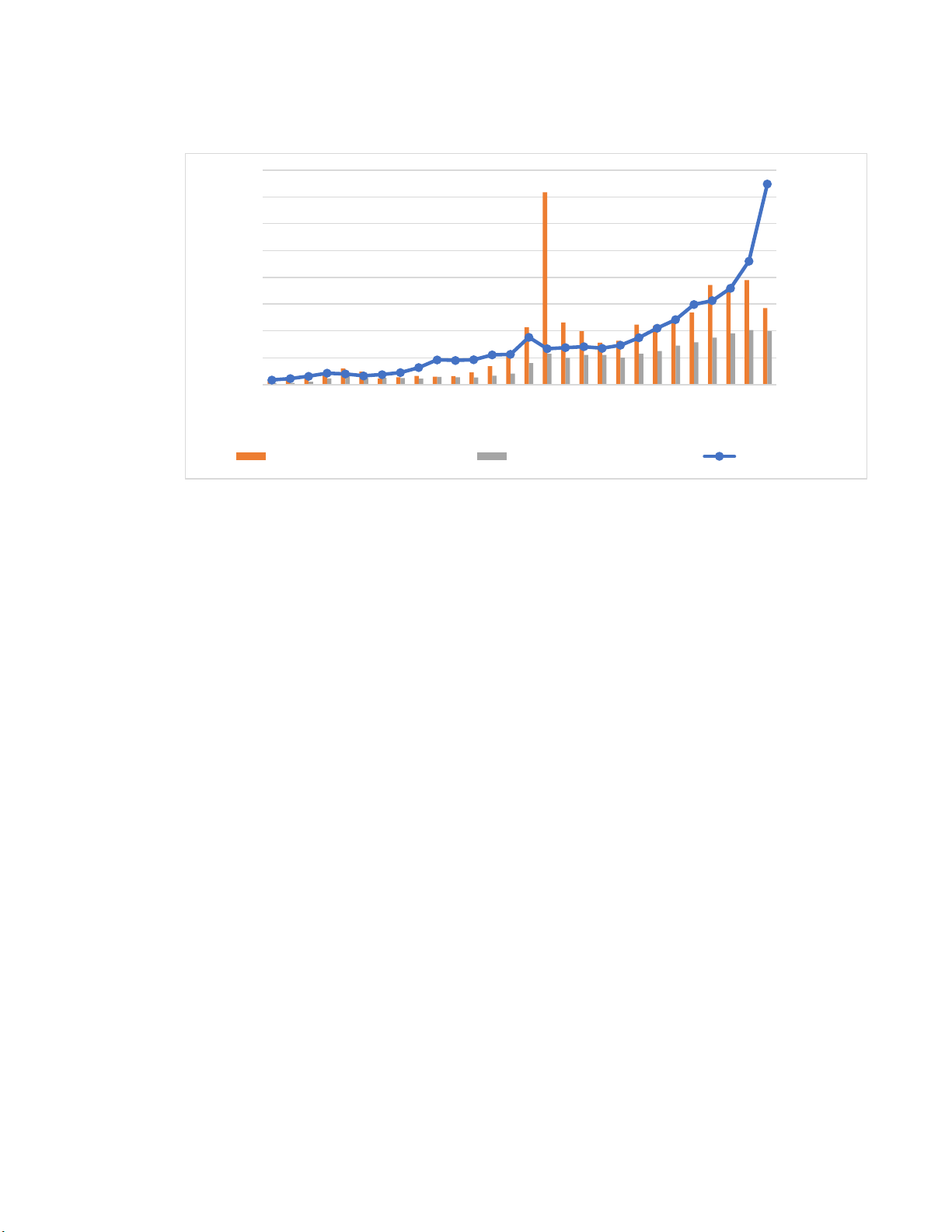
5
FDI attraction of Vietnam. In the period 2011 - 2020, the average annual realized FDI capital accounts
for about 22-23% of social investment capital. (See Figure 1)
Figure 1. Number of projects, registered capital and realized capital in Vietnam
Source: Author's compilation based on data of General Statistics Office (1991-2020)
By the end of 2020, the total newly registered capital, adjusted and contributed capital, bought
shares of foreign investors reached 28.53 billion USD, 75% compared to the same period in 2019.
The realized capital of the FDI project is estimated at 19.98 billion USD, 98% compared to the same
period in 2019. Due to the impact of the Covid-19 pandemic, production and business activities were
affected, and the realized capital of foreign investment projects in 2020 is down compared to 2019
(down 2% compared to 2019). However, the reduction level has improved. Many foreign-invested
enterprises are gradually recovering and maintaining good production and business activities and
expanding projects. The highlight in 2020 was that the adjusted investment capital was over $6.4
billion, up 10.6% over the same period in 2019, there were 1,140 projects registered to adjust the
investment capital, down 17.5% over the same period. Regarding new registered capital, there were
2,523 new projects granted investment registration certificates, down 35% over the same period, the
total registered capital reached 14.65 billion USD, down 12.5% over the same period in 2019. In 2021,
according to just announced report of The Ministry of Planning and Investment, from the beginning
of the year to April 20, 2021, the total foreign direct investment (FDI) registered for new, adjusted
and contributed capital, and purchased shares in Vietnam equal to 99.3% over the same period in
2020. In which, realized FDI capital was estimated at 5.5 billion USD, up 6.8% over the same period
last year. In the first four months of the year, the whole country had 451 new FDI projects granted
investment registration certificates, down 54.2% over the same period, but the total registered capital
reached nearly 8.5 billion USD, an increase of 24.7% over the same period in 2020. The scale of FDI
projects in the first months of 2021 has improved compared to the same period in 2020.
0
1000
2000
3000
4000
5000
6000
7000
0.00
10,000.00
20,000.00
30,000.00
40,000.00
50,000.00
60,000.00
70,000.00
80,000.00
1991
1992
1993
1994
1997
1998
1999
2000
2001
2002
2003
2004
2005
2006
2007
2008
2009
2010
2011
2012
2013
2014
2015
2016
2017
2018
2019
2020
Total Registered Capital (mil USD) Total Realized Capital (mil USD) No. of projects