© 2010 Whitacre and Bender; licensee BioMed Central Ltd. This is an Open Access article distributed under the terms of the Creative
Commons Attribution License (http://creativecommons.org/licenses/by/2.0), which permits unrestricted use, distribution, and repro-
duction in any medium, provided the original work is properly cited.
Whitacre and Bender Theoretical Biology and Medical Modelling 2010, 7:20
http://www.tbiomed.com/content/7/1/20
Open Access
RESEARCH
Research
Networked buffering: a basic mechanism for
distributed robustness in complex adaptive
systems
James M Whitacre*
1
and Axel Bender
2
Abstract
A generic mechanism - networked buffering - is proposed for the generation of robust traits
in complex systems. It requires two basic conditions to be satisfied: 1) agents are versatile
enough to perform more than one single functional role within a system and 2) agents are
degenerate, i.e. there exists partial overlap in the functional capabilities of agents. Given
these prerequisites, degenerate systems can readily produce a distributed systemic
response to local perturbations. Reciprocally, excess resources related to a single function
can indirectly support multiple unrelated functions within a degenerate system. In models
of genome:proteome mappings for which localized decision-making and modularity of
genetic functions are assumed, we verify that such distributed compensatory effects cause
enhanced robustness of system traits. The conditions needed for networked buffering to
occur are neither demanding nor rare, supporting the conjecture that degeneracy may
fundamentally underpin distributed robustness within several biotic and abiotic systems.
For instance, networked buffering offers new insights into systems engineering and
planning activities that occur under high uncertainty. It may also help explain recent
developments in understanding the origins of resilience within complex ecosystems.
Introduction
Robustness reflects the ability of a system to maintain functionality or some measured out-
put as it is exposed to a variety of external environments or internal conditions. Robustness
is observed whenever there exists a sufficient repertoire of actions to counter perturbations
[1] and when a system's memory, goals, or organizational/structural bias can elicit those
responses that match or counteract particular perturbations, e.g. see [2]. In many of the
complex adaptive systems (CAS) discussed in this paper, the actions of agents that make up
the system are based on interactions with a local environment, making these two require-
ments for robust behavior interrelated. When robustness is observed in such CAS, we gen-
erally refer to the system as being self-organized, i.e. stable properties spontaneously
emerge without invoking centralized routines for matching actions and circumstances.
Many mechanisms that lead to robust properties have been distilled from the myriad con-
texts in which CAS, and particularly biological systems, are found [3-21]. For instance,
robustness can form from loosely coupled feedback motifs in gene regulatory networks,
from saturation effects that occur at high levels of flux in metabolic reactions, from spatial
and temporal modularity in protein folding, from the functional redundancy in genes and
* Correspondence:
jwhitacre79@yahoo.com
1 School of Computer Science,
University of Birmingham,
Edgbaston, UK
Full list of author information is
available at the end of the article

Whitacre and Bender Theoretical Biology and Medical Modelling 2010, 7:20
http://www.tbiomed.com/content/7/1/20
Page 2 of 20
metabolic pathways [22,23], and from the stochasticity of dynamicsi occurring during
multi-cellular development [24] or within a single cell's interactome [25].
Although the mechanisms that lead to robustness are numerous and diverse, subtle
commonalities can be found. Many mechanisms that contribute to stability act by
responding to perturbations through local competitive interactions that appear coopera-
tive at a higher level. A system's actions are rarely deterministically bijective (i.e. charac-
terized by a one-to-one mapping between perturbation and response) and instead
proceed through a concurrent stochastic process that in some circumstances is
described as exploratory behavior [26].
This paper proposes a new basic mechanism that can lead to both local and distributed
robustness in CAS. It results from a partial competition amongst system components
and shares similarities with several of the mechanisms we have just mentioned. In the
following, we speculate that this previously unexplored form of robustness may readily
emerge within many different systems comprising multi-functional agents and may
afford new insights into the exceptional flexibility that is observed within some complex
adaptive systems.
In the next section we summarize accepted views of how diversity and degeneracy can
contribute to robustness of system traits. We then present a mechanism that describes
how a system of degenerate agents can create a widespread and comprehensive response
to perturbations - the networked buffering hypothesis (Section 3). In Section 4 we pro-
vide evidence for the realisation of this hypothesis. We particularly describe the results
of simulations that demonstrate that distributed robustness emerges from networked
buffering in models of genome:proteome mappings. In Section 5 we discuss the impor-
tance of this type of buffering in natural and human-made CAS, before we conclude in
Section 6. Three appendices supplement the content of the main body of this paper. In
Appendix 1 we provide some detailed definitions for (and discriminations of) the con-
cepts of degeneracy, redundancy and partial redundancy; in Appendix 2 we give back-
ground materials on degeneracy in biotic and abiotic systems; and in Appendix 3 we
provide a technical description of the genome:proteome model that is used in our exper-
iments.
Robustness through Diversity and Degeneracy
As described by Holland [27], a CAS is a network of spatially distributed agents which
respond concurrently to the actions of others. Agents may represent cells, species, indi-
viduals, firms, nations, etc. They can perform particular functions and make some of
their resources (physical assets, knowledge, services, etc) work for the system.ii The con-
trol of a CAS tends to be largely decentralized. Coherent behavior in the system gener-
ally arises from competition and cooperation between agents; thus, system traits or
properties are typically the result of the interplay between many individual agents.
Degeneracy refers to conditions where multi-functional CAS agents share similarities
in only some of their functions. This means there are conditions where two agents can
compensate for each other, e.g. by making the same resources available to the system, or
can replace each other with regard to a specific function they both can perform. How-
ever, there are also conditions where the same agents can do neither. Although degener-
acy has at times been described as partial redundancy, we distinctly differentiate
between these two concepts. Partial redundancy only emphasizes the many-to-one map-
Whitacre and Bender Theoretical Biology and Medical Modelling 2010, 7:20
http://www.tbiomed.com/content/7/1/20
Page 3 of 20
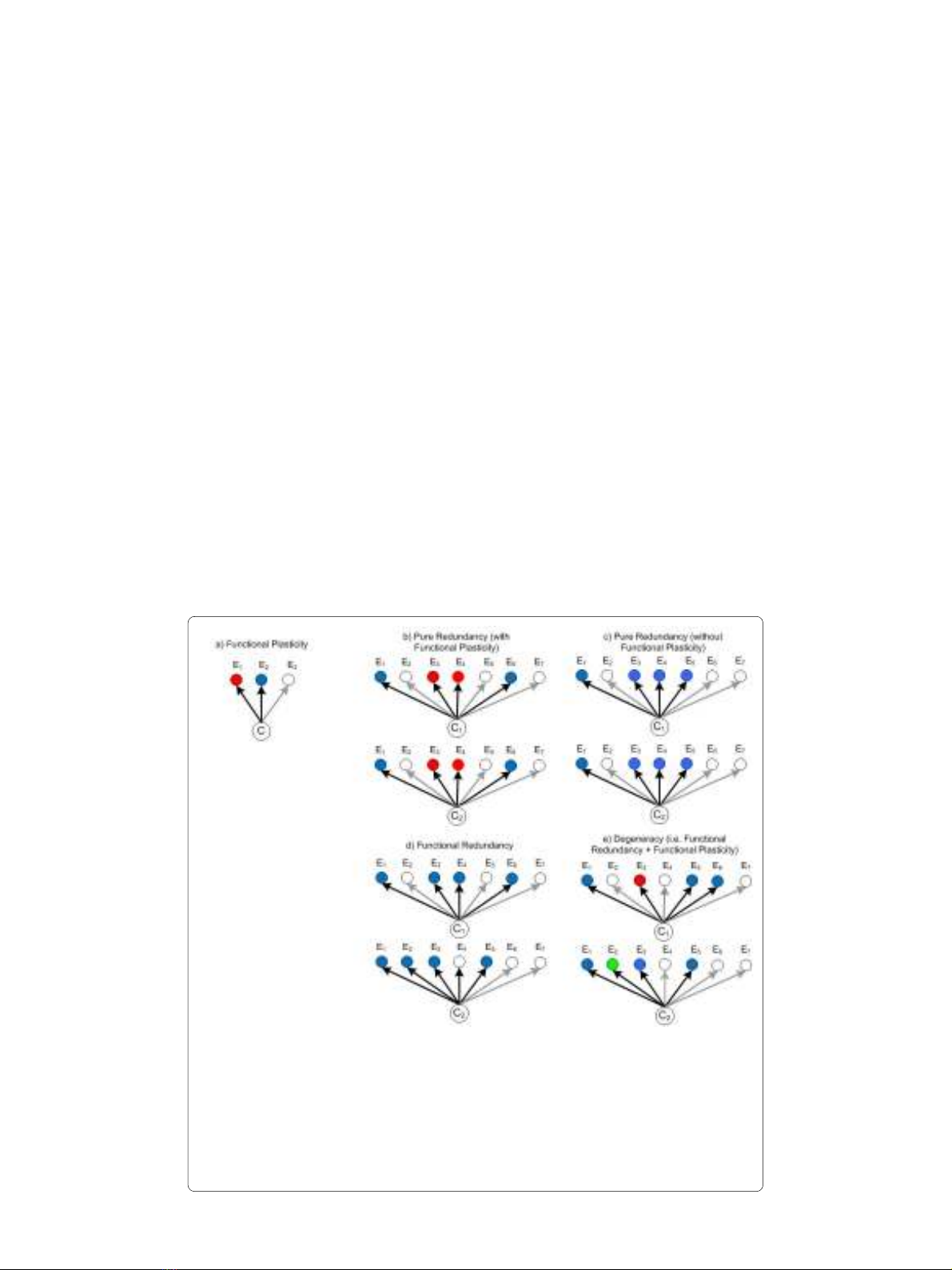
ping between components and functions while degeneracy concerns many-to-many
mappings. Degeneracy is thus a combination of both partial redundancy and functional
plasticity (explained below). We discuss the differences of the various concepts sur-
rounding redundancy and degeneracy in Appendix 1 and Figure 1.
On the surface, having similarities in the functions of agents provides robustness
through a process that is intuitive and simple to understand. In particular, if there are
many agents in a system that perform a particular service then the loss of one agent can
be offset by others. The advantage of having diversity amongst functionally similar
agents is also straightforward to see. If agents are somewhat different, they also have
somewhat different weaknesses: a perturbation or attack on the system is less likely to
present a risk to all agents at once. This reasoning reflects common perceptions about
the value of diversity in many contexts where CAS are found. For instance, it is analo-
gous to what is described as functional redundancy [28,29] (or response diversity [30]) in
ecosystems, it reflects the rationale behind portfolio theory in economics and biodiver-
sity management [31-33], and it is conceptually similar to the advantages from ensemble
approaches in machine learning or the use of diverse problem solvers in decision making
[34]. In short, diversity is commonly viewed as advantageous because it can help a sys-
tem to consistently reach and sustain desirable settings for a single system property by
providing multiple distinct paths to a particular state. In accordance with this thinking,
examples from many biological contexts have been given that illustrate degeneracy's
Figure 1 Illustration of degeneracy and related concepts. Components (C) within a system have a func-
tionality that depends on their context (E) and can be functionally active (filled nodes) or inactive (clear nodes).
When a component exhibits qualitatively different functions (indicated by node color) that depend on the con-
text, we refer to that component as being functionally plastic (panel a). Pure redundancy occurs when two
components have identical functions in every context (panels b and c). Functional redundancy is a term often
used to describe two components with a single (but same) function whose activation (or capacity for utiliza-
tion) depends on the context in different ways (panel d). Degeneracy describes components that are function-
ally plastic and functionally redundant, i.e. where the functions are similar in some situations but different in
others (panel e).

Whitacre and Bender Theoretical Biology and Medical Modelling 2010, 7:20
http://www.tbiomed.com/content/7/1/20
Page 4 of 20
positive influence on the stability of a single trait, e.g. see Appendix 2. Although this view
of diversity is conceptually and practically useful, it is also simplistic and, so we believe,
insufficient for understanding how common types of diversity such as degeneracy will
influence the robustness of multiple interdependent system traits.
CAS are frequently made up of agents that influence the stability of more than just a
single trait because of their having a repertoire of functional capabilities. For instance,
gene products act as versatile building blocks that form complexes with many distinct
targets [35-37]. These complexes often have unique and non-trivial consequences inside
or outside the cell. In the immune system, each antigen receptor can bind with (i.e. rec-
ognize) many different ligands and each antigen is recognized by many receptors [38,39];
a feature that has only recently been integrated into artificial immune system models,
e.g. [40-42]. In gene regulation, each transcription factor can influence the expression of
several different genes with distinct phenotypic effects. Within an entirely different
domain, people in organizations are versatile in the sense that they can take on distinct
roles depending on who they are collaborating with and the current challenges confront-
ing their team. More generally, the function an agent performs often depends on the
context in which it finds itself. By context, we are referring to the internal states of an
agent and the demands or constraints placed on the agent by its environment. As illus-
trated further in Appendix 2, this contextual nature of an agent's function is a common
feature of many biotic and abiotic systems and it is referred to hereafter as functional
plasticity.
Because agents are generally limited in the number of functions they are able to per-
form over a period of time, tradeoffs naturally arise in the functions an agent performs in
practice. These tradeoffs represent one of several causes of trait interdependence and
they obscure the process by which diverse agents influence the stability of single traits. A
second complicating factor is the ubiquitous presence of degeneracy. While one of an
agent's functions may overlap with a particular set of agents in the system, another of its
functions may overlap with an entirely distinct set of agents. Thus functionally related
agents can have additional compensatory effects that are differentially related to other
agents in the system, as we describe in more detail in the next section. The resulting web
of conditionally related compensatory effects further complicates the ways in which
diverse agents contribute to the stability of individual traits with subsequent effects on
overall system robustness.
Networked Buffering Hypothesis
Previous authors discussing the relationship between degeneracy and robustness have
described how an agent can compensate for the absence or malfunctioning of another
agent with a similar function and thereby help to stabilize a single system trait. One aim
of this paper is to show that when degeneracy is observed within a system, a focus on sin-
gle trait robustness can turn away attention from a form of system robustness that spon-
taneously emerges as a result of a concurrent, distributed response involving chains of
mutually degenerate agents. We organize these arguments around what we call the net-
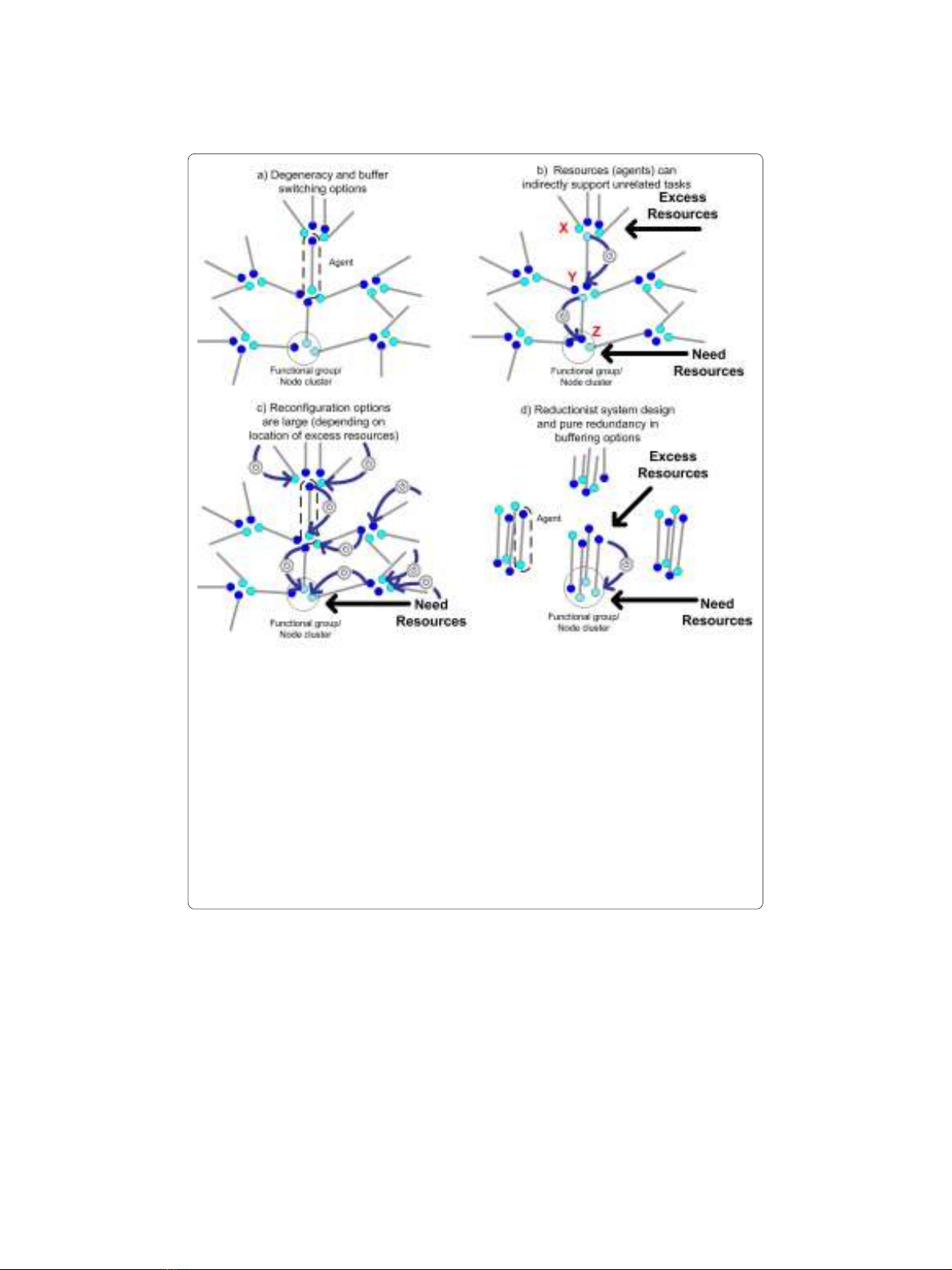
worked buffering hypothesis (NBH). The central concepts of our hypothesis are described
by referring to the abstract depictions of Figure 2; however, the phenomenon itself is not
limited to these modeling conditions as will be elucidated in Section 5.
Whitacre and Bender Theoretical Biology and Medical Modelling 2010, 7:20
http://www.tbiomed.com/content/7/1/20
Page 5 of 20
Consider a system comprising a set of multi-functional agents. Each agent performs a
finite number of tasks where the types of tasks performed are constrained by an agent's
functional capabilities and by the environmental requirement for tasks ("requests"). A
system's robustness is characterized by the ability to satisfy tasks under a variety of con-
ditions. A new "condition" might bring about the failure or malfunctioning of some
agents or a change in the spectrum of environmental requests. When a system has many
agents that perform the same task then the loss of one agent can be compensated for by
others, as can variations in the demands for that task. Stated differently, having an excess
of functionally similar agents (excess system resources) can provide a buffer against vari-
ations in task requests.
In the diagrams of Figure 2, for sake of illustration the multi-functionality of CAS
agents is depicted in an abstract "functions space". In this space, bi-functional agents
Figure 2 Conceptual model of a buffering network. Each agent is depicted by a pair of connected nodes
that represent two types of tasks/functions that the agent can perform, e.g. see dashed circle in panel a). Node
pairs that originate or end in the same node cluster ("Functional group") correspond to agents that can carry
out the same function and thus are interchangeable for that function. Darkened nodes indicate the task an
agent is currently performing. If that task is not needed then the agent is an excess resource or "buffer". Panel
a) Degeneracy in multi-functional agents. Agents are degenerate when they are only similar in one type of task.
Panel b) End state of a sequence of task reassignments or resource reconfigurations. A reassignment is indicat-
ed by a blue arrow with switch symbol. The diagram illustrates a scenario in which requests for tasks in the Z
functional group have increased and requests for tasks of type X have decreased. Thus resources for X are now
in excess. While no agent exists in the system that performs both Z and X, a pathway does exist for reassign-
ment of resources (XTY, YTZ). This illustrates how excess resources for one type of function can indirectly sup-
port unrelated functions. Panel c) Depending on where excess resources are located, reconfiguration options
are potentially large as indicated by the different reassignment pathways shown. Panel d) A reductionist sys-
tem design with only redundant system buffers cannot support broad resource reconfiguration options. In-
stead, agent can only participate in system responses related to its two task type capabilities.vi



![Vaccine và ứng dụng: Bài tiểu luận [chuẩn SEO]](https://cdn.tailieu.vn/images/document/thumbnail/2016/20160519/3008140018/135x160/652005293.jpg)