
* Corresponding author
E-mail address:setyo_pwt@yahoo.com (S. Purwanto)
© 2019 by the authors; licensee Growing Science, Canada
doi: 10.5267/j.uscm.2018.10.011
Uncertain Supply Chain Management 7 (2019) 133–144
Contents lists available at GrowingScience
Uncertain Supply Chain Management
homepage: www.GrowingScience.com/uscm
The effect of competitive advantage and commodity strategic supply chain on Indonesia textile industry
Setiyo Purwantoa*
aSTIE Indonesia School of Management, Indonesia
C H R O N I C L E A B S T R A C T
Article history:
Received September 10, 2018
Accepted October 25 2018
Available online
October 28 2018
The aim of the current study is to examine the role of competitive advantage and commodity
strategic supply chain in the textile industry of Indonesia. Additionally, the mediating role of
export performance was examined to expedite textile industry performance. The moderating role
of supply chain top management team support was also investigated. To achieve the objectives,
primary data were collected with the help of a questionnaire. Employees of textile companies
were selected as the respondents and PLS-SEM was used in this study. Moreover, the preliminary
analysis was performed through SPSS. Ten hypotheses were developed to examine the
relationships among competitive advantage, commodity strategic supply chain, export
performance, supply chain top management team support and textile industry performance.
Findings of the study indicate that competitive advantage and commodity strategic supply chain
played a valuable role to enhance textile industry performance. Export performance is a
mediating variable between competitive advantage and textile industry performance, moreover,
it is also a mediating variable between commodity strategic supply chain and textile industry
performance. Likewise, supply chain top management team support as a moderating variable
enhances the positive impact of competitive advantage on textile industry performance.
ensee Growin
g
Science, Canada
by
the authors; lic9© 201
Keywords:
Competitive advantage
Commodity strategic supply chain
Export performance
Top management team
Industry performance
1. Introduction
The textile industry is one of the key sectors of every country, particularly those countries having rich
agricultural industry. This industry has sufficient contribution on nations’ economy. It has vital
importance for different nations because it has significant contribution to gross-domestic-product
(GDP) (Huang et al. 2017; Sun & Anwar, 2017). An increase in textile industry performance will also
increase the share in GDP, which has a positive consequence on the nation’s economy. Most of the
countries such as China, Vietnam, Bangladesh, Cambodia, Indonesia, Seri Lanka, Thailand, and India
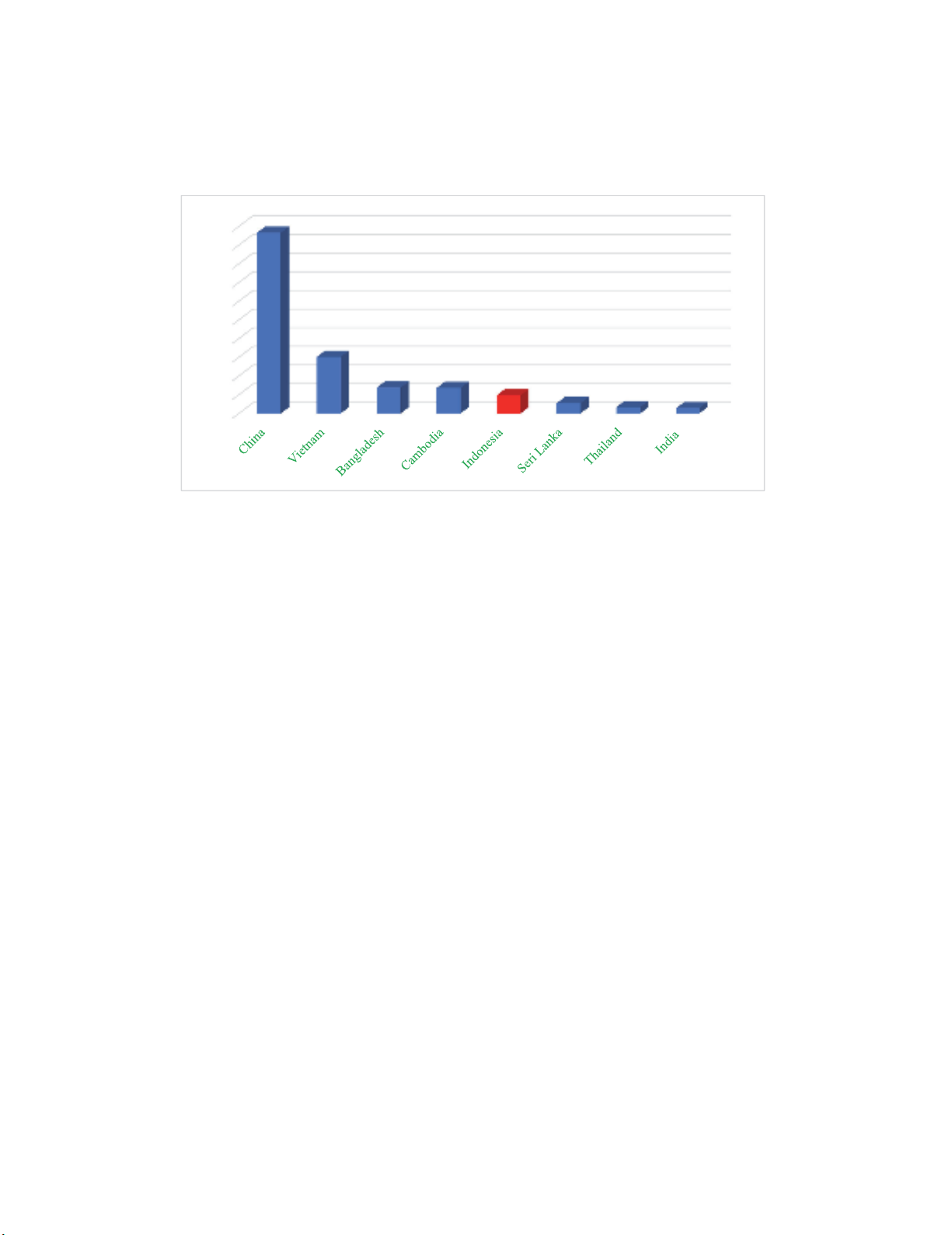
are now focusing on enhancing the growth rate of the textile industry to support their economies. Fig.
1 shows the latest growth rate of various countries from Jan 2018 to Jun 2018. From these estimations,
it is revealed that the textile industry of China is leading as compared to other countries. The growth
rate of China textile industry is approximately 48.3%, followed by Vietnam with 15.1% growth rate.
134
Moreover, Bangladesh has 6.9% growth rate follows by 6.8% in Cambodia. However, Indonesia has
low performance as compared with these countries. Indonesia textile industry has a low growth rate of
only 4.8% during the first half of 2018. This low growth rate has a negative effect on overall
performance and decreases the contribution in GDP.
Fig. 1. Comparison of growth rate in the textile industry (Jan 2018-Jun 2018)
Source: Hong Kong Trade Statistics, Census and Statistics Department
However, low performance in growth rate can be increased with the help of various supply chain
strategies and competitive advantage. Better commodity strategic supply chain activities always have
a positive impact on performance of business. According to Castorena et al. (2014), supply chain has
signifincat influance on business performance. Moreover, Chan et al. (2017) found a positive
contribution of supply chain in firm performance in fasion industry. Furthermore, the competitive
advantage also has a significant association with performance (Flynn et al., 1995). An increase in
competative advntage also increases the performance, as stated by Davis et al. (2000). Therefore, both
competitive advantage and commodity strategic supply chain activities have the ability to enhance
textile industry performance (Samad, 2018; Kadhim et al., 2018).
Apart from commodity strategic supply chain activities and competitive advantage, export performance
and supply chain top management team support also have an important role for performance
improvement. According to Katsikeas et al. (2000), export performance has an important link with
business performance. Furthermore, the role of management team support cannot be neglected. It
encourages the employees for innovation and brings new ideas. It is evident from the literature that top
management team support increases the performance (Lubatkin et al., 2006; Duru & Chibo, 2014; Jaya
& Verawaty 2015; Angbre, 2016; Tanoos, 2017; Kimengsi & Gwan, 2017; Wireko-Manu &
Amamoo, 2017; Dahash & Al-Dirawi, 2018). Therefore, export performance and top management play
a key role to enhance textile industry performance.
In this study, export performance is taken as a mediating variable and supply chain top management
team support taken as moderating variable as shown in Fig. 2. Therefore, the objectives of the study
are listed below;
1. To examine the effect of commodity strategic supply chain and competitive advantage on
textile industry performance,
2. To examine the mediating role of export performance,
3. To examine the moderating role of supply chain top management team support.
0
5
10
15
20
25
30
35
40
45
50

S. Purwanto / Uncertain Supply Chain Management 7 (2019)
135
Fig. 2. Theoretical Framework of the current study
2. Hypotheses Development
2.1 Competitive Advantage and Performance
A firm can have competitive advantage with the help of its contribution towards employees and
customers, it makes more incentive for customers as compared with competitive firms. There are two
unmistakable sorts of competitive advantage, including the cost advantage and the predictable
distinction (Bharadwaj et al., 1993; Da Rocha & Christensen, 1994). The phenomenon of competitive
advantage shows the level of acknowledgment of the competitive strategy sought by the firm (Li &
Dant, 1999; Purnama, 2014; Castorena et.al., 2014; Solomon et.al., 2014; Dim & Ezeabasili, 2015;
Nze et al., 2016; Chowdhury et al., 2018), which ultimately could have a relationship with
performance. While an advantage in cost shows the firm's deliberate endeavors to build productivity,
it could be an advantage related to differentiation communicated through all perspectives of the
products and the services (Piercy et al., 1998). In the intense competitive conditions of the present
environment, many firms may never depend on a single sort of advantage. Rather, they should endeavor
to accomplish and keep up a sound competitive advantage (Treacy & Wiersema, 1993;Wang & Lu,
2016; Nazal, 2017; Taqi et al., 2018) to boost their performance. Multiple competitive advantages could
be more beneficial to enhance performance. Various studies have described that competitive advantage
has a relationship with performance (Newbert, 2008; Porter et al., 1974; Porter, 2011; Li et al., 2006).
H1: There is a relationship between competitive advantage and textile industry performance.
2.2 Commodity Strategic Supply Chain and Performance
In spite of the fact that coordination to encourage the accomplishment of predominant growth has been
a focal point of research activities (Lambert, 2008; Lambert et al., 1978), there is also a trend towards
a more strategic way of dealing with business procedure arrangement. Many believe that strategic
Competitive Advantage
Commodity Strategic
Supply Chain
Textile Industry
Performance
Supply Chain
Top Management
Team Support
Export Performance

136
activities across the boundaries of organizations are another new frontiers for competitive achievement.
Under this specific situation, Frohlich and Westbrook (2001) focused on strategic supply chain and
revealed that it has a significant influence on performance.
Strategic supply chain refers to a wide range of issues and comprise numerous types of various
decision-making activities regarding various problems that impact the long-term growth and processes
of a company, namely; the determination of total number, location, warehouses volume and
manufacturing plants as well as the flow of material with the help of different logistics network, policies
related to the inventory management, contracts with respect to supply, strategies related to distribution,
procurement strategies and supply chain integration, outsourcing, product design, and information
technology (Georgiadis et al., 2005). Commodity strategic supply chain management helps to resolve
different issues and increases the overall performance. According to Cordón et al. (2013), strategic
supply chain has a noteworthy relationship with the performance of any industry. It provides various
strategies in decision making, products and services which increases the performance by creating
innovation in supply chain procedures. Strategies in supply chain increase the valuable services and the
whole distribution process, which influences on performance by satisfying the customers (Cohen &
Roussel, 2005). Different studies such as Bechtel and Jayaram (1997) and Dyer et al. (1998) support
the argument that strategic supply chain has a significant relationship with performance.
H2: There is a relationship between commodity strategic supply chain and textile industry performance.
2.3 Export Performance
There are numerous forces that may influence the overall performance, for example, organizational
culture, capacities, and skills, the status of the export as well as product related differentiation. While
it is difficult to investigate everyone, thus, this study considered vital force, namely; the firm's export
performance. The firms exporting indicates how much organizational assets are distributed in exporting
practices. This study has chosen the firm's exporting since the strategic choice may aid asset distribution
to export systems. The firm's promise to a specific course may upgrade staff feelings of dependability
and obligation to the firm (Wiener & Vardi, 1980). An increase in the firm’s commitment to export
may influence on total exports, which increases the performance. (Etzioni, 1975). Thus, in case the firm
exhibits a solid promise for exporting, administrators might be well-suited to work harder on request,
for example, marketing strategy adjustment. The less dedicated managers may have a tendency to
contribute less (Angle & Perry, 1981), and hence may wish to actualize institutionalized methodologies
which are substantially more straightforward to execute and needs less amount of efforts.
International research recommends more dedicated firms designate more assets to the exporting
movement (Aaby & Slater, 1989). These additional human and budgetary assets empower
organizations to enhance the profundity of arranging systems that would enable supervisors to execute
marketing procedures adjusted to the necessities of various markets (Cavusgil & Zou, 1994). In total,
as expanding stages of assets are focused on the exporting adventure, the company is in an improved
position to enhance its arranging methods and to actualize more versatile procedures. Various studies
have found that expert performance has a significant relationship with performance (Cavusgil & Zou,
1994; Kaynak & Kuan, 1993). By applying this reason to our examination, we suggest the hypothesis:
H3: Export performance mediates the relationship between competitive advantage and textile industry
performance.
H4: Export performance mediates the relationship between commodity strategic supply chain and
textile industry performance.
2.4 Supply Chain Top Management Team Support
According to Hambrick et al. (2015) and Armstrong and Sambamurthy (1999), management team is a
group who is responsible for important executives like Chief Financial Officer (CFO) and Chief
Operating Officer (COO) that have complete responsibility for the company. Literature gives the

S. Purwanto / Uncertain Supply Chain Management 7 (2019)
137
indication that support from top management is the key to the fruitful innovation of products as well as
services (Maidique & Zirger, 1984) and successful implementation of information systems (Liang et
al., 2007) which enhances the performance. Past literature has revealed that the extent of the best
management supports information system plays a vital role in company activities (Yao et al., 2007).
Top management through their positions of authority guarantee adequate assets apportioned to
information technology and support their employees (Lucas, 1981). As already discoursed, top
management is viewed as a two-stage process (Lee et al., 2014) which has an influence on the
performance of employees and automatically improvement in overall performance. Various studies
indicate that top management team support has an important impact on company growth (Yigitbasioglu,
2015). Therefore, supply chain top management team support has a connection with performance
through competitive advantage and supply chain activities.
H5: There is a relationship between supply chain supply chain top management team support and textile
industry performance.
H6: Supply chain top management team support moderates the relationship between competitive
advantage and textile industry performance.
H7: Supply chain supply chain top management team support moderates the relationship between
commodity strategic supply chain and textile industry performance.
Additionally,
H8: There is a relationship between competitive advantage and export performance.
H9: There is a relationship between commodity strategic supply chain and export performance.
H10: There is a relationship between export performance and textile industry performance.
3. Methodology
3.1 Data collection and sample
The sample for the current study comprised Indonesia textile firms. The sample was included all the
textile companies of Indonesia. The managerial employees were the respondents of this study. The
survey was managed online in May 2018. A link was sent with survey and a letter presenting the
researcher as well as the research objectives. It was insured that the responses will be kept confidential.
Three reminders were sent to the respondents in different period of time. All the email addresses were
collected from the head offices of Indonesia textile companies. Three hundred (300) questionnaires
were used to collect the responses. From a total of three hundred (300) survey questionnaires, only one
hundred and forty (140) valid responses were returned. According to Sekaran (2003), in the case of an
email survey, this response rate is sufficient. Therefore, the analysis was conducted by using one
hundred and forty (140) responses to get the objectives. Moreover, on the basis of the well-known rule
of thumb (Chin & Newsted, 1999) one hundred and forty (140) response rate is suitable to analyze the
data for further results. After data collection, response bias was examined, and no big difference was
found between early responses and late responses. Therefore, it proceeded for further analysis.
3.2 Questionnaires Development
The existing questionnaires were developed through previous studies and all the measures were
adapted. A five-point Likert scale was used, and it was designed through five sections. Independent
variable, moderating variable, mediating variable and dependent variables were settled in separate
sections. Each section includes the concerted variable research items. However, the first section was
based on the profile of respondents.










![Đề thi cuối kì Chính sách thương mại quốc tế: Tổng hợp [năm]](https://cdn.tailieu.vn/images/document/thumbnail/2025/20251112/llinhlinhlinhlinhh@gmail.com/135x160/60241762917589.jpg)






![Đề thi Luật Thương mại quốc tế học kì 1 năm 2024-2025 có đáp án (Đề 1) - [kèm đề thi]](https://cdn.tailieu.vn/images/document/thumbnail/2025/20250925/kimphuong1001/135x160/14521758785752.jpg)