

1
TRNG THPT THÁI PHIÊN
T NGOI NGỮ
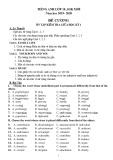
Đ CNG ÔN TP KIM TRA HC KỲ 1- LP 10 CT 7 NĂM
NĂM HC : 2019 - 2020
I. MẬ ếrn ơ ếhi:
Niădung
Nhậnăbit
Thôngăhiu
Vậnădụng
Tổngăcng
I.Trắcănghiệm:ă
0.25 x 32=
8đ
1. Pronunciation
2
2. Stress
2
3. Grammar
3
2
4. Error identification
2
5. Language function
2
6. Preposition
1
7. Sentence Completion
1
8. Vocabulary:
+ Word form
+ Word meaning
+ Synonym
+ Antonym
3
2
2
1
1
9. Reading a passage and choosing
suitable answers.
2
1
1
10. Reading a passage and choosing
the best answer for each of the blanks.
2
1
1
II.ăTựăluận:
Writing:
0.5 x 4= 2đ
a. Rewriting sentences as directed
2
1
b. Writing a complete sentence with the
cues given
1

2
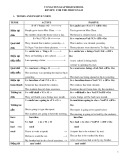
II. Ni dỀng kin ếhức ếhống nhấế chỀng củẬ T :( ếỜnh ơn ếỀần 15 )
NIăDUNGăKINăTHCăTăUNITă1ăĐNăUNITă7
I. GRAMMAR
1. TENSES
FORM
USAGE
1. The Simple
Present
(Thờ hiện ếi ơn )
+ Affirmative : S + V (s/es ) .
+ Negative : S + don’t / doesn’t + V
(bare inf)
+Question : Do / Does + S + V ( bare inf )
?
a. Được dùng để chỉ chân lý
b. Để diển tả thói quen ở hiện tại.
Nó được dùng với các trạng từ : often
, generally , everyday, always ,
sometimes , never ...
2. The Simple
Past
(Thờ qỀá khứ
ơn)
+ Affirmative : S + V –ed / V2
+ Negative : S + didn’t + V
( bare inf )
+ Question : Did + S + V
( bare inf ) ?
a. Diễn tả một hành động, 1 sự kiện
hoặc 1 tình huống đã xa
y ra và
chấm dứt tại một thời điểm xác
định trong quá khứ
b. Kể lại một chuỗi hành động đã xảy
ra trong quá khứ .
Nó được dùng với các trạng từ: last
week / month / year , ago, yesterday,
in 1990, …
3.The Present
Perfect Tense
(Thờ hiện ếi
hoàn thành )
+Affirmative :S +have /has + PP
+ Negative :S + haven’t / hasn’t + PP
+ Question : Have / Has + S + PP ?
a. Diển tả hành động vừa mới xảy ra. Trong
trường hợp này “just’ đặt giữa have và PP
.
b. Diển tả hành động xảy ra trong quá khứ
(thời gian không xác định)
c. Diển tả hành động bắt đầu trong quá khứ
và còn tiếp tục đến hiện tại hoặc tương lai
*For : Được dùng trước khoảng thời gian .( A
period of time )
*Since : Được dùng trước mốc thời gian .( A
point of time )
Nó được dùng với các trạng từ:
already, just, never, not yet, so far,
since, for, recently ,…
4. Past Perfect
(Thờ qỀá khứ
hoàn thành)
+ Affirmative : S +had + PP
+ Negative : S + hadn’t + PP
+ Question : Had + S + PP ?
- Thì quá khứ hoàn thành được dùng để
diễn tả một hành động hay một sự việc
xảy ra trước hành động khác trong trong
quá khứ hay trước một khoảng thời gian
trong quá khứ .
Signal words : before, after, when, by
the time
5. The Present
Continous Tense
(Thờ hiện ếi ếip
diễn )
+ Affirmative :S +am / is / are + V- ing …
+ Negative : S + am not / isn’t / aren’t +
V-ing
+ Question : Am / Is Are + S + V-ing ..?
a) Thì hiện tại tiếp diễn diễn tả 1 hành
động đang diễn ra (tại thời điểm đang nói)
b. Thì hiện tại tiếp diễn được dùng để diễn
tả một sắp xếp, một kế hoạch trong
tương lai (Phải đi kèm với trạng từ chỉ
tương lai )
Nó được dùng với các trạng từ:
now, at present, at the moment.
6. to be going to
+ infinitive
+ Affirmative: S +am / is / are + going to
+ inf. …
a. Thì tương lai với TO BE GOING TO +
INFINITIVE dùng để chỉ một dự định, 1

3
(Tng lẬi dự
ơnh )
+ Negative: S + am not/ isn’t/ aren’t + going
to + inf.
+ Question: Am / Is / Are + S + going to
+ inf. ?
quyết định làm điều gì .
b. Diễn tả 1 khả năng có thể xảy ra căn
cứ trên hiện tượng ở hiện tại .
THE PRESENT PERFECT PASSIVE (Thờ hiện ếi hoàn ếhành ậ ơng )
Form :
Affirmative : S +have/ has +been + PP……
Negative : S + haven’t / hasn’t +been + PP….
Question : Have / Has + S + been + PP ?
2. GERUND AND TO – INFINITIVE :
Function
GERUND
TO – INFINITIVE
Subject
Learning English is interesting
.
To solve the traffic problems seems
impossible .
Object
He suggested going to the
cinema .
We hope to pass the next exam with
high marks
Complement
His favourite sport is
swimming
His greatest wish is to become a
famous doctor
Object of prep / adjective
He is fond of singing
It is easy to learn English .
VERBS followed by
The gerund To-infinitive
_ avoid _ expect
_ have trouble _ try
_ practice _ plan
_ stop _decide
_ consider _ threaten
_ enjoy _ agree
_ miss _ hope…
_suggest …
3. Relative Pronouns WHO , WHOM , WHICH , THAT
a. WHICH : Which thay cho từ đi trước chỉ vật hoặc con vật , làm chức năng chủ ngữ hoặc tân ngữ của động
từ trong MĐQH.
b. WHO thay cho từ đi trước chỉ người , làm chức năng chủ ngữ của động từ trong MĐQH.
Ex: The man is my uncle .The man is standing over there .
c. WHOM thay cho từ đi trước chỉ người , làm chức năng tân ngữ của động từ trong MĐQH.
Ex : The woman is my aunt .You met her yesterday .
…………………………………………………………………………………
d. THAT thay cho từ đi trước chỉ người , chỉ vật làm chức năng chủ ngữ cũng như tân ngữ của động từ trong
MĐQH.
Ex :The man that is standing over there is my uncle .
Notes :
1. That không được dùng với mệnh đề quan hệ không giới hạn .
Ex : Nam , who is wearing a green sweater , is my friend .
2. That không được dùng sau giới từ

4
Ex : The man about whom you are talking is my uncle .
3. Bắt buộc phải dùngTHAT khi nó thay thế cho tính từ so sánh bậc nhất.
Ex : He’s the best doctor that I have ever known .
4. Ta có thể lược bỏ đại từ quan hệ trong mệnh đề quan hệ khi đại từ quan hệ đó làm chức năng tân ngữ.
Ex : This is the CD ( which ) I bought yesterday .
4. WHICH AS A CONNECTOR
WHICH đợcădùngăđăthayăthăchoămtămệnhăđăđngătrcănó,ăngĕnăcáchăviămệnhăđăchínhăbằngă
dấuăphy.ă
Ex : Jill isn’t on the phone . This makes it difficult to contact her
Jill isn’t on the phone, which makes it difficult to contact her
5. USED TO + INFINITIVE :
a. Form : Affirmative : S + used to + inf
Negative : S + didn’t use to + inf
Question : Did + S + use to + inf ?
b. Usage :
Ex 1 : He used to smoke 20 cigarettes a day , but now he doesn’t smoke any more .
1. Used to được dùng để diễn tả một thói quen trong quá khứ ( bây giờ không còn nữa ).
Ex 2: There used to be a post office here .
2. Used to cũng có thể dùng để chỉ tình trạng trong quá khứ .
6. BECAUSE OF AND IN SPITE OF ( DESPITE ):
a. Because of :
Ex :1. He didn’t go to school because he was ill .
He didn’t go to school because of ………………………………………
Because of ( prepositional phrase ) + Noun( phrase)/ V- ing ( phrase )
b. In spite of :
Ex : He managed to come to school although he was ill .
He managed to come to school in spite of …………………………………. .
2. Although the weather was cold , we all wore shorts .
- In spite of ………………………………. , we all wore shorts .
In spite of ( prepositional phrase ) + Noun( phrase)/ V- ing ( phrase)
II. VOCABULARY: Topics:
1. People's background.
2. Special education.
3. Technology.
4. An excursion.
5. Mass media.
6. School talks.

5
Mtăsăđăminhăha:ă
SAMPLE TEST 1
SECTION A (8.0ms)
Mark the letter A, B, C or D to indicate the correct answer to each of the following questions or do as directed
from 1 to 32 :
1
2
3
4
5
6
7
8
9
10
11
12
13
14
15
16
A
B
C
D
.
17
18
19
20
21
22
23
24
25
26
27
28
29
30
31
32
A
B
C
D
1. Mark the letter A, B, C, or D to indicate the word whose underlined part is pronounced differently from
that of the others.
A. scream B. death C. ready D. peasant
2. Mark the letter A, B, C, or D to indicate the word whose underlined part is pronounced differently from
that of the others.
A. future B. mature C. picture D. culture
3. Mark the letter A, B, C, or D to indicate the word that has a different stress pattern.
A. sorrow B. keyboard C. resort D. feature
4. Mark the letter A, B, C, or D to indicate the word that has a different stress pattern.
A. diploma B. computer C. origin D. permission
5. The new surgeon will___________her post in May.
A. go on B. get over C. take up D. look after
6. - Bob : “Bye!” - John: “_____________.”
A. See you lately B. Thank you C. Meet you again D. See you later
7. Mark the letter A, B, C, or D to indicate the word(s) OPPOSITE in meaning to the underlined word.
The conductor told us to fasten our seatbelts as the bus was coming to a bend.
A. loosen B. tighten C. cut D. shake
8. Mark the letter A, B, C, or D to indicate the underlined part that needs correction.
Susan isn’t capable to do the job as a secretary, so let’s find another.
A B C D
9. The child can read many long poems from _______ .
A. brain B. head C. souvenir D. memory
10. I think they are now accustomed to __________ 12 hours a day.
A. work B. to work C. worked D. working
11. Teachers often supplement class discussions with ____________ software.
A. interactive B. interaction C. interact D. to interact
12. I am going to write a letter to complain____________ the director of the English center
A. from B. about C. with D. to
13. Stella _______ looking for a job because she got bored with her studies.
A. considered B. arranged C. decided D. planned
14. Mark the letter A, B, C, or D to indicate the word(s) CLOSEST in meaning to the underlined word.
I am afraid the coming program is not suitable for children.
A. appropriate B. ideal C. occupied D. permitted
15. "Can you type without looking at the __________?" "No. It's too difficult for me to do so."
A. speaker B. mouse C. keyboard D. printer
16. She tried her best to complete the assignment _____________ her illness.
A. in spite of B. although C. because D. because of











%20--%3e%3cdefs%3e%3cstyle%3e%20.st0%20{%20fill:%20%23fff;%20}%20.st1%20{%20fill:%20%237800fa;%20}%20%3c/style%3e%3c/defs%3e%3cpath%20class='st1'%20d='M117.78,12.18H43.11c2.9,3.47,4.65,7.94,4.65,12.82,0,5.6-2.3,10.66-6.01,14.29h76.02l7.22-13.56-7.22-13.56Z'/%3e%3cg%3e%3cpath%20class='st0'%20d='M53.58,26.17h-.59v-1.46h.59v-4.96h2.83c1.78,0,2.67.94,2.67,2.82v5.76c0,1.87-.89,2.81-2.67,2.81h-2.83v-4.96ZM55.36,21.37v3.34h1.1v1.46h-1.1v3.34h1.01c.61,0,.91-.37.91-1.1v-5.93c0-.74-.3-1.1-.91-1.1h-1.01Z'/%3e%3cpath%20class='st0'%20d='M65.99,31.14h-1.8l-.31-2.07h-2.19l-.31,2.07h-1.64l1.82-11.39h2.62l1.82,11.39ZM65.28,18.04c-.25.46-.51.77-.75.94-.21.15-.47.22-.79.22-.26,0-.57-.07-.92-.22l-.38-.15c-.14-.05-.26-.07-.37-.07-.3,0-.53.18-.71.54l-.91-.68c.25-.46.51-.77.75-.94.21-.14.48-.21.79-.21.26,0,.57.07.92.21l.38.15c.14.05.26.07.37.07.3,0,.53-.18.71-.54l.91.68ZM61.91,27.52h1.73l-.87-5.76-.87,5.76Z'/%3e%3cpath%20class='st0'%20d='M74.53,26.89v1.52c0,1.91-.89,2.86-2.67,2.86s-2.67-.95-2.67-2.86v-5.93c0-1.91.89-2.86,2.67-2.86s2.67.95,2.67,2.86v1.11h-1.69v-1.22c0-.75-.31-1.12-.93-1.12s-.93.37-.93,1.12v6.15c0,.74.31,1.11.93,1.11s.93-.37.93-1.11v-1.63h1.69Z'/%3e%3cpath%20class='st0'%20d='M81.4,31.14h-1.8l-.31-2.07h-2.19l-.31,2.07h-1.64l1.82-11.39h2.62l1.82,11.39ZM75.9,19.2l1.52-1.91h1.71l1.51,1.91h-1.61l-.76-.95-.75.95h-1.61ZM77.32,27.52h1.73l-.87-5.76-.87,5.76ZM83.1,15.99l-1.76,1.91h-1.26l1.17-1.91h1.86Z'/%3e%3cpath%20class='st0'%20d='M84.86,19.75c1.78,0,2.67.94,2.67,2.82v1.48c0,1.87-.89,2.81-2.67,2.81h-.85v4.28h-1.79v-11.39h2.64ZM84.01,21.37v3.86h.85c.58,0,.87-.36.87-1.08v-1.71c0-.71-.29-1.07-.87-1.07h-.85Z'/%3e%3cpath%20class='st0'%20d='M93.51,19.75c1.78,0,2.67.94,2.67,2.82v1.48c0,1.87-.89,2.81-2.67,2.81h-.85v4.28h-1.79v-11.39h2.64ZM92.66,21.37v3.86h.85c.58,0,.87-.36.87-1.08v-1.71c0-.71-.29-1.07-.87-1.07h-.85Z'/%3e%3cpath%20class='st0'%20d='M98.8,31.14h-1.79v-11.39h1.79v4.88h2.03v-4.88h1.83v11.39h-1.83v-4.88h-2.03v4.88Z'/%3e%3cpath%20class='st0'%20d='M105.36,24.55h2.46v1.62h-2.46v3.34h3.09v1.63h-4.88v-11.39h4.88v1.63h-3.09v3.18ZM108.17,17.29l-1.76,1.91h-1.26l1.17-1.91h1.86Z'/%3e%3cpath%20class='st0'%20d='M112.2,19.75c1.78,0,2.67.94,2.67,2.82v1.48c0,1.87-.89,2.81-2.67,2.81h-.85v4.28h-1.79v-11.39h2.64ZM111.35,21.37v3.86h.85c.58,0,.87-.36.87-1.08v-1.71c0-.71-.29-1.07-.87-1.07h-.85Z'/%3e%3c/g%3e%3ccircle%20class='st1'%20cx='25'%20cy='25'%20r='20'/%3e%3cpath%20class='st0'%20d='M32.78,19.27c2.92,0,4.43,2.55,5.28,5.33l.71,2.17c.14.38-.33.75-.71.75h-5.61c.19-.33.24-.71.09-1.08l-.75-2.45c-.43-1.32-.99-2.64-1.79-3.77.75-.57,1.65-.94,2.78-.94h0ZM25,18.38c3.25,0,4.9,2.78,5.89,5.89l.76,2.45c.14.42-.33.8-.8.8h-11.69c-.42,0-.94-.38-.8-.8l.75-2.45c.99-3.11,2.64-5.89,5.89-5.89h0ZM25,11.35c1.74,0,3.11,1.37,3.11,3.11s-1.37,3.11-3.11,3.11-3.11-1.41-3.11-3.11,1.41-3.11,3.11-3.11h0ZM17.27,19.27c1.08,0,1.98.38,2.73.94-.8,1.13-1.37,2.45-1.74,3.77l-.8,2.45c-.14.38-.05.75.09,1.08h-5.56c-.42,0-.9-.38-.75-.75l.71-2.17c.9-2.78,2.41-5.33,5.33-5.33h0ZM17.27,12.91c1.51,0,2.78,1.27,2.78,2.83s-1.27,2.83-2.78,2.83-2.83-1.27-2.83-2.83,1.27-2.83,2.83-2.83h0ZM32.78,12.91c1.56,0,2.78,1.27,2.78,2.83s-1.23,2.83-2.78,2.83-2.83-1.27-2.83-2.83,1.27-2.83,2.83-2.83h0ZM27.07,28.56v.09c0,.57-.24,1.08-.61,1.46h0v.05c-.38.33-.9.57-1.46.57s-1.08-.24-1.46-.61h0c-.38-.38-.61-.9-.61-1.46v-.09h1.41v.09c0,.19.05.38.19.47v.05c.09.09.28.19.47.19s.38-.09.47-.19v-.05c.14-.09.24-.28.24-.47t-.05-.09h1.41ZM30.99,28.56v.09c0,1.65-.66,3.16-1.74,4.24-1.08,1.08-2.59,1.79-4.24,1.79s-3.16-.71-4.24-1.79l-.05-.05c-1.04-1.08-1.7-2.55-1.7-4.2v-.09h1.41v.09c0,1.27.47,2.4,1.27,3.25h.05c.85.85,1.98,1.37,3.25,1.37s2.4-.52,3.25-1.37c.85-.8,1.37-1.98,1.37-3.25v-.09h1.37ZM34.99,28.56v.09c0,2.78-1.13,5.28-2.92,7.07-1.79,1.79-4.29,2.92-7.07,2.92s-5.23-1.13-7.07-2.92c-1.79-1.79-2.92-4.29-2.92-7.07v-.09h1.41v.09c0,2.4.94,4.53,2.5,6.08,1.56,1.56,3.72,2.5,6.08,2.5s4.52-.94,6.08-2.5c1.56-1.56,2.5-3.68,2.5-6.08v-.09h1.41Z'/%3e%3c/svg%3e)