

* Corresponding author.
E-mail addresses: rezanoori.alireza.idg@gmail.com (A. Rezanoori)
© 2019 Growing Science Ltd. All rights reserved.
doi: 10.5267/j.esm.2019.6.005
Engineering Solid Mechanics 7 (2019) 313-330
Contents lists available at GrowingScience
Engineering Solid Mechanics
homepage: www.GrowingScience.com/
esm
A new method to improve passenger vehicle safety using intelligent functions in active suspension
system
Alireza Rezanooria*, Mohd Khairol Anuar Ariffina, Aidin Delgoshaeia, Nawal Aswan b. Abdul
Jalila and Zamir Aimaduddin b. Zulkeflia
aDepartment of Mechanical and Manufacturing Engineering, University of Putra, Serdang, 43400, Malaysia
A R T I C L EI N F O A B S T R A C T
Article history:
Received 2 March, 2018
Accepted 26 June 2019
Available online
2
6
June
201
9
In this research a new electronic based mechanism for vehicle suspension system is designd. The
aims are to improve passengers’ safety and comfort. The proposed system is developed for
proactive rapid reaction of suspension system which can readjust the height of chassis while
confronting with wrong conditions of driving such as unflatted road, rainy or snowy road profile.
The results show that the proposed mechanism can successfully increase the stability of the car by
readjusting the height of the the chassis and center of the gravity of vehicle while turning.
© 201
9
Growing Science Ltd. All rights reserved.
Keywords:
Active Suspension System
Vehicle Height Readjusting
Simulation
Stabilizer
1. Introduction
The term automotive was first used by Greek people and consists of 2 words auto (self) and motivus
which means motions. Automotive industry covers a wide range of manufacturing and services
companies for design, engineering, manufacturing, and sailing and after sailing services. Records that
are reported by World Health Organization show that road traffic injuries caused 1.25 million deaths
worldwide in the year 20101. Using this record, it can be concluded that 1 person dies every 25 seconds
during that year. Table 1 indicates regional traffic that causes death in 2013. Of this third world countries
and low income countries dedicated more share of this phenomena 24.1 per 100 000 than developed
countries (9.2 per 100 000). For example Nigeria, Iran, Malaysia, Thailand and some other countries
have maintained a big share than other countries. Table 2 compares some countries in terms of traffic
death rate. Over a third of road traffic deaths in low- and middle-income countries are among pedestrians
and cyclists.
1 https://en.wikipedia.org/wiki/List_of_countries_by_traffic-related_death_rate#cite_note-datatables-3- Retrived in 0.6.08. 2016.
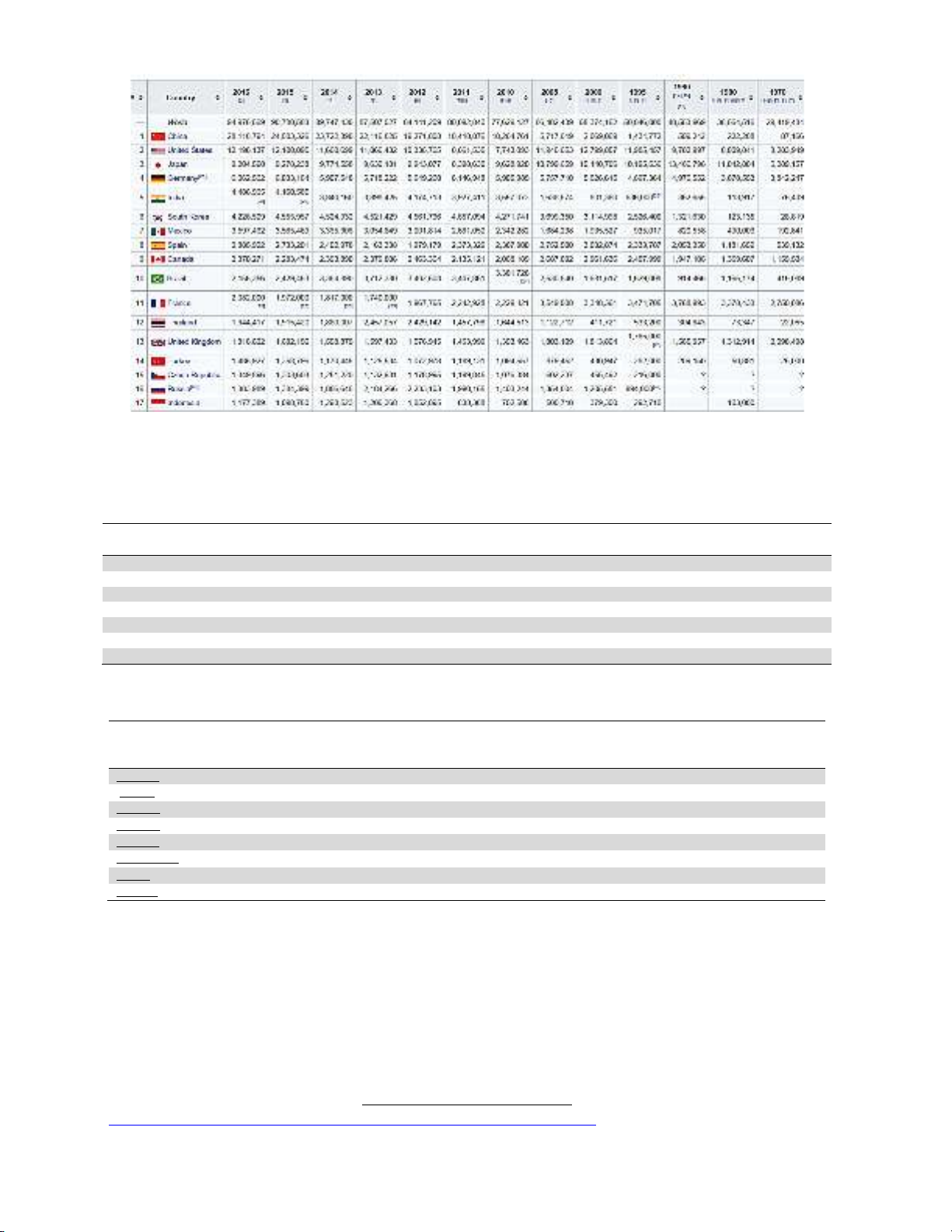
314
Fig. 1. Qouta of countries share in terms of number of manufactured car (2016)- The image retrived from
www.wikipedia in 9/22/2018
Table 1
List of regions by traffic yeilds to death
2
Country Road fatalities per 100,000
inhabitants per year
Road fatalities per 100,000
motor vehicles
Total fatalities latest year (adjusted/estimated
by WHO report)
World 17.4
1,250,000
Africa 26.6 574 246,719
Eastern Mediterranean 19.9 139 122,730
Western Pacific 17.3 69 328,591
South-east Asia 17.0 101 316,080
Americas 15.9 33 153,789
Europe 9.3 19 84,589
Table 2
List of some countries by traffic yields death
Country Road fatalities per
100,000 inhabitants
per year
Road fatalities
per 100,000
motor vehicles
Road fatalities
per 1 billion
vehicle-km
Total fatalities latest year
(adjusted/estimated
figures by WHO report)
Year, data source
(standard source:
The WHO report 2015)
Australia 5.4 7.3 5.2 1252 2013
Canada 6.0 9.5 6.2 2114 2013
Denmark 3.5 6.7 4 196 2013
Germany 4.3 6.8 4.9 3540 2013
Malaysia 24.0 29.9 12.6 7129 2013
United States 10.6 12.9 7.1 34,064 2013
Turkey 8.9 37.3 n/a 6687 2013
Thailand 36.2 74.6 n/a 24,237 2013
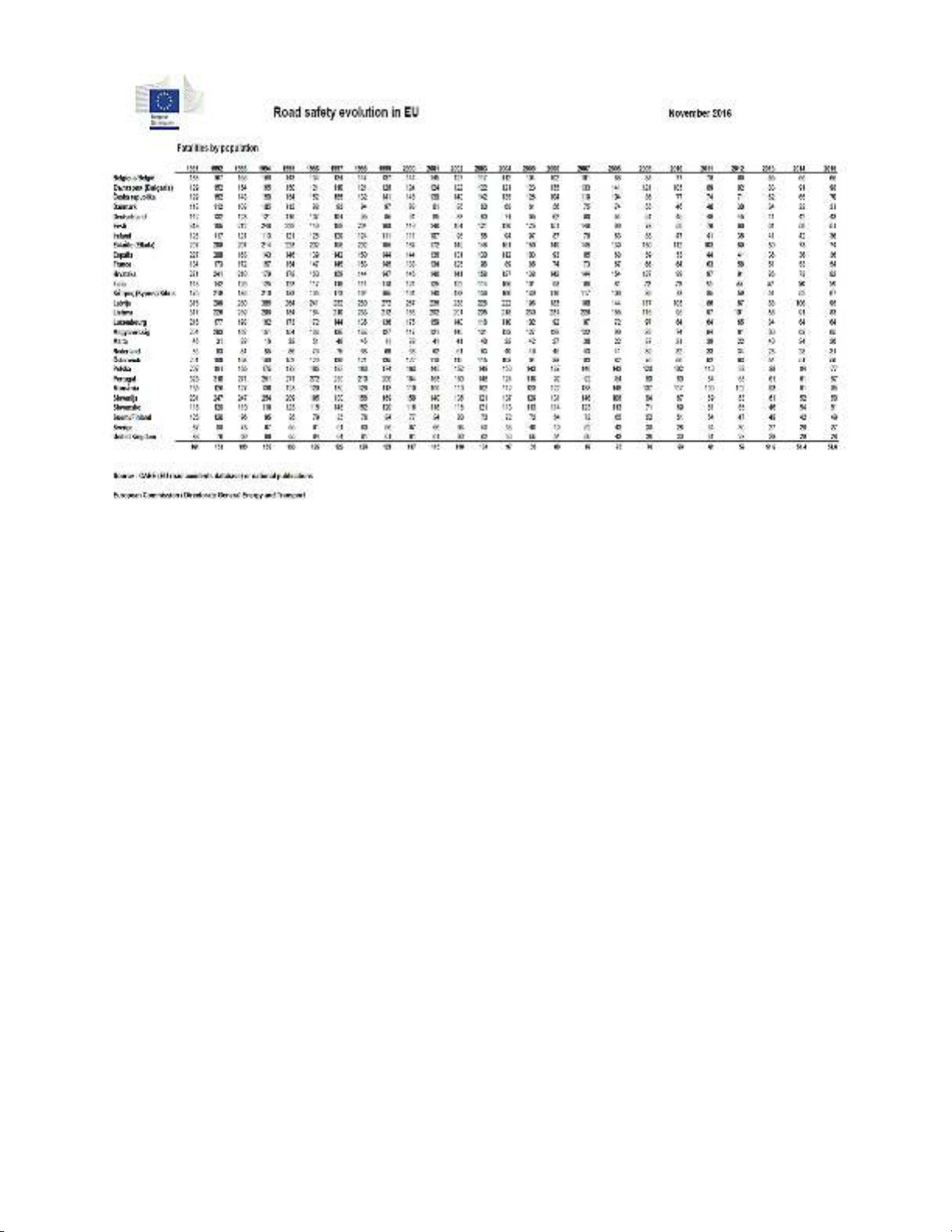
Fortunately, most of the countries now have long term policies to reduce the accidents. Fig. 2 shows
the road safety in the year 2016. The information shows that the safety of the roads was significantly
increased form the year 1992 to 2016.
2 https://en.wikipedia.org/wiki/List_of_countries_by_traffic-related_death_rate#cite_note-irtad2015-4- Retrived in 0.6.08. 2016.
A. Rezanoori et al.
/ Engineering Solid Mechanics 7 (2019)
315
Fig. 1. Road safety evolution in EU
2. Active, semi active and passive suspension systems
As mentioned before the main aim of this research is to design an advanced suspension system for the
motor vehicle. An active suspension system known as Computerized Ride Control helps us adjust the
system continuously when the road conditions are changing. Constantly monitoring and adjusting system
artificially is executed by extension of the design parameters of the system, by means of that changing
the system character on a continuing process. By applying modern sensors and microprocessors, the
information will sense continuously and also change factors in system to react to changing road
conditions. Active suspension suggests better handling, comfort ride, handling, quick respond and safety.
Most of suspension systems in automotive industry use measurement system which is able to measure
forces on the vehicle body on the same time of vehicle motion (YAMADA & Takayoshi, 2007) but most
of time because of lack of adequate process speed or mechanical part operation speed, the slow sensor or
controller cannot collect data and slow mechanical part such as Pneumatic, Hydraulic or Magnetic cannot
perform commands in minimum time which result in less efficiency of system. Many companies are
trying to invent and create new system by high efficiency, fast process and operation. It needs to study
of a measuring system in order to evaluate the effect of vertical and horizontal forces and inequality of
rough road which affect comfortableness, handling and most important safety of vehicle (Schofield et
al., 2006). Information coming from this measuring system will process by controller and move or
command to damper or effective part in suspension system therefore wheel and suspension system have
to coincide with road profile and provide the stable and suspended body (Leegwater, 2007). Creation a
system ables us to predict road profile and its condition is one of the important challenges in automotive
industry. Vehicles equipped by this predictor technology can scan and explore all road condition such as
roughness, height, snags and bump therefore the vehicle can decide easily how to react to the predicted
condition by changing amount of damping coefficient or vertical position of suspension system. The
result will be high handling, ride quality, safety, and comfortableness (Jeong et al., 1990). In a land
vehicle, travel comfort and handling constancy oppose with each other creation the system hard for
vehicles suspension system to follow them at the same time. In order to get better the vehicle act around
this issue, many control designs are planned in the structure of computer controlled suspension system

316
such as active or semi-active suspension system. No matter how a road is smooth and flat because it is
not a suitable place to move heavy vehicle with high-speed. Therefore the system should able to reduce
impact, shock and vibration due to road conditions. The usual passive suspension systems innately result
in cooperation between the quality of ride and handling. Good vehicle handling is because of an
extremely damped suspension (Tamboli et al., 1999). A lower damped suspension may considerably
improve the feeling of rid, but it can decrease the vehicle stability while Ride factor, Handling factor,
Body Mount Optimization are others critical issues (Naude & Snyman, 2003).
The semi-active suspension system computes the speed of vehicle vibration defined by lateral
acceleration sensor as an output. The sensor is fixed on the vehicle body on upper level of the vehicle
and makes enough force agreeing in amount of the vibration speed with an interchangeable lateral damper
on the vehicle (Miller, 1986). Gordon et al. (1998) designed a system that is equipped with an
electromagnetic valve which releases the force in the different direction of damping force. The important
issue is that the failure part in system doesn’t cause to dangerous state because when the power switch is
turned off, the damper function will act as a normal damper. Choi et al. (2000) designed a system where
the objective was to cancel out pitch, heave, and roll. The varieties of inputs are needed for control system
in Semi-Active suspensions to measure mentioned items such as Vehicle speed, Vertical acceleration,
Brake condition, Lateral acceleration, Steering angle velocity, Vehicle level position, Steering angle
position.
Active suspension systems consist of components such as Electronic Control Unit, Changeable shock
absorber, a series of sensors, an actuator atop each shock absorber. Controlling an active suspension
system is based on amount of information which can be collected by some sensors located in different
parts in the vehicle. The sensors begin to monitor the situation, check body motion, rotary-position wheel,
and steering angle and sense excessive vertical motion and finally send this information to controller
(ECU). The controller collects analyses and processes the data quickly in about 10 milliseconds. ECU
sends a vital message to the servo coil spring. Following this an oil pump sends extra fluid to the servo
and this process will increase spring tension, and the result will be decreasing Yaw, Body roll, Spring
oscillation (Zaremba et al., 1997). A number of researches apply pre-control to command dynamic parts
and increase the suspension efficiency (Morita et al., 1992). The laser beams can scan the road to provide
a flexible and comfort car with perfectly responsive ride. The active PRE-SCAN suspension system
reduces at least half of the shock and vibration because of sharp bumps or speed bumps before it ever
effects on the cabin and dissipates noise (Jeong et al., 1990). One of the important tasks of suspension
system is vehicle rollover prevention. The purpose of rollover prevention is to keep away from particular
kind of accidents and to make the contact between tire and road surface optimal therefore improvement
of vehicle handling (Schofield et al., 2006). Linear matrix inequalities used for multi-objective control
for vehicle active suspension systems by proposing a load-dependent controller design approach. This
method is then employed for a quarter-car model with active suspension system. One novel aspect of
their research is designing controllers that gain matrix from the online available information that can be
extracted from body mass using parameter-dependent Lyapunov function which help providing less
conservative results comparing with previous approaches (Gao et al., 2006). Using fast tracking
algorithms to import data from environment and analyze them is critical for scheduling controller system
Delgoshaei et al. (2014). It is suggested a constrained control scheme for active suspensions with output
and control constraints. The performance is used to measure ride comfort so that more general road
disturbances can be considered. Time-domain constraints, representing requirements for: 1) good road
holding which may have an impact on safety; 2) suspension stroke limitation; and 3) avoidance of
actuator saturation, are captured using the concept of reachable sets and state–space ellipsoids. The
proposed approach can potentially achieve the best possible ride comfort by allowing constrained
variables free as long as they remain within given bounds. A state feedback solution to the constrained
active suspension control problem is derived in the framework of linear matrix inequality (LMI)
optimization and multi-objective control. Analysis and simulation results for a two-degree-of-freedom
(2-DOF) quarter-car model show possible improvements on ride comfort, while respecting time-domain

A. Rezanoori et al. / Engineering Solid Mechanics 7 (2019)
317
hard constraints (Chen et al., 2007). It is dealt with the problem of controlling active vehicle suspension
systems in finite frequency domain which is useful for measuring the performance of ride comfort. They
controlled the norm disturbance output using generalized Kalman–Yakubovich–Popov lemma
(GKYPL), which is useful to improve the ride comfort. They found that entire frequency approach
provide better vibration control comparing with finite frequency approach (Sun et al., 2010). To address
a reliable fuzzy H∞ controller design for active suspension systems a Takagi-Sugeno (T-S) fuzzy model
is used by focusing on sprung and unsprung mass variation, the actuator delay and fault and some other
suspension performances. A quarter-car suspension model is also proposed by Li et al. (2011) to check
the performance of the proposed method. They focused to robust sampled data H ∞ control for active
vehicle suspension systems in a quarter car model. For this purpose, they employed an input-delay
approach to transform the active vehicle suspension system into a delay continuous-time system. Gao et
al. (2009) proposed a transferring method contains non-differentiable time-varying state delay and
polytypic parameter uncertainties. Li et al. (2012) addressed an adaptive sliding-mode control problem
for nonlinear active suspension systems considering varying sprung and unsprung masses, unknown
actuator nonlinearity and suspension performances. To control the developed problem they proposed
Takagi-Sugeno (T-S) fuzzy approach to describe the original nonlinear system using a nonlinearity
sector. A spatial vehicle model is designed by Demić et al. (2006) which worked without filtered
feedback of the control system to improve active suspension system. One significant aspect of their
research was using stochastic parameters optimization of active suspension system. Such idea helped
them to minimize sprung mass vibration and standard deviation of forces in vehicle handling and tire
contact area. Computational-intelligence is reviewed involved approaches in active vehicle suspension
control systems and also state of the art in fuzzy inference systems, neural networks, genetic algorithms
(Cao et al., 2008). A polynomial model is proposed by Du et al. (2005) to determine the characters of a
dynamic response in magneto-rheological (MR) damper. They showed that the proposed mechanism
can realize the desired output in the open-loop control scheme. In addition, a static output feedback
H∞ controller is designed to utilize measurable suspension deflection and sprung mass velocity as
feedback signals for active vehicle suspension.
A road-adaptive nonlinear control system is addressed by Huang et al. (2010) which is integrated with
active suspensions. The proposed system continuously monitors suspension travel and adjusts the shape
of the filter in a nonlinear manner to response the different road profiles. Zin et al. (2006) proposed an
active suspension control mechanism to global chassis control using an adaptive 2 degrees of freedom
gain-scheduled controller according to LPV/Hinfin theory. The method is proposed to increase both
safety of comfort of the passengers. Some scientist focused on their ability to provide good road handling
and increased passenger comfort as main criteria of designing a good vehicle suspension. Then, a fuzzy
and adaptive fuzzy control is proposed by Sharkawy (2005) for automobile active suspension system.
They found that active suspension control systems reduces undesirable effects by isolating car body
motion from vibrations at the wheels that. An artificial intelligence Neuro-Fuzzy (NF) technique is
proposed to design a robust controller for vehicle suspension system to reduce passenger’s discomfort
and increasing handling of vehicle. Aldair et al. (2011) showed that the proposed mechanism has faster
reaction to road vibration than other controllers by supplying control forces to suspension system when
travelling on rough road.
A novel energy-regenerative active suspension is proposed by Zheng et al. (2008) to regenerate
electric power from the vibration that are generated by road unevenness. In continue a novel active system
was designed to show the performance in ride comfort.
It is discussed about the conflictions between and suspension deflection performances and ride
comfort during the vibration control. In their research a non-linear model including L2 control of an
active suspension system, which contains non-linear spring and damper elements is presented. The design
method is based on the linear parameter varying model of the system. Their results show that the proposed
method can increase bilinear damping characteristic and stiffening spring characteristic (Onat et al.,



![Sửa chữa và bảo dưỡng bơm trợ lực lái: Bài 5 [Hướng dẫn chi tiết]](https://cdn.tailieu.vn/images/document/thumbnail/2013/20130826/maivanchung/135x160/3041377498544.jpg)


![Đề thi Động cơ đốt trong kết thúc học phần: Tổng hợp [năm]](https://cdn.tailieu.vn/images/document/thumbnail/2026/20260320/hoabattu2026/135x160/24841774320014.jpg)


