

http://www.iaeme.com/IJMET/index.asp 1556 editor@iaeme.com
International Journal of Mechanical Engineering and Technology (IJMET)
Volume 10, Issue 03, March 2019, pp. 1556–1565, Article ID: IJMET_10_03_156
Available online at http://www.iaeme.com/ijmet/issues.asp?JType=IJMET&VType=10&IType=3
ISSN Print: 0976-6340 and ISSN Online: 0976-6359
© IAEME Publication Scopus Indexed
STUDY ON MORPHOLOGY AND MECHANICAL
PROPERTIES OF STOICHIOMETRICALLY
DEVELOPED AL-CU-MG CAST ALLOY
Rakesh Kumar and Varinder Sahni
Department of Mechanical Engineering
Sant Longowal Institute of Engineering and Technology, Longowal, INDIA
ABSTRACT
The present study was carried out to investigate the mechanical properties of newly
developed cast aluminum alloy with the (1.0 at. %) of copper and (1.0 at. %) magnesium
addition in the mole ratio of 1:1:1 of Al-Cu-Mg in as - cast and thermally aged
conditions. The atomic weight (at. %) selection of Cu-Mg on the basis of stoichiometric
calculations, 1 unit (at. %) of copper and 1 unit (at. %) of magnesium preheated at
200
C were mixed in liquid aluminium base material, heated in an electric furnace and
melting temperature was kept at 750
C for about 10 min alone and this melt was hold
at 7300C with alloying additions of copper and magnesium for about 30 min to ensure
complete homogenisation, Further, this liquidous aluminium metal matrix was stirred
at 800 rpm for five minutes and poured at temperature 7000C
10 0C in permanent mild
steel mould preheated at 2000C in order to achieve as- cast aluminium alloy.
The solution treatment at temperature 5000C for 2h followed by a quenching in
water at 60 °C. Further, it was thermally aged at temperature 1600C for 6 h followed
by quenching at room temperature. The effect of solution and aged temperature on
mechanical properties by changing metallurgical morphology and further the role of
intermetallic compounds on mechanical properties of as-cast alloy have been studied.
The optical microscopy and scanning electron microscopy (SEM) equipped with energy
dispersive spectroscopy (EDS) were used to identify the intermetallic phases and
formation of different precipitates were studied by using X-ray diffraction (XRD). The
improvement in hardness values 35.55% at 1% Cu &Mg as-cast alloy with solution
temperature 500 0C,2h and 56.66 % have been recorded and reported at 1% Cu &Mg
as-cast alloy with 160 0C,6h.
Key words: 6xxx Al alloys, Mechanical properties, Solution treatment Temperature,
Thermal Aged temperature
Cite this Article: Rakesh Kumar and Varinder Sahni, Study on Morphology and
Mechanical Properties of Stoichiometrically Developed Al-Cu-Mg Cast Alloy,
International Journal of Mechanical Engineering and Technology 10(3), 2019, pp.
1556–1565.
http://www.iaeme.com/IJMET/issues.asp?JType=IJMET&VType=10&IType=3

Rakesh Kumar and Varinder Sahni
http://www.iaeme.com/IJMET/index.asp 1557 editor@iaeme.com
1. INTRODUCTION
Aluminum alloys are next to steels in use as space vehicles, aircrafts as well as many types of
surface and water borne vehicles [1]. In automobiles, the components such as engine blocks,
head, pistons and wheels etc. are generally aluminum based cast alloys [2]. The low cost and
continuous demands for weight reduction and improvements in fuel efficiency have increased
pace of research in developing aluminum-based cast alloys [3].
The Al-Cu-Mg alloys offer high hardness and strength. Its components contribute the high
degree of damage tolerance [6-8]. The first age-hardening of aluminum alloy as reported in
literature was performed by Alfred Wilm in year 1909 who patented duralumin of casting
components containing Cu and Mg substances [3]. The steps consist of solution treatment,
quenching and artificial aging mechanism is responsible for strengthening is based on the
formation of intermetallic compounds during decomposition of a metastable supersaturated
solid solution by performing solution treatment and quenching [10-13]. Additionally, hardness
and mechanical strength can be increased by aging heat treatment [14-15]
The composition of the alloying elements and casting conditions influence the state of
intermetallic phases and finally the mechanical properties of the alloy [ 16-19]. To improve the
mechanical properties of this aluminium alloys are frequently heat treated by a two-step process
i) solution heat treatment and ii) Thermal aging [20].
The copper and magnesium in combination have been used for improving the aging
characteristic of the alloys. Some of the investigators have taken compositions of alloying
elements in weight fraction or volume fraction but in arbitrary manner. They have used design
of experiments for material compositions as input parameters and different mechanical
properties as responses, and finally optimum values of alloying elements are suggested for the
given objective.
In place of taking the fraction of alloying elements in arbitrary manner, a pattern based on
stoichiometric weight fraction is explored and presented in the paper. Study has been made on
Al-Cu-Mg casting and results in terms of metallurgical and mechanical properties have been
presented. Therefore, this study undertakes the effect of the addition of up to1 at.% of Cu-Mg
and solution treatment time of 2 h on Al-Cu -Mg alloy to understand the resultant
microstructure and its respective hardness. The variation of microstructure, size, morphology
and distribution of precipitates, as well as Brinell Hardness are presented and discussed .
2. EXPERIMENTATION
2.1. Methodology
Initially to start with stoichiometric ratio of Al-Cu-Mg as 23.496 -55.338 -21.165. Such a high
percentage of Cu and Mg cannot be a suitable condition for formation of the Al based alloy,
hence 1 (at. %) each of Cu and Mg as per stoichiometric ratio were taken for mixing with the
base metal.
A graphite crucible of 2-kg capacity was used in electric resistance furnace, and the melting
temperature was kept at 750 0C [7] for 5 min. The Cu and Mg as decided above were preheated
at 200C for 30 minutes and mixed in liquidous aluminium metal and stirred for five minutes.
The melts were hold at 7300C for about 30 min [17] to ensure complete homogenisation and
poured after degassing into a permanent mould. It refines the microstructure of metallic material
which change the morphology and distribution of intermetallic particulates to enhance the
mechanical properties of as-cast aluminium alloy. Finally, metallographic and mechanical
properties of the as-cast alloy have been analysed.
Study on Morphology and Mechanical Properties of Stoichiometrically Developed Al-Cu-Mg Cast Alloy
http://www.iaeme.com/IJMET/index.asp 1558 editor@iaeme.com
2.2. Metallographic tests
The cast specimens were polished as per standard metallographic procedure by using emery
paper of progressive finer grades 400,600,800,1000,1200,1500,2200,2500 and 3000 grit size
with single disk machine. They were polished with alumina powder to obtain a mirror like
surface by solvyt polishing cloth and continue water supply. Kroll’s etchant (Distilled water
(92 ml) +Nitric acid (6ml) +Hydrofluoric acid (2ml) was applied for 15 seconds to reveal
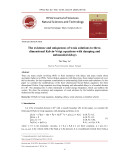
microstructure. Optical microscopy was used to capture microstructures of as-cast and
thermally aged aluminium alloy shown in figure-4. Fractography was done to determine type
of fracture for tensile and CVN samples using scanning electron microscopy (SEM) JEOL
(JSM-6510LV).
2.3. Testing for mechanical properties
Tensile specimen samples were tested on a servo hydraulic based digital controlled tensile
testing machine of having capacity 50 kN (make: Tinius Olsen, UK, Model-H50KS) and
ultimate tensile strength for as- cast alloy and thermally aged cast base alloys was determined.
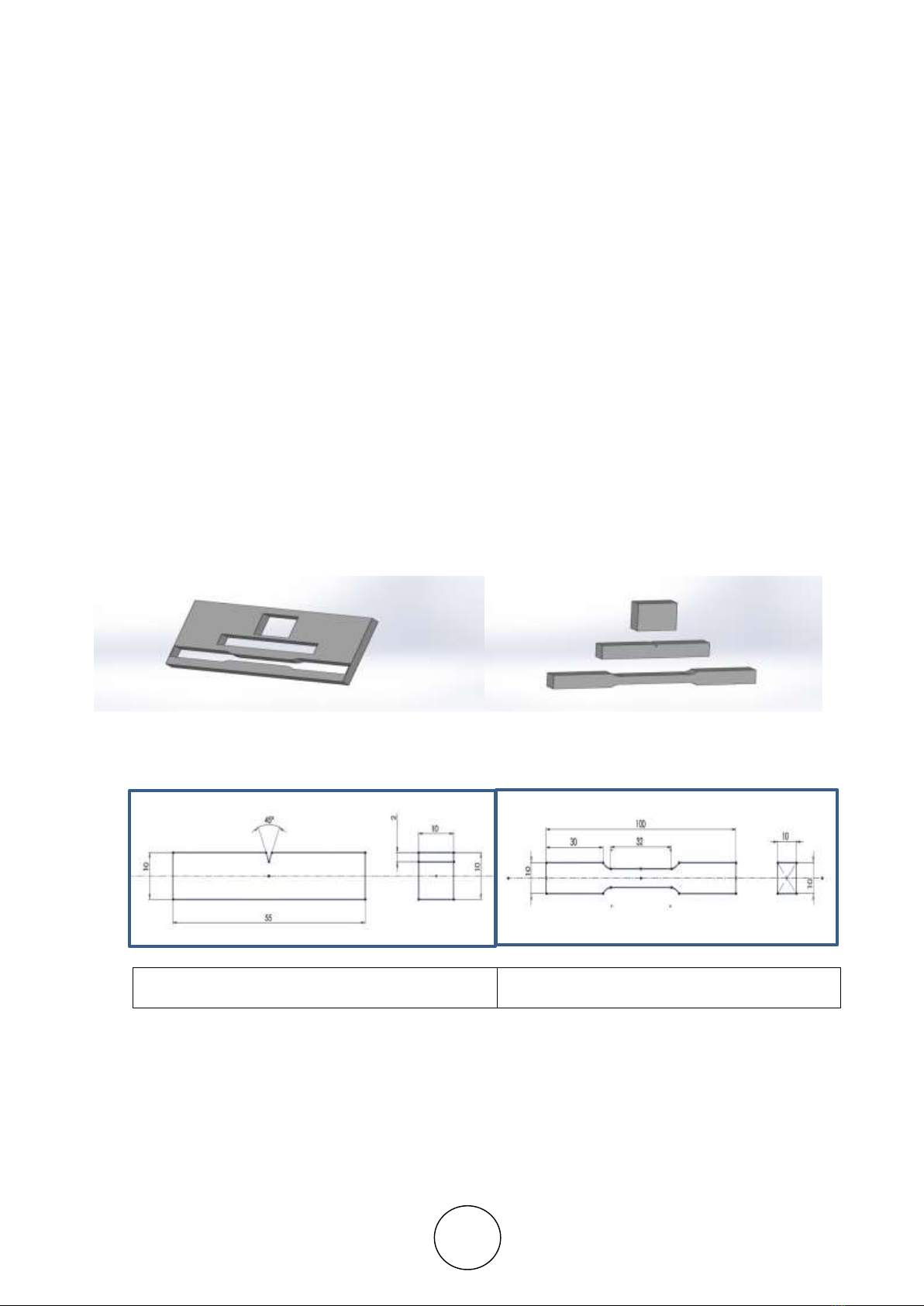
The tensile specimens were prepared in accordance with ASTM E08/E8M-09 standard as
shown in Figure 3. The Charpy V-notch (CVN) test was done to measure the fracture toughness
of as-cast and aged as-cast material. The sample for Charpy V-notch test was prepared as per
ASTM E23-12c standard and shown in Fig. 2. Micro hardness measurements were taken using
Brinell hardness tester (make-: Miraj, Model-B3000(O) with 10 mm diameter indenter at load
500kgf .
3. RESULTS AND DISCUSSION
3.1. Spectro analysis
The chemical compositions were tested as per ASTM E 1251-17a using spark emission
spectrometer analysis (Model No: LMF-01, Spectromaxx, Make: Germany). The chemical
Figure 1. Test specimen extracted from as-cast plate as per ASTM standard
Figure 2. Impact Test Specimen
Figure 3. Tensile Test Specimen

Rakesh Kumar and Varinder Sahni
http://www.iaeme.com/IJMET/index.asp 1559 editor@iaeme.com
compositions of as-cast alloy and thermally aged alloy were tested using spectrometer and
shown in Table 1.
Table 1. Alloying elements composition (wt.%)
Si
Cu
Mg
Fe
Zn
Ni
Mn
Cr
Ti
Sn
Pb
V
Al
1% Cu
&Mg as-
cast
alloy
with
solution
temperat
ure 500
0C,2h
0.42
2
0.28
07
0.5
699
0.60
6
0.00
56
0.00
16
0.01
07
0.00
27
0.1
396
0.00
38
0.00
41
0.00
79
97.9
3
1% Cu
&Mg as-
cast
alloy
with
160
0C,6h
0.47
3
0.31
44
0.6
114
0.64
2
0.00
70
0.00
24
0.01
09
0.00
26
0.1
536
0.00
51
0.00
44
0.00
83
97.7
5
The chemical composition 1% Cu &Mg as-cast alloy with solution temperature 500 0C,2h
and 1% Cu &Mg as-cast alloy with 160 0C,6h from spectrometer analysis on addition (1.0 at.
%) copper and magnesium in the base material, there is significant development of alloying
elements in aluminium metal matrix.
3.2. X-Ray Diffraction (XRD)
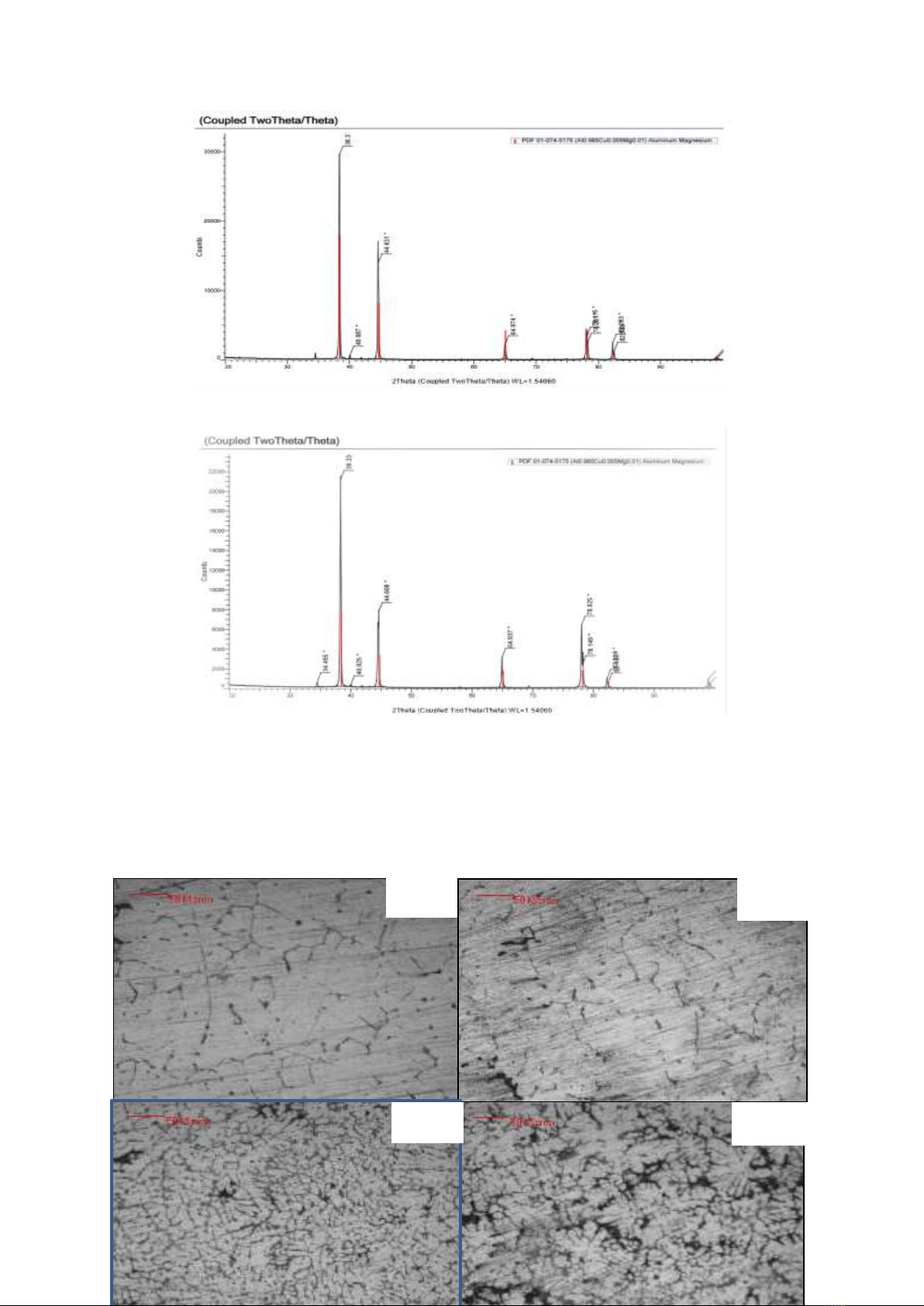
The X-ray diffraction (XRD) technique was used to show different intermetallic precipitate
formations in as-cast and thermally aged alloy which has been observed in XRD spectra as
shown in figure 4(a)&(b).
In as-cast base aluminium alloy, AlCu compound has less strength and Al12Mg17 compound
contributes to hardness of as-cast alloy. However, when aging was done to 160C, formation
of Al5Cu6Mg, sigma phase takes place which increases the tensile strength of the material. At
the elevated temperature coarse precipitate AlCuMg was also formed. The aging treatment
dissolves the AlCu compound and forms complex precipitate compounds which enhance the
strength of the matrix.
The complex compounds occur and formation of coarse precipitates such as Al2CuMg and
Al14Mg13, which enhances the toughness and strength at high temperatures. Sigma phase
precipitation was noticed in as cast and aged aluminium alloyed with copper and magnesium
which enhances their strength as compared to cast base material.
Study on Morphology and Mechanical Properties of Stoichiometrically Developed Al-Cu-Mg Cast Alloy
http://www.iaeme.com/IJMET/index.asp 1560 editor@iaeme.com
Figure 4 (a)
Figure 4 (b)
Figure 4. Intermetallic precipitate formation as per XRD diffraction patterns for (a) 1% Cu &Mg as-
cast alloy with solution temperature 500 0C,2h (b) 1% Cu &Mg as-cast alloy with 160 0C,6h.
3.3. Optical Microscopy (OM) studies
a
b
d
c
















![Bộ câu hỏi lý thuyết Vật lý đại cương 2 [chuẩn nhất/mới nhất]](https://cdn.tailieu.vn/images/document/thumbnail/2025/20251003/kimphuong1001/135x160/74511759476041.jpg)
![Bài giảng Vật lý đại cương Chương 4 Học viện Kỹ thuật mật mã [Chuẩn SEO]](https://cdn.tailieu.vn/images/document/thumbnail/2025/20250925/kimphuong1001/135x160/46461758790667.jpg)


