RESEARC H Open Access
Patient Care Teams in treatment of diabetes
and chronic heart failure in primary care:
an observational networks study
Jan-Willem Weenink, Jan van Lieshout, Hans Peter Jung and Michel Wensing
*
Abstract
Background: Patient care teams have an important role in providing medical care to patients with chronic disease,
but insight into how to improve their performance is limited. Two potentially relevant determinants are the
presence of a central care provider with a coordinating role and an active role of the patient in the network of
care providers. In this study, we aimed to develop and test measures of these factors related to the network of
care providers of an individual patient.
Methods: We performed an observational study in patients with type 2 diabetes or chronic heart failure, who were
recruited from three primary care practices in The Netherlands. The study focused on medical treatment, advice on
physical activity, and disease monitoring. We used patient questionnaires and chart review to measure connections
between the patient and care providers, and a written survey among care providers to measure their connections.
Data on clinical performance were extracted from the medical records. We used network analysis to compute
degree centrality coefficients for the patient and to identify the most central health professional in each network.
A range of other network characteristics were computed including network centralization, density, size, diversity of
disciplines, and overlap among activity-specific networks. Differences across the two chronic conditions and
associations with disease monitoring were explored.
Results: Approximately 50% of the invited patients participated. Participation rates of health professionals were
close to 100%. We identified 63 networks of 25 patients: 22 for medical treatment, 16 for physical exercise advice,
and 25 for disease monitoring. General practitioners (GPs) were the most central care providers for the three
clinical activities in both chronic conditions. The GP’s degree centrality coefficient varied substantially, and higher
scores seemed to be associated with receiving more comprehensive disease monitoring. The degree centrality
coefficient of patients also varied substantially but did not seem to be associated with disease monitoring.
Conclusions: Our method can be used to measure connections between care providers of an individual patient,
and to examine the association between specific network parameters and healthcare received. Further research is
needed to refine the measurement method and to test the association of specific network parameters with quality
and outcomes of healthcare.
Background
Chronic disease represents a significant challenge for
health systems, because it requires major changes in the
organization of healthcare and in the tasks of many health
professionals [1]. Structured clinical management of
chronic disease improves health outcomes and efficiency
of the healthcare delivery [2]. Providing chronic care has
increasingly become the task of a patient care team,
rather than an individual health professional [3], and
improved team functioning is expected to be associated
with better quality and outcomes of healthcare delivery
[4,5]. Previous studies identified numerous factors of
team functioning associated with team performance in
healthcare, though evidence on performance of primary
care teams in treatment of chronic disease remains
ambiguous [5-7].
* Correspondence: M.Wensing@iq.umcn.nl
Scientific Institute for Quality of Healthcare, Radboud University Nijmegen
Medical Centre, P.O. Box 9101, 6500 HB, Nijmegen, the Netherlands
Weenink et al.Implementation Science 2011, 6:66
http://www.implementationscience.com/content/6/1/66
Implementation
Science
© 2011 Weenink et al; licensee BioMed Central Ltd. This is an Open Access article distributed under the terms of the Creative
Commons Attribution License (http://creativecommons.org/licenses/by/2.0), which permits unrestricted use, distribution, and
reproduction in any medium, provided the original work is properly cited.

It has been suggested that the presence of a central
care provider in a team, who acts as a contact point for
both patient and other health professionals and takes
responsibility for the delegation of care to others on the
team, is crucial in achieving optimal outcomes [8,9].
This could optimize the coordination of healthcare
delivery and ensure that all necessary expertise and rele-
vant patient information is present to provide effective
clinical management. Patients who receive medical care
from a team of health professionals may benefit from a
wider range of skills. The inclusion of specific indivi-
duals, such as a nurse or pharmacist, may ensure that
specific elements are more evidence-based [3]. A few
field studies showed that the type and diversity of clini-
cal expertise involved was expected to account for
improvements in patient care and organizational effec-
tiveness [10,11]. Finally, sharing knowledge in patient
care teams could lead to shared practice routines and
better coordination of care.
A key aspect of chronic illness care is that it should
take a patient-centered focus, meaning that it is respect-
ful of and responsive to individual patient preferences
and needs [12]. Ideally, it is characterized by productive
interactions between team and patient that consistently
provide the assessments, support for self-management,
optimization of therapy, and follow-up associated with
good outcomes, and these interactions are more likely
to be productive if patients are active, informed partici-
pants in their care [8]. Previous studies have focused on
patient-perceived involvement [13] and communication
of teams to patients in general [14]. Actual involvement
of individual patients in processes of healthcare delivery
was measured less frequently [15].
Network analysis is a quantitative methodology that
offers the opportunity to measure and analyze connec-
tions between health professionals in a patient care
team [16,17]. Pilot studies have examined the feasibility
and relevance of network analysis for studying patient
care teams in chronic illness care [18,19]. In these pilots,
interactions were measured in a generic way. However,
networks of health professionals differ across individual
patients, even if they have the same disease and same
primary care provider. Furthermore, the patient was not
included in the networks in these pilots. In addition,
associations between network characteristics and health-
care delivery were not yet examined in chronic illness
care. Thus, our aim was to measure information
exchange networks related to individual patients with a
chronic disease, including relevant health professionals
and the patient, and to relate network characteristics to
aspects of healthcare received.
Our study focused on three specific aspects of health-
care for patients with type 2 diabetes or chronic heart
failure (CHF): medical treatment, physical exercise
advice, and monitoring. Previous research has shown
gaps between recommended practice and healthcare
received in these patients [2,20,21], suggesting a poten-
tial for improvement. The structure of the networks of
information flows between the patient and care provi-
ders, and among care providers, was expected to be par-
ticularly related to monitoring routines. Monitoring
demands an active role of the team [22]. Furthermore, it
requires a clear task distribution, knowledge on latest
guidelines, and convincement of its benefits. Despite
recommendations in prevailing practice guidelines, these
benefits remain a topic for continuing debate [23].
Therefore, we expected that social factors would be
associated with monitoring routines.
Three specific objectives were defined. A first objec-
tive was to test the feasibility of the sampling and mea-
surement procedures, because some previous network
studies did not fully report on response rates [18,24]. A
second objective was to examine the variation of net-
work characteristics across individual patients, because
this would open the possibility that these characteristics
are related to relevant outcomes and across chronic
conditions. A final objective was to explore associations
between specific network characteristics and compre-
hensive monitoring in these patients, although the size
of our study was too small to draw firm conclusions on
these associations.
Methods
Study design
An observational study was performed for which we
invited 30 patients with type 2 diabetes and 30 patients
with CHF from three primary care practices. In each
practice, we randomly selected 10 patients with diabetes
and 10 patients with CHF in the medical record system.
Patients with diabetes were selected using available data-
sets in the practices, patients with CHF were selected
with use of the International Classification of Primary
Care(ICPC) code. If a patient was physically or mentally
incapable to participate, he or she was replaced by the
next patient on the list. The ethical committee of Arn-
hem-Nijmegen waived approval for this study. Patients,
general practitioners (GPs), practice nurses, and practice
assistants in the participating practices were asked to
complete a structured questionnaire. Written informed
consent was obtained for collecting data from the
patients’medical record.
Measures
Patient questionnaire
Patients were asked to report on the number of disease-
specific contacts they had had in the past 12 months
concerning medical treatment, physical exercise advice,
and disease monitoring, and what health professionals
Weenink et al.Implementation Science 2011, 6:66
http://www.implementationscience.com/content/6/1/66
Page 2 of 9

were involved in these contacts. Medical treatment was
defined to the participants as any contact related to dis-
ease-specific medication (e.g., dosage, application,
adverseeffects).Physicalexerciseadvicewasdefinedas
any contact related to physical exercise or its impor-
tance. Disease monitoring was defined as any contact
related to disease-specific blood monitoring. Health pro-
fessionals, both in general practice as outside the prac-
tice, were listed by discipline. Other questions
concerned general patient and disease characteristics.
Medical records
After patients’written informed consent, we extracted
information from medical records concerning individual
characteristics and received monitoring. Parameters
included bodyweight, body mass index, blood pressure,
HbA1C (only for diabetes patients), glucose, serum crea-
tinine, potassium, sodium, and lipid values. Medication
for diabetes and cardiovascular conditions was also
extracted.
Care provider questionnaire
Health professionals in the practices were asked about
their role in diabetes and CHF care in general, and
about their collaboration with other health professionals
in medical treatment, physical exercise advice, and dis-
ease monitoring. For these three specific activities, they
were asked to report on patient-related contact with
other disciplines, both inside as outside their practice.
Health professionals were listed by discipline.
Data analysis
We used UCINET 6 for constructing networks and
obtaining network parameters, and SPSS 15 for all other
analyses. Response rates for both patients and health
professionals were determined. We determined reliabil-
ity of reported connections with other health profes-
sionals by examining the proportion of all possible
connections that were mutually reported present or
absent (called reciprocity coefficients in non-directed
networks).
Construction of networks and network parameters
For each patient, three activity-specific ego-centred net-
works were constructed, related to medical treatment,
physical exercise advice, and disease monitoring. An
activity-specific network was only constructed if the
patient reported at least one connection with a profes-
sional regarding the specific activity. A two-step proce-
dure was used to construct these networks: first, patient
questionnaires and medical records were used to iden-
tify connections between the patient and health profes-
sionals; then care provider questionnaires were used to
identify connections between health professionals, defin-
ing a connection if either one or both of the health pro-
fessionals reported to be connected.
If a patient had contact with a health professional
within a general practice (e.g., GP), all health profes-
sionals in that practice were included in the constructed
network. If a health professional was involved in an
activity-specific network (e.g., concerning medical treat-
ment), this professional was included in the other activ-
ity-specific networks of this patient as well.
If the response of a health professional was missing, it
was substituted by the response of the other individuals
in the practice. We filled in a zero indicating no contact,
if both individuals did not provide information on their
connection. This method is commonly used in network
analysis [25], though its appropriateness for this specific
context has not been tested. A ‘zero’in the data files
therefore referred to absence of a connection, or
absence of data on presence of a connection.
Network parameters and hypotheses
We examined a number of specific network parameters,
which we hypothesised to be related to healthcare deliv-
ery and outcomes.
Size and diversity are the number of involved health
professionals and different disciplines. A high number of
involved health professionals could hinder coordination
of care for an individual patient. Multiple involved disci-
plines, however, could be beneficial because of the avail-
ability of a wider range of skills [5].
Density is the proportion of all possible connections in
a network that are actually present. In a dense network,
information can flow quickly between most individuals.
It may also be associated with a number of cognitive
social processes, which result in positive intentions in
team members to use the information in daily practice.
This could contribute to more evidence-based and more
standardized practice patterns [26].
Network centralization is a measure that expresses to
what extent a network is organized around a single per-
son. It has been suggested that the presence of a central
care provider in chronic illness care is crucial to achieve
optimal outcomes [8].
The degree centrality coefficient is the proportion of
all possible connections that are actually present for an
individual. We computed degree centrality coefficients
for the patient and for the most central health profes-
sional. The discipline of the most central health profes-
sional was also noted. A high centrality of the health
professional can contribute to coordination of care
through connection with many other involved health
professionals. When this central health professional is
one with high expertise (in a general practice usually a
GP), knowledge on the best possible care can flow
through the patient care team. Furthermore, initiatives
on improving healthcare more often focus on a central
role for the patient in its own care process [8]. We
Weenink et al.Implementation Science 2011, 6:66
http://www.implementationscience.com/content/6/1/66
Page 3 of 9

think active involvement of a patient will result in a
comprehensive monitoring policy in that patient.
Overlap is the proportion of present and absent ties in
an index activity-specific network that are also present
in another activity-specific network. Medication, advice,
and monitoring overlap numbers of patients were
obtained to see if different health professionals were
involved in different aspects of the care process. It was
expected that a high overlap could contribute to coordi-
nation of care, because involved health professionals will
have knowledge of the entire care process of a patient,
instead of just a smaller part.
Descriptive and comparative analysis
Descriptive statistics of network parameters and clinical
management in the previous 12 months were computed
for the two chronic conditions. For follow-up and iden-
tifying co-morbidity, it is important to establish body
mass index (BMI)/weight, systolic blood pressure, and
creatinine values at least once a year in patients with
diabetes, as well as with CHF [27,28]. We computed a
variable for received comprehensive monitoring that
indicated if all three values were obtained at least once
in the previous 12 months. Descriptive statistics for
both conditions were computed, as well as network
parameters for both groups of monitoring received (not
all monitored/all monitored). Significance of differences
in network parameters between the two conditions, and
between two monitoring groups, was tested using the
Mann-Whitney test.
Results
Feasibility
In one practice, a total of seven CHF patients could be
identified. Therefore, a total of 57 patients was invited
to participate, of whom 32 patients completed the ques-
tionnaire and gave permission for collecting data from
their medical record. Patient response rates varied
between practices and the two chronic conditions
(Table 1). Response rates of health professionals (range:
80 to 100% per practice) and reciprocity coefficients in
the three networks of healthcare professionals were high
(range: 0.667 to 0.857 per practice).
In three out of 32 patients, no connections with health
professionals could be deduced from either question-
naires or medical record, so these patients were
excluded from further analysis. Of the theoretical maxi-
mum of 87 activity-specific networks, a total of 72 net-
works were identified: 24 for medical treatment, 20 for
physical exercise advice, and 28 for disease monitoring.
Four patients with CHF had received all treatment in
hospital rather than primary care in the previous 12
months. These patients were excluded for further analy-
sis, leaving a total number of 25 patients with 63 net-
works: 22 for medical treatment, 16 for physical exercise
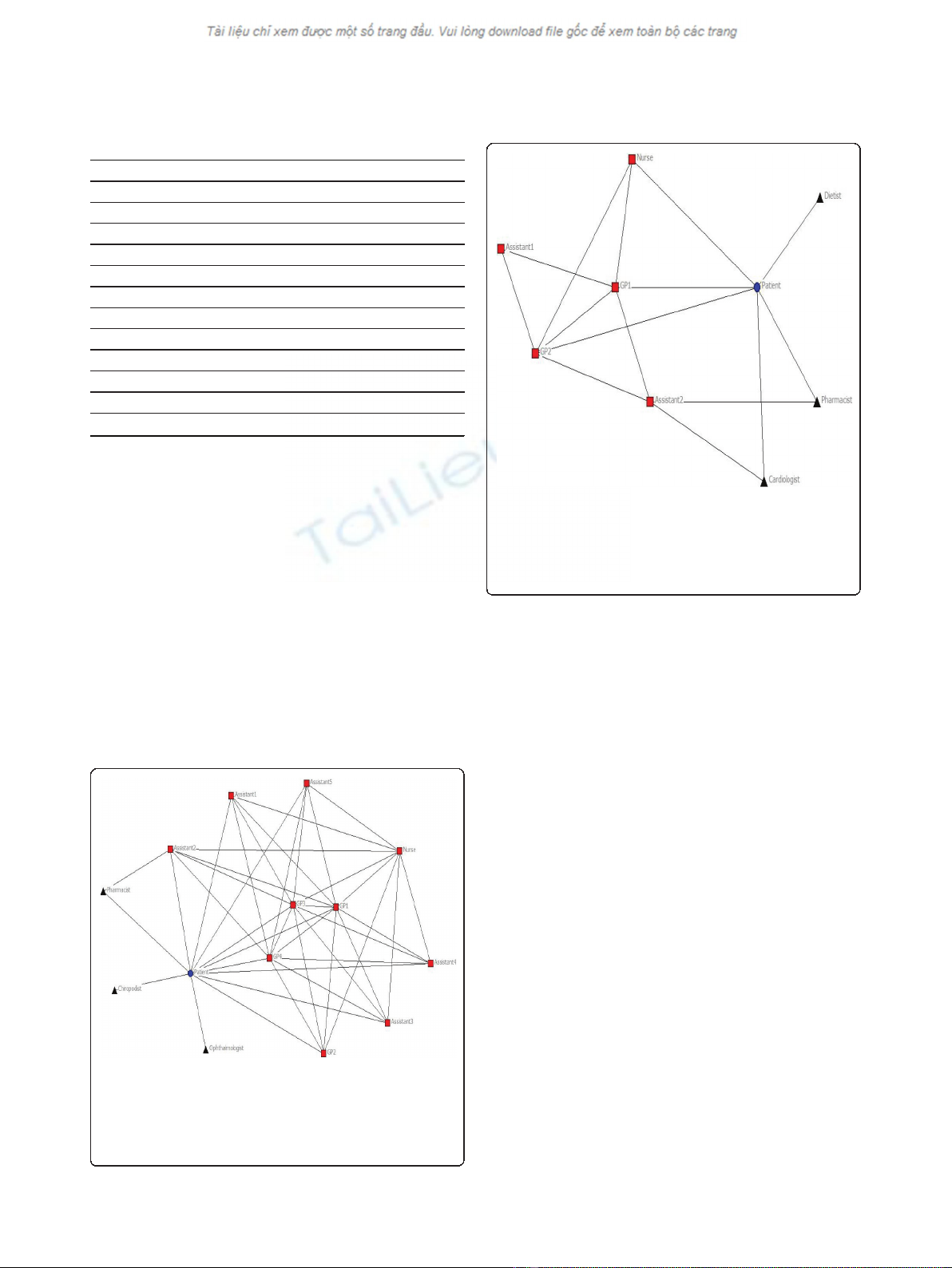
advice, and 25 for disease monitoring. Table 2 illustrates
patient characteristics of our study population. Figure 1
and 2 illustrate networks for medical treatment of a
patient with diabetes and a patient with CHF.
Variation of network characteristics
Table 3 shows the mean and standard deviation of size,
diversity, density, centrality, and overlap of activity-spe-
cific networks for the total number of patients, as well
as differences in mean between patients with diabetes
and patients with CHF. Substantial variation existed
between individual patients, as well as between diabetes
and CHF. Differences were found in size and diversity
of networks between diabetes and CHF. For all three
activities, more health professionals and disciplines
tended to be involved in diabetes, though differences
were not found to be significant. Density of networks
and the total number of connections tended to be
higher for diabetes, though only difference in density of
physical exercise advice networks was found to be sig-
nificant (p = 0.005). The difference in the total number
of connections in a network was only found to be signif-
icant (p = 0.034) for medical treatment. Network centra-
lization seemed to be equal for medical treatment and
monitoring, and showed a (non-significant) difference
for physical exercise advice. On all three activities,
degree centrality of the most central health professional
tended to be higher for diabetes, though this difference
was significant for physical exercise advice only. The
patients’degree centrality tended to be higher for physi-
cal exercise advice only, though no significant difference
Table 1 Response rates per practice and condition, and reciprocity of health professionals
Practice 1 Practice 2 Practice 3 Total
Patients Total 45.0% (9/20) 80.0% (16/20) 41.2% (7/17) 56.1% (32/57)
Diabetes 40.0% (4/10) 90.0% (9/10) 50.0% (5/10) 60.0% (18/30)
Chronic heart failure 50.0% (5/10) 70.0% (7/10) 28.6% (2/7) 51.9% (14/27)
Health professionals 100.0% (6/6) 100.0% (6/6) 80.0% (8/10) 90.9% (20/22)
Reciprocity
a
0.667 0.800 0.857
Reciprocity is the proportion of all possible connections that are mutually reported present or absent by health professionals.
Weenink et al.Implementation Science 2011, 6:66
http://www.implementationscience.com/content/6/1/66
Page 4 of 9
was found. Overlap values did not vary much between
the chronic conditions.
Table 4 shows the clinical management in the pre-
vious 12 months for both chronic conditions. The total
number of disease-specific contacts was higher for dia-
betes patients, and so was the number of contacts for
blood value monitoring. Variation existed on received
monitoring.
Association network parameters with received monitoring
Ten out of 25 patients (40%) received monitoring on
BMI/weight, systolic blood pressure, and creatinine.
Table 5 shows values of network parameters for patients
who did receive and did not receive this comprehensive
monitoring. Differences were found in size of networks,
network centralization of medical treatment and advice,
degree centrality of health professionals and patients,
and in overlap of medical and advice networks. Central-
ity of the most central health professional was positively
associated with monitoring received, while the associa-
tion of patient centrality with monitoring received was
ambiguous for specific activities. A positive association
was observed for physical exercise, while a negative
association was found for monitoring and no association
was observed for medical treatment. Only differences in
size of medical and advice networks, and the number of
connections in advice networks, were found to be
significant.
Discussion
This study showed that it is possible to construct net-
works of health professionals for individual patients with
diabetes and CHF using simple structured question-
naires for patients and health professionals, and patients’
medical records. Our study population was small,
because we aimed to develop and test the method
before applying it on a larger scale. Of all invited
patients, about 50% was willing to participate. The relia-
bility of the reported connections (in terms of connec-
tions’reciprocity) was high for health professionals.
Network characteristics varied substantially across indi-
vidual patients, as well as across chronic conditions. We
observed an association between a high degree centrality
Table 2 Patient characteristics study population (n = 25)
Disease Diabetes 72% (N = 18)
Chronic heart failure 28% (N = 7)
Gender Male 44% (N = 11)
Female 56% (N = 14)
Age Mean 72.83 (sd = 10.72)
Ethnicity Dutch 100% (N = 25)
Living situation Alone 56% (N = 14)
Spouse 36% (N = 9)
Spouse and children 8% (N = 2)
Education None 4% (N = 1)
Primary 36% (N = 9)
Secondary 56% (N = 14)
Higher 4% (N = 1)
Figure 1 Network of a patient with diabetes for medical
treatment. Circle: patient; square: health professional in practice;
triangle: health professional outside practice. Included for illustration
of the method used. The network illustrates the patient and the
health professionals involved. Lines resemble a connection between
two specific individuals.
Figure 2 Network of a patient with CHF for medical treatment.
Circle: patient, square: health professional in practice, triangle: health
professional outside practice. Included for illustration of the method
used. The network illustrates the patient and the health
professionals involved. Lines resemble a connection between two
specific individuals.
Weenink et al.Implementation Science 2011, 6:66
http://www.implementationscience.com/content/6/1/66
Page 5 of 9




![Vaccine và ứng dụng: Bài tiểu luận [chuẩn SEO]](https://cdn.tailieu.vn/images/document/thumbnail/2016/20160519/3008140018/135x160/652005293.jpg)