REGULAR ARTICLE
A minimal predictive model for better formulations of solvent
phases with low viscosity
Maximilian Pleines
1,2
, Maximilian Hahn
2,3
, Jean Duhamet
4,*
, and Thomas Zemb
1
1
Institute for Separation Chemistry, ICSM, CEA, CNRS, ENSCM, Univ. Montpellier, Marcoule, France
2
Department of Physical Chemistry, University of Regensburg, 93051 Regensburg, Germany
3
COSMOlogic GmbH & Co. KG, 51379 Leverkusen, Germany
4
CEA, DEN, DMRC, Univ. Montpellier, Marcoule, France
Received: 20 August 2019 / Received in final form: 10 October 2019 / Accepted: 13 November 2019
Abstract. The viscosity increase of the organic phase when liquid–liquid extraction processes are intensified
causes difficulties for hydrometallurgical processes on industrial scale. In this work, we have analyzed this
problem for the example of N,N-dialkylamides in the presence of uranyl nitrate experimentally. Furthermore, we
present a minimal model at nanoscale that allows rationalizing the experimental phenomena by connecting the
molecular, mesoscopic and macroscopic scale and that allows predicting qualitative trends in viscosity. This
model opens broad possibilities in optimizing constraints and is a further step towards knowledge-based
formulation of extracting microemulsions formed by microstructures with low connectivity, even at high load
with heavy metals.
1 Introduction
Liquid–liquid extraction is the central technology in metal
recycling [1,2]. An important application is the recovery
of major actinides Uranium and Plutonium in the
framework of minimization of highly radioactive waste
by use of Mixed Oxide Fuel (MOX) and the required
closing of the nuclear fuel cycle by using fast neutrons in
the future [3].
Designing efficient metal recovery processes based on
solvent extraction is not a straightforward task due to the
low solubility of inorganic ions in oils. In an optimized
formulation, oil-soluble complexing molecules are required
to (a) complex these ions selectively and (b) to solubilize
the resulting complexes in the organic phase. These so-
called extractants are surface-active molecules that are
composed of a polar complexing group, a Lewis base, and
an apolar moiety that increases the solubility of the
molecules in the organic diluent [4]. Since the pioneering
proposition of the existence of water-poor microemulsions
as w/o micelles by Osseo-Assare in 1991, solvent extraction
in hydrometallurgy has been recognized as based on one
phase transfer involving self-assembly and micellization in
conjunction with supramolecular complexation by “extrac-
tants”in first and second coordination spheres [5]. This so-
called “ieanic”approach has been recently backed up by
combined small angle scattering and molecular dynamic
simulations [6]. Compared to classical microemulsions, the
gain in free energy arising from formation of aggregates is
lower. Therefore, these microemulsions belong to the class
driven by “weak aggregation”[7].
Even if the processes using Tributyl phosphate (TBP)
as selective extractant are known since world-war II,
economic and technical reasons motivate the research
for alternative extractants. One promising approach
that is under development since several years is the use
of N,N-dialkylamides which also have a high affinity
towards Uranium and Plutonium and significant advan-
tages over TBP [8–11]. The main disadvantage of N,N-
dialkylamides is the viscosity of the organic phase which
increases exponentially when processes are intensified by
increasing uranyl and extractant concentration [12].
Emulsification and demulsification in industrial extraction
devices is only efficient when the difference in viscosity
between organic and aqueous phase is small [13,14]. The
problem of viscosity in solvent extraction was already
treated for ionic liquids [15] and vanadium extracting
systems [16] in this journal.
The extraction and coordination of major actinides by
N,N-dialkylamides has been intensively studied in the last
decades [10,17–21]. Ferru and co-workers have been the
first to investigate the aggregation behavior at molecular
and supramolecular scale at elevated extractant concen-
tration by combining molecular dynamics and X-ray
scattering [6,22,23]. At elevated uranyl content that is
*e-mail: jean.duhamet@cea.fr
EPJ Nuclear Sci. Technol. 6, 3 (2020)
©M. Pleines et al., published by EDP Sciences, 2020
https://doi.org/10.1051/epjn/2019055
Nuclear
Sciences
& Technologies
Available online at:
https://www.epj-n.org
This is an Open Access article distributedunder the terms of the Creative Commons Attribution License (https://creativecommons.org/licenses/by/4.0),
which permits unrestricted use, distribution, and reproduction in any medium, provided the original work is properly cited.
representative for industrial extraction processes, they
observed a strongly structured organic solution of
N,N-dialkylamides diluted in heptane. The structure is
formed by complexes of major stoichiometry UO
2
(NO
3
)
2
L
2
that are partly linked via bridging nitrates [6]. Conse-
quently, long linear (UO
2
(NO
3
)
2
)nthreads were found
for 0.5 M extractant in the organic phase. These inves-
tigations have given a first insight into the structure
evolution of N,N-dialkylamides with increasing uranyl
concentration, but do not allow a generalization of the
phenomenon.
Until now, the approaches to tackle the optimization of
formulations at the extraction as well as stripping stages
are based on experimental investigations along “experi-
mental design”[24]. These long suite of experiments find by
trial-and-error a compromise between selectivity and
hydrodynamic properties such as viscosity and interfacial
tension. To our best knowledge, there is no published
explicit predictive model that proposes explanations of the
viscosity increase by quantitative thermodynamic and
nanostructural arguments.
In this work, we propose a first thermodynamic model
that allows understanding the observed differences be-
tween certain extractants as well as the influence of diluent
and solute concentration on the viscosity of the organic
phase and the underlying microstructure.
2 Materials and methods
2.1 Materials
The dialkylamide extractants DEHBA (N,N-(2-ethyl-
hexyl)butyramide), DEHiBA (N,N-(2-ethylhexyl)isobu-
tyramide), DEHDMBA (N,N-(2-ethylhexyl)dimethyl-
butyramide) and MOEHA (N-methyl-N-octyl-(2-éthyl)
hexanamide) were synthesized by Pharmasynthese (Lisses,
France) with a purity higher than 99%. Tributyl phosphate
(purity >97%), n-octanol (>99%), n-dodecane (>99%)
and iso-octane (>99%) were purchased from Sigma-
Aldrich, Isane IP 175 from TOTAL Special Fluids. The
chemical structure of the extractants is presented in
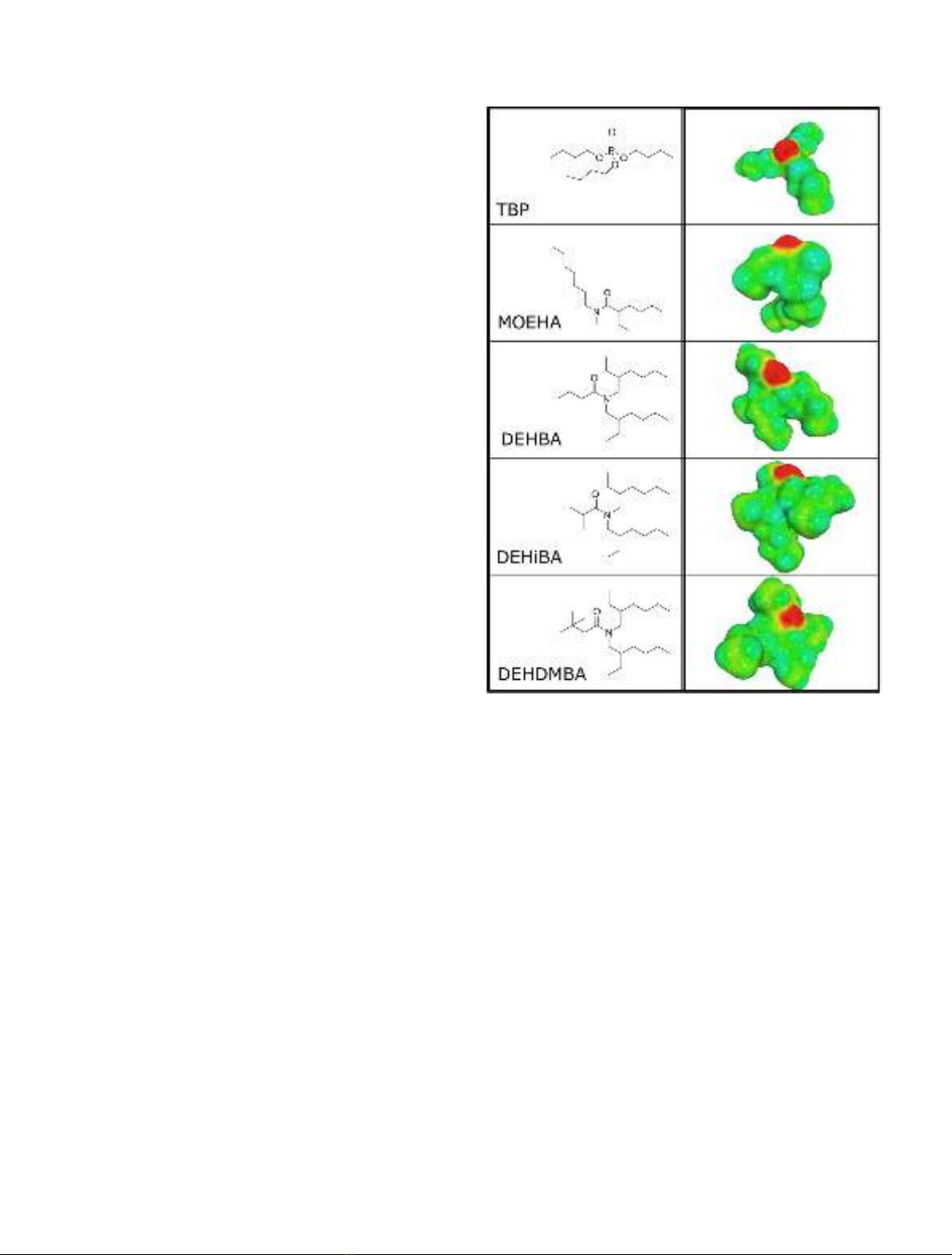
Figure 1.
2.2 Sample preparation
Organic phases were prepared by diluting a certain
extractant in a diluent to reach a definite molarity. After
that, the solutions were contacted for 3 h with aqueous
phases of equal volumes. The aqueous phase consisted of
diluted uranyl nitrate in different concentrations at a
constant acid molarity of 3 M nitric acid. The two phases
were separated after centrifugation. In order to prepare an
organic phase of a definite uranyl content, the concentra-
tion of uranyl in the aqueous phase was chosen so that the
intended concentration of the organic phase is reached after
contact of the two phases according to the known
distribution coefficients. The uranyl content was deter-
mined volumetrically. This procedure includes first a
quantitative reduction of uranium(VI) to uranium(IV) by
a hydrochloric solution of Titan(III) chloride (Merck, 15%)
and second a back-oxidation to hexavalent uranium by
FeCl
3
(27%, VWR). The amount of Fe
2+
, which is related
to the amount of U
6+
, is determined by potentiometric
titration with 0.1 N Titrinorm potassium dichromate
solution (Volusol) [25,26].
2.3 Viscosity measurements
Viscosity measurements were carried out with an Anton
Paar DSR 301 Rheometer under thermostatic control using
a couette CC17 T200 SS geometry (diameter 16.666 mm;
length 24.995 mm). The sample volume was 4 mL. The
geometry of concentric cylinders was chosen because of
security reasons and to minimize evaporation effects. Since
all measured solutions behaved Newtonian, a certain shear
rate (50 1/s) was chosen as representative value for the
viscosity. It was intentionally forgone to extrapolate the
curves to obtain the zero shear viscosity, since the data at
low shear rates were noisy and the presence of a yield stress
could not be excluded for each case. Shear viscosities were
measured under thermostatic control from shear rates of
0.1–1000 1/s with 10 points per decade and a measurement
duration of 6 s/point. Each measurement was carried out
three times and the mean value was taken for plotting.
Fig. 1. Extractant structure and COSMO cavities.
2 M. Pleines et al.: EPJ Nuclear Sci. Technol. 6, 3 (2020)

The standard deviation for these measurements was
approximately 0.1–0.3 mPa s. Since this standard devia-
tion is small for elevated viscosities, error bars are not
shown for reason of better clarity. In the following text, the
term “viscosity”is used equivalently for “shear viscosity”.
2.4 Scattering experiments
Small- and Wide-Angle X-ray Scattering (SAXS) experi-
ments were carried out on a bench built by Xenocs using
X-ray radiation from a molybdenum source (l= 0.71 A
)
delivering a 1 mm large circular beam of energy 17.4 keV.
The scattered beam was recorded by a large online scanner
detector (MAR Research 345) which was located 750 mm
from the sample stage. Off-center detection was used to
cover a large qrange simultaneously (0.2 nm
1
<q<
30 nm
1
,q¼½
4plsin u=2ðÞ). Collimation was applied
using a 12:∞multilayer Xenocs mirror (for Mo radiation)
coupled to two sets of Forvis
tm
scatterless slits which
provides a 0.8 mm 0.8 mm X-ray beam at the sample
position. A high-density polyethylene sample (from Good-
fellow) was used as a calibration standard to obtain
absolute intensities. Silver behenate in a sealed capillary
was used as scattering vector calibration standard. Data
were normalized taking into account the electronic
background of the detector, transmission measurements
as well as empty cell and fluorescence subtraction [6].
Small-angle neutron scattering (SANS) were performed
at the French neutron facility Laboratoire Leon Brillouin
(LLB) on the PAXY spectrometer using four configura-
tions (sample-to-detector distance d= 1 m, wavelength
l=4A
,d=6m,l=3A
,d=8.5m,l=5A
,d=15m,l=6.7A
)
to cover a q-range from 0.0019 to 0.64 A
1
.Measurements
were performed in quartz Hellma cells of an optical path of
1mm. At low q, the measurement time was set to 4 h in
order to deliver sufficiently high statistics. Correction of
sample volume, neutron beam transmission, empty cell signal
and detector efficiency as well as normalization to absolute
scale (cm
1
) was carried out by a standard procedure using the
“PASINET”software.
2.5 Theoretical investigations with COSMO-RS
Within this contribution, the Conductor-like Screening
Model for Realistic Solvation (COSMO-RS [27–29] was
used for the quantification of interactions in solution
and for the theoretical investigation of the extraction
process of uranyl-nitrate with the N,N-dialkylamides:
TBP, MOEHA, DEHBA, DEHiBA and DEHDMBA in
several organic diluents.
In a nutshell, the COSMO-RS method makes use of the
electronic structure of ideally screened molecules in a
homogeneously polarizable dielectric continuum and
calculates chemical potentials, activity coefficients and
free energy-related properties from the statistical thermo-
dynamics of the ensemble of pairwise interacting surface
segments of solute-continuum interface (COSMO surface
cavity, Fig. 1).
The electronic structures of all molecules in their most
relevant minimum energy configurations and hence, the
polarization charge densities on the COSMO surface
cavities around the molecules can either be taken from
the COSMOtherm database or generated by use of
quantum chemical DFT-BP86 [30,31]/COSMO [32] cal-
culations with the TURBOMOLE V7.2 [33–35] program
package. The extractant structures as well as exemplary
COSMO surface cavities can be found in the supplementa-
ry information. Beside of the molecule specific distribution
of the polarization charge densities on the COSMO surface
segments, only the phase composition of the liquid mixture
and the system temperature is needed for a COSMO-RS
calculation.
After the calculation of activity coefficients, chemical
potentials and contact probabilities of all COSMO surface
segments, and subsequently, of all molecules in a self-
consistent iterative procedure, the COSMO-RS model can
be used for the prediction of a broad range of free energy
related properties and thermodynamic equilibrium prop-
erties.
Within this study, the COSMOtherm program (COS-
MOtherm, Version 18.0.2), (Eckert, 2014) was mainly used
for the prediction of partition coefficients of molecules in
infinite dilution between two phases. These partition
coefficients can be calculated as the difference of the
chemical potentials of the compounds in each of the two
phases, and hence, can be interpreted as a measure for the
affinity of a compound towards one of the phases. For more
information about COSMO-RS theory and other applica-
tion fields it is referred to literature [29,36–38].
2.6 General theory
In this work, we present a minimal model at nanoscale for
the prediction of the macroscopic behavior of organic
extractant solutions. The term “minimal”means in that
context that this model can be used with a minimum of
necessary input parameters that are either measurable or
have a precise definition and physical meaning. It combines
three pioneering works with well-established key elements
in colloidal chemistry [39]:
–the concept of pseudo-phases introduced by Shinoda [40]
and later used by Tanford [41];
–the expression for the bending free energy of amphiphilic
films derived from the works of Ninham [42], Hyde [43,44]
and Israelachvili [45];
–classical theories for “living polymers”or “connected
worm-like micelles”proposed by Cates [46–48], Lequeux
[49], Candau [50] and Khatory [51].
The evolving structure in the organic phase can be seen
as made up from four different microphases in chemical
equilibrium: endcaps (EC), cylinders (cyl), junctions (J, or
equivalently, branching points, BP) and monomeric
extractants. These microphases arrange themselves into
a colloidal structure. The fourth microphase, monomers,
does not significantly contribute to the increase in
viscosity. Consequently, its contribution is negligible and
is only considered in the context of this model by decreasing
the number of molecules participating in the decisive
structure. To each of these microphases, an effective
packing parameter Pcan be defined (cf. Tab. 1). This scalar
number is specific for each microphase and represents the
M. Pleines et al.: EPJ Nuclear Sci. Technol. 6, 3 (2020) 3

geometry that an extractant has to adopt to fit into the
interfacial film. The values are estimated from a simple
reversion of the effective packing parameters from the
aqueous, direct case into the reverse case and probably do
not represent the exact limits. The following model and
chosen values are rather used to demonstrate and explain
the viscosity increase of the organic phase than to obtain
quantitative observations. Especially the estimation of the
value for junctions is difficult. For junctions, the value of P
is intermediate between the one of cylinders and the one of
bilayers, respectively, since they can be regarded as a
central bilayer-like region surrounded by three semi-
toroidal sections [52]. Therefore, we have set this value
to 1.2 for junctions.
Experimental observations from X-ray scattering
combined with molecular dynamic simulations have
indicated that the organic phase composed of dialkyla-
mides in organic solution tend to form rather a mesoscopic
living-network-like structure than spherical aggregates [6].
The main compound are cylinder units composed of
alternating uranyl-nitrate chains embodied in a “bottle-
brush”structure formed by extractants.
Extraction of uranyl molecules into the organic phase
swells the polar core of the present reverse aggregates.
Therefore, the mean curvature per extractant and hence,
its spontaneous packing parameter P
0
, decreases with
increasing uranyl content. With changing P
0
also its
differences respective to the effective packing parameter
characteristic for each microphase change with uranyl
concentration. This difference is used in the following to
simulate the evolution of the microphase distribution with
increasing uranyl content.
2.6.1 Microphase distribution
According to the concept of pseudo-phases, the chemical
potential mof a single extractant iin the diluent is equal to
the chemical potential of iinside a microphase [39–41].
mi;endcaps ¼mi;cylinders ¼mi;junction ¼mi;monomer:ð1Þ
The local expression of the chemical potential m
i
of one
extractant in one microphase comprises a standard
reference potential m0
iand a concentration-dependent
term RTlna
i
, where a
i
is the activity.
mi;endcaps ¼m0
i;endcaps þRT lnai;endcaps ð2Þ
mi;cylinder ¼m0
i;cylinder þRT lnai;cylinder ð3Þ
mi;junction ¼m0
i;junction þRT lnai;junction:ð4Þ
According to concepts by Hyde et al., the bending
contribution to the free energy of one extractant in a given
microphase can be expressed, by a harmonic approxima-
tion, as the deviation of the actual extractant geometry
that the extractant must adopt to fit into a highly bent w/o
interfacial film. The crucial point is the difference between
effective packing in a given sample and the “spontaneous”
packing of any given film made of adjacent surface active
molecules. All known extractants are oil-soluble and have
surface active properties.
The “frustration”free energy reflects the cost in free
energy of packing together interface active molecules under
topological constraints. This free energy depends on the
difference between the effective packing parameter Pand
the spontaneous packing parameter P0–multiplied with a
bending constant k*[
43]. In all of the large number of
previously handled cases in the literature, a harmonic
expansion of the free energy has shown to be efficient:
Fi;bending ¼k
2PP0
ðÞ ð5Þ
with Pdenoting the effective packing parameter defined by
the shape of a given micro-phase and P
0
=(v/a
0
⋅l)
denoting the preferred, spontaneous one, vbeing the
volume of the nonpolar moiety, a
0,
the area per surfactant
head-group and lthe mean surfactant chain length. In the
case of extractants, the bending modulus k* was found to
lie in the order of magnitude of 1–2 kT per chain, meaning
that the free energy involved in a sphere to cylinder
transition is of the order of k
B
T[53,54]. Note that using the
Helfrich-Gauss expression of frustration energy thin films is
an expansion of equation (5) and moreover would require
spontaneous and effective curvature radii to be much larger
than chain length: this is never the case in water-poor
extracting systems.
In a next step, the evolving structure is considered as
built from cylindrical micelles decorated with endcaps and
junctions in dynamic equilibrium as defects. Therefore, the
standard reference potential of cylinders is defined as a
reference state. As a result, the difference in standard
Table 1. The three microphases in chemical equilibrium.
Spherical endcaps Bottlebrush cylinder units
surrounding alternating
uranyl–nitrate–uranyl chains
Junctions with a saddle-like
structure with an average
curvature of H≈0
P
EC
=3 P
cyl
=2 P
J
≈1.2
4 M. Pleines et al.: EPJ Nuclear Sci. Technol. 6, 3 (2020)
reference chemical potential Dm
0
of endcaps (EC) and
junctions (J) relative to this potential can be derived from
the differences of the free energy as a frustration of bending
between each microphase of a certain aggregation number
N
agg
[39].
m0
i;EC m0
i;cyl
¼k
2⋅Nagg;EC PEC P0xðÞðÞ
2Nagg;cyl Pcyl P0xðÞ
2
hi
ð6Þ
m0
i;Jm0
i;cyl
¼k
2⋅Nagg;JPJP0xðÞðÞ
2Nagg;cyl Pcyl P0xðÞ
2
hi
:ð7Þ
The spontaneous packing parameter P
0
is varying with
the relative uranyl content expressed as the mole fraction
x= [uranyl]/[extractant]. Therefore, also the standard
reference chemical potentials are dependent on the
concentration of complexed uranyl ions in the organic
phase. The uranyl content xvaries from x= 0, no uranyl
molecules in the organic phase, to x≈0.45, which is the
approximate experimental stoichiometry of [Dialkyla-
mide]/[UO
22+
]≈2.3 [55,56]. At this value, the organic
phase has reached the maximal possible concentration of
uranyl nitrate.
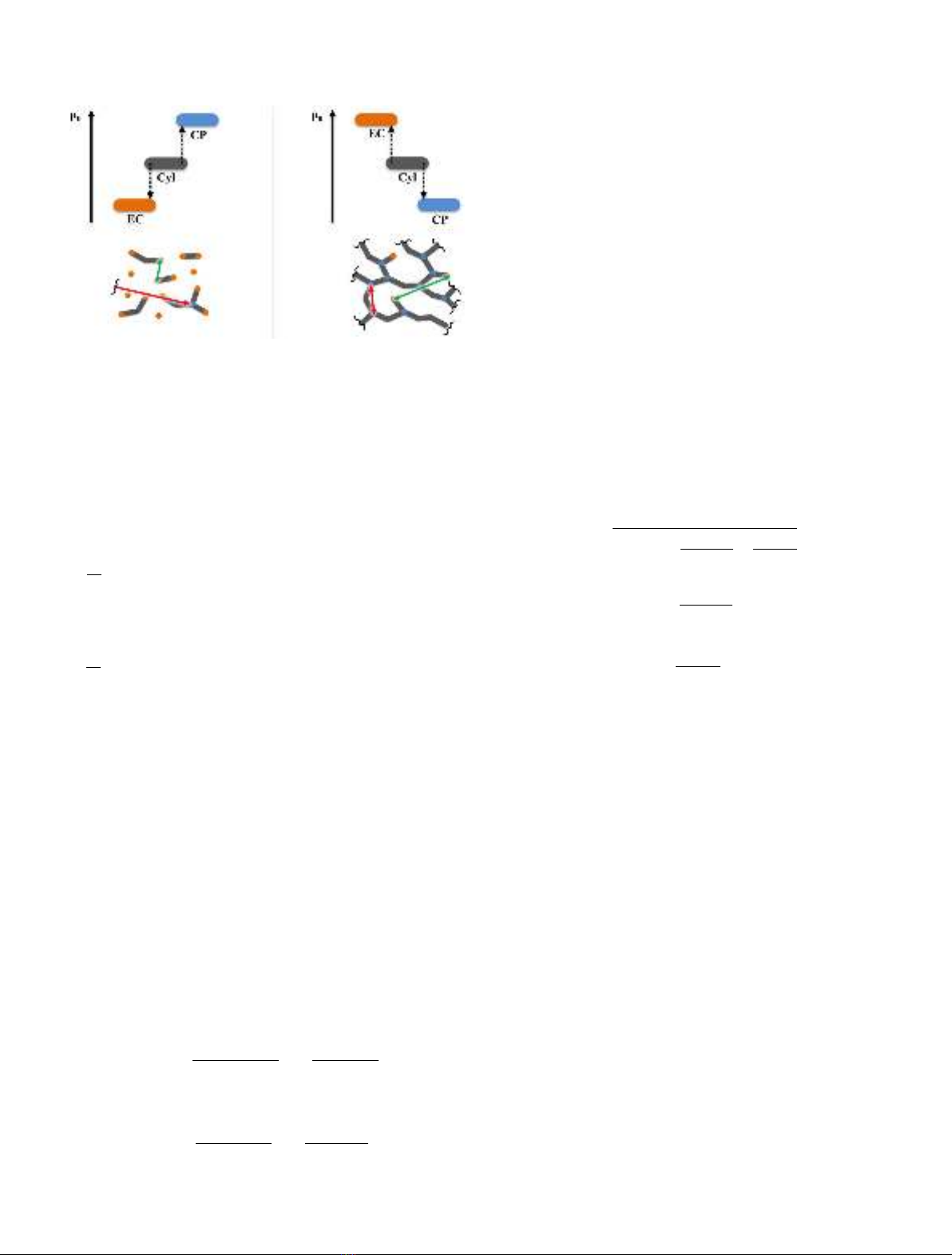
The cost in free energy Dm
0
to convert a cylindrical
microphase into an endcap, or respectively, in junction
units gives the relative probability of occurrence of each
microphase (cf. Fig. 2). Combining equations (2)–(4) and
(6) and (7) leads to an expression for the relative
concentration of extractants in each microphase (ci,
cyl
,
ci,
EC
, ci,
J
).
exp m0
i;EC m0
i;cyl
RT
!
¼ci;cyl·gi;cyl
ci;EC·gi;EC
ð8Þ
exp m0
i;Jm0
i;cyl
RT
!
¼ci;cyl·gi;cyl
ci;J·gi;J
:ð9Þ
The necessary ratio of activity coefficients g
i
can be derived in a first approximation from the number
of extractants per microphase N
agg
as g
i,microphase
∼
1/N
agg,microphase
[39]. The unit used in equations (8) and
(9) can be chosen at will: the easiest scale involves
concentration in moles, meaning distance are of the order
of 1 nm. The molality scale would be more adapted for
evaluating entropic corrections, while the mole fraction
scale implies delicate “infinitely diluted”reference states
that are very far from the electrolyte content in the
polar cores of the micelles. In this work, we use the
concentration scale for evaluating potentials [57].
Respecting mass conservation, the total concentration
of endcap, cylinder and junction units can be calculated
from the relative concentrations c
cyl
/c
EC
and c
cyl
/c
J
and
the total concentration of extractants c
Ex
in solution. The
total number of extractant molecules per volume c
Ex
is
composed of the numbers of extractant N
agg
per cylinder,
endcaps and junctions:
Nagg;cyl·ccyl þNagg;EC·cEC þNagg;J·cJþcmonomers
ðÞ¼cEx
ð10Þ
ccyl ¼cEx
Nagg;cyl þNagg;EC
ccyl=cEC
þNagg;J
ccyl=cJ
ð11Þ
cEC ¼ccyl
ccyl=cEC
ð12Þ
cJ¼ccyl
ccyl=cJ
:ð13Þ
Consequently, if the standard reference chemical
potential of endcaps is low, the resulting population of
endcaps is high. If the standard reference chemical
potential of endcaps is high, the formation of endcaps is
unfavorable and the resulting concentration is expected to
be low (cf. Fig. 2).
As a result, the evolution of the distribution of
microphases can be estimated from the evolution of the
spontaneous packing parameter P
0
with increasing uranyl
concentration.
2.6.2 Microphase equilibrium controlling viscosity
The microphase distribution that is given by the evolution
of the spontaneous packing parameter provides the number
of endcaps, cylinders and junctions at a given uranyl
concentration and defines the evolving microstructure. We
can link this microphase distribution to the macroscopic
properties of the system, in specific viscosity.
We consider the following relationship for reptating
chains according to Cates [46]:
h∼L3
eff ð14Þ
where his the zero-shear viscosity of an entangled solution
of worm-like micelles and Lis the mean contour length of
the micelles. In the case of fast micellar breaking, the
Fig. 2. The influence of standard reference chemical potential on
microstructure (two extreme cases).
M. Pleines et al.: EPJ Nuclear Sci. Technol. 6, 3 (2020) 5













![Ngân hàng trắc nghiệm Kỹ thuật lạnh ứng dụng: Đề cương [chuẩn nhất]](https://cdn.tailieu.vn/images/document/thumbnail/2025/20251007/kimphuong1001/135x160/25391759827353.jpg)