

* Corresponding author.
E-mail addresses: kiryukhin.al@list.ru (A. V. Kiryukhin)
© 2017 Growing Science Ltd. All rights reserved.
doi: 10.5267/j.esm.2017.6.001
Engineering Solid Mechanics (2017) 177-184
Contents lists available at GrowingScience
Engineering Solid Mechanics
homepage: www.GrowingScience.com/esm
Design features of rubber metal compensators and numerical simulation of their
stress-strain state upon hydrostatic compression
Aleksei Vladimirovich Kiryukhina,b*, Oleg Osherovich Mil`mana,b, Anton Viktorovich Ptakhinb,
Galina Ivanovna Shaidurovac and Aleksandr Aleksandrovich Shaidurovc
aTsiolkovsky State University, Kaluga, ul. Stepana Razina 26, Kaluga, 248023 Russia
bZAO Turbokon, ul. Komsomol'skaya Roshcha 43, Kaluga, 248010 Russia
cPerm National Research Polytechnic University, Komsomol'skii prospekt 29, Perm, 614990 Russia
A R T I C L EI N F O A B S T R A C T
Article history:
Received 6 March, 2017
Accepted 9 June 2017
Available online
10 June 2017
This article discusses possibilities of application of widely applied and promoted abroad
methods of active dampening of vibration and pressure oscillations (antinoise technology) in
order to reduce vibration transfer via vibro-insulating couplings (compensators) of fluid
pipelines. This is required in solution of issues of vibration insulation of equipment with regard
to foundation and environment along pipelines with working mediums, for instance, in
transporting of oil and gas, in energy and transport engineering. Reasonability of operation of
active system in combination with means of passive dampening of these impacts is
demonstrated. In terms of efficiency and minimum energy consumptions by active system it is
reasonable to apply active dampening of vibration and oscillations downstream of the vibro-
insulator (compensator) where their level is significantly lower than in the source. In the case
of pipeline this implies dampening of vibration and oscillation downstream of compensator
and damper, however, such works are nearly unavailable. This is attributed to significant
coupling between vibration and pressure oscillation in compensator and pipeline itself,
complicating solution of the problem. It is concluded that for efficient application of active
dampening in pipeline compensators it is required to develop compensators with minimum
coupling between vibration and oscillations.
© 2017 Growin
g
Science Ltd. All ri
g
hts reserved.
Keywords:
Vibration
Pressure oscillation
Dynamic forces
Airborne noise
Energy generating facility
Vibration protection
Pipeline
Compensator
Active vibration protection in
spatial motions
1. Introduction
Development of up-to-date engineering and innovative approaches to improvement of designs and
assemblies is directly related with the use of achievements at interdisciplinary and inter-industry level.
Application of multilayer rubber-metal packages in rocket and helicopter engineering for supports in
nozzle clusters of solid propellant rocket engines, helicopter bearings and engines of various floating
178
crafts. Development of domestic composition of low modulus elastomers on the basis of polyisoprene
made it possible to implement rubber metal absorbers operating in combination with dampening
(difference between deformation work and elastic recovery in the form of hysteresis). Model of elastic
3D grid of vulcanizate acts as spring. Rubber vulcanizate should possess such elasticity modulus which
depends on the value of deformation and not on its rate. Compensators with thin layer elements are
radically new design of elastic couplings of pipeline. They are mainly aimed at decrease in vibration
transfer from its source and at the same time at retention of displacement compensation upon vibration,
impacts and oscillations. Low axial dimensions (in height) can displace structural resonances to high
frequency range, which would permit to obtain significantly lower vibrational rigidity of compensators
with thin layer runner metal elements (TRME) in comparison with rubber cord casing (RCC). The
issues of vibration insulation of any object are related with determination of vibration transfer
properties as frequency functions of rigidity of all structural elastic elements along height upon spatial
motions (Kiryukhin, et al., 2011, 2013; Yablonskii, 2011; Tikhonov, et al., 2012; Chistyakov and
Yablonskii, 2013; Ganiev, 1993, 2013; Kuznetsov, et al., 2011).
Stress-strain state is investigated using single method for rubber layer of various configuration. It
is experimentally established that in thin layer under constrained deformation elastomer is a weakly
compressed material. Low compressibility (Poisson coefficient = 0.4999) means that finite shear
modulus or compressibility parameter can be written as: а = G/K/10-3 –10-4. The most dangerous in
terms of tangential stresses are the points on internal surface of rigid element both in flat and spherical
variants.
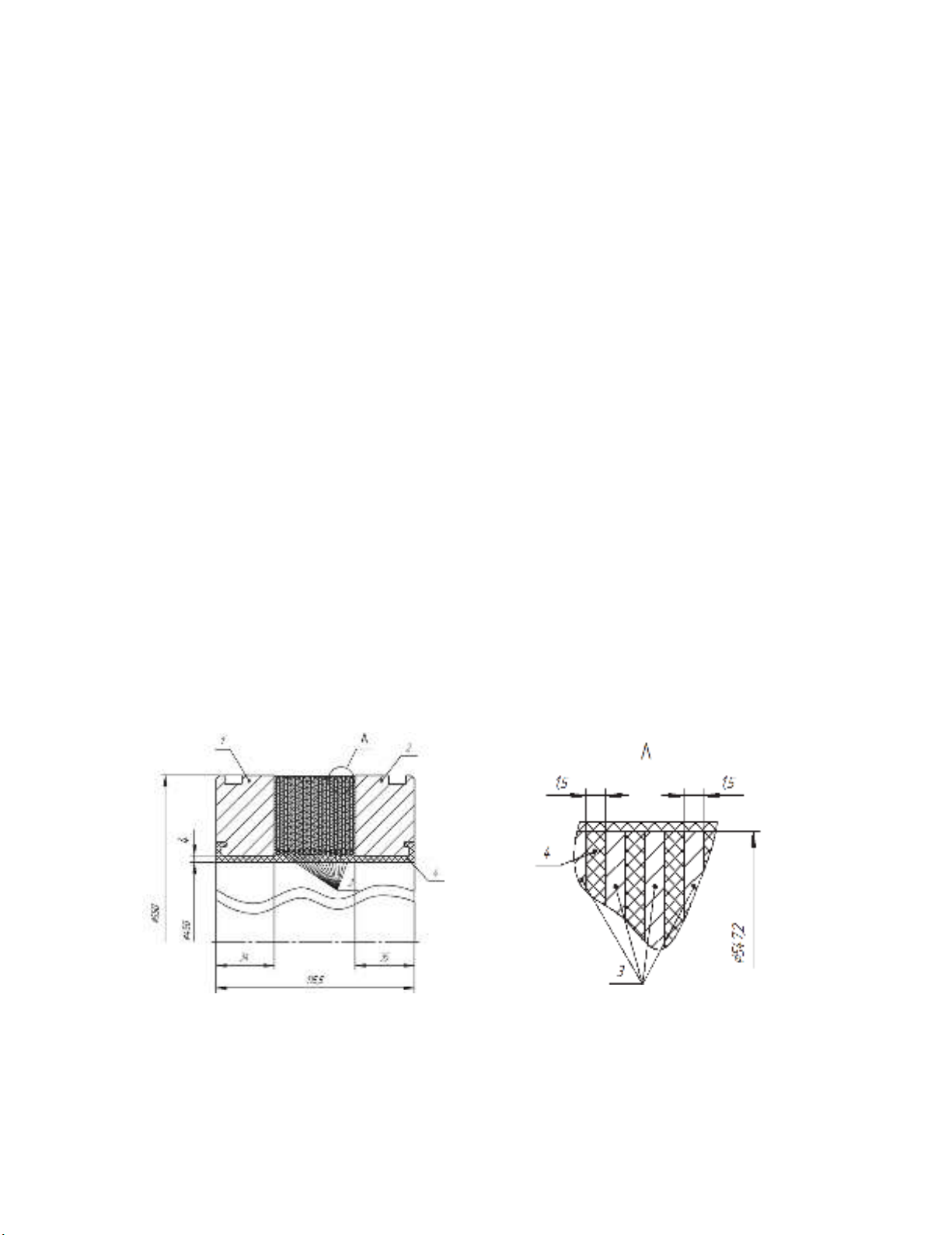
Axially symmetric design of rubber metal element is illustrated in Fig. 1 (Sobol & Statnikov, 2006;
Lighthill, 1981; Lavrov, 1993; Martin & Smith, 2013; Reznichenko & Morozov, 2000; Khorolskii,
2010; Rozhnov & Shchitov, 2007; Zasypkin, 1995; Zaikov, 1991). The design is comprised of support
rings (pos. 1, 2) and rubber metal package composed of a set of steel (plastic) plates (pos. 3), separated
by layer of vulcanized rubber (with elasticity shear modulus of about 0.25 MPa) on the basis of
synthetic rubber (polyisoprene, silicone, or polyurethane of elastic type). Selection of elastomer
material is performed depending on operation conditions with regard to temperature range,
environmental severity and impact pressure in internal cavity of technological object (ASTM D 429-
81).
Fig. 1. Design of thin layer rubber metal element: 1, 2 – support rings; 3 – rigid elements; 4 –
elastomer (vulcanizate) on the basis of polyisoprene
A. V. Kiryukhin et al. / Engineering Solid Mechanics 5 (2017)
179
2. Numerical simulation of stress–strain state
Stress-strain state of TRME upon compression (at pressure Ррimpact and displacement of support rings
by 40 mm) was simulated.
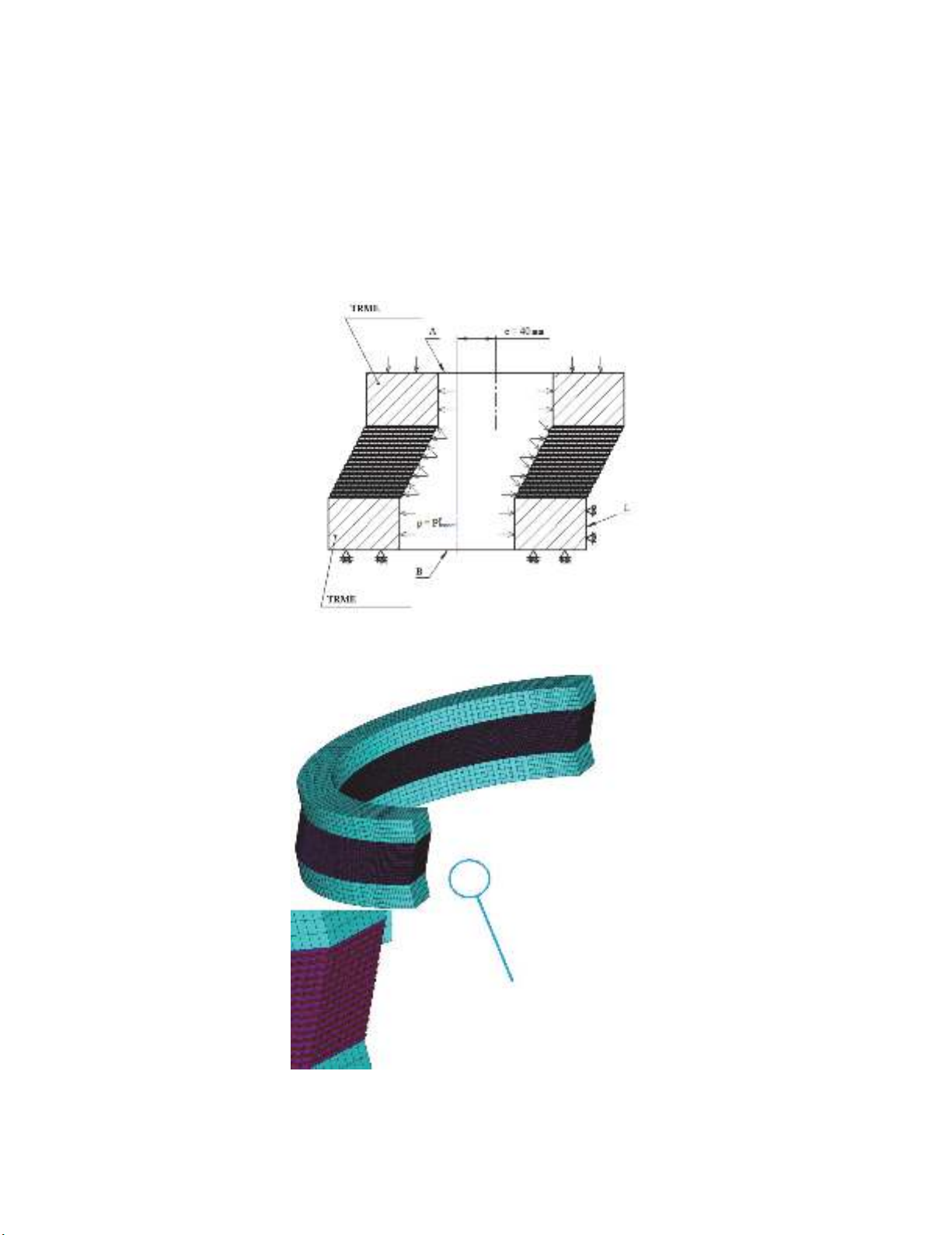
Geometrical model of TRME (Fig. 2) with mutually displaced axes of support rings is considered.
Pressure is applied to internal surface of TRME and free edge “А” of support ring. Free edge “B” of
other support ring is fixed in axial direction. In radial direction the TRME is fixed along the line L. The
units of the edge A are connected by displacement coupling which presets equality of axial motions of
these units (the edge “A” under pressure would remain parallel to the edge “B”). Finite element model
of TRME is illustrated in Fig. 3.
Fig. 2. Calculated diagram of hydrostatic load on TRME
Fig. 3. 3D finite element model of TRME

180
Elastic boundary problem was solved by finite element method on the basis of variational approach.
Equilibrium equation of continuous medium is as follows:
Fn
F
F
~
0
~
(1)
Non-linear geometrical relations which determine stress-strain state of TRME are defined as
follows:
11
22
TTT
uu uu uu
, (2)
where u
,
~
,
~
is the tensor of stresses, strains and distortion; Fun
,, is vector of normal, motions,
surface force, respectively, i
i
q
e
is the Hamiltonian.
Interrelation between stresses and strains is described by the generalized Hooke's law:
((1 ) )
(1 )(1 2 )
((1 ) )
(1 )(1 2 )
((1 ) )
(1 )(1 2 )
2(1 )
rrz
rr
rz
zzr
rz rz
E
E
E
E
(3)
where
E
is the elasticity modulus,
is the Poisson coefficient, r
,
,z
,rz
are the radial, circular,
axial, and shear strains, r
,
,z
,rz
are the radial, circular, axial, and tangential stresses.
Equilibrium equation of finite element system in vector form is as follows:
RK
][ (4)
where ][K is the matric of design rigidity,
is the vector of unknowns,
R is the load vector.
Matrices of finite element rigidity are determined by the following equation:
S
Te rdSBDBk ]][[][2][
, (5)
where ][B is the geometrical matrix used for interrelation between strains and displacement in finite
element depending on the type of finite element, ][D is the elasticity matrix depending on the type of
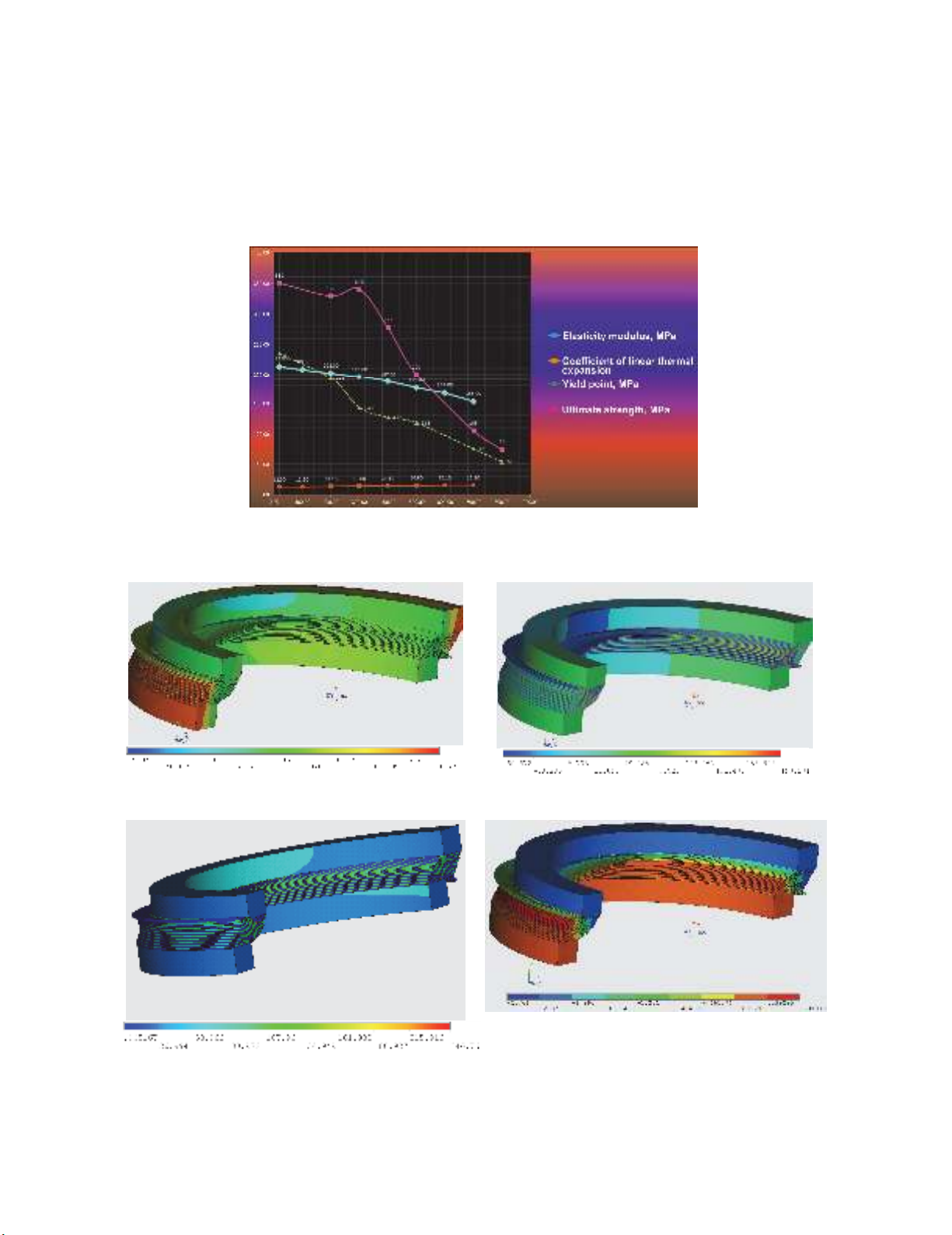
stress state. Nonlinear physic-mechanical and thermo-mechanical properties of plate materials are
illustrated in Fig. 4.
3. Results of numerical simulations
Results of numerical simulation of distribution of TRME stress-stress state parameters are
illustrated in Figs. (5-9). They actually predetermined possibility of development of new generation of
compensators, their operation principle is provided by relaxation ability of low modulus elastomer on
the basis of polyisoprene, plasticized by low molecular divinyl rubber with terminal functional groups.
Shear modulus of the elastomer was calculated by experiment planning matrix with transitional
A. V. Kiryukhin et al. / Engineering Solid Mechanics 5 (2017)
181
vibration rigidity as output parameter. Comparative results of complex tests of items of rubber cord
sleeves and rubber metal type are illustrated in Fig. 10.
Application of specially developed designs of rubber metal elements due to physicochemical
properties of elastomer in combination with perfect system of fixation to rigid elements (support rings
and intermediate plates) provides minimum coupling of pressure oscillations and vibrations, decreases
vibration transfer via their structure by an order of magnitude in wider frequency range in comparison
with compensators made of rubber cord casings.
Fig. 4. Physico-mechanical and thermo-mechanical properties of plate materials as a function of
heating temperature
Fig. 5. Map of axial stresses z
, MPa,
deformation scale 1:8
Fig. 6. Map of circular stresses
, MPa,
deformation scale 1:8
Fig. 7. Map of equivalent von Mises stresses ,
MPa, deformation scale 1:8
Fig. 8. Map of axial displacements , mm,
deformation scale 1:8





![Giáo trình Cấu trúc dữ liệu và giải thuật - Trường CĐ Cơ điện Hà Nội [Mới nhất]](https://cdn.tailieu.vn/images/document/thumbnail/2026/20260323/lionelmessi01/135x160/58171774381670.jpg)


![Giáo trình Tiện nâng cao (Nghề Cắt gọt kim loại, Trình độ Cao đẳng) - Trường Cao đẳng Cơ điện Hà Nội [Mới nhất]](https://cdn.tailieu.vn/images/document/thumbnail/2026/20260323/lionelmessi01/135x160/48101774403543.jpg)


