SIMILARITY MEASURE AND PATH
ALGEBRA FOR TOPIC-AWARE
REPUTATION TRUST IN SOCIAL
NETWORKS
Pham Phuong Thanh∗Tran Dinh Que†,
∗Department of Information Technology, Thang Long University, Ha Noi
†Posts and Telecommunications Institute of Technology
Tóm tắt—Computational trust more and more plays
an important role in interaction process of users or
peers in distributed systems. Most current trust models
are constructed based on interaction experience and
reputation. Interaction trust is estimated from interaction
experience among users, whereas reputation trust is
inferred from some commmunity evaluation via propaga-
tion mechanisms. However, these reputation models either
lack a clear foundation for computation or have no rules
for determining community. And these issues deduce
to difficulty in the trust implementation and design.
Our purpose of this paper is to present a trust model
of reputation, which estimates trustworthiness degrees
based on similairity and path algebra from community.
The similarity measure is resulted from the interest
degrees that are formulated by means of analyzing
entries data dispatched by users and topics. The path
algebra is built from two operators concatenation and
aggregation for integrating respectively scores along a
path and from various paths. We perform experiments to
determine how the path algebra and similarity impact on
trust estimation. Our experimental results show that the
similarity-based estimation outperforms the path algebra
computation.
Từ khóa—social networks, computational trust, rep-
utation, direct trust, inference trust, similarity, path
algebra.
I. INTRODUCTION
In the social networks, the establishment of trust
among users holds paramount importance in ensuring
the efficacy and security of interactions. Trust serves
as a pivotal catalyst, facilitating the seamless exchange
of information, collaborative endeavors, and informed
decision-making processes. Consequently, the develop-
ment of precise and dependable methods for estimating
trust has garnered substantial attention within the do-
main of social network analysis.
This notion of trust encapsulates the reliability that
a user (referred to as the truster) places upon their
Correspondence: Pham Phuong Thanh
Email: thanhpp@thanglong.edu.vn
Manuscript: received: 10/4/2023, revised:
30/5/2023,
accepted: 10/6/2023.
counterparts (referred to as trustees) within the ambit
of their interaction processes. Notably, the exploration
of trust has traversed diverse academic disciplines,
including sociology, psychology, economics, and com-
puter science, as evidenced by studies such as [1]
and [2]. In modern contexts, trust assumes a pivotal
role in activities like knowledge sharing, coordinated
actions, and decision-making mechanisms. Noteworthy
applications span from recommender and decision-
making systems to search engines, exemplified by
works like [3] and [4]. Its relevance extends even to
the burgeoning domain of Social Internet of Things
(IoT) wherein trust facilitates service discovery and
selection, as alluded to in [5].
Within the realm of computer science and social
computing, many trust computation models have been
developed, encompassing variables such as interac-
tions, peer relationships, propagation dynamics, and
contextual influences [1], [6], [7], [8], [9], [10], [11],
[12]. Notable validation efforts have been undertaken,
with data collection from prominent social media plat-
forms like Facebook and Twitter, as evidenced in [13]
and [14].
This academic paper explores the establishment and
management of trust within social networks. Drawing
from the unique attributes of Online Social Networks
(OSNs), we introduce innovative models to assess trust,
encompassing two dimensions: (i) Direct trust, captur-
ing confidence between two users, and (ii) Inference
trust, reflecting reputation-based trust via intermedi-
aries.
Direct trust measures reliance between directly con-
nected users [15], [16]. Existing methods include [17],
[18], [15], [16], and [19], introducing SWTrust and
TidalTrust [20]. Many studies overlook subsequent
confidence determination, treating levels as predeter-
mined or adopting random values. Hamdi [17] explores
direct trust based on shared interests, limited by prede-
fined thresholds. Indirect (Inference) trust gauges trust
between users without direct interaction, relying on the
Pham Phuong Thanh, Tran Dinh Que
No. 03 (CS.01) 2023
JOURNAL OF SCIENCE AND TECHNOLOGY ON INFORMATION AND COMMUNICATIONS 90

wider user community [21][22]. We combine network
structure and inference [21], [22], [17], [20], [19], [23].
Notably, Tidal Trust, by Golbeck, uses a breadth-first
search (BFS) variable to find the shortest trust path
between users. Yet, it prioritizes the nearest neighbor’s
trust value to the destination node, impacting evalua-
tion, especially in sole pathways. Hamdi [17] advances
this by outlining confidence pathway determination
based on pathway potency.ư
Reputation trust, as defined by [24] [25] [26] [27],
pertains to the reliability of one peer (user) with
respect to another, which is drawn from a specific
community or group of peers. Several research efforts
have leveraged the propagation of trust through the
graph structure of networks to formulate reputation
trust models, exemplified by TidalTrust [20], SWTrust
[19], and TrustWalker [28]. These models adopt an
approach where specific paths are selected for com-
putation, with a particular emphasis on mitigating
computational complexity. For instance, they often opt
for the shortest path that connects the truster and the
trustee. However, a critical limitation of this approach
is the absence of foundational principles underpinning
such computational choices.
This paper aims to address this limitation by intro-
ducing techniques for estimating trustworthiness from a
community context. These techniques rely on similarity
measures or operators within the framework of path
algebra.
A further dimension of our inquiry involves a
meticulous comparative analysis between our proposed
similarity calculation and the approach advanced by
Hamdi[17]. The crux of Hamdi’s approach hinges
upon the enumeration of common interest topics be-
tween users, with the threshold of interest serving as
a determinant of user engagement. This exploration
encompasses a triad of distinct threshold values: 0.25,
0.5, and 0.75, each characterizing the spectrum of user
interest in a given topic. We formulate six discrete
models, affording a comprehensive evaluation of both
our proposed approach and Hamdi’s method across
varying threshold regimes.
The implications of our research findings rever-
berate significantly within the domain of trust es-
timation models and similarity calculations within
social networks. By illuminating the efficacies and
idiosyncrasies of distinct user reliability measures and
their intricate interplay with similarity calculations,
our work extends a valuable compass for augmenting
trust assessment within the dynamic milieu of online
communities.
This paper is organized as follows: In Section 2,
we establish the foundational representation of social
media networks and define user interest, setting the
stage for subsequent discussions. Section 3 introduces
novel similarity measurements between users within
social media networks. Sections 4 and 5 delve into
the formulation and elaboration of topic-aware trust
estimation, providing a detailed formula. Moving for-
ward, Section 6 empirically validates our proposed
method and conducts a comparative analysis against
a conventional approach within a social media group,
demonstrating the superiority of our method. Finally,
the conclusion encapsulates our findings and contribu-
tions, reflecting on the implications of our research in
the realm of trust estimation in social media networks.
II. PRELIMINARIES
This section presents the necessary knowledge of
experience trust for building reputation trust, which
previously has appeared in our previous work [29],
[30], [31].
A. Social Network Representation
A social network is defined as a directed graph
S= (U,I,E,T), in which U={u1, . . . , un}is
a set of users, Iis a set of all interactions, E=
{E1, . . . , En}is a set of entries dispatched by users
ui,T={t1, . . . , tp}is a collection of topics. For each
user ui, we denote the hierarchy structure of users,
L0
i={ui},uj∈L1
iis a set of all users connecting
directly with ui,Lk
i, k ≥2is the set of all users who
have direct interaction with uj∈Lk−1
ibut without
uj∈Lk−2
i.
In this paper, we merely concern with building a
model for computing trust
B. User Interests
In order to build the interest measure, we collect and
analyse entries and topics and utilize the technique of
word frequency tf −idf to represent vectors of entries
and topics (refer to [30] for more detail). To define the
correlation cor(et
ij,tk)among entries eij given by ui
w.r.t. topics tk, we utilize the Pearson measure:
cor(u,v) = Pi(ui−¯u)(vi−¯v)
pPi(ui−¯u)2×pPi(vi−¯v)2(1)
where ¯u=1
n(Pn
i=1 ui)and ¯v=1
n(Pn
i=1 vi).
Suppose ∥Ei∥is the number of elements in Eiand
nt
iis the number of θ-entries concerned with the topic
tgiven by ui. It is stated that θ-entry w.r.t. topic tkif
cor(et
ij,tk)≥θ, where 0< θ ≤1is a given threshold.
We are able to define the degree of interest of user ui
in topic tas follows [29]:
•Based on the maximum value of the correlations
observed between entries w.r.t. some topic
intMax(ui, t) = max
j(cor(et
ij,t)),(2)
SIMILARITY MEAURE AND PATH ALGEBRA FOR TOPIC-AWARE REPUTATION TRUST IN SOCIAL NETWORKS
No. 03 (CS.01) 2023
JOURNAL OF SCIENCE AND TECHNOLOGY ON INFORMATION AND COMMUNICATIONS 91

•Based on the average of the correlations observed
between entries w.r.t. some topic.
intCor(ui, t) =
X
j
cor(et
ij,t)
∥Ei∥,(3)
•Based on the number of entries that exhibit a
correlation with the topic above the threshold θ.
intSum(ui, t) = 1
2
nt
i
X
l∈T
nl
i
+nt
i
X
uk∈U,l∈T
nl
k
.
(4)
For easy presentation, we denote intX(ui, t)to be
one of the above formulas, in which Xmay be
Sum,Cor,Max.
III. SIMILARITY AND PATH ALGEBRA
A. Similarity Measure
Similarity measure has been used widely to con-
struct recommendation of items, and services in the
recommender system [20], social network [32][33][10].
Golbeck [32] states that there is a strong and significant
correlation between trust and user similarity: the more
similar two people were, the greater the trust between
them. However, in contrast to her similarity inferred
from ratings on films, in this paper we utilize the
degree of user’s interest for bulding the similarity.
Similar to our previous paper [34], we formalize the
definition of similarity based on the usual metric
measure as follows.
Definition 1. Given a vector space V. A function sim :
V×V→[0,1] is a similarity measure if it satisfies
the following conditions:
(i) sim(u, u) = 1, for all u∈V
(ii) sim(u, v) = sim(v, u)for all u, v ∈V
(iii) sim(u, w) + sim(w, v)−sim(u, v)≤1for all
u, v, w ∈V
We have the following proposition.
Proposition 1. The measure defined by the following
formula is the similarity measure of two peers uiand
ujin topic t
simX
t(i, j) = 1 − ∥intX(i, t)−intX(j, t)∥(5)
where intX(k, j)is the user’s interest as defined in
Section II-B.
B. Path algebra
This subsection presents briefly the operators of
path algebra [35] which has been applied in trust
computation [36] [23] [37] [38] [39]. We reformalize
the necessary formulas for the purpose of our paper.
Definition 2 ([35]).Given a set of natural numbers
N. A mapping op :∪n∈N[0,1]n→[0,1] is called
an aggregation operator if it fulfills the following
conditions:
(i) op(0,...,0) = 0 and op(1,...,1) = 1
(ii) For all k,x1≤y1. . . xn≤yn⇒
op(x1, . . . , xn)≤op(y1,...yn)
It is easy to prove the following proposition.
Proposition 2. Mappings op : [0,1]n→[0,1], which
are defined by the following formulas, are aggregation
operators:
(i) op(x1, . . . , xn) = max(x1, . . . , xn)
(ii) op(x1, . . . , xn) = min(x1, . . . , xn)
(iii) op(x1, . . . , xn) = Πn
i=1xi
(iv) op(x1, . . . , xn) = (x1,...,xn)
n
IV. TOPIC-AWARE EXPERIENCE TRUST
This section presents briefly the experience trust
model which is determined by means of aggregation
function of three forms of interaction and degrees of
user’s interests as follows (refer to [40] for more detail).
- Familiarity famil(i, j) == ∥Ii→∩Ij→∥
∥Ii→∪Ij→∥is a mea-
sure of the degree of common neighbors of two
peers;
- Responsibility response(i, j) = ∥Iresp
i←j∥
∥SkIresp
k←j∥is a
measure of degree of feedback among a sender
ui(truster) and a receiver uj(trustee);
- Dispatching dispatch(i, j) = ∥Iij ∥
Pn
k=1 ∥Iik ∥is a
measure of the degree of messages a truster sends
to a trustee.
Interaction experience trust trustexp(i, j)of user uion
user ujis defined by the formula
trustexp(i, j) = w1×famil(i, j)+
+w2×respond(i, j) + w3×dispatch(i, j)(6)
where w1, w2, w3≥0, w1+w2+w3= 1.
Definition 3. Suppose that trustexp(i, j)is the experi-
ence trust of uion uj,intX(j, t)is the interest degree
of ujon the topic t. Then the topic-aware experience
trust of uion ujof topic tis defined by the formula:
trustexp
topic(i, j, t) = λ×trustexp(i, j) + µ×intX(j, t)
(7)
where λ, µ ≥0, λ +µ= 1.
V. TOPIC-AWARE REPUTATION TRUST
A. Path Algebra based Reputation Trust
Suppose that Φ(i, j)is the set of paths p(i, j)con-
necting uiand ujvia nodes ui=u0, u1, . . . , up=uj.
According to the formula (7), it is able to com-
pute trustexp
topic(k, l, t)w.r.t. each couple uk, ul, k =
0, . . . , p −1, l = 1, . . . , p =jWe use two operators
Pham Phuong Thanh, Tran Dinh Que
No. 03 (CS.01) 2023
JOURNAL OF SCIENCE AND TECHNOLOGY ON INFORMATION AND COMMUNICATIONS 92

⊗and ⊕repectively to represent the aggregation of
trustworthiness along paths and various paths.
Definition 4. The path based topic-aware reputation
trust of uion ujof tis defined by the following
formula:
trustpath
topic(i, j, t) = (8)
⊕p(i,j)∈Φ(i,j)(⊗k,ltrustexp
topic(k, l, t))
where ⊗and ⊕are concatenation and aggregation
operators, respectively.
Definition 5. Given a source peer uiand L1
ij is
the 1-neighbors of both uiand uj. The topic-aware
reputation trust of uion ujwith repmaX is defined by
the formula:
trustrepmaX
topic (i, j, t) = (9)
maxv∈L1
ij (trustexp
topic(i, v, t)×trustexp
topic(v, j, t))
in which trustexp
topic() is the topic-aware experience
trust given in formula (7).
Definition 6. Given a source peer uiand L1
ij is
the 1-neighbors of both uiand uj. The topic-aware
reputation trust of uion ujwith repaP is defined by
the formula:
trustrepaP
topic (i, j, t) = (10)
Pv∈L1
ij (trustexp
topic(i, v, t)×trustexp
topic(v, j, t))
Pv∈L1
ij trustexp
topic(v, j, t)
in which trustexp
topic() is the topic-aware experience
trust given in formula (7).
B. Similarity based Reputation
Definition 7. Given a source peer uiand L1
ij is the
1-neighbors of uiand uj. The topic-aware reputation
trust of uion ujwith trustee similarity (repeeS) is
defined by the formulas:
trustrepeeS
topic (i, j, t) = (11)
Pv∈L1
ij trustexp
topic(i, v, t)×sim(v, j)
Pv∈L1
ij sim(v, j)
in which sim(v, j)is the similarity measure of von
ujbeing defined by the formula (5).
Definition 8. Given a source peer uiand L1
ij is the
1−level neighbors of uiand uj. The topic-aware
reputation trust of uion ujwith truster similarity
(repeS) is defined by the formulas:
trustrepeS
topic (i, j, t) = (12)
Pv∈L1
ij trustexp
topic(v, j, t)×sim(i, v)
Pv∈L1
ij sim(i, v)
in which sim(i, v)is the similarity measure of von
uibeing defined in the formula (5).
Definition 9. Suppose that trustexp
topic(i, j, t)and
trustrep
topic(i, j, t)are the experience and reputation
trust degrees of uion uj, respectively. The unified
topic-aware trust of uion ujof topic tis defined by
the formula:
trusttopic(i, j, t) = γ×trustexp
topic(i, j, t)
+δ×trustrepY
topic (i, j, t)(13)
where repY may be repmaX, repaP, repeS or
repeeS and γ, δ ≥0,γ+δ= 1.
VI. EXPERIMENTAL EVALUATION
A. Problem Statement
•Evaluate the influence of User Similarity on trust:
This study aims to assess the influence of user
similarity on trust measures. Specifically, we com-
pare two approaches for determining trust: one
based on user similarity (utilizing repeeS and
repeS formulas) and another without considering
similarity (employing repmaX and repaP formu-
las). The objective is to investigate the effect of
incorporating user similarity measures on trust
determination.
•A Comparative Evaluation of User Similarity
Measures: Additionally, we seek to compare and
evaluate the outcomes obtained from our proposed
method of determining user similarity with the
similarity determination approach presented in the
thesis by Hamdi [17].
B. Evaluation Methods
We designed a comprehensive test scenario to ad-
dress the aforementioned research questions.
In the context of a large social network group
with continuous article postings, tracking all the posts,
especially those of interest, becomes challenging. Thus,
the fundamental problem we aim to address is whether
we can suggest articles to a specific member (denoted
as ’x’) in the group that align with their preferences
and interests.
To achieve this, we explore the following aspects:
1. Analysis of User Interests and Interactions: Based
on the available group data, we investigate the feasibil-
ity of analyzing a user’s content preferences and their
historical interactions with other members.
2. Importance of Post Content in Predicting User
Interest: We examine whether the content of a post,
reflecting specific topics, plays a significant role in
predicting a member’s interest in that article.
3. Trustworthiness of the Article Poster: Consid-
ering that an article also contains information about
SIMILARITY MEAURE AND PATH ALGEBRA FOR TOPIC-AWARE REPUTATION TRUST IN SOCIAL NETWORKS
No. 03 (CS.01) 2023
JOURNAL OF SCIENCE AND TECHNOLOGY ON INFORMATION AND COMMUNICATIONS 93
its poster, we explore how the historical interaction
data helps ascertain the level of trustworthiness a user
places in the poster. This, in turn, influences the user’s
motivation to receive information from that article.
To address the above aspects, we propose
methods for calculating the level of user interest
in a topic (intX), determining the similarity
between two users on a topic (sim(i, j, t)),
and establishing the trust between two users
(repmaX, repaP, repeeS, and repeS). These
parameters serve as input factors influencing the
output of the scenario described.
In the literature, the definition of similarity lacks
clarity. However, Hamdi’s thesis proposes a method
to determine similarity between two users based on
their shared interests in various topics, as shown in the
formula below:
stv→v′=|domainsv∩domainsv′|
|domainsv∪domainsv′|(14)
Here, N=domainsvand N=domains′
vrefers to
the number of topics that user vand v′are interested
in. This formula quantifies the degree of similarity
between two users by calculating the proportion of their
shared interests to the total number of interest.
In our investigation, we adopt a classification-based
feature extraction approach, utilizing various formulaic
techniques as input models. Additionally, we employ
traditional performance measures such as recall, preci-
sion, and F1-score for evaluation purposes. Precision
is computed as follows:
P recision =T rueP ositives
T rueP ositives +T rueNegatives
(15)
The recall is calculated as follows:
Recall =T rueP ositives
T rueP ositives +F alseNegatives (16)
F1-score is determined by means of precison and recall
as follows:
F1−score = 2 ×P recision ×Recall
P recision +Recall (17)
C. Experimental Data
We utilized a dataset obtained from Kaggle,
specifically sourced from a Facebook group
known as "Cheltenham’s Facebook Groups"
(https://www.kaggle.com/datasets/mchirico/cheltenham-
s-facebook-group), which we will refer to as CG.
The discussions within this group are conducted in
the English language and encompass various topics
related to the daily challenges faced by Cheltenham,
Pennsylvania, USA residents. These topics range
from issues concerning traffic problems, sewer
concerns, and pet-related matters (dogs, cats), to more
Bảng I: Statistics of data collected from CG
Collected Data CG
Number of members 22491
Number of members actively posting 2846
Number of posts 221001
Number of comments (N-Comment) 140856
N-Comment6.707 (mean) 15536
N-Comment ≤0(min) 8127
N-Comment ≤0(25%) 8127
N-Comment ≤2(50%) 12076
N-Comment ≤7(75%) 16077
N-Comment ≤412 (max) 21001
significant subjects like Bill Cosby’s lawsuit. For
detailed statistics of the dataset, please refer to Table
I. With this dataset, we conducted the testing process
as follows:
The test data, with K= 7, is provided in Table
II. The experimental evaluation of the models was
performed and will be presented in the subsequent
subsection, providing comprehensive insights into the
results obtained.
D. Experimental Result
In this evaluation, we investigated the impact of user
trust measures on trust. We considered two approaches
for determining trust based on linear algebra, namely
repaP and repmaX, which do not take user similarity
into account. We compared these approaches with
repeeS and repeS, which incorporate user similarity.
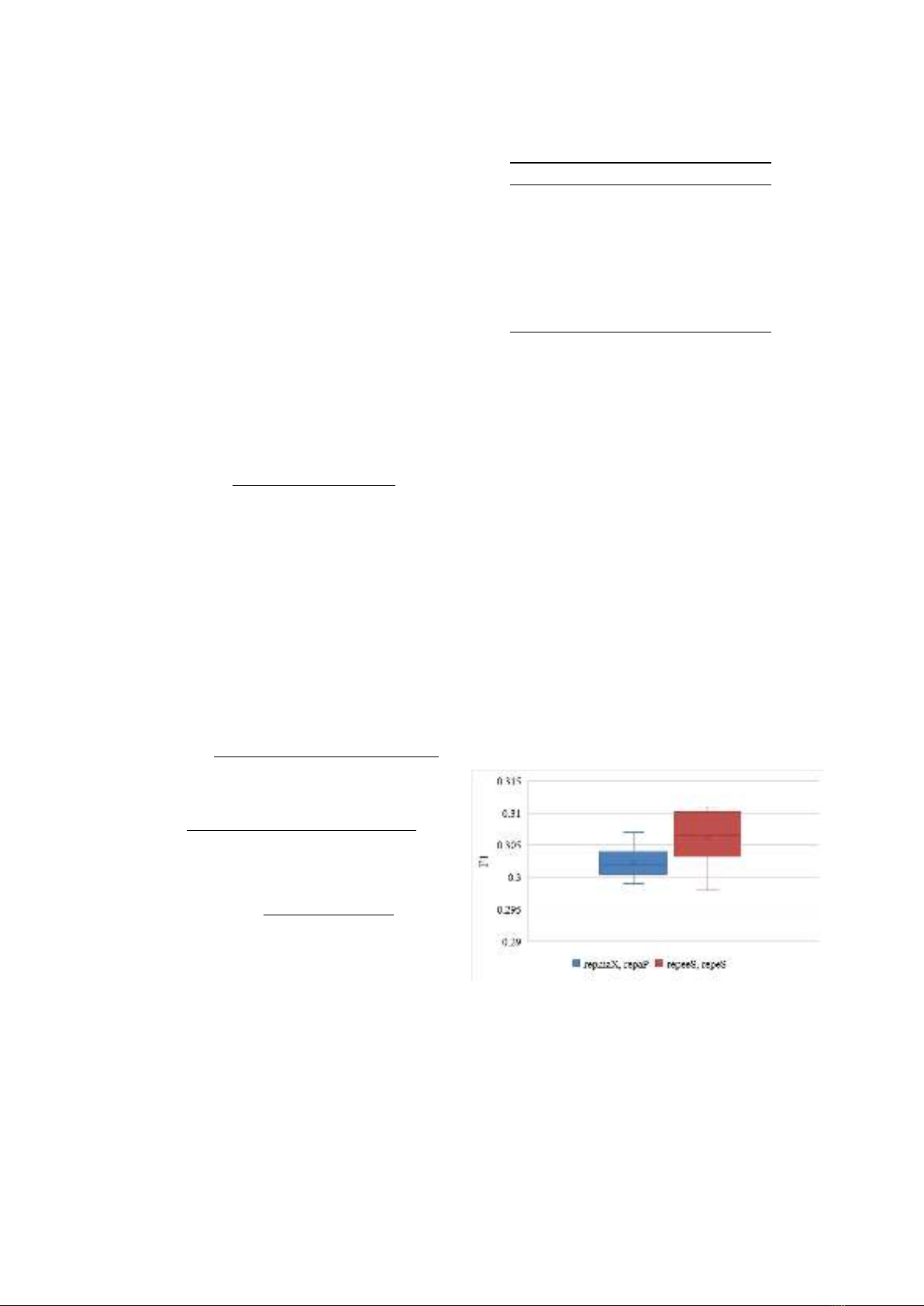
The F1 measure was used to assess the performance
of each model. The results are presented in Table III
and Figure 1 and Figure 2.
Hình 1: Effect of Similarity Measure on trust
The tested models were dependent on various input
parameters. In Table III, we observed that when calcu-
lating trust based on interactions, combining all three
types of interactions (respond, dispatch, and familiar-
ity) led to the empirical trust calculation. Combining
interaction-based trust with one of three functions
of interest (intMax, intSum, and intCor), we have 3
options, and, determining trust in a community-based
Pham Phuong Thanh, Tran Dinh Que
No. 03 (CS.01) 2023
JOURNAL OF SCIENCE AND TECHNOLOGY ON INFORMATION AND COMMUNICATIONS 94