

Chapter 1
Old-Growth Forests: Function, Fate
and Value – an Overview
Christian Wirth, Gerd Gleixner, and Martin Heimann
1.1 Old-Growth Forest Perception
Most of us, scientists and laymen alike, are deeply fascinated by old-growth forest.
We travel to places like the Tongass National Forest
1
in Alaska or the Biatowiez
ˇa
National Park
2
in Poland to enjoy the sight of forests left to their own devices, with
their majestic trees, intriguing structure and rare wildlife. For us, the fascination
arises from a mixture of interest, aesthetic pleasure and maybe a slight alienation.
However, let us hear a different view on old-growth forests:
‘‘There, a desolate tract of land lies, a sad and sullen region, never used as a man’s abode. Its
mountains are covered with forests, dark and dense. Trees without bark and without tops,
stand bent or half broken, withered by age. Others, far more than those first ones, lie down
full length, only to decay on those heaps of wood already rotten and to suffocate the
seedlings that were about to come through. Nature seems to be worn out here; earth
heaped with the ruins of what she brought forth carries piles of debris, instead of her
flowery green, and holds trees loaded with parasitic plants, poisonous fungi and mosses,
those impure fruits of rottenness ...’’
The man who wrote these lines in the eighteenth century was the famous French
scientist Comte de Buffon, author of the multi-volume book Histoire Naturelle
(Lepenies 1989). As a naturalist, Buffon was certainly susceptible to the beauties of
organismic diversity, and yet he perceived old-growth forests as ugly and hostile.
For it to become beautiful, nature had to be tamed and transformed. The French
palace gardens with their strictly geometric arrangement of artfully pruned trees
perfectly reflect the spirit of Buffon’s time (Gaier 1989). Interestingly, by that time
in the eighteenth century, the days where people in Europe had to fear the forests
were long over. Wolves and bears had been exterminated, and the bands of robbers
had nowhere to hide, since Central Europe was almost devoid of primary forests.
1
http://www.fs.fed.us/r10/tongass/
2
http://www.bpn.com.pl/
C. Wirth et al. (eds.), Old‐Growth Forests, Ecological Studies 207, 3
DOI: 10.1007/978‐3‐540‐92706‐8 1, #Springer‐Verlag Berlin Heidelberg 2009

The engraving in Fig. 1.1 shows the landscape around Jena, Germany, the home of
our Max-Planck-Institute for Biogeochemistry, in 1650 (Lepper and Heinrichs
1999). The surrounding hills, which would naturally be covered by a species-rich
temperate deciduous forest, had been turned into sheep-runs interspersed with
croplands on more level ground. Soils were eroded and wood was a scarce resource.
The few places in Europe where remnants of primary forests, and within them
parcels of old-growth forests, could be found were either feudal hunting grounds
(e.g. Białowiez
ˇa), or inaccessible land on steep slopes or in swamps. The remaining
common forest was over-used as pasture woodland, through collection of firewood
and litter raking. European societies responded to this by developing the science of
forestry with the primary goal of restoring the wood supply for the boom in
industry. Heinrich Cotta (1817), one of the German pioneers of forest science,
stated ‘‘In former times we had no forest management but plenty of wood, today we
have the science but no wood left.’’ Another important reaction towards the
devastation of nature and the industrialisation of human life was the awakening
of a positive, almost enthusiastic attitude towards nature in general and forests in
particular. This is manifested in countless poems, songs and novels praising the
beauty of nature. The European romanticism of the early nineteenth century was
probably the first large ecological movement in the Western world (Trepl 1994), but
also in the United States, where the deforestation of the Eastern forests was rapidly
progressing, novelists like Henry David Thoreau were advocating a simple life in
mother nature’s arms. Beyond these extremes of disgust and praise lies the per-
spective of indigenous communities, who seem to embrace nature as a sacred,
living entity and perceive the forests around them with an ‘easy acceptance’ as
Steve Comer, a Mahican Indian of North America, nicely expresses it (Standing
Woman and Comer 1996).
Fig. 1.1 Engraving by Caspar Merian d. J. (1627 1686) of the town of Jena and surroundings in
the year 1650
4 C. Wirth et al.

1.2 Old-Growth Forest Services
Today, a mere 23% of the world’s forest area can be classified as intact
3
(Green-
peace 2006). These intact forests, mostly primary forests located in the tropics and
the boreal zone, are the regions where we can still expect to find a large fraction of
old-growth forests, i.e. forests that show little signs of past stand-replacing dis-
turbances and that have matured to reach a dynamic equilibrium driven by intrinsic
tree population processes. Currently, the area of intact forest in the tropics and
with it the area of old-growth forests is shrinking at a rate of 0.5% per year. Many
developing and threshold countries cut down their forests, as Europeans and North
Americans did in the past, to fuel their budding economies, and developed countries
like Canada, the United States and Russia also continue to harvest old-growth
forests. In the short-term, individual groups and societies might profit from forest
destruction. However, with old-growth forest vanishing at an unprecedented pace,
mankind as a whole loses the ecosystem services provided by these forests.
What are the ecosystem services provided by old-growth forests? As outlined
above, these may be of a spiritual and/or aesthetic nature. However, there are also
many profoundly materialistic services such as the provision of genetic resources,
non-timber products, and habitat for wildlife (hunting and ecotourism), the seques-
tration of carbon, the prevention of floods and erosion, to name only a few. Finally,
old-growth forests provide cultural services as the object of scientific studies. In
Europe we are facing a situation where true lowland old-growth forests are virtually
non-existent. Given this reality, we have lost an important reference point for
research in forestry and forest ecology. The loss of natural ecosystems is always
associated with a loss of information. In retrospective it becomes clear that, in
Europe we do not even know what possibly unique services we are lacking today
due to the disappearance of old-growth forests, simply because they had vanished
long before we could accurately study them.
1.3 Aims and Scope
In the past decades a large number of studies have been conducted in old-growth
forests worldwide addressing such diverse topics as carbon, nutrient and water
cycling, population dynamics, disturbance regimes, and habitat diversity using a
diverse set of approaches and techniques. These include long-term observations,
3
Intact forest areas were originally defined in the context of boreal ecosystems according to the
following six criteria (see Achard et al., Chap. 18): situated within the forest zone; larger than
50,000 ha and with a smallest width of 10 km; containing a contiguous mosaic of natural
ecosystems; not fragmented by infrastructure; without signs of significant human transformation;
and excluding burnt lands and young tree sites adjacent to infrastructure objects (with 1 km wide
buffer zones)
1 Old Growth Forests: Function, Fate and Value an Overview 5
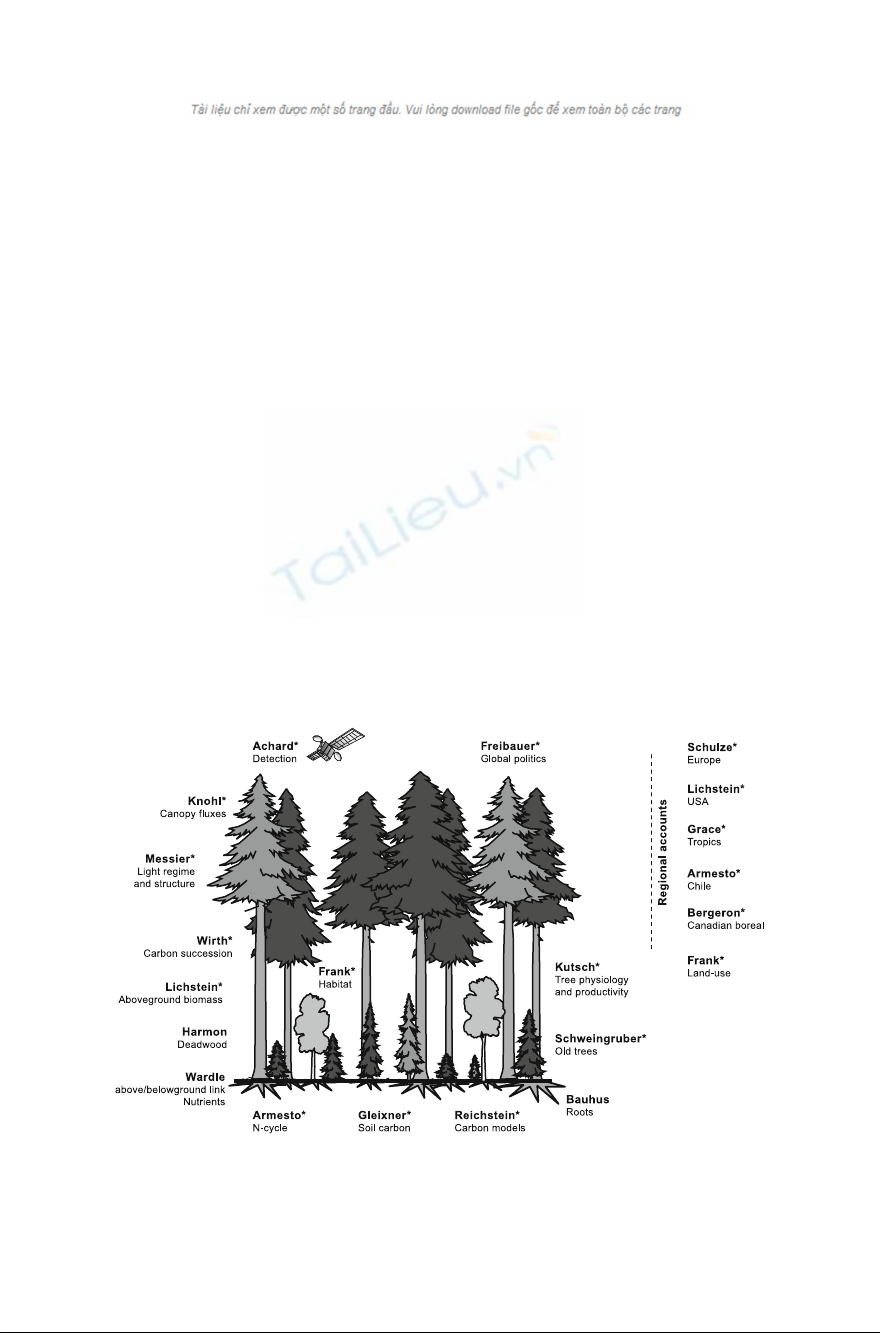
chronosequences studies, the micro-meteorological eddy covariance technique,
stable isotopes, remote-sensing, and modelling, amongst others. This book aims
to synthesise current knowledge on the characteristic functioning of old-growth
forests to evaluate the consequences of the world-wide loss of this type of ecosys-
tem (Fig. 1.2).
The book is divided into six parts: part I serves as an introduction and lays the
definitional foundation for the chapters following. Part II is devoted to aboveground
processes, ranging from deadwood dynamics to canopy fluxes. Part III reviews
belowground processes and covers the topics of root, nutrient and soil carbon
dynamics. Part IV presents regional accounts of tropical and temperate forests in
Europe, and North and South America, and the Canadian boreal forest. Part V deals
with the human dimension, including the effect of land-use, and technical and
political strategies for the protection of old-growth forests.
In the introductory chapters of the book (part I), Wirth et al. (Chap. 2) review
definitions of old-growth and critically discuss their usefulness in the context of
functional ecology. They also present a meta-analysis that estimates the fractional
cover of old-growth forest in different forest biomes without human impact as a
reference point. In addition, the plethora of related terms used in the broad context
of old-growth forest (pristine, primeval, intact, etc.) is reviewed. Part of the defini-
tion of old-growth forest is the presence of old trees. Taking a dendroecological
perspective, Schweingruber and Wirth (Chap. 3) explore to what extent trees differ
from other life forms (shrubs, herbs) in their longevity. In this context, they also
examine the mechanisms underlying the death of cells, tissues and whole plants.
Fig. 1.2 Topics covered by the different chapters in this book. Only the first author is listed.
Asterisks Contributions with co authors
6 C. Wirth et al.

Part II on above-ground processes starts with a contribution by Kutsch et al.
(Chap. 4), who follow up on Chap. 3 by asking whether and how tree age and size
influence the physiology and productivity of individual trees and forests. This
chapter adds new insights to the ongoing debate about ‘age-related decline’
(Ryan et al. 1997). Based on a re-analysis of the dataset of Luyssaert et al.
(2007), the authors are able to show that changes in structure exert a stronger
control on net primary productivity than age per se. To evaluate the role of changes
in species composition on successional trends in productivity, they further analyse
two extensive datasets of leaf physiology of temperate and boreal tree species, and
are able to identify potential mechanisms that operate against an ‘age-related
decline’. Along the same lines, Wirth and Lichstein (Chap. 5) explore how succes-
sional species shifts during the old-growth stage control carbon stock changes in the
aboveground biomass and in deadwood. They present a novel model that uses
widely available tree traits (e.g. maximum height and longevity) to translate
qualitative descriptions of successional pathways of 106 forest cover types of
North America into quantitative predictions of aboveground carbon stock changes.
They compare their results with observed biomass and deadwood trajectories from
long-term chronosequences and inventories (see also companion Chap. 14 by
Lichstein et al.). Old-growth forests are usually characterised by the presence of
very large trees and a complex horizontal and vertical structure. These three
elements create a unique understorey environment that differs from earlier succes-
sional forests. Based on an extensive review of the literature on old-growth forests
in boreal, temperate and tropical biomes, Messier et al. (Chap. 6) review the
distinct structural and compositional features that influence the understorey light
environment and how such light conditions affect the structure and dynamics of the
understorey vegetation. Knohl et al. (Chap. 7) explore the effects of aboveground
structural complexity on the ability of old-growth forests to absorb carbon from the
atmosphere, their interaction of carbon and water cycle and their sensitivity to
climatic variability. To this end the authors review the micro-meteorological
literature and the results from paired catchment studies. Woody detritus is an
important component of forested ecosystems and particularly of old-growth forests.
It can reduce erosion, stores nutrients and water, serves as a seedbed for plants and
as a major habitat for decomposers and heterotrophs. Woody detritus also plays an
important role in controlling carbon dynamics of forests during succession. Harmon
(Chap. 8) reviews the successional dynamics of deadwood and uses a heuristic
model to illustrate major controls on carbon trajectories in deadwood.
The opening chapter of Part III on belowground processes is presented by
Wardle (Chap. 9) who focusses on the feedbacks between vegetation properties,
nutrient leaching and processes driven by the decomposer communities. Based on a
review of millennial chronosequences across the world, he depicts the inevitable
fate of all old-growth forests under the absence of disturbance: a progressive
ecosystem retrogression driven by phosphorous losses that induces a decline in
species diversity and productivity over long time-scales. The function and distribu-
tion of roots and their association with mycorrhizal fungi plays a pivotal role in
forest ecosystems for soil carbon storage and nutrient and water retention. Bauhus
1 Old Growth Forests: Function, Fate and Value an Overview 7














%20--%3e%3cdefs%3e%3cstyle%3e%20.st0%20{%20fill:%20%23fff;%20}%20.st1%20{%20fill:%20%237800fa;%20}%20%3c/style%3e%3c/defs%3e%3cpath%20class='st1'%20d='M117.78,12.18H43.11c2.9,3.47,4.65,7.94,4.65,12.82,0,5.6-2.3,10.66-6.01,14.29h76.02l7.22-13.56-7.22-13.56Z'/%3e%3cg%3e%3cpath%20class='st0'%20d='M53.58,26.17h-.59v-1.46h.59v-4.96h2.83c1.78,0,2.67.94,2.67,2.82v5.76c0,1.87-.89,2.81-2.67,2.81h-2.83v-4.96ZM55.36,21.37v3.34h1.1v1.46h-1.1v3.34h1.01c.61,0,.91-.37.91-1.1v-5.93c0-.74-.3-1.1-.91-1.1h-1.01Z'/%3e%3cpath%20class='st0'%20d='M65.99,31.14h-1.8l-.31-2.07h-2.19l-.31,2.07h-1.64l1.82-11.39h2.62l1.82,11.39ZM65.28,18.04c-.25.46-.51.77-.75.94-.21.15-.47.22-.79.22-.26,0-.57-.07-.92-.22l-.38-.15c-.14-.05-.26-.07-.37-.07-.3,0-.53.18-.71.54l-.91-.68c.25-.46.51-.77.75-.94.21-.14.48-.21.79-.21.26,0,.57.07.92.21l.38.15c.14.05.26.07.37.07.3,0,.53-.18.71-.54l.91.68ZM61.91,27.52h1.73l-.87-5.76-.87,5.76Z'/%3e%3cpath%20class='st0'%20d='M74.53,26.89v1.52c0,1.91-.89,2.86-2.67,2.86s-2.67-.95-2.67-2.86v-5.93c0-1.91.89-2.86,2.67-2.86s2.67.95,2.67,2.86v1.11h-1.69v-1.22c0-.75-.31-1.12-.93-1.12s-.93.37-.93,1.12v6.15c0,.74.31,1.11.93,1.11s.93-.37.93-1.11v-1.63h1.69Z'/%3e%3cpath%20class='st0'%20d='M81.4,31.14h-1.8l-.31-2.07h-2.19l-.31,2.07h-1.64l1.82-11.39h2.62l1.82,11.39ZM75.9,19.2l1.52-1.91h1.71l1.51,1.91h-1.61l-.76-.95-.75.95h-1.61ZM77.32,27.52h1.73l-.87-5.76-.87,5.76ZM83.1,15.99l-1.76,1.91h-1.26l1.17-1.91h1.86Z'/%3e%3cpath%20class='st0'%20d='M84.86,19.75c1.78,0,2.67.94,2.67,2.82v1.48c0,1.87-.89,2.81-2.67,2.81h-.85v4.28h-1.79v-11.39h2.64ZM84.01,21.37v3.86h.85c.58,0,.87-.36.87-1.08v-1.71c0-.71-.29-1.07-.87-1.07h-.85Z'/%3e%3cpath%20class='st0'%20d='M93.51,19.75c1.78,0,2.67.94,2.67,2.82v1.48c0,1.87-.89,2.81-2.67,2.81h-.85v4.28h-1.79v-11.39h2.64ZM92.66,21.37v3.86h.85c.58,0,.87-.36.87-1.08v-1.71c0-.71-.29-1.07-.87-1.07h-.85Z'/%3e%3cpath%20class='st0'%20d='M98.8,31.14h-1.79v-11.39h1.79v4.88h2.03v-4.88h1.83v11.39h-1.83v-4.88h-2.03v4.88Z'/%3e%3cpath%20class='st0'%20d='M105.36,24.55h2.46v1.62h-2.46v3.34h3.09v1.63h-4.88v-11.39h4.88v1.63h-3.09v3.18ZM108.17,17.29l-1.76,1.91h-1.26l1.17-1.91h1.86Z'/%3e%3cpath%20class='st0'%20d='M112.2,19.75c1.78,0,2.67.94,2.67,2.82v1.48c0,1.87-.89,2.81-2.67,2.81h-.85v4.28h-1.79v-11.39h2.64ZM111.35,21.37v3.86h.85c.58,0,.87-.36.87-1.08v-1.71c0-.71-.29-1.07-.87-1.07h-.85Z'/%3e%3c/g%3e%3ccircle%20class='st1'%20cx='25'%20cy='25'%20r='20'/%3e%3cpath%20class='st0'%20d='M32.78,19.27c2.92,0,4.43,2.55,5.28,5.33l.71,2.17c.14.38-.33.75-.71.75h-5.61c.19-.33.24-.71.09-1.08l-.75-2.45c-.43-1.32-.99-2.64-1.79-3.77.75-.57,1.65-.94,2.78-.94h0ZM25,18.38c3.25,0,4.9,2.78,5.89,5.89l.76,2.45c.14.42-.33.8-.8.8h-11.69c-.42,0-.94-.38-.8-.8l.75-2.45c.99-3.11,2.64-5.89,5.89-5.89h0ZM25,11.35c1.74,0,3.11,1.37,3.11,3.11s-1.37,3.11-3.11,3.11-3.11-1.41-3.11-3.11,1.41-3.11,3.11-3.11h0ZM17.27,19.27c1.08,0,1.98.38,2.73.94-.8,1.13-1.37,2.45-1.74,3.77l-.8,2.45c-.14.38-.05.75.09,1.08h-5.56c-.42,0-.9-.38-.75-.75l.71-2.17c.9-2.78,2.41-5.33,5.33-5.33h0ZM17.27,12.91c1.51,0,2.78,1.27,2.78,2.83s-1.27,2.83-2.78,2.83-2.83-1.27-2.83-2.83,1.27-2.83,2.83-2.83h0ZM32.78,12.91c1.56,0,2.78,1.27,2.78,2.83s-1.23,2.83-2.78,2.83-2.83-1.27-2.83-2.83,1.27-2.83,2.83-2.83h0ZM27.07,28.56v.09c0,.57-.24,1.08-.61,1.46h0v.05c-.38.33-.9.57-1.46.57s-1.08-.24-1.46-.61h0c-.38-.38-.61-.9-.61-1.46v-.09h1.41v.09c0,.19.05.38.19.47v.05c.09.09.28.19.47.19s.38-.09.47-.19v-.05c.14-.09.24-.28.24-.47t-.05-.09h1.41ZM30.99,28.56v.09c0,1.65-.66,3.16-1.74,4.24-1.08,1.08-2.59,1.79-4.24,1.79s-3.16-.71-4.24-1.79l-.05-.05c-1.04-1.08-1.7-2.55-1.7-4.2v-.09h1.41v.09c0,1.27.47,2.4,1.27,3.25h.05c.85.85,1.98,1.37,3.25,1.37s2.4-.52,3.25-1.37c.85-.8,1.37-1.98,1.37-3.25v-.09h1.37ZM34.99,28.56v.09c0,2.78-1.13,5.28-2.92,7.07-1.79,1.79-4.29,2.92-7.07,2.92s-5.23-1.13-7.07-2.92c-1.79-1.79-2.92-4.29-2.92-7.07v-.09h1.41v.09c0,2.4.94,4.53,2.5,6.08,1.56,1.56,3.72,2.5,6.08,2.5s4.52-.94,6.08-2.5c1.56-1.56,2.5-3.68,2.5-6.08v-.09h1.41Z'/%3e%3c/svg%3e)